



Watching your organic search traffic fall after investing in your website is discouraging. You have customers to serve, a business to build, and a marketing budget to protect. A declining graph can make all that work feel wasted.
 A decline in traffic is not a verdict on your expertise or the value of your business development. Many website owners face the same uncertainty as AI changes how people discover information. The effects differ by website, and diagnosing your own decline matters. You can adapt without throwing away everything you have built.
Aspiration Marketing helps businesses connect technical SEO, useful content, and answer engine optimization (AEO). This guide gives you seven practical steps to expand your visibility into AI answers while protecting your search foundation.
SEO is now a vanity metric. If you aren't the definitive answer inside the AI summary, your website is a ghost town.
Why Can Traffic Decline Even When Your Expertise Hasn't?
Traffic can decline because search behavior changes, even when your business remains valuable. AI summaries give people another way to obtain answers before visiting a website. That change deserves attention, but it does not explain every decline.
In a study by the Pew Research Center of 900 U.S. adults' browsing activity,
Users clicked a traditional search result in 8% of visits when an AI summary was present, compared with 15% without one.
Furthermore,
Clicks on links within the summary occurred in just 1% of visits with a summary.
These observations describe that specific study's Google searches, not a universal forecast for your website. But they do show why publishing helpful information can produce fewer visits in an answer-first search experience.
You cannot control a search platform's interface. You can control how clearly your business explains its expertise, how accessible your content is, and how you measure the opportunities it creates.
What Does AEO Change, And What Should You Keep?
AEO adds AI answer visibility to your discovery strategy; it does not justify abandoning SEO. Keyword stuffing, mass-producing generic articles, and buying a supposedly guaranteed AI recommendation are poor substitutes for useful information and technical accessibility.
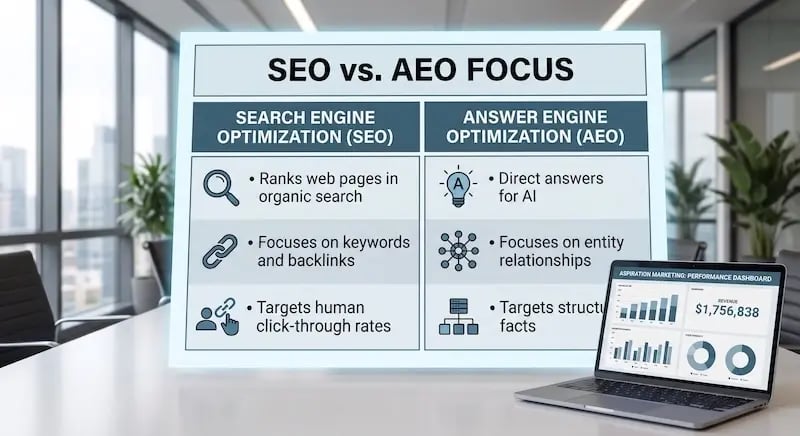
AEO and SEO overlap, but their measurement priorities differ. SEO tracks search visibility and visits. AEO also examines brand mentions, citations, and the accuracy of an AI response in describing your business. Search depends on clicks, while AEO does not.
According to a 2024 Spark Toro Study,
58.5% of Google searches end without a single click to an external website.
This proves that user behavior is shifting towards instant answers, and demonstrates that publishing helpful information can actually produce fewer visits in an answer-first search experience. But this doesn't mean you need to throw away SEO principles altogether.
Google's AI search guidance says existing SEO fundamentals remain relevant to AI Overviews and AI Mode. No special schema or additional technical requirements apply. Pages need indexing and snippet eligibility, and structured data should match their visible content.
The practical goal is broader discovery: help buyers find your website and help search engines retrieve accurate, useful information about your business. Neither effort guarantees inclusion in an AI response.
 How to Build Your AI Search Visibility Step by Step
Start with the diagnosis, then improve the pages and questions that are closest to your buyers' decisions. The seven steps below turn a broad concern about declining traffic into specific work you can prioritize and evaluate.
1. Diagnose What Changed
Diagnose your traffic decline by comparing page-level search performance with business outcomes. In Google Search Console, review impressions, clicks, click-through rate, and average position across comparable periods. Check seasonal patterns and separate branded searches from other queries.
Combine that review with Google Analytics data on landing pages, engagement, and inquiries. Stable impressions with fewer clicks suggest a change in click behavior, but they do not prove AI caused it.
Check indexing problems, tracking changes, broken pages, and shifts in demand. Record which pages lost visits and which still generate qualified inquiries. Your first deliverable is a diagnosis, not a decision to rewrite the entire website.
2. Map The Questions Your Buyers Ask
Map buyer questions by collecting the language customers use throughout the research and purchase process. Review sales conversations, support questions, and website inquiries. Include the follow-up questions that reveal what buyers need before they can make a decision.
For a software business, questions can cover integration requirements, migration risks, implementation steps, and suitability for particular use cases. Group related questions around the problem your offering solves.
Aspiration Marketing uses keyword and entity mapping to connect search intent with relevant topics and content clusters. Choose one commercially important question group first, then identify the pages that should answer it. That gives your next content investment a clear purpose.
3. Make Your Website Accessible And Understandable
Make your website easier to understand by removing access barriers and organizing important information clearly. Check indexing, crawl permissions, internal links, and whether essential content is available as readable text. Review bot access in line with your publishing and data-use policies rather than opening every crawler indiscriminately.
A technical AEO checklist helps organize that review. Use descriptive headings, clear navigation, and consistent business details.
Apply relevant schema markup accurately. JSON-LD is a format for structured data, not a shortcut to AI recommendations. Aspiration Marketing addresses crawl barriers, semantic HTML, and structured data as part of its technical visibility work.
AI search didn't kill your traffic. Your 2,000-word SEO fluff forced users to prefer a bot over your website.
4. Turn existing expertise into clear answers
Turn existing content into useful answers by putting the response close to the question. Keep the explanation, examples, and caveats that help someone act on it. A short summary should make the full article easier to navigate, not replace substantive expertise.
Start with a service page and two articles that already attract relevant buyers. Use descriptive subheadings, answer the central question immediately, and remove vague claims. Add practical examples that reflect your actual work.
Clear subject-verb-object sentences reduce ambiguity. For example, explain which systems your product connects to and what the connection enables. Readers need specific meaning, not repeated keywords or claims about secret AI ranking formulas.
5. Give Buyers Evidence They Can Trust
Build trust by supporting your advice with genuine experience and checkable evidence. Identify the people behind your content, explain their relevant work, and show the reasoning behind your recommendations.
Publish approved customer examples, original research, implementation details, and sourced statistics.
Research from Authoritas indicates that over 76% of sources cited within AI answers already rank in the top 10 organic search results.
State the context and limitations of any outcome. If you do not have permission to publish a customer result, use a clearly labeled illustrative example instead.
Google's EEAT principles of experience, expertise, authoritativeness, and trustworthiness provide a useful quality lens. They are not a universal AI citation score. Give buyers evidence that helps them evaluate your business, without promising how an answer engine will weigh it.
6. Strengthen Your Presence Beyond Your Website
Strengthen your wider presence by making business information consistent and contributing useful expertise where buyers already research. Review your profiles, service descriptions, partner listings, and relevant review platforms for accuracy.
Seek opportunities to contribute to industry publications and answer real community questions. Earn mentions through helpful work rather than posting promotional messages everywhere. Prioritize channels relevant to your customers and where they are in their customer journey, not just a long list of platforms.
For video content, provide accurate titles, descriptions, captions, and transcripts. The goal is to make expertise accessible in multiple formats. Your off-site work should reinforce the same clear account of who you help, what you provide, and how you solve problems.
7. Measure Visibility And Business Outcomes
Measure AI visibility alongside business outcomes to distinguish exposure from commercial progress. Record a consistent set of buyer prompts, the engine used, the date, brand mentions, cited pages, and any factual errors.
Use an AEO visibility assessment as a starting point, then repeat comparable checks. Individual answers vary, so treat prompt tests as samples rather than complete market coverage.
Track AI visibility metrics alongside identifiable referrals, qualified inquiries, and the pipeline. Ask prospects how they discovered you. Attribution will remain imperfect; review trends across signals rather than claiming that every citation led to a sale.
Can Existing Content Give You a Head Start?
Yes. Existing content gives you a starting point when it contains useful, accurate expertise that buyers need. The work you invested in learning your market and explaining your offering still matters.
Choose a small group of priority pages. Check each for a direct answer, relevant examples, current facts, clear ownership, and a useful next action. Improve substance before increasing publishing volume.
Aspiration Marketing's content marketing approach combines strategy, creation, optimization, and performance measurement. That combination helps you connect individual page improvements with the broader job of attracting and converting relevant buyers.
What Should You Prioritize When Resources Are Limited?
Prioritize technical blockers and buyer questions closest to a qualified inquiry. A page that cannot be indexed needs attention before a new article. A service page that leaves implementation questions unanswered can deserve priority over a broad awareness topic.
As a manageable starting sequence, diagnose the decline, select one question group, and improve three relevant pages. Establish baseline measurements before the changes, then review them on a regular cadence. Treat this as an operating plan, not a promised results timeline.
Reclaiming direction begins with a useful next decision. You do not need to solve every aspect of AI discovery before improving the information your next customer needs.
How Aspiration Marketing Helps You Get Found in AI
As a global HubSpot Partner for AI visibility, Aspiration Marketing combines technical visibility work with keyword and entity mapping to help you build an AEO strategy grounded in your business. Our approach connects website accessibility with clear, authoritative content.
Our documented services include technical audits to identify crawl barriers, site performance issues, and semantic markup gaps. We also provide content and data restructuring, semantic HTML alignment, and JSON-LD deployment where appropriate.
Keyword and entity mapping guides pillar pages and connected content clusters around relevant search intent. Together, these approaches give you concrete improvements to deploy rather than another generic instruction to publish more.
Request a Technical Visibility Audit to explore the next priorities for your website. We cannot guarantee an AI citation. We can help you strengthen the technical and content foundations that support discovery.
Your Next Step Toward Better Discovery
Your next step is to select one important buyer question and review the page that answers it. Check the facts, clarify the response, and make the next action useful. That creates a concrete improvement you can evaluate.
The decline you are seeing deserves a thoughtful response, not self-blame. Your expertise remains valuable. Give buyers more ways to find it, and build your next phase of growth around clear answers, credible evidence, and steady improvement.







Leave a Comment
Have thoughts on this article?
Share your feedback, ask questions, or join the discussion with our community.