



Your marketing automation stack is connected. That doesn't mean it's integrated.
On paper, everything looks seamless: your marketing platform pushes leads to your CRM, and your sales engagement tool syncs contacts nightly. In reality, leads are slipping through the cracks of silent breaks that no executive dashboard will ever catch. When systems are technically connected but semantically unaligned, your team spends more time troubleshooting sync errors and manual workarounds than running high-impact campaigns.
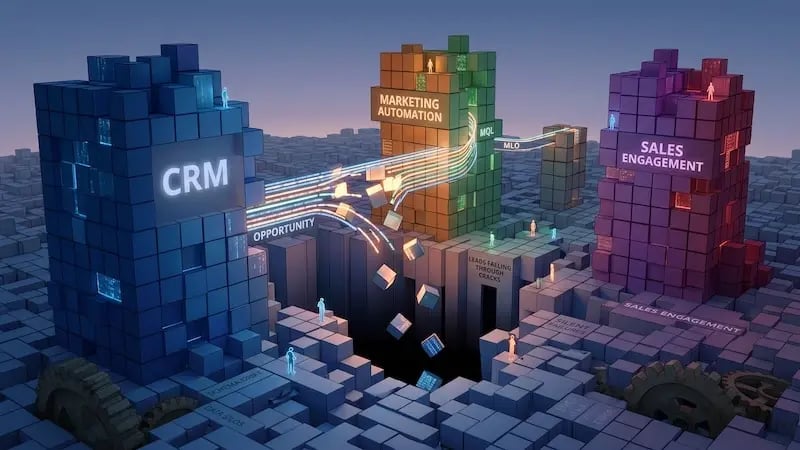 The problem isn't your people—it's the friction sitting inside your integration layer. In this guide, we break down the root causes of cross-system integration breakdowns, provide a step-by-step diagnostic framework you can run this week, and outline a practical governance strategy to keep your revenue stack firing as one unified engine.
Why Marketing Automation Integration Breaks Down
Marketing automation platforms promise a single view of the customer. In practice, the view fractures the moment your CRM, email tool, and sales engagement platform start exchanging data without shared definitions. A "qualified lead" in your marketing automation tool and a "qualified lead" in your CRM can mean two completely different things.
This isn't a fringe scenario.
According to Forrester's Marketing Survey, 2026,
85% of B2B marketers report running integrated campaigns, yet the same respondents cite siloed budgets, operational complexity, and insufficient executive sponsorship as major execution barriers.
The technology is connected. The meaning is not.
Even more alarming is the presence of blind spots in the chain of command that keep integration issues recurring. This isn't just an ops annoyance; it's an execution trap.
Studies show that,
82% of C-level leaders believe their stack and teams are aligned, yet 65% of frontline practitioners report severe misalignment—with 34% pointing directly to disconnected tools and poor data sharing as the cause.
The result is a stack that generates activity rather than a pipeline. Leads get scored on incomplete data, handed off to sales with missing context, and nurtured with messages that contradict what the rep just said on a call. Fixing this requires understanding the specific integration points where meaning breaks down. This is just one of many marketing automation challenges.
What Marketing Automation Integration Is Not
Before diagnosing integration problems, it helps to clear a common misconception. Integration does not mean your tools share an API connection and occasionally sync records. That's data transport, not integration.
True integration means every system in your stack agrees on the same customer identity, the same lifecycle-stage definitions, and the same rules for when a record transitions from one state to another. Without that semantic layer, even a technically "connected" stack produces conflicting signals.
So while the technology is connected, the capability remains locked.
Gartner research shows that marketing teams utilize
Just 42% of their tech stack’s capabilities, largely because teams spend more time troubleshooting cross-platform friction than deploying advanced features.
You can have a perfectly configured API between your marketing automation platform and CRM and still watch abandoned-cart emails land in the inbox of someone who completed a purchase three days ago. The connection works. The integration doesn't.
Warning Signs That Your Marketing Automation Integration Is Failing
Integration problems rarely announce themselves with a clear error message. Instead, they show up as operational friction that teams learn to work around rather than fix. Recognizing these early warning signs of marketing automation integration issues can save you months of compounding data problems.
Watch for these indicators: leads arriving in sales queues with blank or outdated fields, email nurture sequences that fire for contacts who already converted, duplicate records appearing after every sync cycle, and lead scores that do not match the prospect's actual engagement level. Each of these symptoms points to a specific category of integration failure.
Another signal is reporting discrepancies between systems. If your marketing dashboard shows 200 MQLs this month and your CRM shows 175, the missing 25 records are stuck somewhere in your integration layer. These gaps erode trust between teams and make data-driven decisions unreliable.
Five Root Causes of Integration Failures Between CRM, Sales, and Marketing Systems
Integration breakdowns across your marketing stack rarely have a single cause. These five categories cover the majority of failures B2B marketing operations teams encounter when CRM, sales tools, and marketing automation platforms stop working as a unified system.
Architectural Mismatch Between Platforms
Your CRM stores contacts as individual records. Your marketing automation platform thinks in terms of email addresses tied to behavioral events. Your sales engagement tool groups contacts by account. When these three data models collide, records fragment. A single prospect can appear as three separate entities across your stack, each with a different engagement history.

The fix starts with mapping the core object model of each platform and identifying where relationships break. You need one system of record for customer identity and clear rules for how the other systems reference it.
Identity Misalignment Across Systems
Identity misalignment happens when your stack lacks a single, trusted key to match records across platforms. One system uses email, another uses a CRM ID, and a third relies on a cookie-based anonymous identifier. When a prospect converts from anonymous to known, the handoff between these identifiers is where records split or merge incorrectly.
This problem compounds over time. Duplicate records accumulate, lead scores inflate on phantom activity, and your CRM data hygiene degrades with every sync cycle.
Schema Drift Between Connected Tools
Schema drift occurs when one platform updates its data structure, and the connected system does not adjust. A new picklist value gets added to your CRM's lifecycle stage field, but your marketing automation platform still maps the old values. Records start falling into a "none" or "unknown" bucket, and your reporting quietly becomes unreliable.
This is the most insidious failure mode because it rarely triggers an error. Everything looks connected. The data just stops meaning what you think it means.
When duplicate records accumulate and lead scores inflate on phantom activity, it hits the bottom line. Industry data indicates that,
Poor data hygiene and cross-system sync errors cost B2B organizations between 10% and 25% of their total revenue through wasted ad spend, burnt leads, and missed follow-ups.
Process and Governance Breakdown
Even well-architected integrations degrade without governance. New team members create custom fields without updating the sync. A workflow is edited to add a branch, but no one updates the corresponding automation in the connected system. Over time, small changes accumulate into a stack that nobody fully understands, leaving the integration's current state unclear.
Even well-designed campaigns crumble without technical governance. Research shows that
While 80% of companies design structured workflows, over 70% fail to embed them correctly into their CRM and automation platforms, leaving the integration to break down as soon as processes shift.
A CRM governance plan that documents field ownership, change control processes, and regular integration audits prevents this slow decay.
Vendor Platform Constraints
Some integration problems are baked into the platforms themselves. Rate limits throttle API calls during peak sync windows. Required fields in one system have no equivalent in another. Webhook delivery is not guaranteed, and retry logic varies between vendors.
These constraints are not bugs. They are architectural decisions that your integration plan needs to account for from day one. Before selecting any new tool for your stack, audit its API documentation for rate limits, required fields, and sync-frequency capabilities against your existing systems' needs.
How to Diagnose Integration Issues Across Your Marketing Stack
Diagnosing integration failures requires a systematic, record-level approach. Aggregate reports mask problems. A dashboard showing 95% sync success still means 5% of your records carry bad data, and that 5% is concentrated in exactly the records you care about most: recently active prospects in your pipeline.
Step 1: Pick a Single Record and Follow It Across Systems
Choose a recently created or recently updated contact. Open that record in every system in your stack.
Compare the values field by field.
-
Where do they diverge?
-
Is the lifecycle stage the same?
-
Is the lead score consistent?
-
Does the activity timeline match?
This single-record trace reveals more about your integration health than any summary metric. It exposes the exact point where data diverges and gives you a concrete starting point for remediation.
Step 2: Map Your Field-Level Sync Logic
Document every field mapping between your CRM and marketing automation platform. For each field, note the sync direction (one-way or two-way), the conflict resolution rule, and the update trigger. Many integration failures stem from conflict resolution logic: when both systems update the same field simultaneously, which value wins?
If you are running HubSpot integrated with your website and other tools, this mapping exercise often reveals fields that sync in one direction when they should sync in both, or vice versa.
Step 3: Audit Your Lifecycle Stage Definitions
Write down the exact definition of each lifecycle stage in your CRM. Now ask your marketing team to define the same stages. Then ask your sales team. If the three definitions do not match precisely, your integration is translating between incompatible languages every time a record moves from one stage to another.
Misaligned stage definitions are among the most common reasons for marketing and sales alignment to break down. A lead that marketing considers "sales-ready" can sit untouched in a sales queue because it does not meet the rep's definition of qualified.
Step 4: Test Workflow Triggers End to End
For every automated workflow that crosses a system boundary, trigger it manually with a test record and track the outcome in every connected system. Does the enrollment trigger fire correctly? Does the downstream action execute in the expected timeframe? Does the record land in the right state in the receiving system?
This end-to-end workflow testing catches timing issues, permission errors, and silent failures that never surface in normal operation.
Step 5: Review Error Logs and Sync Queues
Every integration tool maintains an error log or sync queue. Review these at least weekly. Look for patterns: repeated failures on the same field, the same record type, or the same time window. These patterns point directly to systemic issues rather than one-off glitches.
Pay special attention to errors that appear immediately after platform updates or configuration changes. These are strong signals that schema drift has occurred and that your field mappings need to be re-validated against the updated data structure.
How to Fix Common Marketing Automation Integration Problems
Once you have diagnosed the failure points, the remediation follows a predictable pattern. The specifics vary by platform, but the principles are consistent across any stack that combines a CRM with marketing automation and sales tools.
Establish a Single Source of Truth for Customer Identity
Designate one system, typically your CRM, as the master record for customer identity. Every other system references this record using a shared identifier. When a new contact is created in your marketing automation platform, the first action in any workflow should be a lookup against the CRM to either match an existing record or create a new one with the correct identifier.
This eliminates the most common cause of duplicate records and ensures that every system is enriching the same contact rather than creating parallel versions of the same person.
Standardize Lifecycle Stages and Lead Definitions
Bring your marketing and sales teams into one room and align on exactly what each lifecycle stage means. Document the criteria for moving a record from one stage to the next. Then configure your automation to enforce these transitions consistently across every system.
This is where lead scoring and nurturing become powerful rather than performative. When scoring rules reflect agreed-upon definitions, the numbers actually mean something to the rep receiving the handoff.
Implement Change Control for Integration Configurations
Create a simple change log that documents every modification to a field mapping, workflow, or sync rule. Before any change goes live, require a review that checks the impact on connected systems. This doesn't need to be a heavy process. A shared document listing the date, the change, the systems affected, and the person responsible is enough to prevent the slow drift that degrades integrations over time.
Build Monitoring Alerts for Silent Failures
Configure alerts for the specific failure modes you identified during diagnosis. A sync error rate that exceeds your baseline, a field that stops updating, or a workflow that does not trigger within the expected timeframe should all generate a notification. Silent failures are the most dangerous because they compound unnoticed.
Building a Governance Framework to Prevent Future Integration Decay
Fixing integration issues once is useful. Preventing them from recurring is what separates organizations with reliable automation from those stuck in a cycle of firefighting and re-implementation.
Fixing your integration layer isn't just a spring-cleaning exercise for your operations team.
Companies with tightly integrated go-to-market technology achieve 24% faster three-year revenue growth compared to those operating with siloed platforms.
Assign Field Ownership Across Systems
Every field that syncs between systems should have a documented owner. That owner is responsible for the field's definition, its valid values, and its mapping logic. When a change request comes in, the field owner reviews the impact across all connected systems before approving the modification.
Schedule Quarterly Integration Audits
Every quarter, run the single-record trace from Step 1 of the diagnostic process on a sample of recently active records. Compare field values across systems, check for new fields that are not mapped, and verify that lifecycle stage definitions still match. This 90-minute exercise catches drift before it becomes a crisis.
Aspiration Marketing builds these audits into every HubSpot implementation engagement, so your governance framework is operational from the start rather than bolted on after problems surface.
Document Your Integration Architecture
Maintain a visual map of your integration architecture that shows every system, every sync connection, every field mapping direction, and every workflow that crosses a system boundary. Update it whenever a change is made. This map becomes the single reference for anyone who needs to understand how your stack connects.
Train Your Team on Cross-System Impact
The people who build workflows, edit fields, and create new automations need to understand how their changes affect connected systems. This doesn't require deep technical training. It requires awareness that a change in one system can break a process in another, and a habit of checking the integration map before making modifications.
How Aspiration Marketing Approaches Integration Strategy
Aspiration Marketing has spent years helping B2B teams untangle disconnected marketing stacks and build integrations that hold up under real operational load. As a certified HubSpot Solutions Partner, Aspiration Marketing brings implementation-grade expertise to every engagement, starting with a full diagnostic of your current stack before recommending any changes.
The approach begins with a needs assessment that maps your existing CRM, marketing automation, and sales tools to identify exactly where data breaks down. From there, the Aspiration Marketing team configures custom integrations, standardizes field mappings, and builds governance frameworks designed to prevent the drift that causes most long-term integration failures.
If you are experiencing persistent sync issues, conflicting lead data, or workflows that fire inconsistently, an integration strategy session with a HubSpot-certified consultant can pinpoint the root causes and map a remediation plan tailored to your stack.







Leave a Comment
Have thoughts on this article?
Share your feedback, ask questions, or join the discussion with our community.