





Does your current marketing partner deliver technical articles that actually resonate with network engineers and chief technology officers?
For marketing leaders at enterprise telecommunications companies, bridging the gap between deep technical capabilities and executive-level positioning is a constant struggle. You contract a generalist B2B agency, share technical specifications, and receive polished posts that lack architectural rigor.
 Infrastructure architects dismiss simplified descriptions of network upgrades. Enterprise IT directors look elsewhere. Worst of all, your sales engineers end up writing their own technical white papers from scratch.
The landscape of enterprise telecommunications procurement has shifted dramatically. Today, infrastructure buyers conduct exhaustive technical audits long before engaging with account teams.
Data from the Gartner B2B Buying Journey Study shows that
Enterprise buying groups spend 27% of their total purchase time conducting independent online research, compared to just 17% spent meeting with potential suppliers.
Furthermore, research by McKinsey & Company reveals that
70% to 80% of B2B decision-makers prefer remote human interactions or digital self-service when evaluating complex technology vendors.
When prospective clients evaluate your infrastructure platforms in isolation, your technical documentation and content engine act as your primary sales force. For telecommunications brands, generalist copywriting will not build trust. You need a structured framework to evaluate B2B content agencies for telecom based on technical domain depth and architectural fluency rather than generic agency lists.
Criterion 1: Technical Domain Depth Across Cloud-Native Architectures
Why do traditional B2B marketing firms consistently fail when writing for enterprise telecommunications providers? The challenge comes down to domain complexity.
The telecom sector demands an understanding of virtualization, edge compute environments, and hardware-to-software shifts.
More specifically, enterprise decision-makers evaluate vendors on critical details such as:
- Cloud-native Network Functions
- Sub-5-millisecond Latency Thresholds
- Zero-trust Perimeter Security
- Microsecond-level Timing Synchronization
- Rigorous Service Level Agreements
These are not deliverables a generic content agency can research and produce with authority.
A generalist agency might draft a surface-level article titled "3 Advantages of Upgrading to 5G Enterprise Networks." A specialized partner among B2B content agencies for telecom, however, understands intuitively how to write about these topics.
Just as a specific example to demonstrate how niche and specific a topic needs to be, according to a report by Analysys Mason,
Enterprise demand for managed private networks and edge computing is growing at over 20% annually, forcing telecom operators to produce increasingly sophisticated technical content to stand out.
 When interviewing prospective agency partners, ask these direct questions to test their technical depth:
- Engineering Extraction: "What structured process do your technical writers use to interview our network architects and product managers without pulling them away from core operational duties?"
- Executive Translation: "Can you share an example of how you translated a complex architectural shift—such as legacy migration to cloud-native network functions—for both a Chief Security Officer and a Chief Financial Officer?"
- Verification Protocols: "How do you verify technical terminology, RFC standards, and network protocols before publishing client materials?"
If an agency responds with broad statements about performing "general internet research," consider that an immediate red flag.
Criterion 2: Revenue Operations and CRM Tech Stack Orchestration
Deep technical white papers sitting on isolated web servers build zero sales pipeline. To generate predictable revenue growth, your content engine must connect directly to your Revenue Operations stack. Revenue Operations (RevOps) is a business function that aligns sales, marketing, and customer service operations to drive revenue growth and provide a better customer experience across the entire lifecycle. This connection to your Customer Relationship Management (CRM) architecture is critical.
Many enterprise telecommunications firms rely on platforms like HubSpot to manage multi-tiered sales accounts. However, standard inbound setups often fall short in telecom because they assume short, linear sales cycles. In reality, enterprise network agreements involve extended Proof of Concept testing phases, complex RFP evaluations, multi-department security reviews, and custom SLA negotiations.

A capable partner among B2B content agencies for telecom understands how to align technical content releases with automated lead scoring, target account stage triggers, and dynamic lead routing.
Data from Salesforce's State of Marketing Report highlights that,
78% of high-performing marketing teams align their content operations directly with account-based marketing tools and CRM data to track client engagements across every stage.
![An infographic titled "[SALES & MARKETING ALIGNMENT WORKFLOW]" illustrating a four-step automated lead scoring and engagement process, using modern corporate vector illustrations against a blurred office background. The workflow is organized into four main connected phases: Phase 1: Prospect Engagement Text: "[PROSPECT READS MEC BLUEPRINT]" Icon: A man wearing glasses holds an open "MEC BLUEPRINT" document featuring a cloud-based network diagram. He also uses a magnifying glass, and several books are visible, signifying research and learning. Phase 2: Lead Scoring Trigger Text: "[TRIGGERS ACCOUNT SCORE +20]" Icon (Internal Details): This section includes an upward-trending bar graph with a bold "+20" graphic. A horizontal arrow points to a circular "SCORE" gauge or dial (speedometer style) with a needle pointing to a medium level. Icon (External Context): Surrounding icons include two brown money bags (one with a dollar sign) and a circular set of dynamic arrows, indicating increased potential and activity. A direct vertical arrow points from this phase to the bottom row of panels. Phase 3: Personalized Content Delivery Text: "[DYNAMIC CONTENT DISPLAYS SLA FRAMEWORK]" Icon: A dynamic illustration featuring a centralized "SLA FRAMEWORK" table displayed on a laptop screen. The table cells are populated with placeholder text like "AVAILABILITY 99.9%," "RESPONSE TIME," "UPTIME," and "RELIABILITY." A cluster of three cloud icons with a network topology above them is linked to the laptop, and glowing digital circuits connect it back to the first phase, emphasizing personalization based on behavior. Phase 4: Sales Team Activation Text: "[SALES ENGINEER PROMPTED FOR OUTREACH]" Icon: A focused Sales Engineer is seated at a desk, looking at a tablet with the message "PROMPT:." He is wearing a communication headset. Overhead, a chat bubble contains the text "EMAIL CALL." The surrounding background elements—glowing network nodes, data streams, and office reflections—converge on this final step, showing how automation leads to precise, manual outreach. The entire infographic uses clear text labels in rectangular boxes and modern icon styles, with logical flow arrows connecting each component.](https://blog.aspiration.marketing/hubfs/Telecom%20SALES%20%26%20MARKETING%20ALIGNMENT%20WORKFLOW.webp) When vetting candidate agencies, evaluate their technical RevOps capabilities alongside their writing portfolio:
When vetting candidate agencies, evaluate their technical RevOps capabilities alongside their writing portfolio:
- Platform Certification: Are their team members certified in enterprise CRM implementation, custom workflow automation, and pipeline analytics?
- Dynamic Account Personalization: Can they build automated content rules that display custom messaging based on a visitor's industry vertical, bandwidth requirements, or network footprint?
- Intent Data Collection: Do they know how to design progressive profiling forms that collect critical intent data without adding friction for busy engineering leaders?
An agency partner that pairs technical domain knowledge with CRM orchestration helps you convert digital traffic into qualified enterprise opportunities.
Criterion 3: Comprehensive Full-Funnel Buying Committee Enablement
A frequent mistake among telecom providers is spending heavily on top-of-funnel brand awareness campaigns while neglecting mid-funnel technical validation and bottom-of-funnel sales enablement tools.
Short blogs and broad infographics might generate initial website traffic, but they rarely equip an internal network champion to pitch a multi-million-dollar infrastructure overhaul to an executive board. High-performing telecom marketing programs build structural content assets that simplify complex infrastructure decisions.
Your agency partner should produce a balanced suite of assets tailored to every stage of the enterprise purchase path:
| Buying Stage | Primary Content Goals | Recommended Deliverables |
|---|---|---|
| Top of Funnel (Awareness) | Educate the market on broader network shifts, edge compute standards, and infrastructure modernization trends. | Telecom industry benchmark reports, executive interview series, and network transformation guides. |
| Middle of Funnel (Consideration) | Assist technical teams in evaluating architectural approaches, cloud-native frameworks, and deployment options. | Network architecture blueprints, CapEx vs. OpEx total cost modeling tools, and migration white papers. |
| Bottom of Funnel (Decision) | Validate operational reliability, regulatory compliance, and strict SLA performance for executive buying committees. | Security compliance audits, customer deployment case studies, high-availability SLA briefs, technical RFP response templates. |
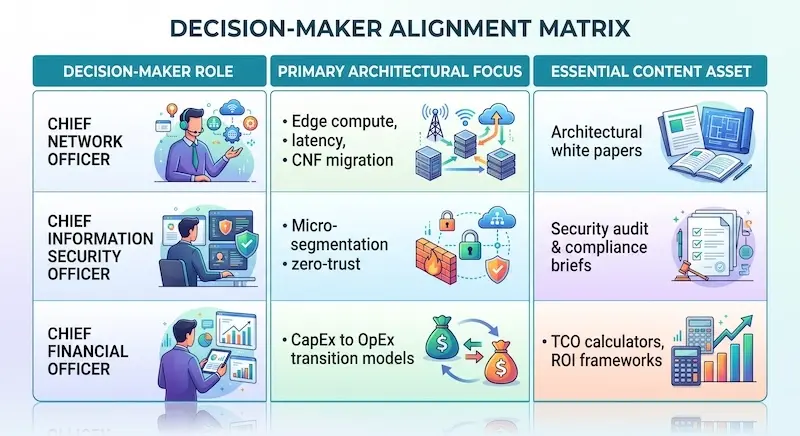
Your content strategy must provide tailored assets for every voice on the buying committee. For example:
- The CFO requires total cost-of-ownership models and operational expenditure benefits.
- The Chief Network Officer needs latency benchmarks and API specifications.
- The Systems Administrator requires deployment guides and management dashboard workflows.
Criterion 4: Revenue Attribution and Business Impact Metrics
Impressions, click-through rates, and social media likes might look encouraging in a monthly reporting deck, but they do not fund network expansions or data center upgrades. When selecting candidate B2B content agencies for telecom, insist on moving past surface-level vanity metrics in favor of revenue-focused key performance indicators.
According to research from the Content Marketing Institute,
67% of successful enterprise B2B marketers cite clear content performance measurement linked to pipeline acquisition as a primary driver of their growth.
A forward-thinking marketing agency evaluates campaign performance using business metrics that reflect pipeline acceleration:
- Pipeline Contribution Percentage: The total percentage of qualified enterprise pipeline influenced by technical assets throughout the sales process.
- Content-Influenced Contract Value: Total closed-won revenue tied directly to accounts that engaged with specific technical assets.
- Account Velocity Acceleration: The rate at which target enterprise accounts move from initial technical research to active commercial proposals.
- High-Intent Search Rate: The proportion of site visitors arriving via targeted commercial search terms rather than broad informational terms.
During discovery calls, ask candidate agencies to share live attribution dashboards from current enterprise accounts. Look for clear measurement models that connect technical reads directly to signed deals.
Criterion 5: Readiness for Answer Engine Optimization (AEO)
When enterprise network architects begin researching prospective vendors, how do they locate authoritative technical data?
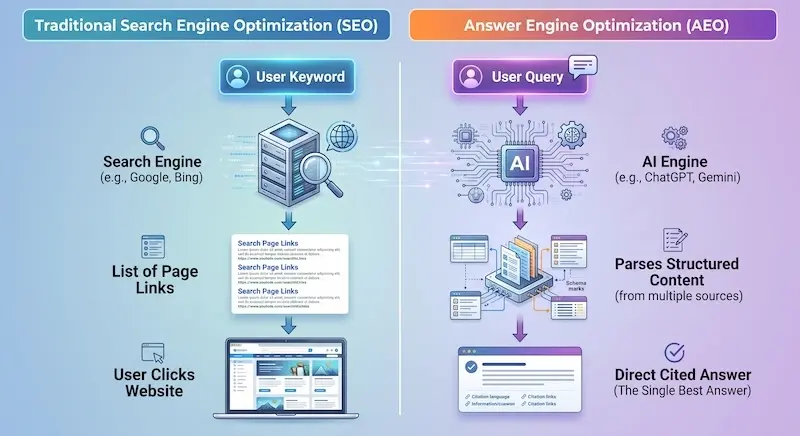
Historically, engineers entered keywords into search bars and reviewed traditional search engine result pages. Today, enterprise decision-makers increasingly turn to AI-driven answer engines and conversational search platforms to summarize platform capabilities, compare network benchmarks, and draft technical requirements.
This shift makes readiness for Answer Engine Optimization (AEO) a critical capability. Answer Engine Optimization (AEO) is the process of creating and structuring content so that artificial intelligence models can easily parse, understand, and use it to provide direct, cited answers to user queries. While traditional search engine optimization (SEO) focuses on ranking web pages in search results, AEO focuses on making your technical data, architectural diagrams, and schema the definitive source for AI-generated responses.
For enterprise telecommunications providers, securing traditional page-one links is no longer sufficient. Your technical documentation must serve as the authoritative direct source retrieved when a CTO prompts an AI model for vendor comparisons.
Building a Scalable Technical Content Engine
Choosing the right partner among B2B content agencies for telecom requires looking beyond polished sales presentations and generic agency awards. For enterprise telecommunications brands, long-term success relies on three non-negotiable factors: deep architectural fluency, seamless integration with your RevOps infrastructure, and a focus on revenue attribution.
When you collaborate with an agency that understands enterprise telecommunications, content evolves from an ongoing expense into a predictable growth driver. Your technical documentation answers the exact architectural questions enterprise buyers are asking, establishing credibility well before your sales team reaches out.
At Aspiration Marketing, we specialize in helping growth-focused telecommunications and technology brands build high-impact inbound systems. As a certified HubSpot partner, we align technical content strategies directly with your CRM platform to help you capture target demand, shorten complex sales cycles, and drive measurable revenue growth.
Ready to elevate your technical content strategy? Contact our team at Aspiration Marketing today to schedule a comprehensive content and RevOps audit.






Leave a Comment
Have thoughts on this article?
Share your feedback, ask questions, or join the discussion with our community.