





Are your inbound marketing campaigns delivering a predictable sales pipeline, or are you paying for empty vanity metrics like clicks, impressions, and downloads that never convert?
 For B2B tech scaleups and supply chain software providers, the buyer journey is far from simple. Sales cycles span 6 to 18 months. Purchase decisions involve multi-member buying committees. Every buyer demands deep proof of value long before they agree to a live demo. Standard consumer or generic business-to-business agency playbooks fail in this environment because complex tech platforms require domain credibility, seamless technical execution, and precise lead alignment.
According to research from HubSpot,
Inbound marketing tactics generate leads that cost 62% less than traditional outbound leads and deliver significantly higher conversion rates.
Furthermore, research from Demand Gen Report reveals that,
47% of B2B buyers view 3 to 5 pieces of content before ever engaging with a sales representative.
Selecting the right partner is not about finding creative decorators who make pretty templates. It is about identifying a strategic team that bridges technical architecture, deep vertical knowledge, and regional execution.
What Is a B2B Inbound Marketing Agency?
A B2B inbound marketing agency is a specialized strategic partner that helps business-to-business companies attract, engage, and convert ideal customers through targeted content, search optimization, marketing automation, and Revenue Operations (RevOps).
Unlike traditional agencies that focus primarily on brand awareness or paid ads, a B2B inbound marketing agency aligns marketing programs directly with the B2B sales cycle. They build long-term systems that pull qualified buyers through the sales funnel.
1. B2B Lead Generation Fit and Pipeline Realism
Does your current agency measure success in website traffic surges, or do they track Sales-Qualified Leads (SQLs) and closed revenue?
In the world of B2B tech scaleups, high site traffic means very little if none of those visitors ever match your Ideal Customer Profile (ICP). A specialized B2B inbound marketing agency understands the crucial difference between top-of-funnel interest and genuine bottom-of-funnel buying intent.
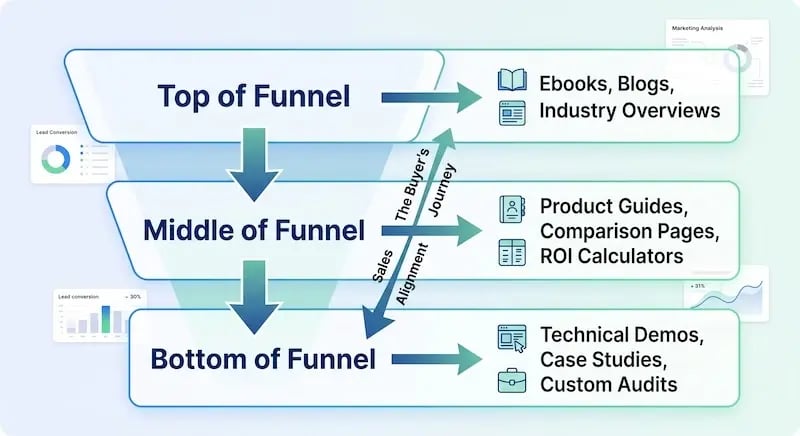
Differentiating MQLs from SQLs
Many generalist agencies boast about driving thousands of Marketing Qualified Leads (MQLs). However, downloading an ebook on general industry trends does not mean a prospect is ready to buy. A true B2B partner sets up rigorous lead-scoring frameworks that evaluate both fit and engagement:
-
Demographic and Firmographic Fit: Company size, industry sector, job title, software stack, and geographic location.
-
Behavioral Intent: Repeated visits to pricing pages, downloads of implementation guides, or views of API documentation.
Content-to-Pipeline Mapping
Consider a supply chain software vendor selling enterprise warehouse management solutions. You do not just need traffic from casual readers. You need fleet managers, logistics heads, and procurement directors who are seeking answers to real-time visibility bottlenecks or ERP system integration challenges.
Your agency must map content directly to these pain points at every step of the decision-making process:
-
Top of Funnel (Awareness): Educational guides addressing global supply chain disruptions or regulatory compliance shifts.
-
Middle of Funnel (Consideration): Detailed vendor comparison frameworks and technology feature breakdowns.
-
Bottom of Funnel (Decision): In-depth case studies, customer ROI calculators, and interactive platform walkthroughs.
Data backs up this focused approach.
According to HubSpot Research,
B2B companies that prioritize inbound content strategies generate 3x more leads per dollar compared to traditional outbound tactics.
When content directly matches buyer intent, lead quality improves dramatically, and sales cycles shorten.
Vetting Questions to Ask Agencies
- "How do you define a Sales-Qualified Lead versus a Marketing-Qualified Lead for our specific software space?"
- "What methodology do you use to tie organic content directly to pipeline velocity and revenue creation?"
- "How do you handle lead scoring to ensure our sales team receives only high-intent opportunities?"
2. Deep Vertical Expertise in B2B Tech and Supply Chain
Can an agency copywriter explain API integrations, warehouse management systems, or multi-tenant cloud architecture without requiring weeks of hand-holding from your team?
If you have to spend hours educating your agency on your industry terminology, you are paying for their learning curve. High-tech scaleups and supply chain software companies operate in nuanced spaces where superficial content damages brand trust immediately.
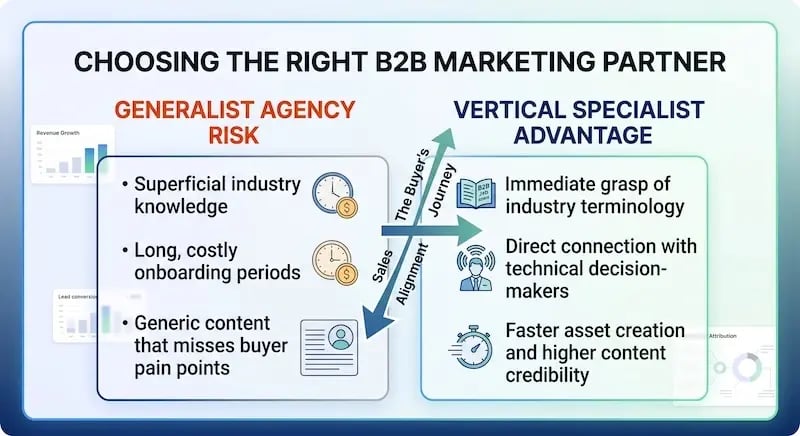
Eliminating the "Learning Curve" Tax
Generalist agencies often assign junior writers to recycle surface-level topics from competitor blogs. This creates fluff pieces that fail to impress sophisticated buying committees.
A specialized agency brings immediate domain knowledge to the table. They know the market challenges, understand regulatory pressures, and recognize what keeps your prospective buyers up at night. This eliminates months of slow onboarding and allows your team to publish high-value assets right away.
Speaking the Language of Technical Buyers
B2B software purchases involve multiple decision-makers across the C-suite and engineering departments:
-
Chief Technology Officers (CTOs): Care deeply about system integration, security protocols, API flexibility, and data architecture.
-
Chief Operating Officers (COOs): Focus on operational efficiency, implementation timelines, and resource overhead.
-
Chief Supply Chain Officers (CSCOs): Seek solutions for end-to-end supply chain visibility, risk mitigation, and warehouse automation.
Marketing enterprise logistics software differs completely from selling simple software-as-a-service (SaaS) tools. Topics such as Electronic Data Interchange (EDI) protocols, cold-chain compliance, and telematics require exact technical vocabulary. If your content lacks this precision, technical decision-makers will click away instantly.

Research by Gartner shows that,
77% of B2B buyers say their most recent purchase decision was very complex or difficult. An agency without deep domain knowledge only adds friction to an already complex process.
Vetting Questions to Ask Agencies
- "Can you share recent case studies or writing samples specific to enterprise software or supply chain tech?"
- "Who actually writes and plans our content—generalist copywriters or specialized tech industry strategists?"
- "How do your strategists stay updated on emerging technologies and industry regulations in our field?"
3. Technical Architecture and RevOps Capability
Is your agency simply creating web pages, or are they wiring up the digital infrastructure that connects Marketing, Sales, and Customer Operations?
In modern B2B growth, creative assets are useless if the underlying technical architecture is broken. High-growth software companies require smooth data flow across their entire technology ecosystem.
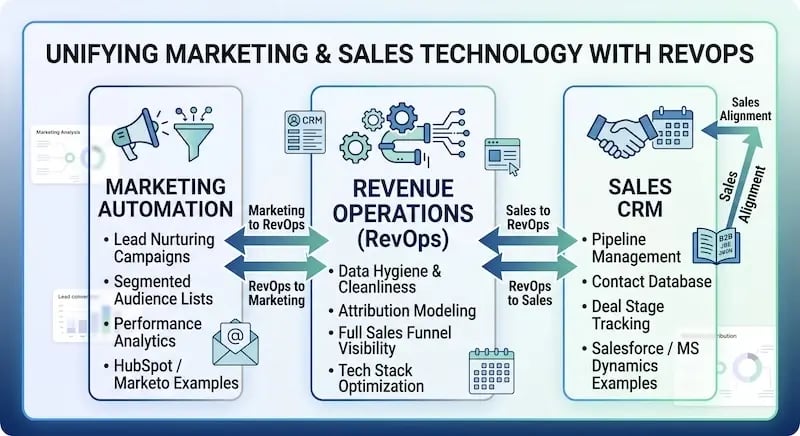
Beyond Surface-Level Marketing
Design and copywriting are only part of the equation. A complete B2B agency configures and optimizes the marketing automation systems that power your growth engine, including:
-
Customer Relationship Management (CRM): Proper deal pipelines, custom properties, and contact management in tools like HubSpot or Salesforce.
-
Marketing Automation Systems: Automated nurture sequences, lead routing rules, and lifecycle stage triggers.
-
Data Hygiene and Governance: Clean data structures that prevent duplicate records and maintain reliable reporting.
Revenue Operations (RevOps) Integration
Revenue Operations (RevOps) is a business function that aligns marketing, sales, and customer service operations to drive predictable revenue and enhance efficiency across the entire customer lifecycle. It breaks down operational silos by integrating systems and data. When RevOps functions smoothly, every prospect touchpoint is tracked, measured, and acted upon immediately.
For instance, consider what happens when a tech scaleup lacks technical RevOps integration: a high-value enterprise lead requests a demo, but the lead scoring system fails to flag it. The notification sits in an unassigned inbox for three days. By the time a sales representative reaches out, the prospect has already booked a demo with a competitor.
Seamless RevOps alignment prevents these costly breakdowns. Automated workflows instantly assign high-intent leads to the right sales reps, trigger immediate calendar-booking links, and update deal stages automatically.
According to research from Aberdeen Strategy & Research,
Organizations with strong alignment between marketing and sales achieve a 20% annual revenue growth rate, whereas unaligned companies experience a 4% decline.
Vetting Questions to Ask Agencies
- "How do you handle Revenue Operations (RevOps) and complex CRM integrations between marketing and sales tools?"
- "How do you set up closed-loop attribution modeling to prove which content channels drive closed deals?"
- "What is your team's technical certification status across platforms like HubSpot, Salesforce, and Google Analytics?"
4. Regional Market Alignment and Scalability
Can your inbound agency scale alongside your business as you expand across North American, European, or global markets?
Growing B2B tech scaleups rarely stay confined to a single geographic area. As your business grows, your marketing programs must adapt to different regional market dynamics, buyer behaviors, and regulatory environments.
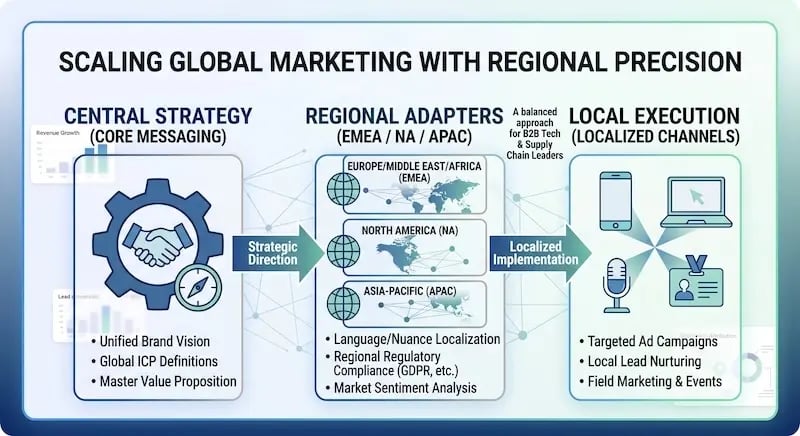
Localization versus Literal Translation
Expanding into new markets involves much more than translating website copy into a new language. Effective regional alignment requires true content localization:
-
Regulatory Compliance: Adhering strictly to regional data privacy laws, such as GDPR in Europe, CCPA in California, or PIPEDA in Canada.
-
Industry Standards: Adjusting terminology to match local logistics, trade, and software standards (e.g., North American vs. European supply chain terminology).
-
Buyer Preferences: Adapting content tones and sales messaging to align with local business culture and procurement expectations.
Global Portal and Multi-Market Management
Managing multi-region inbound campaigns can quickly become overwhelming without clear organizational systems. A skilled agency helps establish centralized marketing automation portals. This structure allows global headquarters to maintain brand consistency while giving regional teams the flexibility to run localized campaigns.
Data underscores the value of localized communication.
A comprehensive study by CSA Research revealed that,
76% of online buyers (including enterprise B2B decision-makers) prefer purchasing products and services when information is available in their native language and tailored to their region.
Vetting Questions to Ask Agencies
- "What experience do you have running and scaling B2B inbound campaigns across multiple countries or languages?"
- "How do you manage multi-region CRM and marketing portals without fragmenting global reporting data?"
- "How do you ensure marketing content complies with local privacy laws and regulatory frameworks?"
B2B Agency Evaluation Checklist
Use this comparison table to evaluate prospective marketing partners during your selection process:
| Evaluation Criteria | Generalist Agency | Pure Design Shop | Specialized B2B Tech Agency |
|---|---|---|---|
| Technical Depth | Low / Superficial understanding of complex software | Low / Focuses almost entirely on visual design | High / Deep domain expertise in tech and supply chain |
| Lead Alignment | Clicks, page views, and generic downloads | Brand awareness and creative assets | Sales-Qualified Leads (SQLs) and revenue pipeline |
| RevOps & Tech Stack | Basic email automation tools | None / Delivers static designs only | Advanced CRM integration and data attribution |
| Vertical Knowledge | Requires lengthy, costly onboarding | None / Relies on client to supply technical details | Immediate plug-and-play industry knowledge |
| Regional Scalability | Limited to single-market tactics | Focuses on basic asset creation | Multi-market localization and regional portal setup |
How to Choose the Right B2B Inbound Marketing Partner
Choosing the right B2B inbound marketing agency comes down to finding a team that views marketing through the lens of business growth and sales pipeline architecture.
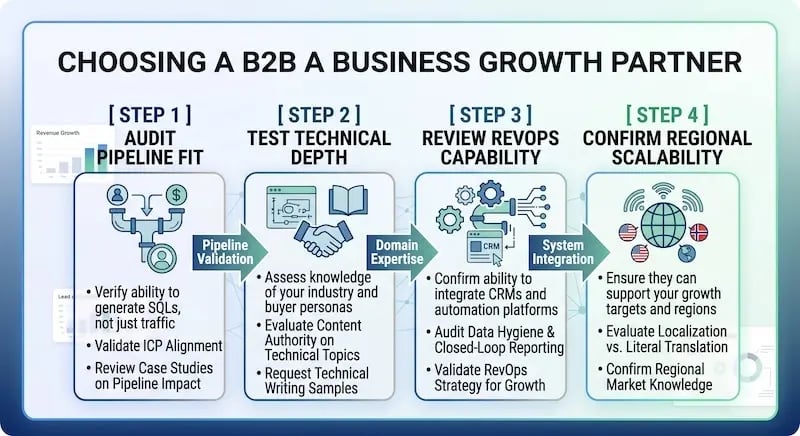
When evaluating potential partners, look past slick sales presentations and focus on real operational capabilities:
-
Audit for Pipeline Fit: Verify that the agency measures success by SQLs, deal velocity, and pipeline creation, rather than by top-of-funnel web traffic alone.
-
Test Domain Knowledge: Ask agency strategists how they plan to write for your technical buyer personas, such as CTOs, heads of supply chain, or IT architects.
-
Review Technical Architecture: Ensure the team has deep RevOps capabilities to cleanly connect your marketing automation tools to your sales CRM.
-
Confirm Regional Scalability: Choose a partner capable of executing localized campaigns across multiple target markets as your company expands.
Avoid agencies that offer one-size-fits-all packages or focus solely on vanity metrics. Demand a growth partner that integrates deeply with your team and builds a reliable, scalable inbound marketing engine.
Accelerating Your B2B Inbound Strategy
Navigating the complex B2B buyer journey requires a specialized balance of industry knowledge, technical capability, and revenue-focused alignment.
At Aspiration Marketing, we operate as an extension of your growth team. Rather than relying on generic agency playbooks, we focus on technical architecture, Revenue Operations (RevOps) integration, and tailored inbound strategies designed specifically for B2B tech scaleups and supply chain software providers. We help you build a predictable sales pipeline, connect your technology stack, and expand into key growth markets with confidence.
Ready to transform your inbound marketing engine into a predictable revenue driver? Explore Aspiration Marketing's inbound marketing solutions to audit your growth potential and connect with our growth architects today.



.webp?width=600&height=375&name=Choose%20B2B%20agency%20for%20EdTech%20(1).webp)



Leave a Comment
Have thoughts on this article?
Share your feedback, ask questions, or join the discussion with our community.