



B2B intent data is behavioral data showing that a company, or a person at that company, is researching a topic tied to a problem you solve. It improves lead quality only when it is joined to fit criteria, a shared scoring model, and a fast follow-up process in your CRM. On its own, it is a list of accounts that read about a topic. Our approach at Aspiration Marketing is to build it into HubSpot RevOps and architecture, so a signal reaches the right rep with context and a deadline.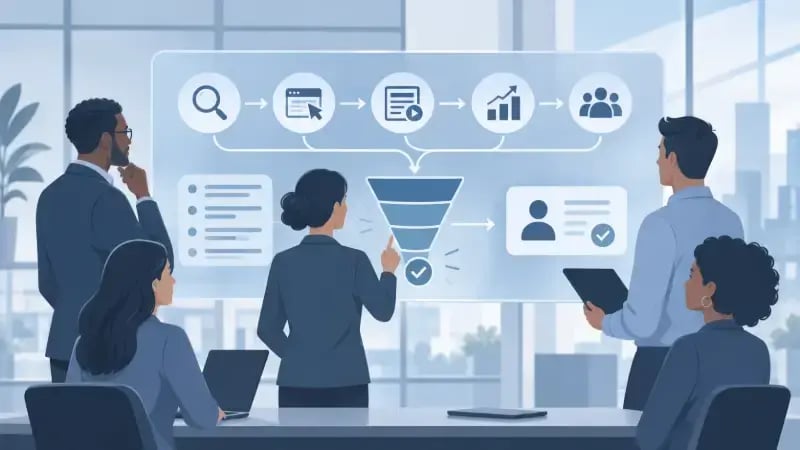
This guide is for marketing, revenue, and RevOps leaders. It covers what intent data is, the three types of intent data, how to judge a signal, how to turn signals into qualified leads, and what US privacy rules mean for sourcing.
What B2B intent data tells you
Intent data records content consumption and behavior that point to interests and current needs. In its 2026 guide, ZoomInfo describes it as behavioral data showing when an account is actively researching a topic. Providers compare each account’s activity with its own normal research level and flag accounts whose interest is rising.
That gives you three things:
- Who is researching. Usually an account, sometimes a person.
- What they are researching. A topic, a category, a competitor, or your brand.
- When interest rose. A surge against the account's own baseline.
It does not tell you budget, authority, or a purchase date. A surge means an account is reading more than usual. It does not mean a buying committee has been formed. Treat intent as a prompt to prioritize and personalize, and use fit, engagement, and conversation to qualify.
Teams that use it report benefits. Forrester’s Q1 2023 Global B2B Intent Data Survey found that more than 85% of companies using intent data had achieved business benefits. Forrester also noted that many teams lack reporting to trace the impact of intent spend deeper into the revenue funnel. That gap is a CRM design problem, and we return to it below.
First-, second-, and third-party intent data
The type determines how much you can trust a signal and how much work it takes to use.
| Type | Where it comes from | Strength | Typical use |
|---|---|---|---|
| First-party | Your website, email, social, product and events | Observed directly, known content, often known person | Scoring, routing, retargeting, follow-up |
| Second-party | Another company’s audience, such as review sites, shared with rights | Strong signal of product research | Late-stage account prioritization |
| Third-party | Cooperatives, publisher data, ad-network bidstream | Wide coverage of accounts you do not yet know | Finding in-market accounts, ABM targeting |
As IntentData.io's buying guide defines them, first-party data is what you observe in interactions with your own channels. Second-party data is collected by another company, often from registered users who allow it to share contact details and behavior. Third-party data usually relies on reverse IP lookup, publisher or media-exchange data, or ad-network bidstream data. Most third-party data reports account activity. Some sources identify contacts, while others append contact details from unrelated sources.
Second-party signals in practice
TrustRadius' intent playbook describes second-party downstream intent as signals from buyers researching a product or a competitor's product, including who views reviews, pricing, and details. It suggests feeding these into lead scoring so sales can prioritize high-value, lower-funnel accounts while marketing nurtures earlier-stage users.
Third-party sources are not equal
ZoomInfo's guide lists three main third-party sources: data cooperatives such as consent-based publisher co-ops, publisher-direct data, and bidstream data. It calls bidstream the weakest, because it captures only a brief snapshot of each visit and carries more noise. If a vendor cannot say which of the three it uses, you cannot judge the quality of what you are buying.
How a signal is produced
Knowing the mechanics helps you read a score sensibly. ZoomInfo describes five steps:
-
Capture behavioral signals from consented sources.
-
Classify content into topics.
-
Resolve activity to accounts through IP addresses and domains.
-
Set a research baseline for each account.
-
Flag a surge when research rises well above that baseline.
Scoring factors include content volume, the number of people researching the account, content type, time on page, and recency. Two consequences follow. A large company always generates more raw activity, so a baseline matters more than a count. And a signal tied to a single anonymous visit is weak, while a signal with several people reading across multiple topics is stronger.
HubSpot's own buyer intent product captures four signal types: visitor intent, research intent, company news, and contact-level signals. According to HubSpot's product page, it also surfaces 30 days of signal history for any company it tracks, so a rep has context on day one. For teams already on HubSpot, that keeps signals in the same record as deals, tickets, and campaigns. Our Data Agent explainer covers how HubSpot's data tooling supports that kind of work.
How to judge whether a signal is reliable
Most disappointment with intent data comes from treating every flag as equal. TechTarget's research team sets out five tests for genuine purchase intent data:
-
The behavior is observed and can be confirmed.
-
The recording system is owned by you or by a trusted second party.
-
The content that prompted the action is known.
-
The exchange is meaningful, with multiple interactions and, in B2B, patterns across several people in the buying group.
-
The individual is known through opt-in or log-in.
Their conclusion is that a single interaction is rarely meaningful. Use that as a working rule. Before you route a signal to sales, ask:
-
Is it more than one visit or one article?
-
Is more than one person involved?
-
Does the topic match something you sell, not just your industry?
-
Is it recent? One practical model halves a signal’s value every 7 to 10 days, as described in SDR.ai's 2026 playbook.
A signal that fails these tests still has a use. It can support advertising or nurture content. It should not trigger a call from a rep.
From intent data to qualified leads
The teams that improve lead quality do not rank by intent alone. They qualify in two stages.
Stage one: filter for fit
Start with your ideal customer profile (ICP): industry, company size, revenue, technology in use, and the roles you sell to. An account that shows intent but cannot buy from you is a distraction. Salesmotion’s October 2026 framework takes this approach, filtering for firmographic and technographic fit first, then ranking the survivors by signal intensity. It treats an account with both third-party research signals and first-party engagement as the highest-confidence sales-qualified lead.
Stage two: rank by intent and engagement
ZoomInfo suggests tiering accounts A to C on ICP fit and putting high-intent A or B accounts at the top of each rep's weekly list. It also advises personalizing the first email around the intent topic without telling the prospect you can see their research. That second point matters for trust: write about the problem, not about their browsing.
Intent should be included in lead and account scoring as a single weighted input alongside fit and engagement. Here is a simple illustration, with figures you should calibrate to your own data:
| Component | What it measures | Example inputs |
|---|---|---|
| Fit | Can they buy from us? | Industry, headcount, tech stack, role |
| Intent | Are they researching now? | Topic match, surge, number of people, recency |
| Engagement | Are they talking to us? | Pricing page visits, demo requests, replies |
One published model combines fit (0 to 30 points) with a recency-decayed intent score and routes leads to tiers: 0 to 39 points for nurture, 40 to 69 for SDR review, and 70 or more for immediate account executive outreach within 24 to 48 hours (SDR.ai). Treat these as a template, not a standard. Your thresholds should come from your own closed-won history.
What the routing decision changes
Eyko’s case study scored 14,200 leads over 90 days. It projected a 24% close rate for the 1,840 high-fit, high-intent leads, and 4% for high-fit, low-intent leads rushed to sales. These are one vendor's projections, not benchmarks, but they show the logic: routing the right 13% of leads to reps quickly protects both conversion and rep time.
For context on your own funnel, LeanData's 2022 benchmarking report (311 respondents) found a median MQL-to-SQL conversion of 20%, with the 75th percentile at 33%. Compare your rate by source before and after you add intent to scoring. If intent-flagged leads do not convert better than the rest, your model needs adjustment.
Alignment: the part that decides results
A scoring model that marketing built alone rarely survives contact with sales. ZoomInfo's lead scoring and routing guide says the MQL threshold that triggers a handoff should be agreed upon jointly, with a typical starting range of 50 to 100 points, calibrated to historical data. It also recommends:
- A joint MQL definition.
- A follow-up service level agreement (SLA).
- A feedback loop that lets reps flag mis-scored leads.
- A quarterly review against trailing 90-day win data.
Speed is part of the SLA. Optifai's 2026 study of CRM timestamps from 939 B2B companies reported that
leads contacted within 5 minutes closed at 32%, against 12% at 24 hours or more. It also found that only 23% of companies respond that quickly.
This is one vendor's dataset, so use it to measure your own response times by lead source, not as a promise.
These are CRM tasks. A signal needs a property, a rule, an owner, a notification, and a report. Without them, the data sits in a dashboard that no one opens, which is the reporting gap Forrester described.
Where Aspiration Marketing fits
Intent data is only as useful as the system that acts on it. We combine 13+ years of HubSpot platform experience with marketing, sales, and customer success alignment, so the scoring model, routing rules, and reporting live in one CRM. HubSpot RevOps and architecture is where we design that foundation: properties, lead scoring, lifecycle stages, and handoff.
The signal also needs a response. For accounts you want to reach before they raise a hand, B2B outbound marketing turns an intent topic into a relevant first touch. For accounts already reading your content, inbound demand generation gives them the next useful page. Our core components of ABM guide show how account selection, content, and sales follow-up connect. We deliver in seven languages, which matters when the same topic surges in several markets.
Privacy and sourcing in the US
Sourcing is where intent data can create legal exposure, and the rules are stricter than many B2B teams assume.
-
California. According to UnifyRev's 2026 guide, the CCPA exemption for B2B contact data expired on January 1, 2023. Business contact information for California residents now includes rights to access, delete, correct, and opt out of data sales. The guide cites penalties of $2,663 per violation and $7,988 per intentional violation.
-
Notice and opt-outs. Ilynk.ai's January 2026 guide says buyer intent counts as personal information when it can identify or relate to an individual. That brings notice at collection, honoring Global Privacy Control signals, a visible “Do Not Sell or Share” link, and responses to access or deletion requests within 45 days.
-
Vendor terms. Ask any provider for proof of consent, the origin of its data, and its security certifications. Prefer consent-based first-party signals, and avoid bidstream data where you cannot verify provenance.
-
EU, UK and Canada. If you market to residents there, different rules apply, including consent for email tracking pixels in France from April 2026 per Lewis Silkin's comparative analysis. Confirm requirements with your counsel before cross-border campaigns.
Rules vary by state and change often. Have your legal counsel review your data sources and tracking disclosures before launch.
A 90-day plan
- Weeks 1 to 2: Agree on the ICP and a joint MQL definition between marketing and sales. Pull 12 months of closed-won and closed-lost data.
- Weeks 3 to 4: Audit first-party signals in your CRM: pricing page visits, demo requests, content downloads, email replies. Fix duplicate records and missing company associations.
- Weeks 5 to 6: Build the scoring model with fit, engagement, and intent inputs. Set tiers and SLAs.
- Weeks 7 to 8: Add third-party or second-party intent for your priority topics, after privacy and vendor review.
- Weeks 9 to 12: Route live signals, track response time and conversion by tier, and hold the first quarterly review with sales.
Start with first-party data. It is the most reliable, it costs the least, and it exposes the process problems that any paid feed would inherit.
Sources
-
ZoomInfo: What Is Intent Data? Types, Examples and How to Use It
-
Salesmotion: How to Use Intent Data to Find Sales Qualified Leads
-
LeanData: 2022 Inbound & Outbound Sales Pipeline Performance Benchmarking Report
-
Ilynk.ai: How to Use Buyer Intent Data Without Violating Privacy Rules






Leave a Comment
Have thoughts on this article?
Share your feedback, ask questions, or join the discussion with our community.