



As consumers move through the buyer's journey, they make dozens, if not hundreds, of small, subconscious decisions that directly influence their progress toward conversion. Yet most marketing strategies dismiss micro-decisions, focusing instead on influencing shoppers' big, deliberate choices.
 However, the typical customer journey is not entirely deliberate.
Research shows that up to 95% of shopping decisions are based on consumers' subconscious emotions.
This data suggests that addressing and prioritizing micro-decision moments in the online customer journey could drive engagement, sales, and even long-term customer loyalty.
This guide examines the role of micro-decisions in the typical buyer's journey and suggests several tactics to use these moments to guide prospects toward a purchase decision.
Micro-Decisions Shape How Customers Move Through the Buying Journey
Although they may represent only a small moment in the customer journey, micro-decisions directly influence where prospects end up after each interaction with a brand. Understanding what influences buyer decisions is critical when it comes to business success.
Look at how consumers behave online. You'll find that almost every movement through the sales funnel represents a micro-decision.
-
Selecting a product category directly impacts whether web visitors find what they need.
-
Applying a search filter determines how quickly they find solutions to their pain points.
-
Reading a review influences brand trust and consumer confidence.
-
Interacting with product comparison content shapes each shopper's evaluation journey, guiding them closer to or further from a particular option.
None of these actions directly affects conversion decisions. Nevertheless, they shape how customers move through the buying journey and determine their likelihood of becoming customers. Why? The reason is closely related to user experience.
Micro-decisions can help website visitors narrow their options, especially when browsing large inventories. They directly influence product understanding and value. Lastly, micro-decisions shape people's willingness to interact with a brand, deciding whether a lead continues moving through the sales funnel or abandons it altogether.
In other words, one of micro-decisions' biggest roles in the online customer journey isn't necessarily to guide prospects toward conversion. Instead, micro-decisions shape customers' movement through the buying journey by reducing friction and making progress easier.
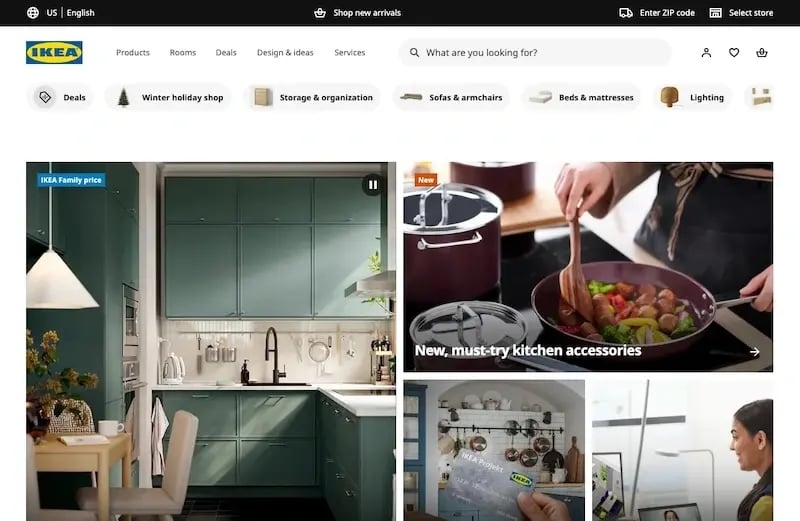
For example, IKEA optimizes micro-decision moments in its site's UX to encourage movement through the customer journey. Its navigation menu lets shoppers browse based on product function, room, deals, or services.
An additional menu provides web visitors with quick access to more specific categories, such as winter holiday solutions, storage and organization, sofas and armchairs, beds and mattresses, and lighting.
By including these navigation options in a highly visible spot on its homepage, IKEA makes it incredibly easy for shoppers to discover products and narrow their choices, reducing the need to waste time browsing irrelevant products and minimizing the frustration that comes with complex navigation menus (which are common with brands with similarly large inventories)
Descriptive Product Categories Make Complex Selections More Manageable
If you look at what deters web visitors from progressing through the buyer's journey, you'll find that stalling in the sales funnel or abandoning it often boils down to confusion. After all, clarity boosts confidence and reduces consumers' risk perception, making them far more likely to make positive purchase decisions. However, uncertainty almost always leads to hesitation.
This is why customer-centric product education plays such an important role in guiding movement through the sales funnel. When they understand a solution's benefits and potential limitations, consumers feel more comfortable considering the brand's offer and, eventually, clicking the 'Buy' button.
But here's the deal about product education in the buyer's journey. Waiting until a lead lands on a product page to explain its benefits is not enough. With that approach, consumers may never feel inclined to explore your offer.
So, how do you make complex selections less daunting and more manageable? One of the best ways is to integrate low-effort customer education into every stage of the buyer's journey. That way, you can optimize micro-decision moments and avoid overwhelming customers with complex product selections.
For instance, consider how product categorization drives micro-decisions throughout the customer journey.
Unclear large product catalogs almost always drive overchoice, a consumer psychology phenomenon directly related to lower purchase intent.
However, a simple UX design strategy of optimizing product categories for user education and clarity turns complex selections into manageable micro-decision moments, where shoppers can make confident navigation decisions without feeling overwhelmed.
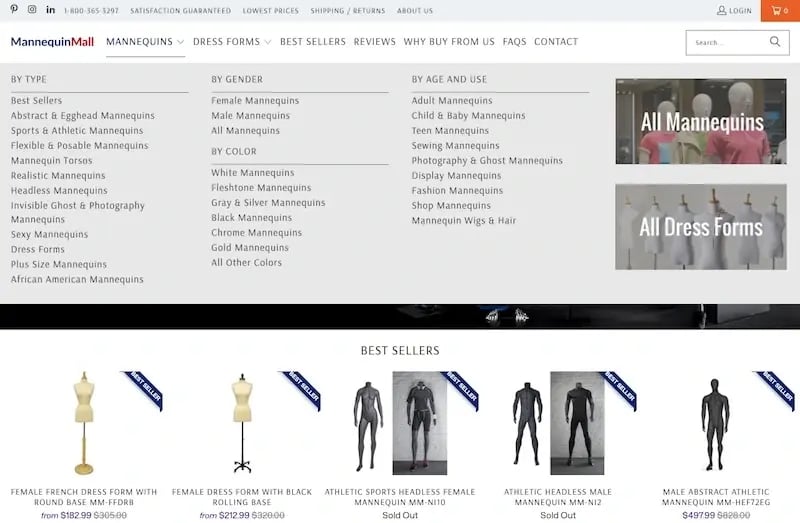
Check out Mannequin Mall's approach to organizing its retail display products into manageable choices that don't require advanced pre-purchase product understanding. The brand first creates categories based on product type. Then, it lets shoppers narrow their search by product type, style, appearance, intended use, and other easy-to-understand factors.
Doing so, Mannequin Mall doesn't force web visitors to make navigation micro-decisions they may not understand. Instead, it helps all leads, including non-expert buyers, confidently navigate the customer journey, even when they're unfamiliar with the types of dress forms and mannequins that exist, while still having a clear goal for their purchase.
Making the Right Choices in the Right Order Simplifies Purchasing
The buyer journey is often depicted as a funnel or inverted pyramid, which makes sense. Outcomes and choices in the top sections of the funnel inevitably affect the attractiveness and suitability of those at the bottom.
If the upper stages of the customer journey go well, leads are much more likely to convert. But if anything in those initial phases makes your audience feel overwhelmed, uncertain, or unconfident, those leads will most likely abandon the sales cycle.
But why does this happen? As consumers move through the customer journey, they make small (or big) decisions at every step. Whether those choices are right or wrong ultimately impacts their shopping experience in the next stage of the journey.
In other words, final purchase decisions often depend on what choices shoppers made earlier during the customer journey. For example, if they don't clearly define their requirements, they are likely to end up with a product selection that doesn't meet their needs. That could cause them to abandon your funnel and move elsewhere.

With this in mind, guiding your audience through each micro-decision could make conversions more attractive, less overwhelming, and easier overall.
One of the best ways to reach this goal is to identify your target audience's basic needs and align your offer with their requirements.
Look at Adobe's research on consumer expectations. You'll find that:
88% of shoppers want to engage with brands that are setting new standards in meeting their expectations.
So, don't waste your prospects' time by letting them browse through hundreds of irrelevant options. Instead, help them find the perfect solution to their pain points by structuring the buying journey to support informed micro-decisions at every stage of the shopping process.
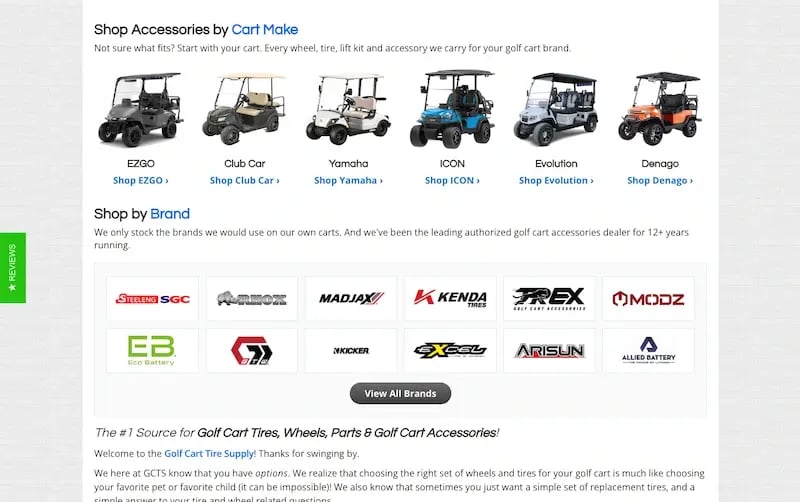
For example, Golf Cart Tire Supply understands that whether customers find the right product for their needs depends on the product meeting a set of requirements. So, it guides customers through essential compatibility factors for tires and wheels. In doing so, Golf Cart Tire Supply ensures leads only have to consider relevant options, making pre-purchase micro-decisions easy, intuitive, and highly optimized to drive satisfaction at the bottom stages of the customer journey.
Guided Product Searches Reduce Uncertainty and Decision Friction
What do consumers do when they land on a website? If you look at Nosto's web user behavior research, you'll discover that:
69% of web visitors go straight for the search bar. Yet 80% leave due to a poor experience.
This data reveals a common UX mistake directly related to the role of micro-decisions in the online customer journey. Here's how.
When they use a site's search option (no matter how basic or advanced), consumers still have to decide which results to click on. If choosing where to go next isn't intuitive, their confidence immediately suffers, and they'll likely abandon their search.
One of the best ways to avoid this scenario is to create guided product search tools that proactively reduce uncertainty and decision friction. A great search experience helps shoppers translate their needs and requirements into actionable filters that narrow down their selection of relevant products. But for this to happen, what is searchable on your website matters a lot.
Simple product identifiers can be helpful. However, in some industries, there aren't enough. Instead, leads need to be able to conduct searches based on specifications and characteristics. And the results should give them access to an equal measure of product pages, educational content, and post-purchase support resources.
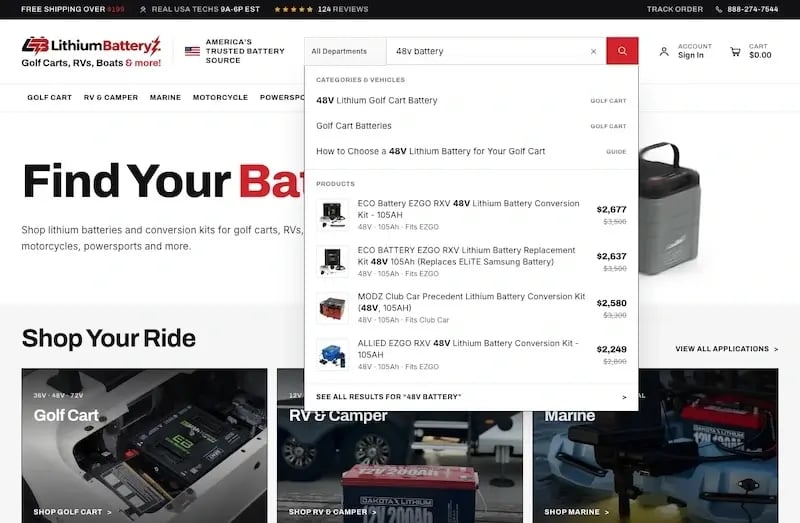
The LithiumBatteryZ website's search bar is an excellent example of how to support micro-decisions through guided product searches. This brand's search results incorporate educational content, product category pages, and filtered product pages.
But this UX strategy doesn't only improve the overall product discovery experience. Instead, LithiumBatteryZ gives shoppers specialized assistance, helping visitors quickly find what they need, whether a product or an informative resource, ensuring they are fully confident in their choice before clicking the 'Buy' button.
Structured Comparisons Help Customers Evaluate Product Trade-Offs
One of the most prominent effects of the global e-commerce economy is that most consumers have access to much more choice than they ever did before. At face value, this may seem like a good thing. But returning to the idea of overchoice, it quickly becomes clear that choosing from many options can make the customer journey more frustrating than it needs to be.
In fact, consumer behavior research shows that buyers constantly seek ways to make their purchase decisions easier. Data suggest that nearly all shoppers research their purchases before converting.
PWC found that consumers use a variety of platforms to find pre-purchase information, including price comparison websites, social media, search engines, and others.
Of course, when optimizing micro-decisions in the customer journey, you don’t want to leave prospects to their own devices as they decide whether to buy from your brand or a competitor. Instead, you want to create structured resources that help your audience evaluate potential product trade-offs and choose the option best suited to resolving their pain points.
Side-by-side comparisons and structured buying guides can be a great way to do this, as they base product selection on customer-centric micro-decision moments. Instead of focusing solely on the big picture, these resources guide customers through individual attributes and how they relate to personal preferences.
Furthermore, when done right, this type of content highlights key trade-offs. In doing so, it helps consumers eliminate unsuitable options, narrow down their search criteria, and focus on solutions that fit their personal preferences.
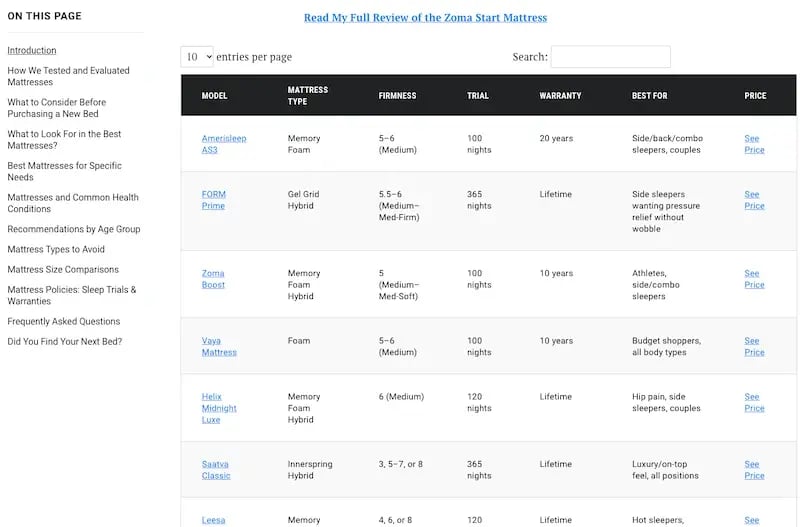
This SleepJunkie post is an excellent example of structured comparison content that guides consumers through small, yet important micro-decision moments in the customer journey. It's such a valuable resource not only because it gives readers a great overview of the fifteen most popular products on the market.
This article breaks down customer decisions into small, personal choices like firmness, mattress position, cooling capabilities, and pressure relief, intuitively guiding shoppers to the best option for their specific needs without overwhelming them with the sheer choice of options on the market.
Trust Signals Help Customers Make the Final Purchase Decision
The fascinating thing about the buyer's journey is that consumers practically never stop reevaluating their decisions, even when they're on the verge of buying.
Just look at research from the Baymard Institute. It shows that:
70.22% of shoppers abandon their purchases even after adding an item to their carts. Why? Most often, this comes down to unexpected costs, low brand trust, poor CX assurances, and complex UX.
The findings reveal that customers must make several micro-decisions even after identifying a product that fits their needs. Their lack of confidence often stems from trust issues, whether that involves payment, delivery, or potential risks.
With these in mind, one of the best ways to help your leads make the final purchase decision is to incorporate trust signals into your online presence. However, you need to do it at every step of the customer journey because brand credibility is a major purchase-influencing factor.
Some of the most impactful trust signals that support micro-decisions include transparent shipping costs, return policies, and warranties. Customer reviews and feedback are also highly impactful, especially since most shoppers seek them out before deciding whether to buy. Finally, addressing payment security and customer data privacy is a good plan, seeing as these are increasingly important trust factors in 2026.
To ensure trust signals are encouraging rather than overwhelming, display them at the right moment. Payment security information is key at the end of the customer journey. However, in the earlier stages of the sales funnel, this information may simply be distracting. Moreover, it can pull customers' focus away from the key insights they need at that point in their journey.
For example, Framework does a great job distributing trust signals across its website. On the homepage, it simply focuses on key CX considerations, such as lifetime upgradeability. However, on its product pages, it goes into much more detail, covering factors like expected shipping times, cancellation policies, warranties, and shipping costs, all of which build customer confidence and drive purchase intent.

Final Thoughts
The online customer journey is not a series of attractive marketing pitches that somehow convince consumers to convert. It's a process that involves multiple considerations, micro-decisions, and even reevaluations before prospects are ready to buy. Failing to account for those small moments could mean the difference between a conversion and a website abandonment.
The optimization tactics discussed in this guide aren't just a collection of tips for making your leads more likely to convert. They're a series of key UX considerations that guide prospects through the buyer's journey, focused on removing frustrations and doubts and boosting customer confidence. Because, at the end of the day, it is confidence alone that will make your prospects pull the trigger and click that 'Buy' button.
If you're interested in learning more about the buyer's journey, reach out to Aspiration Marketing's team of content and inbound marketing professionals.







Leave a Comment
Have thoughts on this article?
Share your feedback, ask questions, or join the discussion with our community.