



What happens to a customer support ticket after an autonomous customer agent hits "resolve"? In most organizations, that ticket ends up in a digital graveyard. It becomes a line item in a monthly report, a data point in an administrative archive, or a metric used to calculate an agent's speed. But does resolving a ticket actually fix the underlying problem that caused the customer to reach out in the first place?
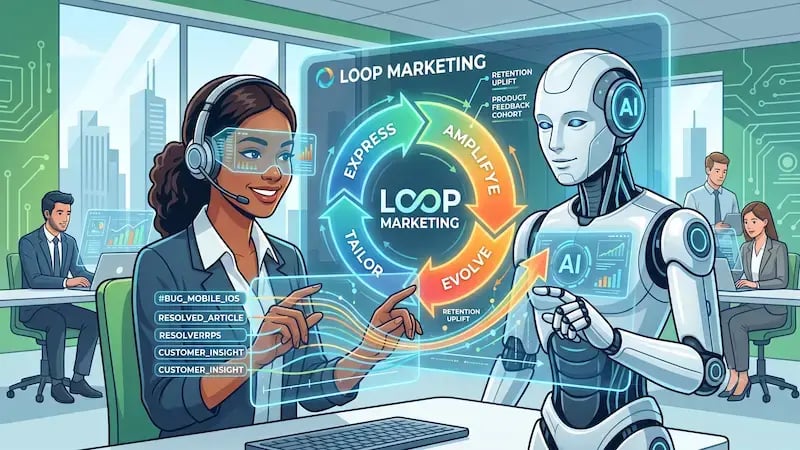 When a customer encounters a bug, a confusing piece of documentation, or a flawed checkout process, they don't just want a polite apology and a quick workaround. They want the product to work correctly. Yet, traditional business models keep customer support teams and product development teams completely isolated from one another. Support agents handle the fallout of product flaws, while product managers guess what features to build next based on lagging indicators or focus groups.
This is where loop marketing changes the game. Loop marketing is a continuous business model that breaks down corporate silos by creating a real-time data loop across marketing, sales, customer service, and product management. Instead of operating as a linear funnel where customers drop off at the end, loop marketing functions as an active flywheel.
The framework consists of four distinct stages: Express, Tailor, Amplify, and Evolve. While the first three stages focus on customer acquisition, engagement, and onboarding, the Evolve stage is where true long-term value is unlocked.
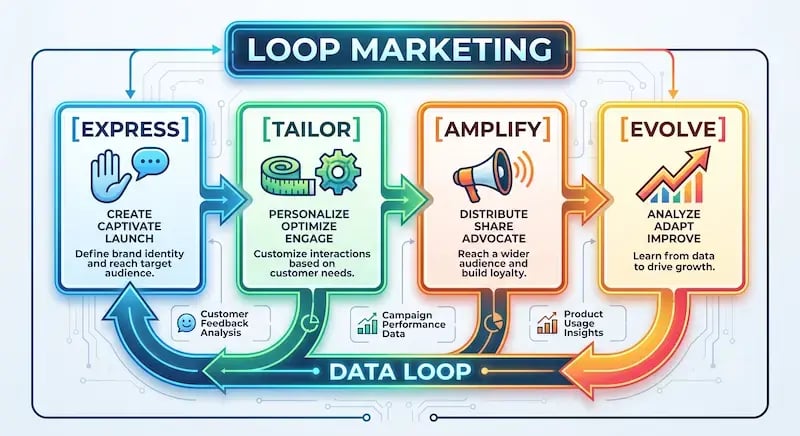
In the Evolve stage, the frontline customer service agent ceases to be a transactional worker who merely closes files. Instead, they become a vital data engine. They act as strategic contributors, turning daily ticket-resolution data into a roadmap for continuous optimization and sustainable growth. This is the human-in-the-loop process in practice.
Defining the Evolve Stage: Moving Past Vanity Metrics
To understand why the Evolve stage is so critical, we have to look closely at how traditional customer service teams measure success. For decades, the support industry has relied on standard efficiency metrics:
-
Average Handling Time (AHT): How fast can an agent get a customer off the phone or close a live chat?
-
Ticket Volume: How many issues did the team clear out of the queue today?
-
First Contact Resolution (FCR): Was the problem patched up during the very first interaction?
While these metrics matter for operational budget tracking, they are ultimately vanity metrics when viewed from a broader business perspective. A low average handling time might mean your agents are rushing customers off the phone without addressing the root cause of their frustration. Closing 500 tickets in a day looks impressive on a dashboard, but if 400 of those tickets are about the exact same recurring software glitch, your company is wasting massive amounts of capital on repetitive tasks.
Loop marketing shifts the focus away from sheer speed and redirects it toward loop velocity. Loop velocity measures how quickly your organization captures an insight on the front lines, transfers it to the appropriate internal department, and implements a permanent solution.
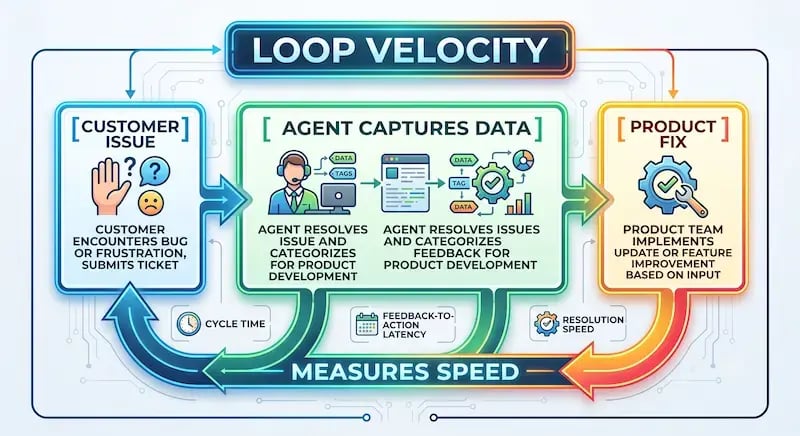
When you optimize for loop velocity, you stop looking at support tickets as expensive problems. Instead, you look at them as free, real-time user testing data.
The financial and operational impact of closing this loop is substantial.
According to an industry study by HubSpot,
Organizations that build continuous, integrated feedback loops across their service and operational teams see a 37% faster time-to-solution for customer problems within a single fiscal year.
This speed directly influences consumer loyalty. A recent market study by Shopify reveals that,
60% of consumers state that fast, high-quality resolution from reps is the number one factor that influences their decision to make a repeat purchase from a brand.
The Evolve phase takes those high-quality resolutions and turns them into permanent system upgrades. It ensures that when an agent helps a customer, that specific issue is resolved not just for that individual, but for every future user who interacts with the brand.
The Customer Service Agent as a Data Alchemist
How does an organization actually build this bridge between front-line support and product development? It requires transforming the support representative's role into that of a data alchemist.

In a traditional setup, customer support agents and product managers speak completely different languages.
-
A support agent talks in terms of human frustration, emotional temperature, and localized bugs.
-
A product manager talks in terms of user stories, development sprints, code architecture, and feature backlogs.
Because these teams use different software systems and rarely sit in the same meetings, critical user feedback gets lost in translation.
The Evolve phase solves this problem through product management data mapping. By using a unified customer relationship management platform enhanced with modern classification layers, unstructured human conversations are systematically transformed into structured operational data.
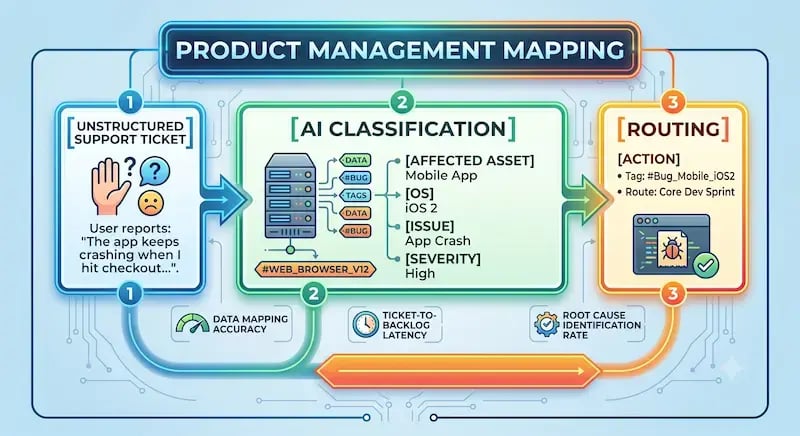 Let's look at how this data transformation works in practice:
-
The Human Interaction: A customer contacts a company via live chat, frustrated because they cannot complete a purchase. They tell the agent, "Every time I try to save my updated billing address on the checkout page using my tablet, the screen goes blank and nothing happens."
-
The Analytical Categorization: The agent solves the customer's immediate problem by manually processing the transaction. However, instead of simply tagging the ticket as "Billing Issue" and closing it, the agent uses an integrated CRM interface to link the ticket to a specific asset category:
Checkout_Page / Mobile_View / Address_Field_Validation_Error. -
The Automated Routing Loop: Because the agent categorized the problem accurately, the CRM system cross-references this ticket with twenty other similar inputs received over the last 48 hours. Because you've already built smart routing workflows, the system automatically creates an aggregated data cohort and adds the item directly to the product engineering team's current development sprint queue, escalating the issue to the right humans.
By mapping customer service data directly into product management workflows, the frontline agent shifts from a reactive responder to an active product scout. They provide the precise data that engineers need to build actionable software updates.
A Clear Scenario: The Cost of a Broken Loop
Consider the real-world impact this has on a growing software company. Imagine a mid-sized SaaS business that releases a new feature update for its project management platform. Due to a minor design flaw, the new update accidentally hides the "Export Data" button on certain web browsers.
Within three days, the customer support team receives a wave of 150 incoming support tickets from anxious users who cannot export their weekly reports.
-
Scenario A (The Broken Loop): The support agents handle each ticket individually. They send users a manual copy-paste workaround link, apologize for the inconvenience, and close the files. The agents are too busy clearing the heavy queue to spot the larger trend. The product team remains completely unaware of the issue because their next feedback meeting with support isn't scheduled until the end of the quarter. Over the next month, 8% of those frustrated users cancel their subscriptions due to perceived platform instability.
-
Scenario B (The Evolve Phase Loop): The very first time an agent spots this specific problem, they log it using a standardized trend tag. By the time the tenth ticket arrives, the integrated CRM flags the anomaly and alerts the product manager. The agent's input provides the engineering team with the exact browser version, error type, and user context needed to locate the issue. A hotfix patch is deployed within 48 hours. The ticket volume drops back to zero, user frustration is minimized, and critical retention revenue is preserved.
The Human-AI Alliance in modern Customer Support
When discussing automated workflows and data integration, a natural question always arises:
"If software can categorize trends and route tickets automatically, will machines eventually replace human support representatives?"
The short answer is no. The Evolve stage of loop marketing does not replace human agents; it elevates them. It relies entirely on a balanced Human-AI Alliance. In this model, artificial intelligence is utilized to manage heavy data volume and perform repetitive tasks, while human agents handle data validation, quality control, emotional nuance, and critical edge cases.
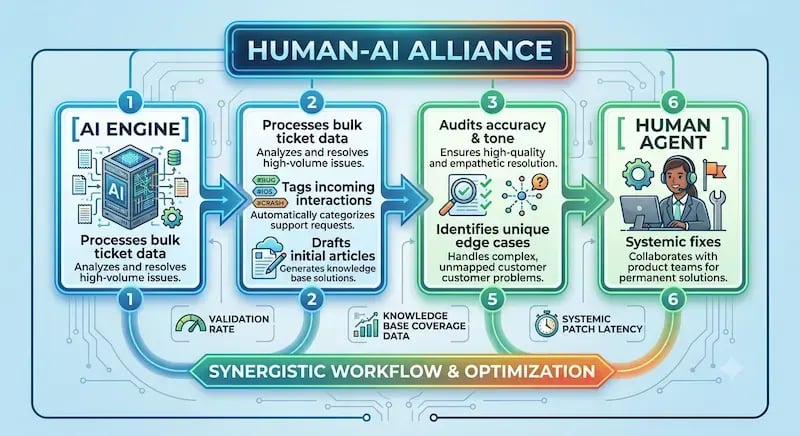
AI systems are excellent at recognizing broad patterns across thousands of text inputs, but they lack the contextual understanding to judge whether an automated resolution was truly helpful or merely convenient. Human agents are required to audit resolution accuracy, screen for software hallucinations, and clean customer support data before it is entered into the main product database. Clean data is vital; if a support database is cluttered with misclassified tickets or duplicate entries, the product team will end up building updates based on faulty premises.
Empowering Agents to Scale Self-Service Solutions
Another core responsibility of the modern agent in the Evolve framework is driving autonomy by creating high-quality self-service elements.
When an agent encounters a completely new user problem that requires deep troubleshooting, they create a unique solution. In a loop marketing ecosystem, that solution shouldn't be trapped in a single agent's head. By using modern, integrated service platforms, the agent can easily convert their successful ticket resolution text into a draft for a public knowledge base article with a single click.
An artificial intelligence tool can instantly clean up the agent's internal notes, format them into a scannable FAQ article, and add relevant search keywords. The agent then reviews the draft for technical accuracy and approves it for immediate publication.
This workflow transforms a one-time human solution into a permanent self-service asset that can assist thousands of future users. The statistical evidence supporting this operational shift is clear:
-
Improved Efficiency: According to the HubSpot State of Service Report, 74% of customer service leaders state that AI implementations have directly improved their overall response times, allowing teams to focus on structural improvements rather than ticket backlogs.
-
User Preference: This efficiency aligns perfectly with modern buyer behavior. Research indicates that 78% of service leaders acknowledge that modern customers actively prefer to resolve issues independently via well-optimized self-service portals and clear knowledge bases before reaching out to a human representative.
By building these self-service resources, customer service agents actively shrink the future ticket queue. They clear out low-level, repetitive questions from their daily workload, freeing up their schedule to focus on deeper strategic analysis alongside the product development team.
Strategic Advantages of Closing the Loop
When you integrate your customer service data directly into your product development cycle, your entire business shifts in market positioning. You effectively transform customer support from a traditional operational cost center into a core revenue-retention asset.
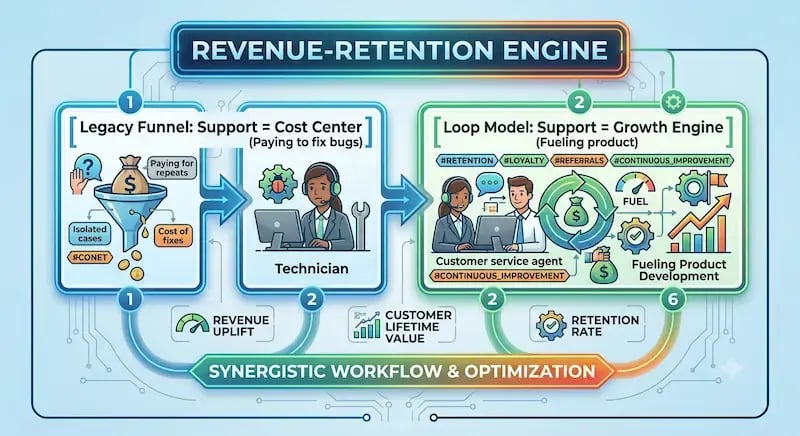
In standard corporate setups, executives look at customer support as an expensive necessity. They spend capital on agents simply to handle complaints and minimize damage. However, when an organization uses loop marketing, every single customer support interaction yields valuable business intelligence that can be used to optimize the core product.
This continuous optimization provides several clear business advantages:
1. Minimizing the "Leaky Funnel" Effect
A business can spend millions of dollars on marketing campaigns and sales strategies to acquire new accounts. However, if those newly acquired customers encounter systemic user experience flaws during their first thirty days, they will leave the platform just as quickly as they arrived. By using front-line support data to identify and fix onboarding friction points in real time, you protect your initial marketing investments and maximize your customer lifetime value.
2. Boosting Long-Term Brand Loyalty
Customers do not expect a company to be perfect, but they do expect it to listen. When a user reports a system flaw and sees that flaw permanently fixed in a software update a few days later, they feel heard. This rapid responsiveness creates brand advocates who remain loyal to your business over the long term.
3. Avoiding Multi-Trillion Dollar Risks
The financial risk of maintaining poor, disconnected customer experiences is higher than ever before.
According to research published by Shopify,
Poor customer experiences put an estimated $3.7 trillion of global consumer sales at risk annually.
Organizations that fail to connect their support insights back to their product designs risk losing substantial market share to more agile, responsive competitors.
| Strategic Dimension | Legacy Closed Funnel Support | Loop Marketing Evolve Phase |
|---|---|---|
| Primary Goal | Resolve individual tickets quickly | Optimize systemic business processes |
| Data Flow | One-way silo (Stays in support) | Real-time loop (Feeds product dev) |
| Core Success Metric | Average Handling Time (AHT) | Loop Velocity & Customer Retention |
| Agent Role | Transactional Troubleshooter | Strategic Data Alchemist |
To put these concepts into focus, take a moment to look at your organization's current support operations and ask yourself three questions:
- "Are your customer service logs sitting in an isolated database, or are they directly fueling your next product development cycle?"
- "Do your software engineers know what your support agents went through this morning?"
- "Are you paying to solve the exact same customer complaint week after week?"
Turning Support into Strategic Growth
The Evolve phase of loop marketing redefines what it means to offer great customer support. It proves that the true value of a customer service team isn't just their ability to handle high ticket volume or maintain a polite tone under pressure. Their true value lies in their unique position as the primary collection point for real-world user experience data.
When you empower your frontline customer service agents with the right CRM frameworks, training, and automated data-mapping tools, you turn every incoming support ticket into an instructional blueprint for company growth. You stop guessing what your users want, because they are already telling your support agents exactly what they need.
Moving away from legacy, fragmented systems and building these advanced operational loops requires specialized technological integration and a clear, data-driven strategy. This is where Aspiration Marketing provides essential expertise.
As a leader in modern operational strategy, Aspiration Marketing helps forward-thinking companies design and implement AI-powered CRM architectures that break down corporate silos. By connecting your frontline support infrastructure directly to your product development management platforms, we help you clean customer data, accelerate your loop velocity, and unlock the substantial business value hidden deep inside your daily customer support logs.






Leave a Comment
Have thoughts on this article?
Share your feedback, ask questions, or join the discussion with our community.