





How does an international enterprise handle a 300% spike in customer support tickets without blowing past its operational budget or hiring local teams around the world?
 If your company operates across borders, you already know the challenge. Expanding into new regions means encountering diverse customer bases. These customers expect fast, clear, and highly precise technical help in their own native languages. They do not want to wait for an agent in a distant time zone to wake up, and they certainly do not want their complex technical issues lost in translation.
Historically, scaling support infrastructure meant accepting a direct, linear increase in your payroll. If you wanted to support customers in Western Europe or East Asia, you had to recruit, onboard, train, and manage bilingual support representatives. You had to worry about covering time zone shifts, navigating local labor laws, and building redundant teams to handle sudden traffic surges.
According to data from Gartner's Customer Service Language Coverage Report,
Adding just a single supported language can increase contact center operating costs by 18% to 25%.
When you multiply that by five, six, or seven languages, the financial math quickly becomes unsustainable for agile enterprises.
But what if you could break this rigid link between your ticket volume and your headcount?
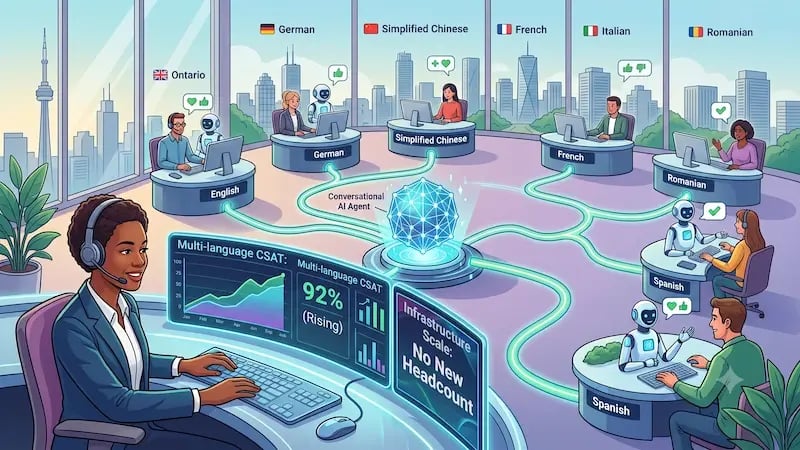
Today, forward-thinking enterprises are moving away from linear human hiring. Instead, they leverage modern autonomous customer service agents to deliver native-level troubleshooting simultaneously across seven global languages:
- English
- German
- Simplified Chinese
- French
- Italian
- Romanian
- Spanish
These enterprises are scaling up their infrastructure while keeping their headcounts completely flat.
The Multilingual Bottleneck: Why Traditional Localization Fails
Why does language choice matter so much to your bottom line? The reality is that language is a massive trust signal for modern buyers.
A study highlighted by IMARC Group shows that:
72.4% of consumers are much more likely to purchase a product if information is readily available in their own language,
while,
42% of consumers completely avoid products that do not offer localized options.
| Multilingual Customer Support Realities: |
|---|
| 72.4% More likely to buy if info is in native language |
| 42.0% Completely avoid products without local options |
| 3.2x Longer average wait time for non-English support |
When a non-English customer encounters a technical bug or a billing issue, they experience a significantly degraded service.
According to a benchmark report by Talkdesk,
The average wait time for non-English customer service is 3.2 times longer than for English-based support.
This long delay causes a,
Noticeable drop in customer satisfaction, dragging down overall CSAT scores by an average of 23%.
To fix this, many companies try using basic translation plugins on top of their existing help desks. But these tools usually fall flat. Why? Because there is a massive difference between raw translation and automated content localization.
-
Raw Translation is the direct conversion of words from one language to another. It misses the underlying context, strips away your specific brand voice, and regularly botches complex technical jargon.
-
Automated Content Localization is a process that understands the intent behind the words. It accounts for local colloquialisms, recognizes industry-specific terms, and dynamically adapts responses across German, French, and simplified Chinese.
When you rely on low-quality translation tools, your human agents have to step in to clean up the mess. They spend hours deciphering broken tickets, translating responses back and forth, and apologizing for misunderstandings. This high level of operational friction does more than just frustrate your customers; it destroys team morale.
The constant stress of managing siloed, multilingual support queues contributes heavily to a staggering 63% agent burnout rate across international contact centers.
From Basic Chatbots to Autonomous Customer Agents
To build a genuinely resilient framework for scaling support infrastructure, we have to look past the basic chatbots of the past decade. Traditional bots rely on rigid, pre-programmed decision trees. They can handle simple, predictable questions like "Where is my order?" or "How do I reset my password?"

However, the moment a customer asks a complex question, uses an unusual sentence structure, or mixes languages, the legacy bot breaks down. It gets stuck in a loop, forcing an angry customer to wait for a human representative.
An autonomous customer service agent is an advanced conversational AI engine that works in a completely different way from legacy bots. These agents do not rely on static scripts. Instead, these advanced conversational AI engines connect securely with your internal brand data to synthesize accurate, helpful answers on the fly.
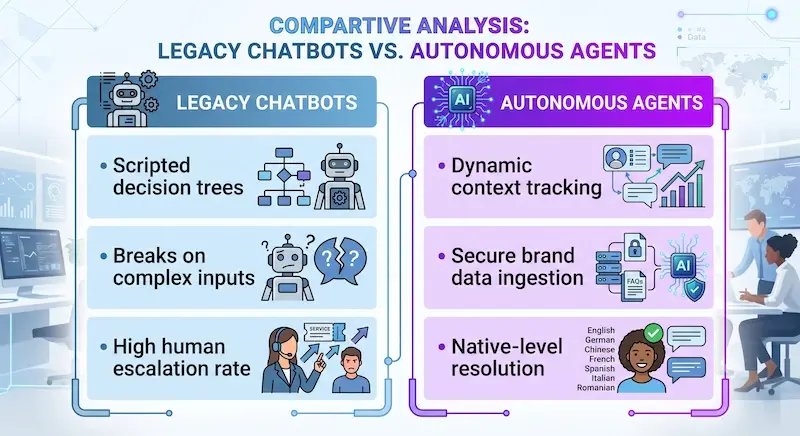 These autonomous customer service agents possess true situational awareness. This means they track historical context, remember past interactions, and understand the user's specific goals just like an experienced human expert.
According to data from Avaya,
70% of consumers now expect AI agents to demonstrate this type of situational awareness during troubleshooting conversations.
This technology stands out because it can handle deep technical troubleshooting across multiple languages simultaneously.
Imagine a SaaS company experiencing a minor database issue. An autonomous agent can simultaneously:
-
Walk a developer in Berlin through an API integration in flawless German.
-
Help an accountant in Rome adjust a complex billing issue in perfect Italian.
-
Guide a logistics manager in Shanghai through a system configuration in simplified Chinese.
The agent does not lose technical accuracy or mix up industry terms when switching between languages. Modern AI speech and text recognition engines support more than 100 languages.
More importantly,
The performance gap between English and non-English text processing has narrowed to a mere 4 percentage points.
This means your global customers get the exact same premium tier-1 and tier-2 support as your English-speaking users, without you having to build out localized operations in every country.
Achieving "Zero-Click" Resolutions at Global Scale
Because communication technology moves so fast, the traditional support ticket is quickly becoming obsolete. In our fast-paced global economy, modern customers reject asynchronous email queues. They do not want to fill out a long contact form, receive an automated confirmation message, and then wait 24 to 48 hours for a support representative to reply. They want answers immediately.
This shift in customer expectations has led to the rise of the "zero-click" resolution. A zero-click resolution is an outcome where a customer states their problem, and the automated platform resolves it instantly. No human agent needs to read the ticket, categorize it, or type a manual response.
This is not just a passing trend; it is what buyers now prefer. Research shows that
51% of consumers prefer interacting with automated bots over human agents when they need immediate answers to simple, direct inquiries.
They value speed and accuracy far more than human small talk.
How does a zero-click strategy work when you are managing an international business? Imagine a sudden software outage that affects users across Europe and Latin America simultaneously. Your system experiences a sudden rush of urgent support requests written in French, Romanian, and Spanish.
Instead of watching your help desk queue spiral out of control, your AI-driven infrastructure takes over. This infrastructure identifies the root cause of the issue, pulls the correct troubleshooting steps from your internal documentation, and resolves hundreds of incoming conversations natively and concurrently.
By removing human routing for these repetitive tier-1 and tier-2 issues, you can dramatically reduce the operational pressure on your core staff.
In fact, businesses that deploy autonomous agents lower their peak-season staffing strain by up to 68%.
Your core team stays calm and focused, your operating costs remain predictable, and your customers get answers in seconds.
Strategic Playbook: Implementing Multilingual AI Agents
Transitioning to an AI-driven, multilingual support system does not have to happen overnight. It requires a clear, practical approach to protect your brand reputation and ensure data security.
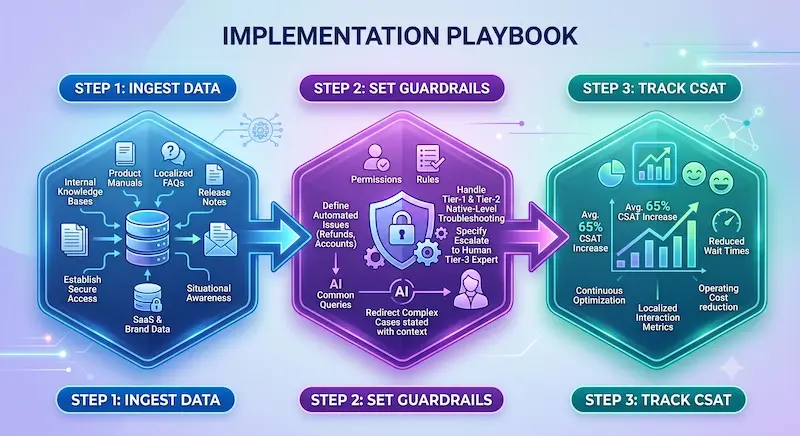
Phase 1: Safe Brand Data Ingestion
Your autonomous agents are only as smart as the information you give them. The first step is to establish secure, real-time access to your company's internal knowledge bases, product manuals, localized frequently asked questions (FAQs), and release notes. Modern service engines ingest this data safely, ensuring sensitive customer information remains private while providing the AI with the context it needs to solve problems accurately.
Phase 2: Defining Guardrails and Constraints
You must set clear, firm boundaries for your autonomous service engine. You need to define exactly which issues the AI can resolve on its own—such as processing refunds, updating accounts, or guiding users through basic product setups—and which issues require human intervention. If a customer is highly frustrated or has a highly complex, edge-case problem, the system should instantly hand the conversation over to a tier-3 human specialist, along with a complete summary of the chat so the customer never has to repeat themselves.
Phase 3: Continuous Optimization via CSAT
Once your system is live, you need to track interaction-level metrics across all seven supported languages. Look closely at your customer satisfaction scores for each specific language region.
Because AI-driven systems eliminate long wait times,
Companies that adopt automated customer service tools see an average 65% increase in their overall CSAT scores.
The financial return on this strategy is clear and immediate.
By automating repetitive tasks and streamlining workflows, businesses that prioritize these modern customer experience strategies,
Reduce their overall customer support operating costs by 20% to 30%, while continuing to grow their top-line revenue.
When the bottom line shows you're increasing revenue and customer scores while not overspending, it's hard not to see the value in adding multilingual customer AI support agents.
Support Without Payroll
Expanding your company into international markets does not mean you have to drastically increase your corporate payroll. Successfully scaling support infrastructure across English, German, simplified Chinese, French, Italian, Romanian, and Spanish is fully achievable today through autonomous customer service agents. These platforms deliver fast, native-level troubleshooting at a fraction of the cost of traditional contact centers.
The brands that lead the global market are those that remove friction from the customer journey before it hurts retention. If you want to keep your international customers happy, you need to provide immediate, high-quality answers in their preferred languages.
To navigate this digital shift successfully, your business needs a strategic partner who knows how to combine advanced AI execution with a strong, multilingual digital strategy. Aspiration Marketing helps global organizations deploy sophisticated conversational AI engines, optimize localized content workflows, and scale international support infrastructure safely and predictably.
If you're ready to transform your global customer experience and implement efficient, zero-click service resolutions, connect with the expert team at Aspiration Marketing today.






Leave a Comment
Have thoughts on this article?
Share your feedback, ask questions, or join the discussion with our community.