





If you've ever spent more than ten minutes arguing with a chatbot that simply couldn't understand a basic request, know that you're not alone. Most of us have felt that specific brand of digital frustration. We ask about a billing discrepancy, and the bot replies with a link to a generic FAQ page on changing a password. It feels like talking to a brick wall that has been painted to look like a friendly robot.
Customers don't want a bot that sounds "human" and feels. They want one that functions.
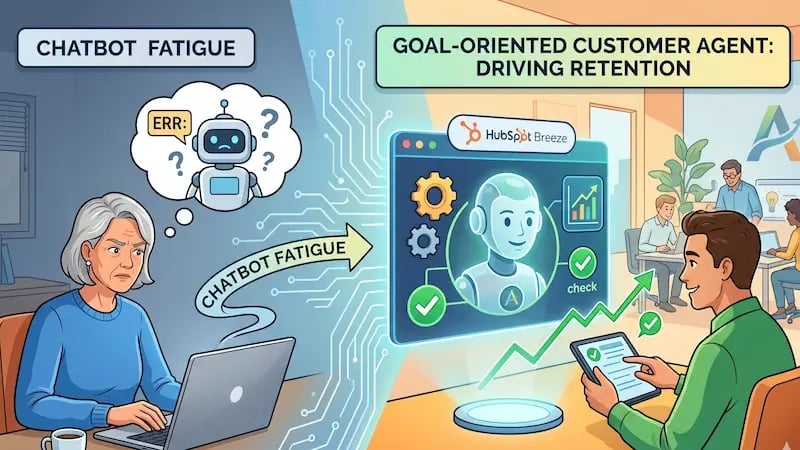 In the world of business, this is more than just a minor annoyance. It is a major threat to your bottom line. When customers feel ignored or misunderstood, they don't just get annoyed; they leave.
In fact,
Recent data shows that 73% of consumers will switch to a competitor after multiple bad service experiences.
In an era where switching costs are lower than ever, can your business afford to lose nearly three-quarters of its customer base over preventable service friction?
This is why we are seeing a massive shift in the industry. The era of the "basic chatbot" is ending. We are now entering the age of goal-oriented customer agents. But what does that actually mean for your team? And how can these tools turn your support department into a retention engine?
What Exactly Is a Goal-Oriented Customer Agent?
To understand the future, we have to look at the past. Traditional chatbots are reactive. They work on "if/then" logic. If a user types the word "shipping," the bot shows shipping info. They are essentially search bars with a personality.
A goal-oriented customer agent is an advanced AI system designed to understand user intent and perform actions to resolve issues, rather than simply matching keywords to provide information. Instead of just matching keywords, these agents understand intent. They don't just "talk"; they "do." While a chatbot might tell you how to find your tracking number, a goal-oriented customer agent will look up the number, check the carrier's status, and proactively offer to start a claim if the package is delayed.
Think of it this way:
-
Chatbots are like a library catalog. They tell you where the information is.
-
Goal-Oriented Agents are like a research assistant. They go get the information and summarize it for you.
Research suggests that,
These agents can improve customer satisfaction by up to 120% compared to traditional scripted bots.
This is because goal-oriented customer agents focus on the "reasoning" aspect of a conversation. They use Large Language Models (LLMs) to decide the best path toward a specific resolution, rather than following a rigid, pre-written script.
Why Goal-Oriented Agents Are Essential for Retention
Retention is built on trust, and trust is built on reliability. If a customer knows that every time they have a problem, it will be solved quickly and correctly, they have no reason to look elsewhere.
Speed is the Ultimate Currency
In customer service, speed is not just a "nice to have." It is the primary driver of loyalty.
88% of executives now believe that automated systems designed for quick resolutions significantly boost user loyalty.
When a goal-oriented agent handles a query, the resolution is nearly instant. There is no waiting for a human to finish another call or a "we will get back to you in 24 hours" email.
Scaling Without Losing the Human Touch
The biggest fear for many leaders is that AI will make their brand feel "cold." However, the opposite is often true. By using AI to handle the repetitive, "low-value" tasks, your human agents are freed up to handle the high-emotion, complex cases that truly require empathy.
Organizations using AI for support have reported a 31.5% boost in customer satisfaction scores.
Ask yourself: If your support team could reclaim 20% of their day from answering "Where is my order?" or "How do I update my credit card?", what high-impact retention strategies could they finally execute? They could spend that time on proactive outreach, customer success calls, or building better onboarding materials.
How HubSpot's Breeze Customer Agent Changes the Game
One of the most exciting developments in this space is the HubSpot Breeze customer agent. It is specifically designed to move beyond the limitations of old-school bots. But what makes it a goal-oriented agent rather than just another window on a website?

Native Integration and the "Single Source of Truth"
An AI agent is only as smart as the data it can access. Most chatbots fail because they are siloed. They don't know what the customer bought last week or if they have an open ticket in another department.
The Breeze customer agent lives directly inside your HubSpot CRM. It has access to the full context of the customer journey. It knows their name, their purchase history, and their previous interactions. This allows it to provide "expert-level" answers. It isn't just guessing; it is looking at the facts.
From Conversation to Action
As we mentioned earlier, the "goal" in "goal-oriented" is about completion. The Breeze agent can be trained on your specific Knowledge Base to answer complex B2B questions. It can also perform actions. This shift radically reduces ticket volume.
In fact,
Modern AI agents are now capable of resolving up to 75% of inquiries without any human intervention.
The Human-in-the-Loop Safeguard
The best AI systems are not designed to replace humans entirely. They are designed to collaborate. The Breeze agent knows its limits. If a customer starts expressing high levels of frustration or asks a question outside its training, it can perform a warm handoff to a human agent. The human gets a full transcript of what has already happened, so the customer doesn't have to repeat themselves—one of the biggest pain points in service.
Strategic Implementation: How to Deploy for Success
If you are ready to move toward a goal-oriented model, you cannot just "turn it on" and walk away. It requires a strategy focused on Answer Engine Optimization (AEO). Answer Engine Optimization (AEO) is the practice of structuring your content so that AI models (like Breeze or even Google's Search Generative Experience) can easily find and use your information to answer user questions.
Architect Your Knowledge Base
Your AI agent is only as good as its training data. You need to treat your Knowledge Base as the "brain" of your agent.
-
Use clear, concise language.
-
Structure articles with clear headings (H2s and H3s).
-
Use bullet points to list steps in a process. This makes it much easier for a goal-oriented agent to parse the information and deliver a direct answer to the user.
Define Your Success Metrics
Don't just measure "number of chats." Measure "Goal Completion Rate."
-
Did the user get their answer?
-
Did they need to open a follow-up ticket?
-
Did they rate the interaction as helpful? By setting specific KPIs, such as "Reduce Tier 1 ticket volume by 40%," you can objectively see the ROI of your AI investment.
Maintain Your Brand Voice
Just because it is a machine doesn't mean it should sound like one.
64% of consumers say they are more likely to trust AI if it exhibits human-like traits such as friendliness and empathy.
You can "tune" your goal-oriented agent to use the same language, tone, and professional warmth as your human team.
The Future of Frictionless Service
The move toward goal-oriented agents is a win for everyone. Customers get their problems solved instantly. Support teams get to focus on meaningful work. Businesses see higher retention rates and lower operational costs.
In the B2B world, the stakes are even higher. Your customers aren't just buying a product; they are buying a partnership. If your support experience is clunky and outdated, it sends a message that you aren't invested in their success. On the other hand, providing a seamless, AI-powered support experience shows that you value their time.
We are moving into a world where "self-service" doesn't mean "figure it out yourself." It means "we have provided a smart agent to help you get it done immediately." That is the hallmark of a modern, customer-centric brand.
Final Thoughts on Retention
Retention is often described as a "leaky bucket" problem. You can keep pouring new leads into the top, but if there are holes in the bottom, you will never grow. Poor customer service is the biggest hole in most buckets.
Goal-oriented agents are the "sealant." They provide fast, accurate, and helpful service that keeps customers from looking for an exit. They transform the support experience from a cost center into a value driver.
If you are looking to stay ahead in the competitive B2B landscape, the question isn't whether you should use AI. The question is how quickly you can move beyond simple chatbots and start delivering true, goal-oriented service. Your customers are waiting.
How to Get Started
Transitioning to this new model can feel overwhelming. Where do you start? How do you ensure your data is ready? This is where expert guidance makes all the difference.
At Aspiration Marketing, we specialize in helping businesses navigate this transition. We don't just help you install a bot. We help you architect the "Single Source of Truth" within your CRM, ensuring your private AI models are trained on accurate, high-quality data. From setting up the HubSpot Breeze customer agent to optimizing your entire Knowledge Base for AEO, we ensure your AI doesn't just talk—it performs.
The goal of customer service has always been the same: to help the customer. Now, we finally have the tools to do that at scale, with precision and a touch of personality. By deploying goal-oriented customer agents, you aren't just following a trend; you are building a foundation for long-term growth and customer loyalty.
Let’s move beyond the chatbot together and build something that truly works for your customers.





Leave a Comment
Have thoughts on this article?
Share your feedback, ask questions, or join the discussion with our community.