





Why do enterprise marketing teams spend thousands of dollars producing elite, one-hour webinars only for them to sit on a server, collecting digital dust? You know the cycle. Your team conducts deep research, books internal subject matter experts, coordinates production, and hosts a live session. The event goes well, and a few hundred people watch.
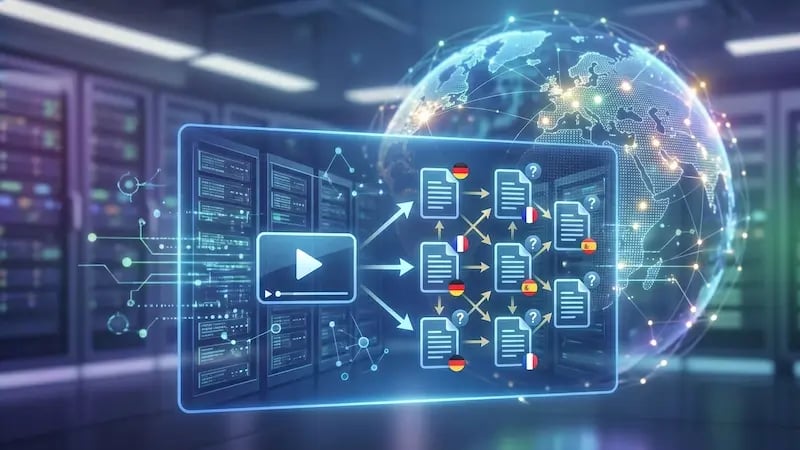 Then what? The recording gets buried in an archive or uploaded to a YouTube channel that receives minimal traffic.
According to Wistia/HubSpot, while 91% of businesses now use video as a core marketing strategy, data reveals that almost 90% of teams try to reuse webinar content, yet many struggle to extract long-tail value beyond simple social media clips.
It is a massive waste of proprietary data, intellectual property, and expert insight.
At the same time, the ground beneath the marketing landscape is shifting. Traditional Search Engine Optimization (SEO) is no longer the sole gatekeeper of digital traffic. We are in the era of AI, where Answer Engine Optimization (AEO) is the process of optimizing content to be found, understood, and served as direct answers by AI-powered search engines and large language models (LLMs). Users no longer just type keywords into search boxes; they ask complex questions to services like ChatGPT, Claude, Gemini, and Perplexity.
How deep is the impact of AI on your existing content visibility?
Recent behavioral studies from Shiwaforce show that the introduction of AI-powered search overviews and direct answers reduces average traditional click-through rates (CTR) by roughly 15.5%, with non-branded informational queries dropping by as much as 20%.
This data highlights that the metric of success has fundamentally shifted from traditional clicks to secure placement inside AI-generated summaries.
So, how do you bridge the gap? How do you turn a single, high-value enterprise video asset into a continuous engine for global AI discovery? The solution lies in building an automated, multi-lingual, deeply linked AEO blog cluster. By converting your video assets into structured, machine-readable text, you ensure that AI bots crawl, understand, and cite your brand as the definitive source of truth.
Let us break down the exact technical workflow to turn your video webinars into a global AEO blog cluster.
Step 1: Ingesting & Transcribing the Video Matrix
How do you transform a passive video file into a highly machine-readable text asset that AI bots love? It all starts with capturing the ground truth of your video through high-fidelity transcription. You cannot build a search-optimized or AI-optimized content engine on a flawed foundation.
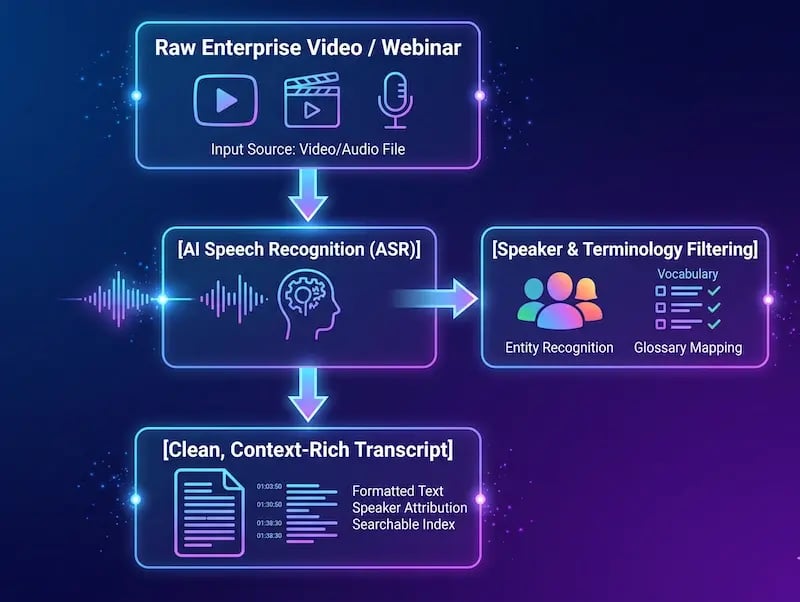 The first phase of the workflow requires advanced automated speech recognition (ASR) engines. While basic, out-of-the-box transcription tools can capture general speech, enterprise videos often contain highly technical jargon, specific product names, and unique industry acronyms. Standard tools frequently misinterpret these terms, leading to messy text files that confuse both human readers and AI crawlers.
To prevent these errors, your technical workflow must pass the raw audio through a specialized transcription layer that incorporates contextual guardrails. Before running the transcription, feed the AI engine a localized dictionary.
This includes:
-
Detailed speaker profiles to ensure proper attribution.
-
Enterprise product glossaries and trademarked names.
-
Industry-specific technical acronyms.
-
A list of common competitor names mentioned during the session.
By applying these custom guardrails, you eliminate AI hallucinations and transcription errors right from the start.
According to Zoom, over 52% of B2B marketers consider webinars the most effective way to distribute thought leadership, making these transcripts an unmatched source of original enterprise insights and first-party data.
Once the ASR engine completes its pass, the workflow should auto-generate a clean, timestamped transcript. This file serves as the raw material for your entire content cluster. It holds all the unique data points, case studies, and expert quotes necessary to build authoritative articles.
Step 2: The Core Pillar – Drafting the "Answer-First" Blueprint
Why do standard blog formats fail miserably in the age of AI search? The answer is simple: traditional blog posts are built for human skimming, but they often lack the explicit, structured data blocks that language models look for when answering user queries. To capture real estate in AI overviews, you must rethink your content architecture from the ground up.
What is an Answer-First Blog Format?
An answer-first blog format is a content structure that provides direct, explicit answers to specific user questions immediately beneath headings, before expanding into deeper contextual analysis. This layout allows AI search bots to easily pull quotes and credit your site. This is what writing content for LLMs entails.
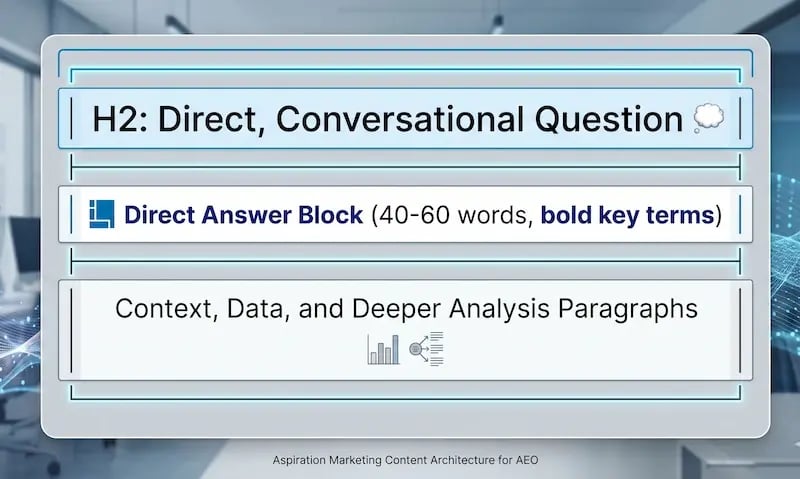 When you construct the main pillar article of your cluster, you must follow the "Inverted Pyramid" strategy. Instead of writing long, narrative introductions that bury the main point, your text should address high-intent user queries instantly.
Studies from Evergreen Media show that 40% to 61% of Google AI Overviews pull their information directly from lists, bullet points, or heavily structured text blocks.
To optimize the pillar blog for repurposing enterprise video, structure your writing using this repeatable framework:
-
Write all primary H2 headings as direct, conversational questions that a customer would type into an AI assistant.
-
Provide an explicit, absolute answer of 40 to 60 words immediately beneath each header. Bold the primary terms within this block.
-
Follow this direct answer block with your supporting data, graphics, and deep-dive commentary extracted from the webinar transcript.
Highly structured content utilizing this exact answer-first layout is up to 3x more likely to be cited by LLMs like ChatGPT and Perplexity.
By formatting your core pillar blog this way, you make it incredibly easy for answer engines to scrape your content, recognize its authority, and link back to your enterprise domain as the source.
Step 3: Spinning the Web – Engineering the Multi-Lingual Cluster
How do you scale a single webinar into a broad web of topical authority that spans multiple countries and languages? You do this by breaking the main presentation into focused subtopics and creating a highly organized digital cluster.
 A one-hour webinar usually covers several distinct concepts. For example, a video about cloud migration might cover:
-
Security
-
Cost Management
-
Performance Optimization
-
Team Training.
Instead of packing all these points into a single massive article, you should spin the video into a central pillar blog post and four to six targeted subtopic articles.
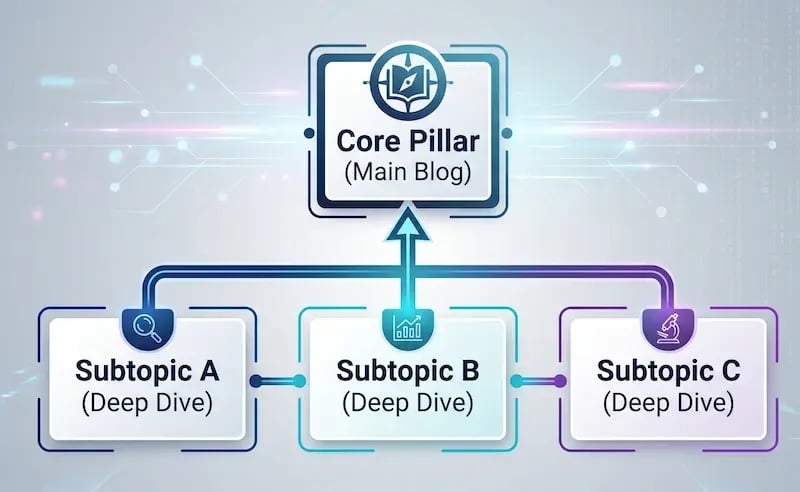 This method turns spoken-word nuggets into long-form written authority. Each subtopic article focuses in depth on a single keyword string. To maximize search visibility, the workflow must set up automated, contextual interlinking between all pieces in the cluster. Every subtopic article must contain a link pointing back to the main pillar blog using clear, semantic anchor text. At the same time, the pillar blog should link to each subtopic article.
This internal linking structure does two things:
-
It helps human readers navigate your deep-dive content easily.
-
It establishes a clear, semantic map that tells Google's Knowledge Graph and AI web crawlers exactly how your content pieces relate to one another.
Once the English cluster is finalized, the workflow moves to global scaling. You cannot rely on basic, word-for-word machine translation if you want to rank well internationally. Instead, use fine-tuned AI translation workflows that preserve your unique enterprise brand voice guidelines across languages.
When you translate the web cluster into target languages such as German, Spanish, or French, ensure the system adjusts for localized phrasing, idioms, and industry terms. Every international variant should feature correct localized metadata and hreflang tagging. This ensures your brand builds a highly visible, native digital footprint that aligns perfectly with global query habits.
Step 4: The Technical AEO Optimization Checklist
Can AI bots easily read and parse your blog posts without hitting technical roadblocks? Producing high-quality content is only half the battle. If an AI crawler cannot access, render, or interpret your website's underlying code, your content will never show up as a cited answer.
Only Google Gemini can effectively render complex client-side JavaScript on the fly; alternative AI crawlers like GPTBot (OpenAI) and ClaudeBot (Anthropic) require clean, server-side-rendered, structured environments to efficiently scrape text. If your enterprise blog relies heavily on heavy JavaScript elements that load slowly, AI bots will simply skip your page and pull information from a competitor.
To verify your site is fully machine-readable, your technical deployment team must follow this AEO checklist:
The Technical AEO Stack
- Server-Side Rendering (SSR): Deliver clean HTML directly to crawlers so they do not have to wait for JavaScript to execute.
- Semantic HTML Elements: Use clear tags like <article>, <header>, <section>, and <aside> to give bots an immediate understanding of your page layout.
- Structured Data Injection: Automatically inject comprehensive JSON-LD schema markup into the header of every blog post.
According to The Real Social Company's AEO benchmarks,
Adding structured FAQ, HowTo, and Article schema tags yields an average 50% increase in AI snippet and assistant search appearances.
This structured code acts as a direct translator for AI bots, presenting your data in a standardized format they can digest instantly.
Additionally, do not overlook multi-modal assets. Webinars are highly visual, filled with slide decks, charts, and diagrams. When you embed these images into your blog cluster, include context-rich, descriptive alt text. If you embed the video recording directly into the post, use explicit video schema with accurate timestamp markers. This allows AI search engines to see, index, and pull direct answers from your visual media assets just as easily as they do from your text.
Summarizing the Complete Workflow
To help your team execute this strategy consistently, look at how the entire system functions from start to finish:
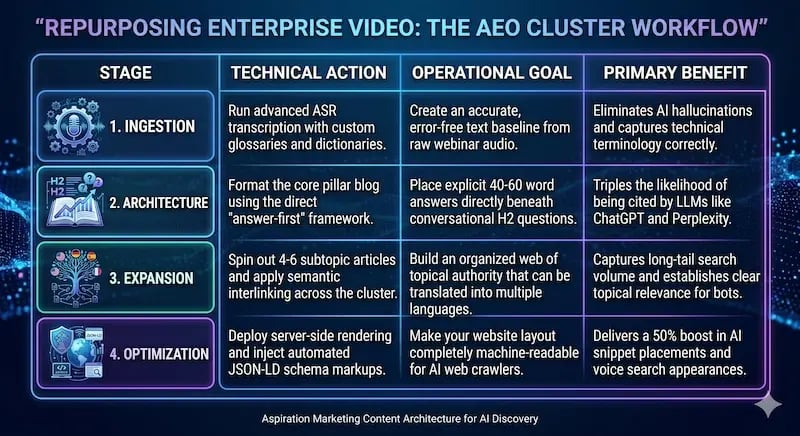
The Future of Enterprise Video
Transitioning from traditional video repurposing to engineering AI-ready digital ecosystems is no longer just an optional growth hack.
It is a baseline requirement for enterprise survival in an era where up to 60% of searches result in zero clicks on traditional web links.
If your content is not structured for quick extraction, your brand will simply disappear from the AI search landscapes where your buyers spend their time.
Enterprise marketing leaders do not need to hire more content writers to solve this challenge. Instead, they need an automated content architecture that maps their existing video expertise directly to how AI answer bots scan the web. It is about working smarter with the valuable assets you already own, maximizing your reach, and securing your place as a trusted industry authority.
Are you ready to stop letting your high-value video assets go to waste? To seamlessly implement this technical workflow, deploy custom brand voice masters, and ensure your entire digital presence is fully machine-readable, discover how the growth experts at Aspiration Marketing can design and execute your global AEO cluster strategy. Let us help you transform your enterprise video content into a powerful, automated engine for global AI discovery.




Leave a Comment
Have thoughts on this article?
Share your feedback, ask questions, or join the discussion with our community.