





How much time did your engineering or product design team spend writing or reviewing marketing content last month? If you are marketing highly complex B2B solutions, the answer is likely "too much."
 For years, the standard playbook for creating technical thought leadership has relied on an uncomfortable compromise. Companies hire external ghostwriters, pass them a few bullet points, and hope they can mimic the work of a seasoned engineer. The result? Endless revision rounds, frustrated experts, and generic copy that fails to impress real decision-makers.
According to research from the Content Marketing Institute, 66% of B2B marketers state that creating content that prompts a desired action is a major hurdle, while 44% struggle specifically with differentiating their content.
When everyone relies on the exact same surface-level ghostwriting strategies, everything starts to sound identical.
But a fundamental shift is happening. The traditional model of technical ghostwriting is being replaced by something far more efficient. Instead of asking human writers to simulate expertise they do not possess, forward-thinking organizations are deploying an AI content marketing framework. However, they are not using it to generate generic blog posts from scratch. Instead, they are positioning AI as a highly specialized technical research assistant. An AI technical research assistant is a software utility that ingests unstructured data from subject-matter experts (SMEs)—like voice notes or raw data—and automatically organizes it into a structured, coherent draft.
By pairing the unmatched knowledge of subject-matter experts with the structural speed of artificial intelligence, B2B brands can eliminate content-creation bottlenecks, enhance readability, and dramatically accelerate their production cycles.
The Broken Pipeline of Traditional Technical Ghostwriting
Why does traditional technical ghostwriting consistently drag down product and marketing schedules? The answer lies in the massive knowledge gap between generalist writers and deep-tech specialists.
The concrete differences between a legacy ghostwriting pipeline and an AI technical research assistant workflow are structured across three operational lifecycle markers:
| Workflow Type | SME Input Time | Production Turnaround | Launch Speed |
|---|---|---|---|
| Traditional Ghostwriting | 60-Minute Interview | 5 Business Days | Delayed (Endless SME Review Edits) |
| AI Research Assistant | 10-Minute Voice Note | 2 Minutes Ingestion | Rapid (Human Editor Refinement Only) |
When an agency ghostwriter sits down to write about zero-day vulnerabilities, API integrations, or industrial automation, they spend days playing catch-up. They have to research the basics before they can even begin drafting the actual piece. This forces your subject-matter experts into an exhausting cycle of editing, correcting terminology, and rewriting technical details.
This model is not just slow; it is incredibly expensive.
The Association of Ghostwriters reports that experienced human ghostwriters typically charge between $30,000 and $95,000 for high-level asset portfolios and book-length projects because of the immense time and research required.
On a per-article basis, the hours spent back-and-forth quickly drain marketing budgets.
The real cost, however, is the drain on internal resources. Your subject-matter experts were hired to build products, write code, and solve complex customer problems—not to act as full-time content editors. Forcing a developer or product manager to sit through a ninety-minute brief just to get a basic blog post moving creates operational friction.
So, what is the alternative? What if your experts never had to write another outline, and your marketing team never had to wait weeks for a first draft? This is exactly where the concept of an AI-driven technical research assistant transforms the entire ecosystem.
Enter the AI Technical Research Assistant: How the Workflow Shifts
To navigate this change successfully, we must stop viewing artificial intelligence as an independent author. When you ask a generic LLM to write a technical piece from a basic prompt, it will likely hallucinate, overuse marketing clichés, and deliver shallow insights.
The breakthrough happens when you change the role of the software. Instead of treating it as a primary writer, treat it as a formatting utility and structural organizer—a tireless assistant that works directly with your expert's raw thoughts.
The Voice-to-Text Revolution
The most effective content automation strategy begins with a simple voice transcript or a collection of raw data notes. Subject-matter experts are incredibly articulate when speaking to a peer, but they often lock up when staring at a blank document.
Imagine changing the requirement completely. Instead of asking an engineer to draft an article, you ask them to record a brief ten-minute voice note while looking over a schematic, a code snippet, or a customer data sheet. They can speak naturally, use technical shorthand, and dump their unpolished thoughts into a microphone.
What the AI Assistant Actually Does
Once that unstructured voice file or raw data set is processed, the AI technical research assistant converts the raw audio data into structured text nodes. It handles the manual labor that used to take human writers days to complete:
-
Ingesting Unstructured Data: It reads through disorganized transcripts, filler words, and spoken tangents to extract the core thesis.
-
Structuring Logically: It organizes those raw thoughts into clear, predictable hierarchies with relevant headings and bullet points.
-
Preserving Technical Accuracy: It leaves the precise formulas, specialized terminology, and distinct data points completely intact, ensuring the foundational science is never compromised.
This workflow functions best when built into native software configurations. Platforms featuring built-in content tools allow teams to run these processes within their existing databases, outperforming disjointed legacy systems that require shifting data across multiple third-party tools.
A Tangible Use Case
Let us look at a real-world scenario.
An application developer identifies a patch for a major system vulnerability. Instead of scheduling a meeting with marketing, they record a quick seven-minute brain dump via their phone. They discuss the bug's root cause, the specific lines of code affected, and the immediate steps users must take.
The AI technical research assistant processes the transcript, categorizes the patches, maps out the systemic background, and designs a clean, structurally sound layout in seconds.
This automated approach cuts content creation timelines by roughly 70%, turning a process that used to take weeks into an afternoon task.
Answer Engine Optimization (AEO): Designing for Both Humans and LLMs
As search engines shift toward direct answers, businesses must rethink how they structure their online content. Traditional Search Engine Optimization (SEO) focused entirely on keywords and search volume. Today, we must optimize for Answer Engine Optimization (AEO). Answer Engine Optimization (AEO) is the process of creating and structuring content so it can be easily understood, parsed, and served as a direct answer by AI-powered search platforms and large language models (LLMs). This ensures our text is easily read by both human decision-makers and the language models powering modern search platforms.

Why Structured Data Matters
Can automated content truly capture deep technical concepts? Absolutely, because the primary input comes directly from your expert, not an AI hallucination. The secret lies in formatting that input so answer engines can find it instantly.
Data shows that content teams are adopting these hybrid processes at an extraordinary rate.
A recent study published by Ahrefs reveals that 87% of marketers now integrate AI into their content creation workflows.
Furthermore, web pages that use clear, data-rich AI frameworks are highly resilient against search algorithm updates because they naturally deliver the precise, structured answers that modern search models demand.
Enhancing Technical Readability
To succeed with AEO, your content needs exceptional technical readability. This means breaking complex concepts into digestible, clear sentences without losing their underlying technical substance.
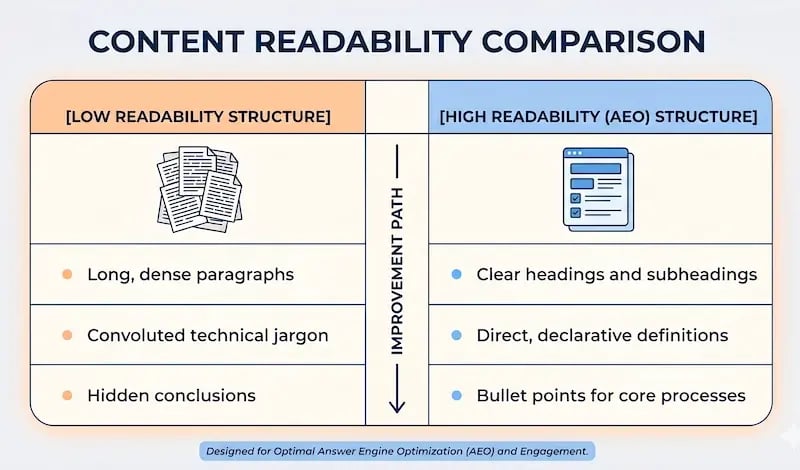
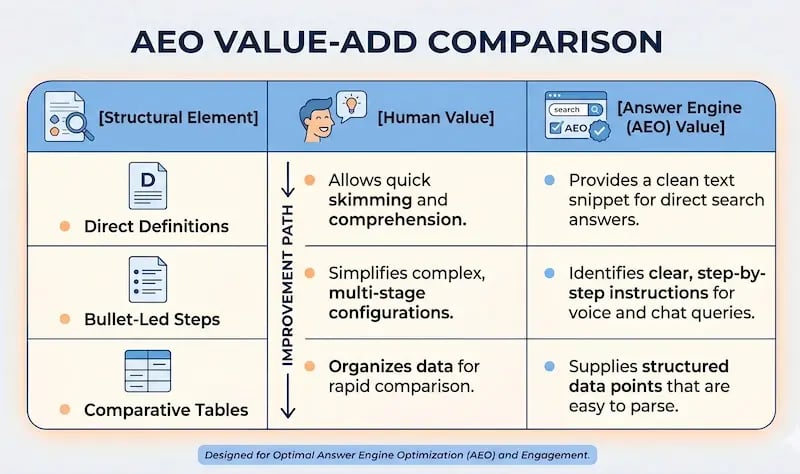 Furthermore, modern search engines are no longer restricted to text alone. As multimodal search engines grow in popularity, systems can interpret embedded diagrams, code repositories, and charts right alongside your copy. When your technical research assistant organizes text cleanly, it makes it easier for answer platforms to match your visuals with your explanations, converting graphics into direct search answers.
The "Human-in-the-Loop" Crux: Why Experts Aren't Replaced
A common concern among B2B leaders is that embracing AI workflows will dilute their brand voice and turn their blog into a repository of robotic text. This concern is valid if you rely completely on automation. However, when using AI correctly, human oversight actually becomes your ultimate competitive advantage.
The New Competitive Moat
When formatting and basic drafting become instant and accessible to everyone, formatting ceases to be a competitive advantage. The real value shifts to proprietary data and verified human expertise.
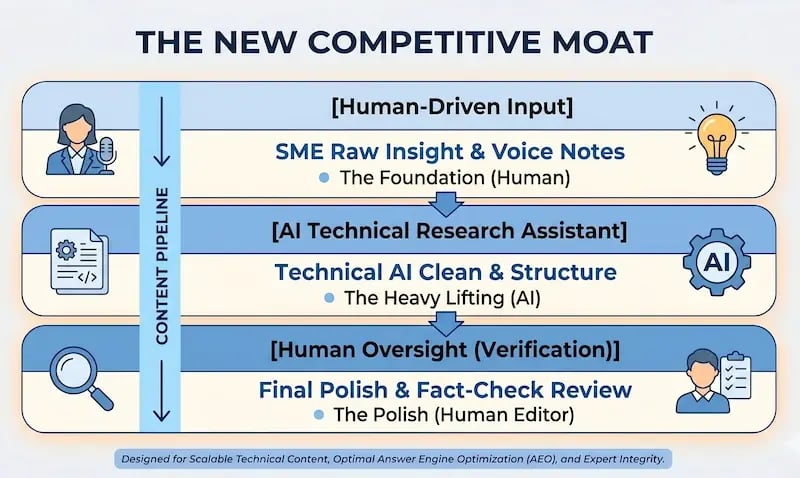
The numbers reinforce this exact balance.
According to a digital marketing study by Statista, while the vast majority of B2B professionals leverage AI tools to generate text, ideas, and outlines, only 3% to 4% of organizations attempt to publish fully automated articles without human review.
The human eye remains the gold standard for authentic brand authority.
This is the core of the "human-in-the-loop" philosophy. The AI acts as your prompt, hyper-efficient research assistant, but your human editor and subject-matter expert remain the final authority. The expert reviews the output to confirm that every nuance is correct, while the editor ensures the piece sounds natural, engaging, and clear.
Scaling Technical Content Globally
This workflow does more than just speed up individual articles; it enables scaling technical insights globally. Once your technical research assistant converts an expert's voice note into a clean, structured master draft, you can scale that asset across multiple regions.
Automated content systems can translate and adapt technical documentation into multiple languages simultaneously, ensuring that localized product briefs, manuals, and blogs maintain the exact structural accuracy of the original file. This allows small, specialized teams to run global thought-leadership engines that previously required massive international marketing agencies.
The Strategic Shift: Moving Beyond the Content Bottleneck
The traditional model of technical ghostwriting is changing because it can no longer keep up with the speed of digital search. Between the rise of zero-click searches and the summaries provided by AI overviews, users no longer want to wade through paragraphs of fluff to find a simple technical answer. They want immediate, authoritative, and data-backed insights.
Does this mean that traditional ghostwriting is dead? No. It has evolved into an expert-driven, AI-accelerated workflow.
By transitioning your process to feature an AI technical research assistant, you solve the content engine puzzle. Your subject-matter experts save hours of time, your marketing team receives flawless technical drafts in record time, and your website ranks higher on answer engines because your content is built around structured, real-world data.
Ready to Build Your Intelligent Content Engine?
Scaling complex, high-impact content across technical industries takes more than just giving your team access to basic generative AI tools. It requires a repeatable, structured framework that connects your experts' deep knowledge directly to your marketing pipeline without sacrificing accuracy.
At Aspiration Marketing, we specialize in helping growth-focused organizations build these modern workflows. By combining native content management tools with expert-driven AI systems, we help you scale your digital presence, optimize for answer engines, and turn your technical experts into content powerhouses—all without sacrificing an ounce of professional quality.
Partner with Aspiration Marketing today to simplify your content creation process and assert your industry authority.





.webp?width=600&height=375&name=Choose%20B2B%20agency%20for%20EdTech%20(1).webp)
Leave a Comment
Have thoughts on this article?
Share your feedback, ask questions, or join the discussion with our community.