



Are you measuring the success of your customer service team by how fast they say hello, or by whether they actually solve the problem?
For decades, customer experience (CX) leaders relied on a trusted playbook of traditional operational metrics. We tracked First Response Time (FRT) and Average Handle Time (AHT) as if they were the sole indicators of support health. We celebrated when a call center agent answered a ticket in seconds, assuming speed equaled satisfaction.
 But the modern support floor has fundamentally changed. Artificial intelligence now handles thousands of customer conversations simultaneously, delivering responses in milliseconds. In this new landscape, instant replies are no longer a competitive advantage—they are the baseline expectation.
Because of this shift, legacy speed metrics are losing their meaning. If an AI agent replies instantly but fails to resolve the underlying issue, your response metrics look spectacular on an executive dashboard, but your customer retention drops silently in the background. Speed without resolution is simply automated frustration.
To prove true AI customer service ROI, enterprise leaders must look past superficial speed and containment numbers. This deep dive breaks down the four outcome-focused retention metrics that matter most when evaluating your AI deployment, backed by verified industry data, to give you a clear roadmap for your support floor.
1. True AI Deflection Rate vs. The Automation Loop
When a customer closes a chat window with an AI agent, what actually happens? Did they walk away with a clean, verified solution, or did they simply give up out of pure exhaustion?
Traditional help desk platforms track a metric called "containment." This metric simply counts the number of users who started an interaction with an AI bot and did not manually click a button to request a human agent during that session.
However, containment is often a vanity metric that masks severe, underlying customer friction. If a customer gets trapped in a circular conversational loop with an unhelpful bot, closes the browser window in anger, and sends a frustrated email to your support queue two hours later, a basic tracking system still marks the initial chat as successfully contained. Your reports show a triumph for automation, while your customer database records a massive hit to consumer loyalty.
This gap isn't just an assumption; the numbers back it up.
Data from the Qualtrics Consumer Experience Trends Report reveals that
Nearly 1 in 5 consumers report getting zero benefit from their AI customer service experiences—an operational failure rate four times higher than AI applications in any other corporate department.
Compounding this issue,
Broader industry research shows that 56% of dissatisfied customers choose not to actively complain or trigger an escalation flag in the chat interface.
Instead, they fall into a state of "passive defeat"—they abandon the system entirely, walking away silently while your software logs a false victory.
To measure real financial return, you must pivot from basic containment to a True AI Deflection Rate. True deflection means the AI understood the customer's intent, provided an accurate answer, and completely resolved the issue, removing the need for any follow-up contact across any of your communication channels.
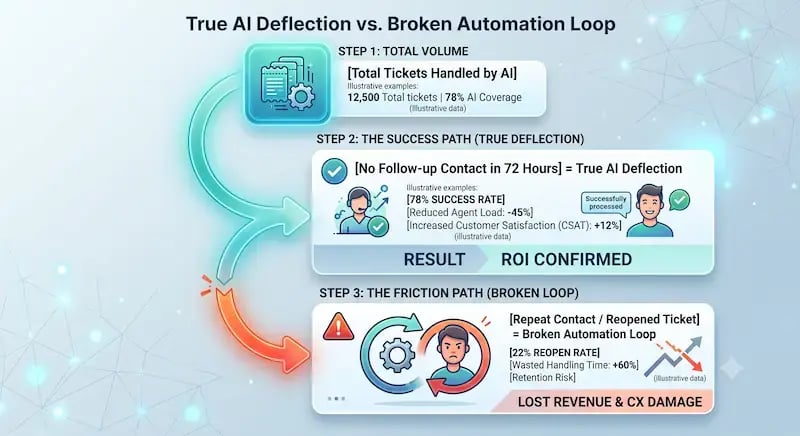
To measure this accurately, your operations team must establish strict time-based tracking windows. Industry leaders examine 24-, 48-, and 72-hour repeat-contact rates. If a customer interacts with your AI and does not open a new ticket, initiate another chat, or call your phone line within that designated timeframe, you have achieved a true deflection.
According to data published by Zendesk,
Well-implemented AI platforms can achieve 70% to 90% First Contact Resolution (FCR) in autonomous interactions.
If your autonomous resolution rate is below 60%, it is a clear indicator that your AI is providing words rather than actual resolutions.
To clean up your data, you should actively track your reopen rates following automated closures. If a specific AI workflow shows a high closure rate but an equally high reopen rate within 48 hours, your automation is likely frustrating your users rather than helping them. This structural gap isn't just an assumption; it is an active operational leak.
Data from Zendesk indicates that,
Nearly 60% of consumers say their primary grievance with AI support tools is the repetitive loop of having to explain their issue all over again when an automated resolution fails.
When your system logs a fast "closure" but forces the customer to reopen the interaction shortly after, the AI has not saved your team money—it has simply deferred a more expensive, more frustrated human intervention.

To protect long-term customer retention, these rapid reopen rates must be monitored as immediate indicators of broken conversational logic rather than successful automated containment. True retention relies on identifying these broken paths, auditing the conversational transcripts, and refining the AI's logic to close the gap.
2. Cost Per Resolution (CPR) Reduction and Pricing Shifts
How much does it cost your business to solve a single customer problem? This is the core question behind AI customer service ROI, yet many organizations struggle to answer it accurately because they look at support costs through an outdated lens.
Historically, customer service was viewed strictly as a cost center. Managers focused heavily on reducing headcount, squeezing vendor contracts, or lowering software licensing fees. However, calculating the return on investment for modern AI tools requires examining the Cost Per Resolution (CPR).
To calculate your true CPR, take the total cost of ownership (TCO) of your AI platform—including setup fees, API usage, internal maintenance hours, and subscription costs—and divide it by the number of verified independent resolutions. Then, compare this number to the fully burdened cost of a human agent resolving those same issues.
A human agent handling an issue carries a high per-ticket cost due to labor, benefits, real estate, management overhead, and training time. When an AI agent autonomously resolves routine tasks such as tracking orders, processing basic refunds, or updating account details, the cost drops dramatically.
| Support Vector | Average Cost Per Ticket | Primary Value Driver |
|---|---|---|
| Traditional Human Agent | High ($5.00 - $15.00+) | Empathy, complex problem solving, and high-tier negotiation |
| Autonomous AI Agent | Low ($1.00 - $2.00 or less) | Instant availability, 24/7 scaling, zero queue times |
This clear financial difference is driving a major shift in how software companies charge for support tools. Software vendors are moving away from traditional per-seat licensing models that have dominated the industry for decades. For example, industry platforms like HubSpot have disrupted traditional software economics by shifting their AI pricing models away from per-use or seat fees toward a per-resolution model.
This shift completely changes the dynamic between your business and your software vendor. In a traditional per-seat model, the software provider makes money even if their tool is inefficient, slow, or poorly adopted—you are paying for the access, not the outcome. In a per-resolution model, the vendor generates revenue only when the AI actually solves the end user's problem.
This model aligns the software's performance directly with your corporate retention goals. If the tool does not deliver a clear, accurate solution that keeps the customer from escalating the ticket, you do not pay for a resolution. It forces the technology to earn its keep on every single interaction, providing an undeniable line item for calculating your operational savings.
3. AI-Assisted CSAT Trends and Segmented AHT
Many support managers panic when they review their team's data in the weeks after a major AI deployment. Why? Because they notice that their human agents' Average Handle Time (AHT) is suddenly going up.
At first glance, a higher AHT appears to be a negative trend. In a traditional call center environment, a spike in handle time meant agents were struggling, processes were broken, or customer friction was increasing. But in a modern hybrid support model, a rising human handle time is actually proof that your AI is doing its job perfectly. This occurs because of the Filtration Effect.
When an intelligent AI agent successfully absorbs 50% to 70% of your high-volume, repetitive inquiries, it leaves your human queue completely clear of simple tasks. Your agents are no longer spending their days resetting passwords, pasting tracking links, or repeating standard return policies.
Instead, the only tickets that reach your human team are those that involve highly complex, emotionally charged, or nuanced situations that require human empathy, deep system access, and creative problem-solving skills.
Naturally, these complex tickets take longer to resolve. A billing dispute involving three separate invoices and an angry customer will always take more time than a simple order status update. Therefore, looking at a single, blended handle time for your entire department will skew your data and lead to poor operational decisions.
To keep your reporting clean and meaningful, you must segment your data into four distinct interaction streams:
-
AI-Only Autonomous Resolutions: Simple, repetitive tickets are solved instantly by the AI without any human intervention.
-
Human-Only Resolutions: Complex, high-tier issues that bypass the AI entirely based on customer tier, VIP profile, or high-risk intent detection.
-
AI-Assisted Human Resolutions: Contexts where a human agent drives the conversation, but an AI co-pilot feeds them real-time recommendations, call summaries, or internal knowledge base links.
-
AI Escalations: Failed autonomous sessions that require a live handoff, requiring deep study to see exactly where the conversational thread broke down.
By splitting these streams, you can accurately measure AI-assisted CSAT trends.
When an AI co-pilot summarizes a long chat history instantly for a human agent during a live handoff, the customer does not have to repeat their story. The human agent steps into the conversation seamlessly, armed with all the context they need to solve the problem immediately.
This reduces customer effort, speeds up human resolution time for complex issues, and directly lifts your Customer Satisfaction (CSAT) scores, helping protect your customer retention.
4. Resolution Accuracy and Data Cleanliness
An AI support engine is only as good as the information it feeds on. If your internal documentation, product guides, and customer databases are unorganized, outdated, or filled with contradictions, your AI will pass that disorganization directly to your customers with absolute confidence.
Inaccurate data creates an expensive loop of compounding errors. If an AI agent reads an outdated policy document and gives a customer the wrong instructions, it triggers a painful chain reaction. The customer gets frustrated, their trust drops, and they end up contacting your team multiple times across phone, email, and chat to fix the mistake. This issue, known as an AI hallucination, is a direct drain on your customer retention metrics.
To prevent this, operations leaders must move away from the set-it-and-forget-it mentality and establish strict protocols for auditing the accuracy of resolution. You should regularly pull a random sampling of autonomous AI interactions and grade them on three criteria:
-
Intent Accuracy: Did the AI correctly understand what the customer was asking for, even if they used slang, typos, or emotionally charged language?
-
Factual Accuracy: Was the information provided completely accurate based on your current, live company policies and product specifications?
-
Brand Alignment: Did the response tone align with your brand standards, remaining professional, helpful, and direct without sounding robotic?
Beyond auditing, you need to design smart routing workflows to protect your customer experience. Complex enterprise support issues should never get stuck in an unhelpful automated dead end. If the AI detects that an issue requires administrative privileges, system access it does not possess, or high levels of emotional empathy, it must immediately route the user to the correct human tier.
This approach creates a balanced, highly efficient hybrid support floor. Automation serves as a powerful front line, handling volume instantly, eliminating wait times, and keeping queues clear. This frees your human specialists to do what they do best: act as high-value retention experts who handle complex, high-stakes customer relationships with care and precision, turning your support operation into a true net-retention engine.
Turning Support Into a Retention Engine with Aspiration Marketing
Proving true AI customer service ROI requires a fundamental shift in how you look at support data. True operational success is not about tracking how fast an automated system can send a generic message or how many users it can contain in a chat window. It is about measuring concrete business outcomes:
-
True deflection windows
-
Localized cost-per-resolution drops
-
Clear resolution accuracy
-
Hyper-segmented human efficiency trends
When you focus heavily on these metrics, you change customer support from an expensive cost center into a predictable engine for customer loyalty.
Navigating this data transformation can feel overwhelming, especially when you are managing complex customer pipelines and integrating advanced AI tools into legacy infrastructure. This is exactly where Aspiration Marketing steps in.
We act as your strategic growth partner, specializing in deep analysis of support workflows, auditing data pipelines for maximum accuracy, and setting up clear tracking systems that prove your technology investments are paying off. We help companies replace confusing vanity metrics with clear, actionable insights that protect margins, improve agent morale, and keep customers happy over the long term.
Let's work together to design a data-driven AI framework that optimizes your operations and secures long-term customer loyalty.
Ready to explore how to audit your data for AI resolution accuracy?






Leave a Comment
Have thoughts on this article?
Share your feedback, ask questions, or join the discussion with our community.