





When was the last time you opened a customer support ticket and felt good about it? For most people, submitting a ticket feels less like getting help and more like shouting into a void. You fill out a long form. You describe your problem for the third time. Then, you receive a sterile email:
"Your request number is #84920. We will get back to you within 24 to 48 business hours."
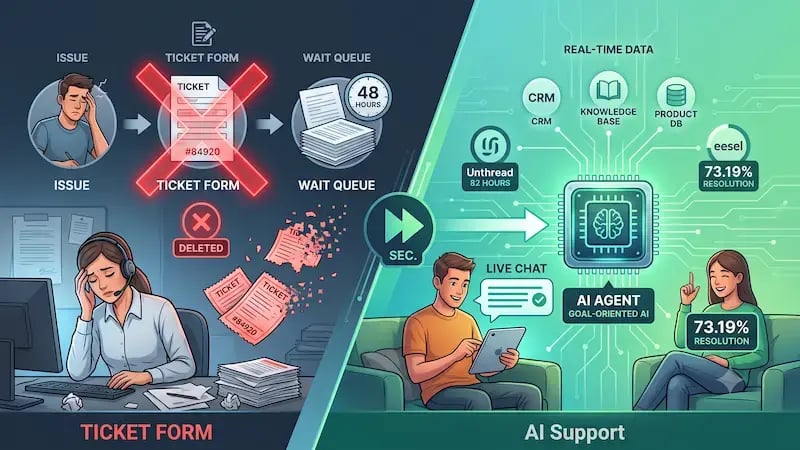 For the modern consumer, that wait is an immediate source of friction. We live in an era where dinner arrives in thirty minutes and streaming video plays instantly. Yet, when something goes wrong with a software platform or an online order, customer service suddenly feels stuck in 2010.
A massive paradigm shift is currently underway. The traditional, manual support ticket is dying. Customers no longer want to click through complex menus or wait out a multi-day queue. Instead, organizations are moving toward zero-click service resolutions.
How does this shift change the customer experience? By leveraging autonomous, real-time technology, businesses can now resolve issues instantly inside active chat interfaces. This approach removes manual queue waiting times entirely. It also fundamentally transforms traditional service level agreements (SLAs).
Let's explore why the support ticket is fading away and how your organization can embrace a seamless, zero-click future.
What Is a Zero-Click Service Resolution?
To understand this shift, we must define the core concept clearly. This definition is essential for understanding the future of artificial intelligence in customer service.
Zero-Click Service Resolutions Defined
A zero-click service resolution is a customer service process in which an issue is fully resolved during the user's initial interaction—such as a live chat or messaging interface—without requiring the customer to submit a ticket, wait for an email, or navigate to an external portal.
Unlike self-service models that require users to search through endless knowledge base links, zero-click resolutions bring the exact answer directly to the user. The customer does not need to click around, open new tabs, or wait for an asynchronous human response.
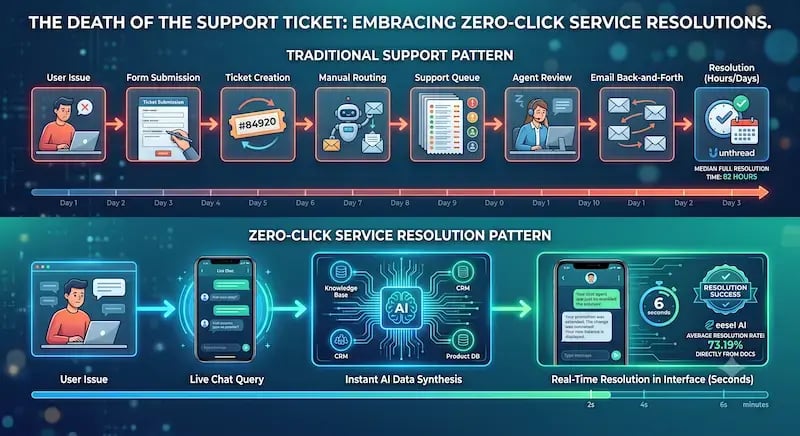
The Power of Immediate AI-Driven Data Synthesis
How do these instant resolutions actually work under the hood? The process relies on immediate, AI-driven data synthesis.
When a user types a query into a chat window, modern AI engines do not simply search for matching keywords. Instead, they analyze the user's query context in real time. The system simultaneously connects to various internal data structures, such as:
- Corporate knowledge bases
- Product documentation
- User account histories
- Active system status pages
The AI synthesizes this data in milliseconds. It then delivers the precise solution or applies the requested fix directly in the active chat window.
For example, if a customer asks why their billing amount changed, the system does not link them to a general billing policy article. It looks up the account, identifies the specific promotional expiration, calculates the difference, and explains it in plain language instantly. The customer gets a complete resolution without a single ticket being generated.
The High Cost and Friction of the Traditional Support Ticket
To appreciate why customer service must evolve, we need to look closely at the structural flaws of the manual ticketing system.
The Lifecycle of an Average Ticket
The journey of a standard support ticket is filled with hidden delays. First, a user fills out a web form. Next, an automated routing tool or a support manager triages the ticket. The ticket then sits in a queue waiting for an available human agent.
When an agent finally picks up the ticket, they often need more information. This triggers a series of back-and-forth emails. Each exchange adds hours or days to the clock. By the time the issue is resolved, the customer's frustration has peaked.
What the Data Shows About Support Delays
The numbers behind traditional support workflows tell a stark story. Many organizations believe their response times are acceptable, but industry benchmarks show a widening gap between company performance and customer desires.
The reality of the wait tells a compelling story:
Comprehensive benchmark data published by Unthread reveals that the median full resolution time across 1,000 SaaS companies is an incredible 82 hours.
That represents more than three full business days of waiting for a resolution.
This delay clashes directly with what customers actually expect.
The same research shows that 60% of customers define an "immediate response" as 10 minutes or less.
When a company takes days to fix an issue that a customer expects to be solved in minutes, loyalty drops. Forced waiting times create an underlying friction that erodes trust in a brand.
The Financial Strain of Manual Queues
Manual queues do more than just frustrate your customers. They also drain your operational budget.
Managing a high volume of support tickets requires significant human labor. Tier 1 support agents spend most of their days routing tickets, verifying account details, and answering the same repetitive questions. This repetition leads to high team member burnout and constant turnover.
Furthermore, as ticket volumes scale alongside customer growth, companies face a difficult choice. They must either hire more support representatives or watch their resolution times stretch even longer. Neither option is sustainable.

Why should we force users to adapt to slow internal workflows when modern technology can move at the speed of conversation? The manual ticketing system was built for an era of limited connectivity. Today, it serves as a bottleneck rather than a solution.
How Zero-Click Service Resolutions Redefine Traditional SLAs
The introduction of zero-click service resolutions changes how customer service departments measure success. For decades, the industry relied on standard Service Level Agreements (SLAs). These metrics kept teams focused on specific goals.
The Collapse of the Response Timeline
Traditional SLAs track metrics such as:
- Time to First Response (TTFR): How long a customer waits to hear that a human is looking at their issue.
- Time to Full Resolution (TTFR): The total time required to close a ticket.
The disconnect, however, lies between the accepted benchmarks and what customers actually want/expect. For example,
In a traditional setup, a First Response SLA of two hours is often considered excellent, according to EmailAnalytics.
Compare that to the customer expectation metrics we highlighted earlier.
A full-resolution SLA of 24 hours is viewed as standard.
Zero-click service resolutions compress these timeframes entirely. When an AI-driven agent handles a query, the concepts of "queue" and "response latency" no longer apply. Instead of measuring response times in hours, businesses can measure them in seconds.
Data shows that advanced AI-driven support structures can reduce active response times down to a mere 6 seconds, as documented by Native.cloud.
| Metric | Traditional Support Setup | Zero-Click AI Architecture |
|---|---|---|
| Average Response Time | 2 to 4 Hours | ~6 Seconds |
| Median Resolution Time | 82 Hours | Under 2 Minutes |
| Primary Interaction Interface | Email / External Portal | Active Chat Window |
| Operational Workflow | Asynchronous Queue | Real-Time Data Synthesis |
Think about what this shift means for your operations. What happens to customer loyalty when your time to resolution matches the speed of a single thought? It transforms support from a stressful chore into a seamless perk of using your product.
Beyond the Basic Chatbot: The Rise of Autonomous Customer Agents
Many business leaders confuse zero-click service resolutions with traditional chatbots. This misconception causes companies to hesitate, as early chatbots often caused more frustration than help.
Scripted Chatbots vs. Autonomous Agents
To achieve true zero-click resolutions, companies must move beyond the basic, scripted chatbot. The differences between old-school tools and modern autonomous engines are substantial.
- Scripted Chatbots: These tools rely on rigid, pre-written keyword rules or static if/then decision trees. They present users with a strict list of buttons. If a customer types a question that strays from the script, the bot fails. It then defaults to creating a traditional support ticket, adding an extra layer of frustration.
- Autonomous Customer Agents: These are goal-oriented, context-aware systems built on advanced AI models. They don't just match keywords; they understand natural human intent. They safely access integrated data sources, synthesize information on the fly, and execute actions independently within secure guardrails.
Real-World Resolution Capabilities
This evolution is not a theoretical prediction. Autonomous customer agents are already handling complex tasks effectively.
According to an in-depth product performance study by eesel AI, modern autonomous customer-facing AI engines are now achieving an average resolution rate of 73.19% directly from integrated documentation.
This means nearly three out of every four inquiries can be resolved completely without human intervention and without generating a single support ticket.
The Structural Impact on Human Teams
When you deflect over 70% of routine inquiries at the chat layer, the shape of your support funnel changes completely.
The bottom of the support queue vanishes. Human agents no longer spend hours resetting user passwords, processing basic refunds, or pasting links to documentation. Instead, the autonomous agent handles these tasks instantly.
This shift frees your human support staff to focus on high-value work. They can spend their time on complex, technical issues, enterprise account management, and deep empathetic conversations that require human intuition.
As a result, your team becomes more effective, employee satisfaction rises, and your operational costs drop significantly.
Strategic Implementation: Preparing Your Infrastructure for a Zero-Ticket Era
Transitioning away from traditional support tickets requires deliberate planning. You cannot simply install a basic chat widget on your website and expect zero-click results overnight. Your underlying technology infrastructure must be prepared to support real-time data synthesis.
1. Build a Unified, Accessible Knowledge Base
An autonomous customer agent is only as smart as the information it can access. If your documentation is scattered across Google Docs, internal PDFs, and old Slack channels, an AI cannot help your customers.
Organizations must break down these data silos. You need to gather, update, and centralize your product and service documentation. Ensure your content is written in clear, logical language. This allows generative AI models to accurately index, retrieve, and synthesize information during live interactions.
2. Establish Secure, Real-Time Data Pipelines
To resolve complex customer issues without creating tickets, an AI agent needs context. It needs to know who the customer is, what plan they are on, and what errors they might be experiencing.
This requires building secure, real-time data pipelines between your chat interface, your Customer Relationship Management (CRM) platform, and your core product database. Security is vital here.
The AI must operate within strict data guardrails. It must access user data safely, ensuring that private information remains protected while still providing the context needed for an instant resolution.
3. Shift Your Core Operational KPIs
If you want to change how your team resolves issues, you must change how you measure success. Traditional customer service teams focus heavily on volume-centric metrics.
In a zero-click service environment, tracking ticket volumes or queue lengths becomes less relevant. Instead, leaders should focus on modern performance indicators:
- Self-Service Resolution Rate: The percentage of conversations handled entirely by the AI agent without human assistance.
- Instant Query Deflection: The volume of potential tickets prevented by immediate chat resolutions.
- Real-Time Customer Sentiment Tracking: Assessing customer satisfaction instantly during the chat interaction, rather than waiting for an emailed survey days later.
By aligning your metrics with zero-click goals, you encourage your team to focus on building automated resolution paths rather than managing manual queues.
Stepping Into the Future of Customer Support
The traditional support ticket is a relic of an older era. Forcing modern customers to wait 82 hours for answers that already exist within your digital systems is no longer a viable business strategy. The future belongs to organizations that remove friction and value their customers' time.
By embracing zero-click service resolutions, you turn support into an immediate, effortless experience. You eliminate manual queue wait times, compress response loops to seconds, and let your human teams focus on your most critical business challenges.
Are you ready to stop managing queues and start resolving problems instantly?
Navigating this transition requires specialized expertise. Designing the proper data architecture and deploying goal-oriented AI engines demands a strategic partner who understands both business growth and modern technology.
This is where Aspiration Marketing can assist your business. We help growth-oriented companies plan, implement, and optimize next-generation AI customer agent strategies. By integrating advanced autonomous AI layers directly into your existing CRM workflows and knowledge management platforms, we help you eliminate ticket bottlenecks for good.
With our guidance, your organization can move past traditional SLAs, maximize self-service resolutions, and deliver the instant, effortless service experiences your customers expect. Contact Aspiration Marketing today to transform your customer support model.






.webp?width=600&height=375&name=Choose%20B2B%20agency%20for%20EdTech%20(1).webp)
Leave a Comment
Have thoughts on this article?
Share your feedback, ask questions, or join the discussion with our community.