





In the past, marketing was something that happened at the beginning of a customer’s journey. You would run ads, write blogs, send emails, and host webinars to get someone to click "buy." Once that transaction was complete, the customer was often handed off to a service team. At that point, the marketing engine stopped. But in a world where customer acquisition costs are rising, can we really afford to stop marketing just because a lead became a client?
The Evolution of the "Always-On" Marketer
The reality of modern business is that the "Always-On" marketer must look past the initial sale. We are moving from a world of Generative AI—where we use tools to write better emails or create images—to a world of Autonomous AI. This is the era of the agent. Specifically, a customer agent is an autonomous AI that doesn't just answer questions but can execute tasks and drive revenue through implementing customer agents.
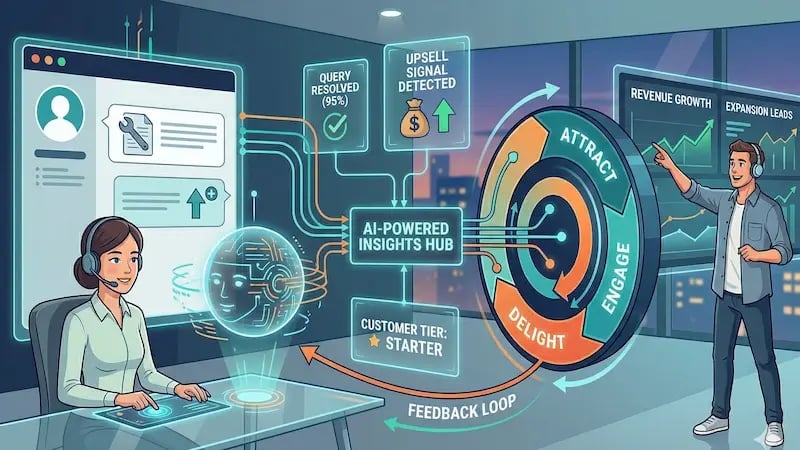
In the era of the flywheel, we use a new paradigm. Loop marketing is a model where the end of one sale is the beginning of the next expansion, creating a seamless circle where service feeds marketing, and marketing feeds service, all supported by a Breeze Agent. If a customer asks a question, they aren't just looking for a fix; they are signaling their current needs, their pain points, and often, their readiness to upgrade. Are you listening to those signals?
The Problem: When Service Becomes a Marketing "Black Hole"
For many organizations, the service department is where great marketing data goes to die. We spend thousands of dollars on CRM systems and analytics to understand a lead's behavior, but the moment they open a support ticket, that data becomes siloed.
According to the Salesforce State of the Connected Customer report, 54% of customers feel like sales, service, and marketing teams don't share information.
This creates a disjointed experience. Have you ever been pushed a "new customer" discount email for a product you've owned for three years while you were simultaneously waiting for a support agent to fix a bug? It’s frustrating, and it happens because the marketing loop is broken.
Traditional chatbots have historically been part of the problem, not the solution. Most bots are built for "deflection." Their primary KPI is to stop a human from having to talk to a customer. While this saves money, it often kills the relationship. These bots are reactive. They wait for a keyword, offer a link to a help article, and hope the customer goes away. They don't "detect" intent; they just manage volume.
When you treat service as something that can be pushed off to a bot, you lose the most important signals. A customer might ask,
"Does this software integrate with Salesforce?"
A reactive bot gives them a setup guide. An autonomous agent, however, recognizes that this customer is on a basic tier that doesn't include integrations. That question is a strong signal of intent to upgrade. Without the right agent implementation, that revenue opportunity evaporates into a black hole.
The Architecture of Growth: Implementing Customer Agents
So, how do we move beyond the simple FAQ bot? The answer lies in the technical architecture of the next generation of AI tools. To build a Conversational Marketer AI agent, we have to move toward Retrieval-Augmented Generation (RAG). Retrieval-Augmented Generation (RAG) is a technique where an AI model is “grounded” in your specific data, such as your Knowledge Base, instead of relying only on its general knowledge.
When you implement customer agents on a platform like HubSpot, the agents are trained on your specific Knowledge Base, blog posts, and product documentation. This ensures that every answer is brand-approved and technically accurate.
But the real magic happens with the Model Context Protocol. This allows the agent to understand exactly who it is talking to. It doesn't just see a random user; it sees "John Doe from Company X," who has been a customer for six months and currently uses the Starter package. Because the agent has this context, its answers aren't just generic—they are personalized.
This leads to what we call the Zero-Click Resolution standard. The goal is to solve the user’s problem immediately within the chat interface, without making them click through five different links or wait for an email. When you deliver this level of value instantly, you build massive brand equity. You’ve helped the user. Now, they are in a much better headspace to hear about a new feature or a higher-tier service that could make their life even easier.
Consider Glamnetic, a SaaS company that implemented these agents to handle technical documentation. By grounding the AI in their specific product manuals,
Glamnetic saw a 45% reduction in initial ticket volume almost immediately.
But more importantly, the marketing team began to see a surge in expansion leads because the agent was trained to flag users who were asking about advanced features.

Identifying "Upsell Signals" in the Support Flow
If we want to turn a support agent into a growth engine, we have to define what buyer intent looks like in a chat window. This is where the agent's training becomes vital for the marketing team.
Essentially, you're looking for any intent trigger; ideally, one that leans toward an upsell or expansion of current services. This is any question or statement that suggests a user is outgrowing their current setup. Common triggers include:
- Questions about seat limits or user permissions.
- Inquiries regarding API access or advanced integrations.
- Asking "How do I do [X]?" when [X] is a feature only available in the Pro or Enterprise tiers.
When an agent identifies these triggers, it shouldn't just send a sales pitch. That would feel robotic and annoying. Instead, it uses a trigger. For example, the agent might say:
"I can certainly show you how to set that up! It looks like that feature is part of our Enterprise tier, which also includes [Benefit Y]. Would you like me to send you a quick overview of how that works, or should I have your Account Manager reach out to discuss a trial?"
This is a soft upsell that feels like a natural part of the conversation. If the customer says yes, the agent can automatically enroll them in a tailored marketing workflow in HubSpot or send a high-priority alert to the Account Manager.
The data backs this up.
According to Gartner, proactive customer service can lead to a 9-point increase in Value Enhancement Scores.
When you anticipate a customer's needs and show them the path to more value, they don't feel "sold to"—they feel supported.
Building the Loop: A Triple-Layered Integration
Implementing customer agents isn't a set-it-and-forget-it task. It requires a strategic integration into your existing marketing flywheel. You have to think of the agent as a new member of your marketing team.
The first step is properly training the model. You should feed your full marketing knowledge base into the environment. This includes not just technical "how-to" guides, but also case studies, white papers, and your brand's unique point of view on industry trends. The more the agent knows about your "why," the better it can communicate your "what."
To ensure this works at scale, a Triple-Layered Integration Strategy is necessary, focusing on specific growth-oriented KPIs. This strategy is measured by its impact on expansion revenue from support, agent-assisted conversions, and the overall lift in Customer Lifetime Value (CLV).
One of the biggest fears companies have is that an AI agent will sound pushy and ruin the brand's reputation. This is why the agent's tone is so important. It should be inquisitive and informative. It should ask questions like, "Are you finding that your current team limits are slowing down your workflow?" This prompts the customer to reflect on their own pain points, making the eventual upgrade suggestion feel like a helpful solution rather than a cold pitch.
Measuring Success: KPIs for the Conversational Marketer
If you are going to invest time in implementing customer agents, you need to know if they are actually working. Traditional service metrics like average handle time remain useful, but the Conversational Marketer should also consider growth-oriented KPIs.
-
Expansion Revenue from Support: How many upgrades or new feature adoptions started with a conversation with the agent? This is the ultimate proof of the "Loop Marketing" model.
-
Agent-Assisted Conversions: How many leads who were already in the pipeline were "nudged" toward a closing decision by an interaction with the agent?
-
Customer Lifetime Value (CLV) Lift: We know that 80% of future revenue comes from just 20% of existing customers. By using agents to proactively manage that 20%, you significantly increase the long-term value of your database.
Beyond revenue, there is the metric of operational efficiency. How much time is your sales team saving because they are only talking to expansion leads who have already been qualified by the agent? By the time a human gets involved, the customer has already expressed interest and seen the initial value proposition. This shortens the sales cycle and makes it much more pleasant for everyone involved.
The Human Element in an AI World
It is important to remember that while the agent is autonomous, it is not an island. The best implementations of this technology are those that know when to step back. The hand-off is a critical moment. If a customer expresses frustration or a highly complex emotional need, the agent must be programmed to recognize that and bring in a human immediately.
The goal is not to replace humans; it is to free them up to do the work that only humans can do. While the agent is busy resolving 500 routine queries and identifying 20 potential upsells, your human marketers and sales reps can focus on high-level strategy and deep relationship building.
Think of the agent as the "scout" for your marketing team. It is out there on the front lines, 24/7, gathering data, helping people, and looking for the next opportunity. It ensures that no customer is left behind and no revenue signal is ignored.
Implementation Checklist for Your First Agent
Ready to get started? Here is a simple framework for your initial rollout:
- Audit Your Knowledge Base: Is your documentation up to date? If the agent reads bad info, it will give bad info.
- Define Your Triggers: What are the top three questions that usually lead to a sale? Teach the agent to look for these.
- Map the Workflow: When the agent finds a lead, where does it go? Make sure your HubSpot workflows are ready to catch what the agent throws.
- Test the Voice: Does the agent sound like your brand? Use your existing brand guidelines to tune the AI's personality.
- Monitor and Iterate: Read the transcripts. See where the agent is succeeding and where it might be missing signals.
Closing the Loop for Sustainable Growth
The shift from reactive service to proactive conversational marketing is one of the biggest opportunities in the AI era. By implementing customer agents that understand both the "how" of support and the "why" of marketing, you turn a cost center into a profit center.
You are no longer just solving problems; you are opening doors. You are turning the "black hole" of support into a lighthouse that guides your customers toward greater value and your company toward greater growth.
The role of the marketer is changing. We are no longer just creators of content; we are orchestrators of experiences. We are the architects of the Loop. By embracing these autonomous tools, you ensure that your brand is always helpful, always present, and always looking for the next way to serve your clients.
Your customers are already talking to you every single day. They are telling you what they need, what they want, and what they are willing to pay for. It’s time to start listening for those growth signals hidden in the noise. It's time to become a Conversational Marketer.
Partnering for AI Success
Navigating the complexities of AI integration can be daunting. At Aspiration Marketing, we specialize in bridging the gap between technical AI implementation and strategic marketing growth. We don't just help you turn on a chatbot; we help you architect a comprehensive Loop Marketing strategy within the HubSpot ecosystem.
Whether you are looking to deploy your first Breeze agent or optimize your entire CRM for the autonomous era, we provide the expert insights and hands-on support needed to turn AI potential into real-world revenue. Let's work together to ensure your marketing never stops, even after the sale.






.webp?width=600&height=375&name=Choose%20B2B%20agency%20for%20EdTech%20(1).webp)
Leave a Comment
Have thoughts on this article?
Share your feedback, ask questions, or join the discussion with our community.