





Investing in software is rarely the hard part for a growing technology business. The real challenge starts when you try to connect that software to your daily operations.
For Canadian mid-market tech and SaaS companies, implementing a powerful revenue platform like the HubSpot CRM can feel like a major turning point. You expect cleaner data, smoother handoffs between marketing and sales, and predictable revenue growth.

Yet, many software rollouts fail to deliver on these promises. Why does this happen? The answer usually comes down to how the system was configured and whether the business had the right guidance along the way.
When you look for external help, hiring a HubSpot Partner seems like the most logical next step. However, not all partners offer the same level of service, technical skills, or industry experience. Selecting the wrong agency can lead to stalled adoption, broken workflows, and wasted budgets.
To protect your investment and build a reliable revenue engine, you should evaluate a HubSpot partner before choosing them. Consider these seven critical factors before signing a contract.
1. Agency Tier Status Does Not Equal Technical Mastery
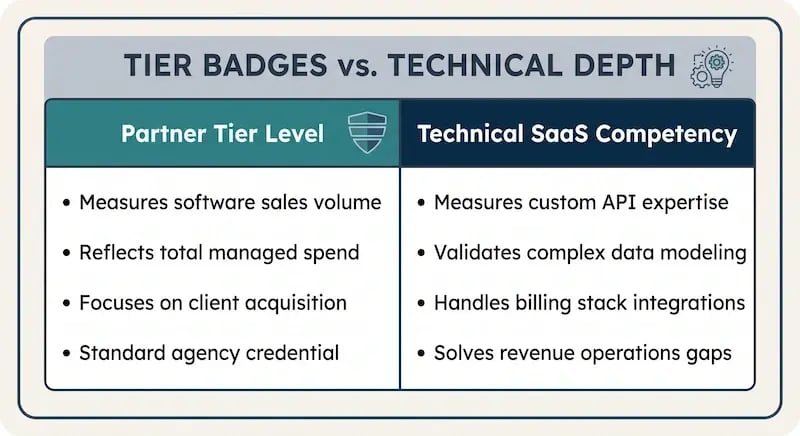
When evaluating service providers, it is easy to focus on tier levels like Gold, Platinum, Diamond, or Elite. These badges look impressive on a website, but what do they actually mean?
A HubSpot Partner tier status is a designation that primarily reflects an agency's software resale volume and total managed client accounts. This status is a measure of sales performance, not necessarily technical capability. A high-tier agency might excel at selling marketing packages to small local businesses, but it may lack the expertise needed to configure a complex B2B SaaS tech stack.
 What SaaS and Tech Companies Really Need
Mid-market technology firms operate differently from traditional businesses. You often have complex product tiers, usage-based pricing, and distinct buyer journeys. Your CRM must connect smoothly with payment gateways, product analytics, and customer support platforms.
Consider a scenario in which a SaaS company needs to integrate HubSpot CRM with payment tools such as Stripe or Chargebee. A generalist agency might build basic deal stages, leaving your internal developers to handle complex API integrations.
On the other hand, a partner with true technical expertise will design a system that automatically updates customer lifecycle stages based on real-time billing data.
Before choosing a provider, look past marketing badges. Ask candidates to demonstrate their experience with complex data models and custom integrations similar to yours.
2. Differentiate Between Basic Certifications and Official Accreditations
A HubSpot Academy certification is an individual credential earned by passing online tests, demonstrating a general understanding of the software. While these certifications show that an agency's team understands the software, they do not guarantee that the agency can manage a complex, multi-departmental rollout.
To find high-level technical skills, you must look for official HubSpot Accreditations. An official HubSpot Accreditation is a credential awarded to an entire agency after passing rigorous third-party technical reviews of real client work, verifying the agency's ability to handle complex system architecture.
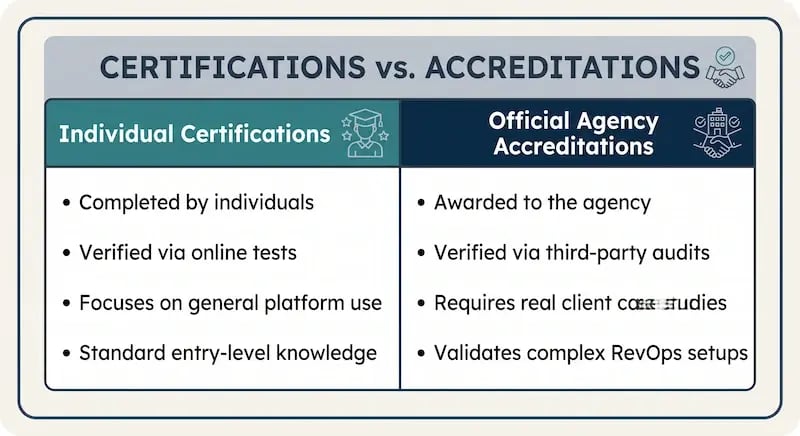 Accreditations—such as the HubSpot Custom Integration Accreditation or the HubSpot CRM Implementation Accreditation—are granted to agencies that pass rigorous third-party technical reviews. HubSpot examines real client work, reviews documentation, and interviews past customers to verify that the agency can handle complex system architecture.
Why Accreditations Matter
If your business needs custom data objects, multi-currency reporting, or legacy system migrations, accreditations serve as verified proof of capability.
When interviewing prospective partners, ask them directly:
- Which official agency accreditations do you currently hold?
- Can you walk us through the technical documentation from a recent accredited project?
- Can you show us an anonymized portal walkthrough of a pipeline you previously built for a company at our revenue scale?
3. Data Cleaning Must Precede Data Migration
Data migration is the process of transferring data from one system to another. When you transfer ten years of unorganized customer records into a brand-new platform, you simply automate existing disorganization. For a new CRM, data migration is often one of the most risky phases of an onboarding project.
Research published by Salt Creative shows that,
88% of sales professionals prioritize accurate customer data, yet 23% name poor data quality as their single largest operational barrier.
The Cost of Dirty Data
Migrating clean data is essential for accurate pipeline tracking and messaging. If your team imports duplicated records, outdated contacts, or inconsistent custom fields, your automated workflows will fail. Imagine sending onboarding sequences to active clients or automated renewal reminders to accounts that have been lost.

A reliable HubSpot implementation partner will not simply ask for a CSV file to upload. Instead, they will insist on a structured data migration protocol:
-
Audit and Cleanse: Identifying duplicate records, archiving inactive contacts, and standardizing property values.
-
Field Mapping: Creating clear maps between your old system properties and your new CRM properties.
-
Sandbox Testing: Running sample imports in a test environment to verify data integrity before going live.
-
Live Migration and Audit: Executing the final transfer and running post-migration checks to ensure accuracy.
If a vendor skips the testing phase, your internal teams may spend months fixing data errors after launch.
4. Process Mapping Must Come Before Software Configuration
A common mistake mid-market tech companies make is setting up software tools before mapping out their business processes. Process mapping is the act of defining and visualizing a business's customer journey and operational standards before configuring any software settings. Standard software configurations rarely match your actual sales cycle. When you build pipelines without clear internal alignment, confusion follows.
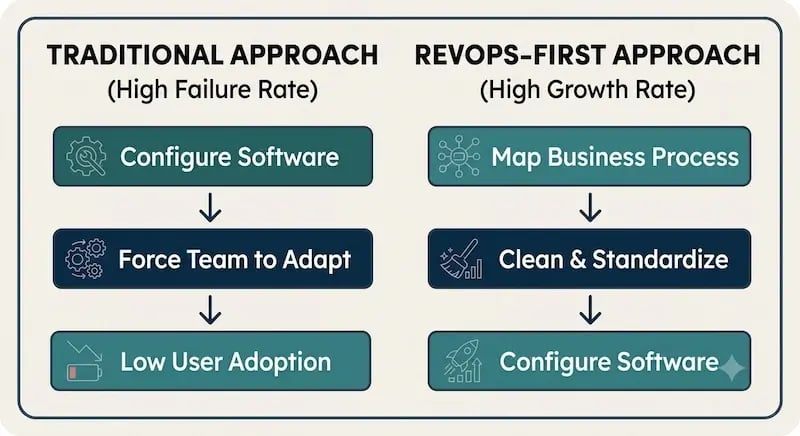 According to a study on CRM adoption by Vantage Point,
63% of CRM implementations fail to deliver expected ROI due to process misalignment and low adoption rates.
Software tools cannot fix broken sales processes; they can only amplify the processes you already have.
The Value of Process Mapping
A skilled partner will lead discovery workshops to map out your customer journey before making any adjustments to your portal settings. They will help you define key operational standards:
- What specific criteria mark the transition from a Marketing Qualified Lead (MQL) to a Sales Qualified Lead (SQL)?
- How are leads distributed among account executives?
- What triggers automated follow-up sequences for prospective clients?
Setting up these workflows correctly pays off quickly. Industry statistics compiled by Searchlab show that:
Implementing automated lead routing within an aligned CRM framework can cut response times to under five minutes, making leads 21 times more likely to convert.
By standardizing your sales process before configuring software settings, you build a clear operational foundation that supports steady business growth.
5. Demand a Custom Scope of Work Over Template Checklists
Basic onboarding packages offered by general service providers often follow generic checklists. While template onboarding might cover basic account configuration—like installing tracking pixels and setting up standard deal stages—it rarely meets the needs of scaling tech firms.
Mid-market SaaS companies require a cohesive Revenue Operations (RevOps) setup. This means aligning Marketing Hub, Sales Hub, Service Hub, and Operations Hub so that data flows freely across your business. A custom Scope of Work (SOW) is a detailed agreement that addresses a business's specific metrics—such as Customer Acquisition Cost (CAC), Net Revenue Retention (NRR), and Monthly Recurring Revenue (MRR)—and outlines the required custom objects, lifecycle logic, and reporting dashboards.
Connecting Marketing and Sales Systems
When departments work in isolation, valuable operational data gets lost.
Research from Searchlab demonstrates that:
B2B organizations integrating CRM with marketing automation platforms produce 451% more qualified leads than those operating disconnected tools.
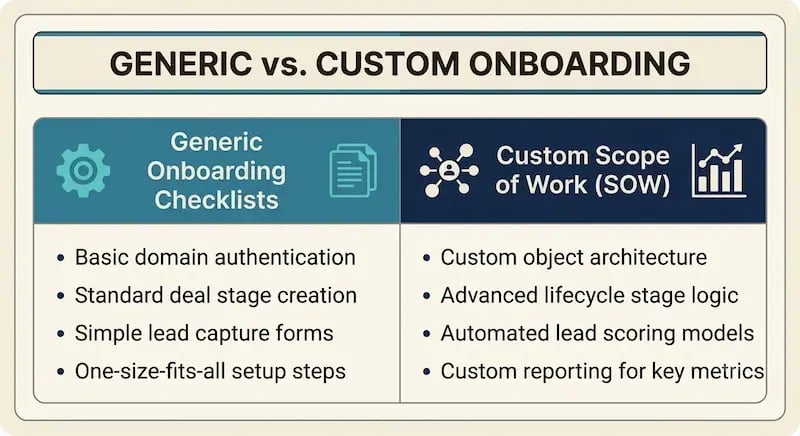 Ensure your agreement details the custom objects, lifecycle logic, and reporting dashboards your business actually requires.
6. Prioritize Role-Specific Change Management and Training
Even the most well-designed CRM system will fail if your team hesitates to use it. User resistance remains one of the largest hurdles during software rollouts. Role-specific training is a change management strategy that provides tailored instruction to different teams based on how they use the software in their distinct daily tasks.
Data published by 4CRMs shows that
50% of sales leaders consider CRM implementation difficult, pointing to user resistance and complex interfaces as primary challenges.
Giving your team a generic video walkthrough is rarely enough to build long-term platform adoption.
The Power of Role-Based Training
To drive long-term system use, look for service partners that offer tailored, role-specific training sessions. Different teams use the software in distinct ways:
-
Sales Representatives: Need practical training on managing deal pipelines, setting up email sequences, and using mobile tools during meetings.
-
Sales Managers: Require guidance on setting up team dashboards, reviewing pipelines, and tracking forecast accuracy.
-
Marketing Operations: Need training on campaign tracking, attribution models, and automated lead nurturing.
-
Customer Success Managers: Require instruction on handling customer onboarding tickets, tracking renewal dates, and monitoring account health.
When each department receives training tailored to their daily tasks, confidence grows, and platform adoption follows naturally.
7. Review Pricing Models, Support Protocols, and Data Compliance
The final area to evaluate before selecting a HubSpot Partner involves business terms, ongoing support commitments, and data privacy policies.
Transparent Pricing Structures
Clear financial expectations prevent unexpected costs later in the project. Ask prospective providers how they structure their fees:
-
Fixed-Fee Milestones: Ideal for clear, well-defined projects with fixed timelines.
-
Retainer Models: Best suited for ongoing support, iterative workflow improvements, and custom development.
Beware of contracts with vague pricing terms for custom API development, system testing, or post-launch technical support.
Service Level Agreements (SLAs) and Honest Debriefs
When a critical workflow breaks, you need to know help is available. Ask vendors about their service commitments:
- What is your standard response time for critical technical issues?
- Do you offer dedicated account management, or are support tickets routed to a general queue?
- Can you share an example of a past implementation that encountered unexpected difficulties and explain how your team resolved them?
Data Security and Compliance
For Canadian businesses, complying with data privacy laws is essential. Your partner must understand Canadian regulations such as PIPEDA, regional laws, and international standards such as SOC 2. Verify how the agency handles consent collection, data hosting locations, and user permission levels to keep your customer records secure.
How to Evaluate Your Options
Choosing the right implementation provider requires careful evaluation. Use this simple checklist during vendor interviews to compare candidates side by side: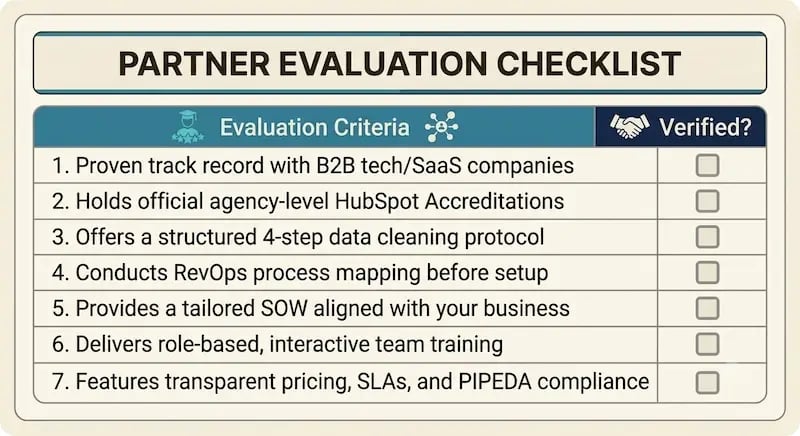
Making the Right Choice for Long-Term Growth
Deciding on a software partner is about more than setting up a new platform. It is about building an operational foundation that supports repeatable, long-term revenue growth.
When you prioritize technical skills, clear data migration plans, process mapping, and tailored team training, you turn your CRM into a reliable business asset. Asking candidate agencies tough questions up front helps protect your budget, keep your project on track, and set your entire organization up for success.
At Aspiration Marketing, we help growing mid-market tech and SaaS organizations bridge the gap between software features and real business results. As an accredited HubSpot Partner, our team builds tailored revenue operations engines—guiding businesses through custom CRM architecture, clean data migrations, and strategic change management.
Ready to make the most of your software investment? Contact Aspiration Marketing today to schedule a practical CRM readiness assessment for your business.




.webp?width=600&height=375&name=Choose%20B2B%20agency%20for%20EdTech%20(1).webp)


Leave a Comment
Have thoughts on this article?
Share your feedback, ask questions, or join the discussion with our community.