





As a high-growth tech startup, what's your primary focus? Are you only chasing that next round of funding? Or are you building a stable foundation that enables long-term growth? The truth is, you need both. Scaling up quickly is exciting. But it quickly turns your early, simple customer tracking into a mess. These informal processes become a roadblock.
I. The Need for an Agile CRM
You know you need a CRM. But many basic CRMs only look backward; they track history. For a high-growth business, your CRM must be a future-proof engine for growth. If your system can't handle dynamic needs and unique product data, it will soon create fragmented data and disjointed customer experiences.
The HubSpot CRM is different. It's far more than a digital filing cabinet. At its core, the HubSpot CRM is a unified, scalable platform built to manage the complex, fast-paced world of tech startups. This system gives you the strong operational core you need for stable, predictable scale. In this guide, we examine the specific features that make the HubSpot CRM the ideal operational tool for achieving market dominance.
II. Data Centralization and the Flywheel: Your Blueprint for Sustainable Growth
Why is a strong CRM the cost of entry into today's market? Because your HubSpot CRM holds a goldmine of customer data. You must access, understand, and make money from this data. This level of deep insight only happens when data is centralized. Every team needs easy access to it.
In the past, companies used the old sales funnel. That model pushed leads toward a single sale but often ignored the customer after the deal closed. Tech companies live or die by customer retention and referrals, so the funnel approach doesn't work for them.
Modern growth relies on the HubSpot Flywheel. The HubSpot Flywheel is a model that puts your customer’s experience at the center of the business. It uses your data to power a smooth flow between Marketing (Attract), Sales (Engage), and Service (Delight). A centralized CRM guarantees these three teams are always aligned. This single, unified view of every prospect and customer is key to any modern product-led growth model.
Experience-Driven Marketing isn't just a buzzword; it's how you win. Research from Forrester proves this point: Companies that focused on customer experience grew 40% faster and increased their customer lifetime value by over 60% compared to those that did not. Without a unified CRM, creating that seamless, customer-centric experience is impossible.
III. Scaling Through Segmentation: Achieving Pinpoint Audience Accuracy
Are your marketing messages getting noticed? Or are you just making more noise? Consumers are overloaded with promotional content. Analysts estimate the average American sees between 5,000 and 10,000 promotional messages daily. That's a considerable number. It proves why broad, generic campaigns fail. They cause apathy. If your message isn't super-relevant, people simply tune you out.
This is where the HubSpot CRM's powerful Segmentation tools become essential. Segmentation is the practice of dividing your audience into focused groups based on specific actions or properties. It lets you focus your limited tech startup resources only on the leads most ready to buy. This boosts your success rate quickly.
Isolation by Activity
Segmentation must be about more than simple demographics like job title. It must be based on what people do. The simplest way to do this is with HubSpot Segments. These lists update in real time. They isolate groups based on contact, company, or—most importantly—activity.
For example, you could create a list that updates automatically to show:
- All prospects who have visited your pricing page more than twice in the last month but haven't requested a demo.
This is not just a lead—it shows strong buying intent. This feature lets your Sales team target warm leads with extreme accuracy.
Utilizing Custom Behavioral Events
A standard set of tracking events is usually not enough for highly technical or specialized tech startups. HubSpot understands this. For their Enterprise clients, you can set up and track Custom Behavioral Events. Custom Behavioral Events are user actions specific to your product that you can define and track within HubSpot, such as "Feature X Trial Activation" or "API Key Usage Count."
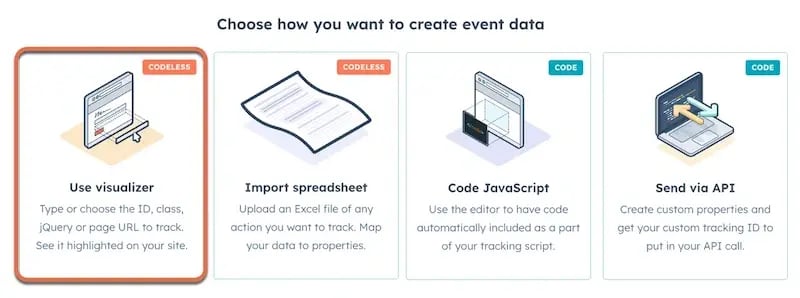 For a SaaS company, this is vital. This detailed, in-app data flows right back into the HubSpot CRM. It powers innovative Marketing Automation and improves your overall CRM operations. Using this data for detailed segmentation can accelerate your marketing ROI.
IV. Contextualization for Accelerated Sales: Smart Content and Journey Mapping
The buying cycle for complex B2B solutions is long—it might take many months. How can you stop your sales team from sending a hard-sell proposal when a prospect is just starting their research? Context is the answer.
You aim to offer the perfect content exactly when a buyer needs it. This will make you appear as a helpful resource rather than an annoying interruption.

Mapping Content to the Three Stages
The HubSpot CRM lets you label and track prospects by their stage in the Buyer's Journey. The Buyer's Journey is the active research process a potential buyer goes through, divided into three stages: Awareness, Consideration, and Decision. Linking content to these stages triggers the right message at the right time, greatly improving your conversion results.
Take an example of a B2B forecasting software startup:
| Stage | Buyer's Pain Point | Content Triggered |
|---|---|---|
| Awareness | The buyer realizes their planning is bad. | Blog Post: "The Hidden Costs of Legacy Software." |
| Consideration | The buyer looks at options (e.g., new software, outsourcing). | Guide: "Comparing Integration Architectures: 5 Key Factors." |
| Decision | The buyer chooses a final vendor based on results. | Case Study: "Why Company X Chose Our Technology." |
By only sending Decision-stage content (like a case study) to prospects who are tagged as Decision-stage in the HubSpot CRM, you keep the message relevant, removing friction from the sales process.
Feature Deep Dive: HubSpot Smart Content
HubSpot Smart Content is a feature that dynamically changes what a visitor sees on your website or in emails based on data in the HubSpot CRM. You use rules tied to this data to change content in real time.
This means you don't need five different landing pages. You only need one, and it changes itself:
- A new visitor sees a banner that says, "Download our Free Guide."
- An existing customer sees that same space display, "Check out the Latest Feature Update."
This level of contextual engagement simplifies your admin work, accelerates sales, and dramatically improves conversion rates.
V. Personalization at Scale: Building Relationships with Custom Data
In B2B tech, personalization is more than just using a first name in an email. It means showing you understand their specific, complex business problems. It should feel like destiny—the perfect solution arriving right when they need it.
The Custom Data Imperative
A modern tech startup's most critical data points are usually unique to your product. They might be "Number of Seats Licensed," "Current Product Version," or "Primary Programming Language." A generic CRM just cannot capture this. This is where the HubSpot CRM's flexibility truly excels. You can easily create and use Custom Properties. HubSpot Custom Properties are data fields you create to capture and store unique information specific to your business model and product.
Imagine a cybersecurity startup. They track a custom property called "Compliance Frameworks Required." This lets them instantly find all contacts who need SOC 2 compliance documents. They can then trigger a personalized email from the sales rep with that exact white paper. This is targeted, helpful, and builds trust.
Hyper-Personalization through Activity
You can also use activity data to make your communications feel deeply personal, even when they're automated through workflows:
- Deal Stage Bots: You can use deal stages to launch highly customized chatbots on relevant website pages. This works for prospects in specific phases. For example, a bot for the "Evaluation" stage can appear on your API documentation page. It's ready to answer technical questions and speed up the sale.
- Workflow Delays: You can set up workflows to wait until a contact finishes a specific action or visits a key page. This ensures the message arrives when the prospect actively thinks about the problem you can solve.
Combining Custom Properties and activity tracking means you’re not just sending emails. You're having a one-on-one conversation at scale, which builds the critical B2B trust needed to secure those multi-year contracts.
VI. Beyond the CRM: The Startup Ecosystem Edge
A high-growth tech startup needs tools that work together. Your HubSpot CRM is powerful because it's not an island. It is the central part of an entire family of connected services (Hubs).
The Data Hub Advantage
Tech companies rely on clean data and smooth tool connections. HubSpot's Data Hub handles this. Data Hub is a HubSpot toolkit that acts as a central data platform, providing better data quality, improved integrations, and flexible Business Process Automation. The Data Hub ensures data stays clean when syncing between an old billing system and your CRM. This is a huge win for a startup trying to scale fast.
Seamless Scalability
Starting small is easy with the HubSpot CRM's strong free tier. The real value is how easily you can add the Marketing, Sales, Service, and Content Hubs as your business grows. This future-proof design guarantees you won't outgrow your platform in a year or two. It saves you the expensive and painful process of migrating to a new system when you reach your next big milestone.
VII. Your Blueprint for Sustainable Scale Starts Now
Choosing a CRM is a commitment to a growth strategy. For tech startups, a basic solution just won't work. You need a platform that handles complex, dynamic data. It must also support personalized engagement across the entire customer lifecycle.
You gain a clear advantage by using the unique features of the HubSpot CRM—from its strong Segmentation using Lists, to its deep Contextualization via Smart Content, and the vital flexibility of Custom Properties. This advantage directly improves your lead quality, conversion efficiency, and overall ability to scale successfully.
Are you ready to turn your data from a pile of contacts into a powerful, revenue-generating machine? While the HubSpot CRM is intuitive, unlocking its full potential requires expert help with strategy, setup, and alignment with your unique sales process. Aspiration Marketing is a Top-Rated HubSpot Solutions Partner. We have deep experience in implementation, onboarding, and ongoing support for high-growth tech firms. We help you supercharge lead generation, automate your CRM operations, and ensure you get the most value from your HubSpot investment.


.webp?width=600&height=375&name=Choose%20B2B%20agency%20for%20EdTech%20(1).webp)



Leave a Comment
Have thoughts on this article?
Share your feedback, ask questions, or join the discussion with our community.