



AI-powered search engines like ChatGPT, Perplexity, and Google AI Overviews are reshaping how B2B buyers discover and shortlist vendors. If your brand doesn't appear in those AI-generated answers, you're invisible during the most critical moments of the buying journey. Choosing the right HubSpot partner for AI visibility is now a revenue-critical decision.
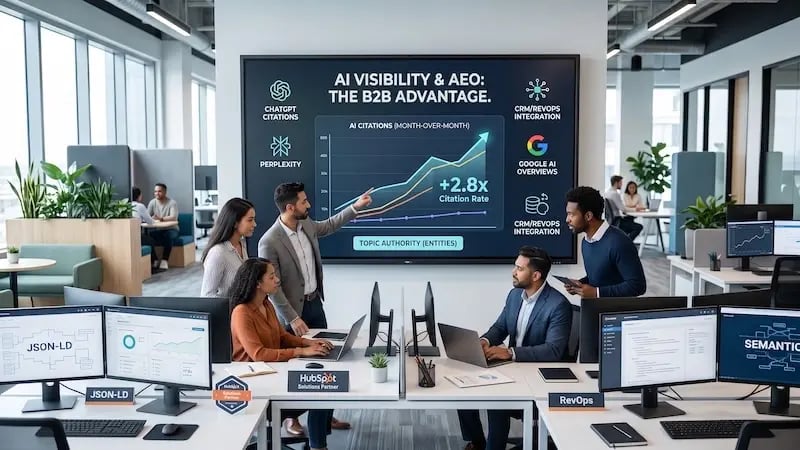 Aspiration Marketing helps B2B teams build the technical and content infrastructure required to get cited by AI search engines. This guide walks you through every evaluation criterion, from certifications and RevOps alignment to content strategy and measurable outcomes, so you can select a partner that drives real growth.
Why AI Visibility Matters for HubSpot Partner Selection
B2B buyers are increasingly self-directed.
According to a 2026 Gartner survey,
67% of B2B buyers now prefer a rep-free experience, and 45% already used AI tools during a recent purchase.
Furthermore,
94% of global buyers now use generative AI tools like ChatGPT and Perplexity during their purchasing journey—with more than half using them specifically to research and compare vendors.
This means your brand needs to show up in AI-generated answers before a buyer ever speaks to your sales team. A HubSpot partner that only focuses on traditional SEO and content creation is leaving your brand out of the conversation.
Choosing a partner with AI search optimization capabilities is no longer optional. It's the difference between being discovered during research and being entirely excluded from the buyer's shortlist.
What AI Search Optimization Is Not
AI search optimization is not traditional SEO with a new label. Ranking on page one of Google does not guarantee your content will be cited by ChatGPT, Perplexity, or Google AI Overviews.
It is not keyword stuffing by adding "AI" to your meta tags. Answer engines parse structured data, entity relationships, and semantic context rather than simple keyword density.
It is also not a one-time technical fix. AI search optimization requires ongoing content engineering, schema maintenance, and structured data updates that evolve alongside the models that consume your content.
What AI Search Optimization Actually Involves
Answer Engine Optimization (AEO) is a strategy that structures your web content so AI models can extract, synthesize, and cite it in conversational search results. It sits alongside traditional SEO as a complementary discipline, not a replacement.
The core components include JSON-LD schema deployment, semantic HTML markup, entity mapping, and content structured around natural-language queries. Your HubSpot partner should be able to execute all of these at the technical level, inside your HubSpot Content Hub. This also includes optimizing your HubSpot CRM so that it's readable by AI agents: a unified single source of truth.
Generative Engine Optimization (GEO) extends AEO by focusing on how your brand is represented across multiple AI platforms. A partner with both AEO and GEO capabilities can help you control your narrative in AI-generated summaries across ChatGPT, Perplexity, Claude, and Google AI Overviews.
The key distinction is intent. Traditional SEO optimizes for clicks. AEO optimizes for citation. Your partner needs to understand both and build a strategy that covers the full spectrum of modern B2B discovery.
Key Terms You Need to Know Before Evaluating Partners
Before you start comparing agencies, it helps to align on terminology. Here are the terms you'll encounter most often:
|
How to Evaluate HubSpot Partner Certifications for AI Readiness
HubSpot Solutions Partner Tier and Accreditations
Start with the basics. Check the partner's tier in the HubSpot Solutions Partner program and look for accreditations that signal implementation depth, such as onboarding accreditation.
A partner with HubSpot Certified Trainers and onboarding accreditation, vetted by HubSpot to deliver technical implementations. This matters because AI visibility requires proper CRM configuration, content hub setup, and data architecture.
AI and AEO-Specific Experience
Certifications alone don't tell the full story. Ask the partner to show you specific AEO or AI search optimization campaigns they've run. Look for evidence of technical audits, schema deployments, and measurable improvements in citations.
A partner that lists "AI" as a service but can not walk you through a real AEO engagement is a risk. You need practitioners, not resellers of generic marketing services.
Consider that,
Buyers now complete roughly 80% of their purchasing decision independently before engaging sales reps
This means there's really no reason not to make absolutely sure that your HubSpot partner has the right credentials.
Why RevOps Alignment Is Critical When Choosing a HubSpot Partner
AI visibility is not a standalone marketing project. The content cited by AI search engines depends on data from your CRM, sales conversations, and customer success interactions.
If your marketing team creates content in a silo, disconnected from sales and service data, the resulting material will lack the specificity and authority that AI models reward. A HubSpot partner that understands RevOps can connect these data sources into a unified content engine. This includes some data hygiene basics, such as deleting duplicate records, relying on custom properties, and having a human-in-the-loop to ensure the data your CRM holds is correct.
Aspiration Marketing's RevOps consulting unifies marketing, sales, and success teams on a single HubSpot platform. This alignment creates the data foundation for producing content that AI engines recognize as authoritative and citation-worthy.
Step-by-Step: How to Vet a HubSpot Partner for AI Visibility
Step 1: Audit Their Own AI Search Presence
Before hiring a partner, search for their brand name in ChatGPT, Perplexity, or Google AI Overviews. If they don't appear in AI-generated results for their own services, that's a clear signal.
A partner that practices what they preach will have structured data, schema markup, and content that earns AI citations. Their own AI visibility is the first proof point.
Step 2: Request a Technical Visibility Audit
Ask for a sample audit of your site's AI readiness. A qualified partner will evaluate your schema markup, semantic HTML, content structure, and entity relationships, not just your keyword rankings.
This audit should identify specific gaps, such as missing JSON-LD scripts, weak FAQ structures, or content that lacks the entity context AI models need to cite your brand.
Step 3: Evaluate Their Content Strategy Approach
AI search engines favor content that answers specific questions with clear, structured responses. Ask the partner how they approach content creation for AEO. Look for pillar-cluster models, FAQ optimization, and semantic entity mapping.

A partner focused on AI visibility will create content specifically engineered for extraction by AI models, not just content that ranks on traditional search results pages. Ask them to show you an example of content they've structured for RAG retrieval.
Pay attention to how they handle multilingual content as well. If your ICP spans multiple geographies, your partner needs to localize content for AI engines in each target language and market.
Step 4: Assess RevOps and Data Integration Capabilities
Ask how the partner connects marketing content to CRM data. Can they build workflows that use sales and service insights to inform content topics? Do they structure revenue operations as an integrated discipline?
This integration is what separates a technical partner from a content agency. AI-cited content requires real customer data, real use cases, and real specificity.
Step 5: Check for Measurable AI Visibility Metrics
A credible partner will track specific AEO metrics, not just traditional SEO KPIs. Ask about citation tracking, brand mention monitoring across AI platforms, and AI visibility scoring.
If a partner can not tell you how they measure success in AI search, they're guessing. You need data, not assumptions.
Step 6: Review Case Studies and Client Outcomes
Ask for case studies that specifically mention AI search outcomes, not just traditional traffic or lead metrics. Look for evidence of increased AI citations, improved brand mentions in AI-generated answers, and measurable pipeline impact.
Partners that deliver measurable AI visibility improvements will be eager to share their results. If they can not point to a single example of moving a client from zero AI citations to consistent brand mentions, proceed with caution.
The Technical Foundation Your Partner Needs to Build
Schema Markup and JSON-LD Deployment
Your partner should deploy Organization, Article, FAQ, and HowTo schema types across your HubSpot site. These structured data formats tell AI models exactly what your content is about and how to cite it.
In fact,
Websites with rich JSON-LD schema and clear semantic structure see up to 2.8x higher citation rates in AI search tools compared to unoptimized sites.
Aspiration Marketing's AEO and SEO optimization services include automated JSON-LD script deployment and semantic HTML tag alignment designed to maximize brand placement in AI answer summaries.
Semantic HTML and Entity Architecture
AI models parse your HTML structure to understand content hierarchy and relationships. Your partner needs to implement proper heading hierarchies, clearly define entities, and structure content around the natural-language questions your ICP asks.
This is not a cosmetic change. Semantic architecture is the technical foundation that determines whether AI models can correctly extract and attribute your content.
Content Structured for RAG Retrieval
Retrieval-Augmented Generation (RAG) is the process by which AI models use external content to inform generated answers. Your content needs clear answer blocks, concise definitions, and standalone paragraphs that can be extracted on their own.
Every section of your content should make sense on its own if an AI model pulls it out of context. This is a design requirement, not an afterthought.
Measuring Ongoing AI Visibility Success With Your Partner
AI visibility is not a set-it-and-forget-it project. The models that power ChatGPT, Perplexity, and Google AI Overviews are updated regularly, and your content's citation status can shift as a result.
Your partner should establish a regular reporting cadence that includes AI citation frequency, brand-mention sentiment across AI platforms, and changes in your schema coverage. These metrics sit alongside traditional SEO KPIs like organic traffic and keyword rankings.
Aspiration Marketing tracks AI visibility metrics as part of its monthly optimization roadmap for HubSpot clients. This includes monitoring brand mentions across AI answer engines and adjusting content and schema strategies based on real performance data.
Ask your partner how often they re-audit your site's AI readiness. A quarterly technical review is a reasonable baseline, with more frequent checks during major content launches or site migrations.
How to Assess a Partner's Content Strategy for AI Engines
Pillar-Cluster Content Architecture
A pillar-cluster model organizes your content into topic hubs that signal authority to both search engines and AI models. Your partner should build pillar pages around core topics and cluster them with supporting blog posts that cover subtopics in depth.
This structure helps AI models understand the breadth and depth of your expertise on a given subject, thereby increasing the likelihood of citation.
FAQ and Question-Based Content Optimization
AI answer engines prioritize content that directly answers questions. Your partner should create dedicated FAQ sections with structured schema markup and optimize blog headings to mirror the natural-language queries your audience uses.
Look for a partner that researches the actual questions your ICP types into AI tools, not just the keywords they search on Google.
Entity Mapping and Topical Authority
AI models evaluate content based on entity recognition and topical depth. Your partner should map the core entities in your industry (your brand, competitors, product categories, use cases) and create content that connects these entities with clear semantic relationships.
This entity-first approach is what distinguishes AI search optimization from traditional keyword-based SEO.
Red Flags to Watch for When Evaluating HubSpot Partners
Not every partner that claims AI expertise can deliver results. Here are specific warning signs:
-
No schema markup on their own site. If they haven't implemented structured data for themselves, they can not do it for you.
-
Vague "AI-powered" language with no technical specifics. Ask for details on JSON-LD deployment, entity mapping, and RAG optimization. Generic buzzwords are not a strategy.
-
No AEO-specific metrics or case studies. Traditional SEO metrics alone don't measure AI visibility. You need citation-tracking and brand-mention data.
-
Siloed services with no RevOps component. If the partner treats content, CRM, and sales as separate workstreams, your AI visibility will suffer from disconnected data.
-
No HubSpot certifications or accreditations. A HubSpot partner without verified certifications introduces risk to your HubSpot implementation.
How Aspiration Marketing Approaches AI Visibility for HubSpot Clients
Aspiration Marketing is a certified HubSpot Solutions Partner with dedicated AEO and SEO optimization services built specifically for B2B teams. Our approach starts with a technical visibility audit that evaluates your schema architecture, content structure, and entity coverage.
From there, we build a roadmap that integrates content engineering, RevOps alignment, and ongoing AI citation monitoring. Every piece of content we create is structured for both traditional search engines and AI answer engines.
Our team includes HubSpot Certified Trainers and HubSpot Onboarding-accredited consultants who have implemented AI visibility strategies across software, EdTech, telecom, and supply chain industries. We treat AI visibility as a core part of your growth infrastructure, not a side project.
Our content marketing practice creates material specifically engineered for AI extraction, combining keyword research, entity mapping, and structured data deployment in a single production workflow.
How to Choose the Right HubSpot Partner for AI Visibility
Selecting a HubSpot partner for AI visibility requires evaluating technical capabilities, RevOps maturity, and demonstrated AI search results. Start by auditing the partner's own AI presence, then request a technical visibility audit of your site.
Prioritize partners with HubSpot certifications, AEO-specific experience, and the ability to connect your CRM data to your content strategy. The right partner will treat AI visibility as an integrated discipline, not an add-on to traditional SEO services.
Your brand's presence in AI search results is now a competitive differentiator. The partner you choose will determine whether you're cited or invisible. Aspiration Marketing is here to help.







Leave a Comment
Have thoughts on this article?
Share your feedback, ask questions, or join the discussion with our community.