





Have you ever wondered how your brand actually looks through the eyes of an Artificial Intelligence? For years, we've obsessed over being number one on a search results page. We tracked blue links, fought for keywords, and monitored our rankings with a microscopic focus. But the world of digital discovery is shifting beneath our feet.
Today, your potential customers aren't just scrolling through a list of websites; they are asking questions. They are asking ChatGPT for product comparisons, Gemini for travel itineraries, and Perplexity for technical troubleshooting.
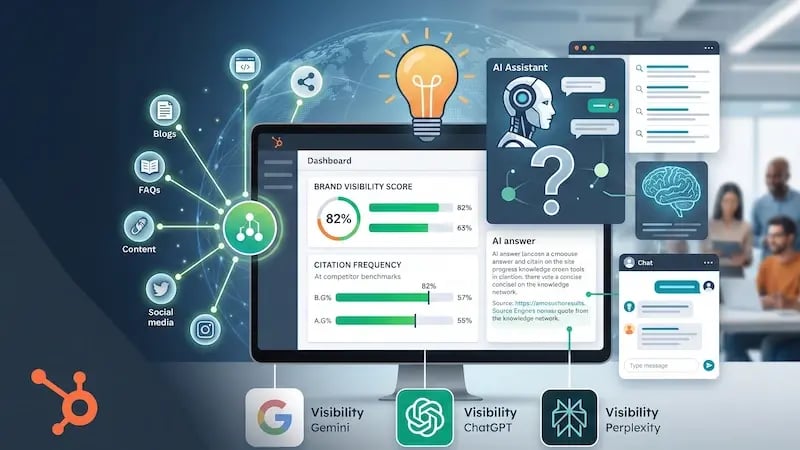 In this new "Ask and Answer" era, traditional SEO rules are no longer enough to guarantee visibility. We have moved firmly into the territory of Answer Engine Optimization (AEO). Answer Engine Optimization (AEO) is the process of optimizing content to be selected and presented as the primary answer by AI-powered search tools and large language models. The question is no longer just "Do I rank?" but rather "Am I the answer that the AI provides?"
If you feel like you're flying blind in this new landscape, you're not alone. Measuring your presence inside a complex neural network is a far cry from checking a Google results page. This is where the Answer Engine Optimization Grader becomes an essential part of your marketing stack. The HubSpot Answer Engine Optimization Grader is a marketing tool designed to analyze and score a brand's visibility, sentiment, and citations within AI-generated answers from models like ChatGPT, Gemini, and Perplexity. This technical guide will walk you through how to use this tool to ensure your business isn't just a result, but the definitive answer.
The Massive Shift: From Search Results to AI Answers
Before we dive into the technical how-to, it's good to refresh ourselves on the why. Why is the Answer Engine Optimization Grader suddenly the most important tool in your belt? The numbers tell a very clear story about where the industry is headed.
According to a recent report by Gartner, organic search traffic to brand websites is predicted to decrease by 25% by the end of 2026 due to the rise of AI chatbots and other virtual agents.
When users get a complete, accurate answer directly from an AI interface, they often have no reason to click through to a website. This "Zero-Click" phenomenon is already well underway.
In fact, research by SparkToro indicates that nearly 58.5% of Google searches now end without a single click.
If your traffic is built on being a link, you are at risk. If your traffic is built on being the source of truth that the AI cites, you are future-proofed.
What is the Answer Engine Optimization Grader?
The Answer Engine Optimization Grader is a diagnostic health check for your brand's AI reputation. Most marketers spend their time optimizing for algorithms they can see. AEO requires you to optimize for Large Language Models (LLMs) that function like black boxes.
This tool pulls back the curtain. It analyzes how your brand is perceived across the "Big Three" of AI search: ChatGPT, Gemini, and Perplexity. It evaluates three critical pillars:
- Visibility: Are you being mentioned at all?
- Sentiment: When you are mentioned, is the tone positive, or is the AI highlighting your flaws?
- Citations: Which specific pages or third-party sites is the AI using to verify information about you?
By using the grader, you move from guesswork to data-driven execution. Let's look at how to move through the phases of using this tool effectively.
Phase 1: Benchmarking Your Brand Visibility Score
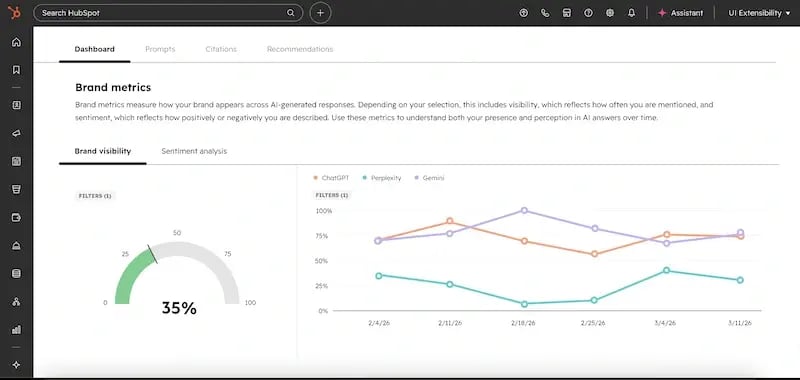
The first step in any technical optimization process is establishing a baseline. When you first run your site through the Answer Engine Optimization Grader, you will receive a Brand Visibility Score. A Brand Visibility Score is a numerical value from 0 to 100 that represents your brand's "share of voice" in AI-generated answers, as measured by the HubSpot Answer Engine Optimization Grader.
 Why Visibility Matters
In traditional SEO, you might rank for "Best CRM Software." You see your link at the top, and you feel successful. In the world of AEO, visibility is about being the recommendation. If a buyer asks, "What is the best CRM for a mid-market manufacturing firm?" the AI will likely list three or four options based on its training data and real-time search capabilities. If you aren't one of those listed options, your visibility score for that specific intent is zero, regardless of your Google rank.
Steps to Benchmark Successfully
- Identify Core Prompts: Don't just track your brand name. Track the questions your customers actually ask.
- Analyze Answer Share: Look at who the AI is recommending. If your competitors are appearing more frequently, the grader will show you which of their assets are outperforming yours.
- Identify Gaps: Many B2B companies discover a "Visibility Gap"—they might have great SEO traffic but 0% AI visibility because their content is too gated or formatted in a way that AI models can't easily parse.
Example: A specialized logistics company recently used the grader and found a surprising result. While they held the top organic spot for "global shipping routes," ChatGPT consistently recommended a smaller competitor. The grader revealed why: the competitor had a plain-text "Knowledge Hub" that the AI could easily read, while the leader's data was hidden inside complex, interactive JavaScript maps that the AI's crawler couldn't fully interpret.
One of the most powerful features of the Answer Engine Optimization Grader is the ability to see where the AI is getting its information. AI models don't just know your pricing or your feature list; they find that data through a process called Retrieval-Augmented Generation (RAG). Retrieval-Augmented Generation (RAG) is the process AI models use to find and incorporate external data from verified sources to generate more accurate and contextual answers.
The Credibility Factor
Citations are the new backlinks. When an AI provides an answer, it builds trust by citing its sources.
According to a user study by Perplexity AI, 75% of users trust AI-generated answers as much as or more than traditional search results—provided that clear citations are included.
Technical Source Mapping
The grader identifies which specific domains the AI is referencing to build its answer about your brand. You might find that the AI is ignoring your own website and instead pulling data from:
- Industry review sites (G2, Capterra).
- Public forums (Reddit, Quora).
- News outlets and PR releases.
- Social media discussions.
If the AI is citing a three-year-old review that mentions a bug you've since fixed, your AEO strategy needs to focus on Off-Page AEO—updating those external signals so the AI has fresh, accurate data to pull from.

Phase 3: Actionable Optimization Strategies
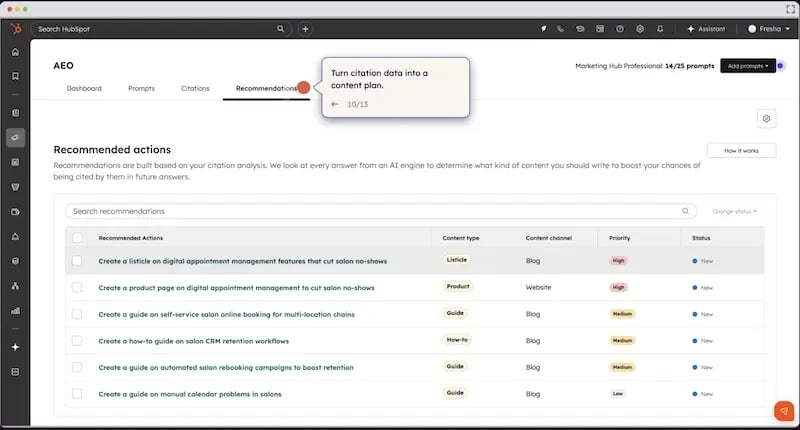
Once the grader has identified your weaknesses, it's time to apply technical fixes. Optimization for AI is less about keyword stuffing and more about Information Density and Entity Recognition.
1. The Identity Protocol: Using Semantic Triples for Global Consistency
If you've followed the shift toward AEO, you likely know about the semantic triple—the Subject-Predicate-Object framework that machines use to understand facts. But while we often discuss this as a writing tool for your blog, it is actually the secret weapon for your off-page SEO.
Think of the semantic triple as your brand's Identity Protocol. When Perplexity or OpenAI's models scan the web, they aren't just looking for your website. They are looking for every mention of your brand across the digital universe to build a Knowledge Graph. A Knowledge Graph is a structured map of interconnected facts and entities that AI models use to understand what your company actually does.
The biggest risk to your AI visibility is the "semantic gap." A semantic gap is a conflict that occurs when your website says one thing but your external profiles say another, which reduces an AI's confidence in your brand.
| Source | Statement (Semantic Triple) |
|---|---|
| Website Statement | "Our software [Subject] automates [Predicate] payroll taxes [Object]." |
| LinkedIn Profile | "We [Subject] empower [Predicate] financial synergy [Object]." |
To a human, these might sound similar. To an AI, they are conflicting data points. If the AI sees a gap, it loses confidence. When confidence drops, the AI is less likely to cite you as a source. To optimize your off-page SEO, you must ensure that every guest post, press release, and social profile uses consistent semantic triples. You are essentially teaching the AI exactly who you are, one clear fact at a time.
Research into RAG systems indicates that providing AI with structured, semantic facts can significantly reduce "hallucination" rates.
Specifically, Microsoft benchmarks show that adding a semantic knowledge layer can improve the accuracy of LLM responses to business-specific queries by up to 40% compared to raw text alone.
Consistency is the key to being the Single Source of Truth.
2. The Strategic TL;DR Summary
Humans scan, but AI models prioritize. One of the best ways to improve your AEO standing is to include a "Too Long; Didn't Read" (TL;DR) summary at the top of every long-form article.
- Technical Tip: Place a 3-4 sentence summary immediately after your H1 tag.
- The Result: The AI sees a high-density "nugget" of information right at the start of the crawl, making it much more likely to be used as a featured snippet or AI answer.
3. Strategic FAQ Integration
Questions are the language of AI. By integrating a robust FAQ section on your product pages, you are essentially "feeding" the AI the exact question-and-answer pairs it needs.
- Use Schema Markup (FAQPage) to make it even easier for the Answer Engine Optimization Grader to recognize your content as an authoritative source.
- Ensure the answers are concise (under 50 words) to fit the conversational format of voice assistants and chatbots.
Phase 4: Overcoming Hallucinations and Negative Sentiment
The Answer Engine Optimization Grader doesn't just look for your name; it looks for your reputation. One of the most frustrating parts of the AI era is the hallucination —when an AI confidently states something false about your company (e.g., claiming you don't have a specific feature that you actually launched last month).
Sentiment Tracking
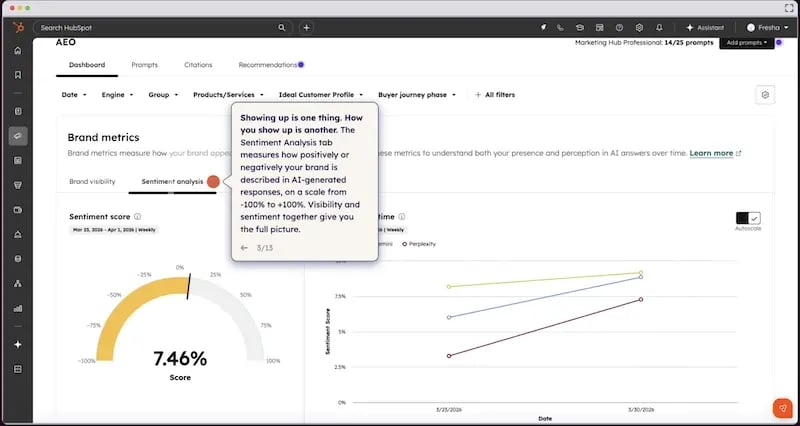
The grader will alert you if the prevailing sentiment in AI answers is neutral or negative. If the AI says, "Users often complain about [Brand]'s complex setup," that information is now part of the permanent "identity" the AI has built for you.
How to Correct the Narrative
- Update the Source: Find the citation the AI is using (often a forum or an old blog post).
- Data Grounding: Use the grader to ensure your technical documentation is up to date and publicly accessible. AI models prioritize "grounded" data—information that can be verified across multiple reliable sources.
- Consistency is Key: The more consistent your information is across the web, the less likely the AI is to hallucinate.
Why the HubSpot AEO Tool is Different
In a sea of marketing tools, why focus on the HubSpot ecosystem for AEO? The answer lies in Data Synergy.
Most AEO tools work in a vacuum. They look at the web, but they don't look at your business. When you use the Answer Engine Optimization Grader within the HubSpot ecosystem, the insights become much sharper. By connecting your CRM data, you can see how AI visibility directly impacts your lead generation and deal velocity.
For example, you might find that leads who found you via a "Perplexity Answer" have a 20% higher conversion rate than those who found you via a standard Google search. This data allows you to prioritize your content budget where it actually generates revenue, rather than just chasing vanity metrics.
Making AEO Part of Your Workflow
Optimization isn't a "one-and-done" task. It's a lifecycle. To stay ahead of the curve, you should integrate the grader into your monthly reporting.
- Monthly Audits: Run the grader to see if your Visibility Score is trending up.
- Prompt Testing: Experiment with different questions. If you launch a new feature, how long does it take for the AI to start mentioning it in answers?
- Content Refinement: Use the grader's recommendations to update your highest-traffic posts with TL;DR summaries and semantic triples.
According to the HubSpot State of Marketing 2024 report,
Nearly 60% of consumers have used AI-driven search for product research in the last quarter.
In that same study,
They also found that 76% of consumers say AI-enabled search sounds more appealing than traditional search, and 72% plan to use AI-powered search for shopping more frequently in the future.
If you aren't optimizing for those searches today, you are essentially handing that percentage of the market to your competitors.
Be the Business the AI Recommends
The digital landscape is changing faster than ever. We are moving away from an era of "browsing" and into an era of "knowing." In this new world, your brand's survival depends on your ability to be the clearest, most authoritative, and most cited answer in the room.
The Answer Engine Optimization Grader is your roadmap. It tells you where you are invisible, where you are misunderstood, and exactly what steps you need to take to fix it. By focusing on entity-based SEO, clear summaries, and consistent data grounding, you can ensure that when a buyer asks an AI for help, your brand is the one that gets the spotlight.
At Aspiration Marketing, we understand that navigating the technical nuances of AI discovery can feel overwhelming. The shift from keywords to answers requires a fundamental change in how you create and distribute content. As experts in the HubSpot ecosystem and pioneers in the AEO space, we specialize in helping brands move through this transition with confidence.
Whether you need help interpreting your Answer Engine Optimization Grader results or you want to build a comprehensive content strategy that dominates across ChatGPT, Gemini, and Perplexity, we are here to provide the expert guidance you need. We don't just help you show up in search results; we help you become the definitive answer that drives growth.
Are you ready to see how your brand scores in the eyes of AI? Let's work together to audit your visibility and secure your place in the future of discovery. The era of being a result is ending—it's time to become the answer.




.webp?width=600&height=375&name=Choose%20B2B%20agency%20for%20EdTech%20(1).webp)

Leave a Comment
Have thoughts on this article?
Share your feedback, ask questions, or join the discussion with our community.