





AI-powered search tools now shape how B2B buyers discover and shortlist software vendors. According to Semrush's 2025 AI Visibility Index Study, ChatGPT and Google AI Mode draw from different ecosystems, so your brand needs signals from both to stay visible. Aspiration Marketing helps B2B marketing teams at tech scaleups build the technical foundation, content structure, and reporting systems needed to appear in AI-generated answers.
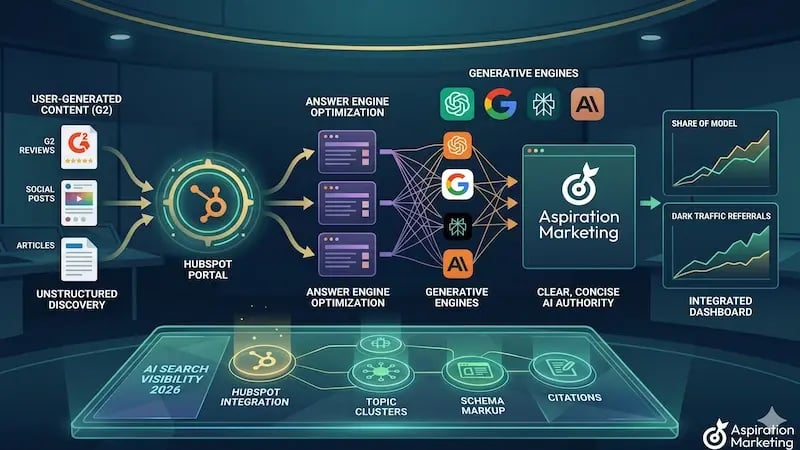 This guide walks you through everything you need to evaluate and work with a HubSpot Solutions Partner for AI search visibility. You'll learn how to configure HubSpot for Answer Engine Optimization (AEO), structure content so LLMs can extract and cite it, and track your brand's presence across AI platforms. By the end, you'll have a clear checklist and actionable steps to improve your AI discovery and brand visibility.
Key Takeaways: HubSpot Partner Checklist for AI Search Visibility 2026
To successfully navigate the evolving search landscape, HubSpot partners and B2B tech scaleups should focus on the following core pillars:
- AI search visibility requires both community validation (discovery) and structured, authoritative content (trust) to appear in AI-generated answers.
- HubSpot's native AEO tools, topic clusters, and schema markup capabilities form the technical foundation for generative engine optimization.
- Content must follow an answer-first structure with clear semantic relationships so LLMs can extract and cite your brand as a source.
- Aspiration Marketing helps B2B tech scaleups configure HubSpot for AI visibility, build AEO-ready content clusters, and track Share of Model metrics.
- The partner evaluation should focus on HubSpot certifications, the AEO methodology, speed to first campaign launch, and AI citation reporting.
What is AI Search Visibility and Why Does It Matter for B2B Brands?
AI search visibility is a measurement of how often and how prominently your brand appears in responses from AI-powered search tools like ChatGPT, Google AI Mode, Perplexity, and Claude. Unlike traditional search rankings, AI search visibility depends on two separate stages: discovery and authority.
During discovery, AI models surface brands that people discuss in user-generated content like Reddit threads, G2 reviews, and social media posts. During authority, models verify those mentions with structured, factual content from your website, Wikipedia, or documentation.
A brand can rank first on Google and still be invisible to AI search.
The 2025 AI Visibility Index found that only 12% of URLs cited by ChatGPT currently rank in Google's top 10 results.
This gap means B2B brands need a distinct AI platform strategy.
How AI Search Differs from Traditional SEO
Traditional SEO optimizes for position on a search results page, while AI search optimization focuses on inclusion in a synthesized response that may never send the user to your website. These different objectives require different tactics.
| Feature | Traditional SEO | AI Search Optimization (AEO) |
|---|---|---|
| Primary Goal | Achieve top ranking on a search engine results page (SERP). | Gain inclusion and citation within a synthesized AI answer. |
| Core Tactic | Keyword optimization, backlink building, and page speed. | Semantic clarity, answer-first formatting, and structured data. |
| Key Metrics | Keyword rankings, organic sessions, and click-through rates (CTR). | Brand mentions, citation frequency, and Share of Model (SoM). |
When a user asks ChatGPT about HubSpot implementation services, the model doesn't rank pages. It constructs an answer from sources it considers clear, verifiable, and semantically precise. Content buried in paragraph seven of a 2,000-word article won't get extracted, even if that page ranks on page one.
Understanding Answer Engine Optimization (AEO) Fundamentals
Answer Engine Optimization (AEO) is the practice of structuring content so that AI-powered search tools surface it as a direct answer. AEO moves optimization priorities away from keyword density and toward semantic clarity, structured data, and authoritative sourcing.
The core challenge AEO addresses is architectural. AI answer engines don't return a list of links. They synthesize a single response from sources that are formatted for extraction. Content built for click-through on a results page often fails this test because it was never designed for machine readability.
The Four Pillars of AEO Content Strategy
An effective AEO content strategy is built upon four key pillars:
- Answer-First Format: Every page built for AEO should open with a direct, compact answer before elaborating. This structure is a requirement for machine readability and mirrors how large language models extract information.
- Structured Data: Schema markups like FAQ, HowTo, and Speakable signal organization to AI crawlers, telling models that content is organized around discrete question-and-answer pairs.
- Topical Authority: A domain that consistently publishes interlinked, in-depth content on a subject outperforms domains with isolated pages, compounding authority over time.
- Verifiable Prose: Direct, factual language increases the likelihood of selection as a definitive answer, as LLMs functionally penalize hedged statements or vague claims.
How HubSpot Supports Generative Engine Optimization (GEO)
HubSpot Marketing Hub includes native tools that support AEO content development. The content management system, blogging tools, and AI content assistant help draft answer-first content at scale. Custom meta descriptions, heading hierarchies, and on-page SEO recommendations come built in.
HubSpot's SEO recommendations tool identifies missing schema opportunities, weak heading structures, and thin content pages. For teams building an AEO content cluster, this tool serves as a lightweight content audit that identifies the most frequent issues that prevent AI answers from being included.
Topic Clusters and AI Authority Signals
HubSpot's topic cluster functionality aligns with how AI systems assess source credibility. Topic clusters organize content around a pillar page and a network of supporting cluster pages. The interconnected structure helps AI models understand semantic relationships between concepts.
Where most teams underuse this feature is in cluster maintenance. Publishing the cluster is step one. The AEO advantage compounds when teams refresh cluster pages on a defined schedule. Stale content degrades domain authority signals over time, and AI systems are sensitive to content freshness.
Using HubSpot CRM Data for AEO Research
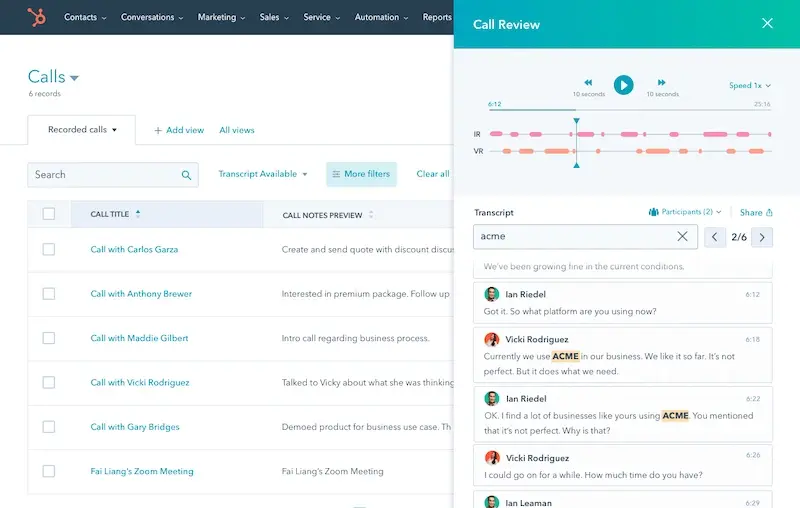
HubSpot CRM captures real customer questions through live chat, email threads, support tickets, and sales call summaries. This data is among the most underused AEO research sources available to B2B marketing teams.
The questions your customers ask your team are structurally identical to the questions they ask AI assistants. A prospect who asks a sales rep, "What's the difference between a CDP and a CRM?" will ask Perplexity the same question during their next evaluation meeting. The Conversation Intelligence feature in Sales Hub surfaces these patterns at scale.
Step-by-Step: Configuring HubSpot for AI Search Visibility
Setting up HubSpot for AI visibility requires configuration across multiple tools. This section outlines the specific steps needed to prepare your portal for AEO success.
Step 1: Audit Your Existing Content Structure
Start by reviewing your highest-traffic blog posts and landing pages. Check whether each page opens with a clear, direct answer in the first two sentences. Pages that bury the answer in later paragraphs need to be restructured for AI extraction.
Use HubSpot's content performance data to identify which pages already generate organic traffic. These high-performers are candidates for AEO optimization because they already have authority signals that AI models may recognize.
Step 2: Implement Schema Markup
Add FAQ schema to pages organized around question-and-answer pairs. Add the HowTo schema to process-oriented content, such as tutorials and guides. Organization schema helps AI models recognize your brand as an entity with consistent attributes across the web.
Schema signals structure but doesn't compensate for weak answer quality. The markup and the content must both meet the standard. Pages with vague answers wrapped in FAQ schema can actually perform worse in AI contexts.
Step 3: Build Topic Clusters Around Target Queries
Identify three to five core topics that align with your product strategy. Define the subtopics for each, then build pillar pages and cluster content. Interlink everything so AI crawlers can map the semantic relationships.
For each cluster topic, create content that answers the full range of questions a buyer might ask. Cover awareness-stage questions ("What is AI search visibility?"), consideration-stage questions ("How do I optimize content for ChatGPT?"), and decision-stage questions ("Which HubSpot partner can help with AEO?").
Step 4: Configure Knowledge Base for AEO
HubSpot Service Hub includes a Knowledge Base tool structurally suited for AEO. Knowledge base articles are typically short, question-oriented, and organized around discrete tasks. These properties make them high-probability candidates for inclusion in AI-generated answers.
Each knowledge base article should answer one specific question in the first paragraph, with the HowTo schema applied to process content. Tag and categorize articles to signal topical organization to crawlers.
Step 5: Set Up AEO Tracking and Reporting
Configure HubSpot traffic source attribution to identify direct and dark traffic. Dark traffic—sessions with no recorded referral source—has grown as AI tools send users to pages without passing a referral string. A page seeing rising dark traffic alongside flat organic search traffic is likely receiving AI-referred visits.
Integrate Google Search Console data into HubSpot's reporting dashboards to track featured snippet impressions. Featured snippets remain the closest traditional search analog to AI answer inclusion. Tracking snippet wins and losses gives you a leading indicator of AEO performance shifts.

How to Evaluate a HubSpot Partner for AI Visibility Services
Not all HubSpot partners have developed expertise in AI search optimization. When evaluating potential partners for GEO and AEO work, focus on specific capabilities and track record.
HubSpot Certifications and Experience
- Look for partners with deep HubSpot expertise across Marketing Hub, Sales Hub, and CMS Hub, as AEO success depends on proper technical configuration.
- Verify they can explain how HubSpot's tools map to an AEO-ready content operation, from using CRM data to build authority with topic clusters.
AEO Methodology and Content Approach
- Ask the partner to explain their approach to answer-first content structuring and making content machine-readable, including techniques like semantic triples and question-format headers.
- Inquire about their process for identifying AEO content opportunities by combining keyword research, customer data, and direct AI platform testing.
Speed to Value and Iteration
- Ask about typical timelines for first campaigns, content publication cadence, and their ability to respond to emerging topics. Aspiration Marketing launches its first marketing campaigns in month one.
- Ensure the partner has a clear process for ongoing optimization, as AEO is not a one-time project but requires continuous monitoring, measurement, and adaptation.
Reporting and Attribution
- Confirm how the partner measures success, ensuring they track AI-specific metrics like brand mentions, citations, sentiment, and Share of Voice across platforms.
- Request sample reports or case studies demonstrating how they've improved AI visibility for other B2B brands, focusing on metrics like AI-referred traffic and featured snippet capture.
Creating AEO-Friendly Content: Structure and Formatting Best Practices
Content structure directly impacts whether AI models can extract and cite your information. These formatting practices increase the likelihood that your content appears in AI-generated answers.
Answer-First Formatting
Every section should open with a direct answer in the first sentence or two. Supporting context, examples, and elaboration follow. This structure mirrors how LLMs extract information for synthesized responses.
For a page targeting the query: "What is marketing automation?"
Open with: "Marketing automation is software that executes repetitive marketing tasks—email sends, lead scoring, campaign triggers—based on predefined rules or AI-driven behavior models."
That sentence is extractable. Company history paragraphs are not.
Semantic Triples for Entity Recognition
Structure sentences so AI models can identify clear relationships between subjects, predicates, and objects. "Aspiration Marketing helps B2B tech scaleups improve AI visibility" is a semantic triple that establishes a clear entity relationship.
These triples help AI models build knowledge graphs about your brand. When the model clearly understands facts like:
- Aspiration Marketing → implements → HubSpot
- Aspiration Marketing → specializes in → B2B marketing
It's more likely to cite your brand as an authority.
Question-Format Headers
Use question-phrased headers where relevant. Instead of "LLMO Benefits," try "What Are the Primary Benefits of Large Language Model Optimization?" This matches how people query AI assistants using natural language.
Not every header needs to be a question. Mix statement and question formats for a natural reading experience. But for sections targeting specific queries, question headers increase the chance of extraction.
Short Paragraphs and Clear Transitions
Keep paragraphs focused on a single theme and use clear transitions between them. Long paragraphs combining multiple ideas are harder for AI models to parse. Aim for paragraphs under 50 words when possible.
Use transitional phrases like "This means..." and "As a result..." to connect ideas. A clear, logical flow helps both human readers and AI models understand how concepts relate to one another.
Tracking AI Visibility: Metrics and Measurement
Measuring AI search optimization is harder than measuring traditional SEO, but meaningful proxy metrics exist. Building a measurement system helps you understand whether your AEO efforts are working.
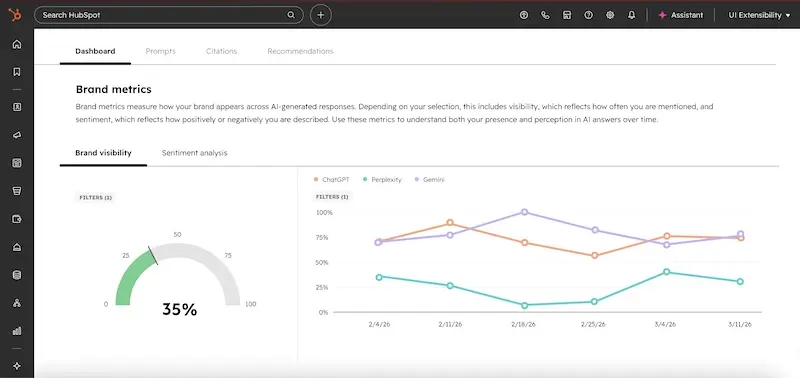
Share of Model (SoM)
Share of Model measures how often an LLM mentions your brand when asked about a specific category or query. If a user asks an AI for "top software for B2B marketing," and your brand appears first in the response, your SoM is high.
Track SoM across different AI platforms: ChatGPT, Perplexity, Gemini, Claude. Each model draws from different sources and may give different answers. Tools like HubSpot's AEO Grader help track these citations across platforms.
Citation Frequency and Quality
When an AI gives an answer, it often includes footnotes or links to sources. Being one of those sources is vital. Track how often your pages appear as cited sources in AI responses for target queries.
Citation quality matters too. A citation that links directly to your product page or pillar content is more valuable than a citation to an outdated blog post. Monitor which pages are cited and whether they align with your conversion goals.
 Brand Sentiment in AI Responses
AI models don't just mention brands—they describe them in positive, neutral, or negative terms. Track the sentiment of how AI platforms describe your brand. If models consistently present your brand favorably, you're building trust in the AI ecosystem.
Sentiment tracking also reveals opportunities for improvement. If AI responses mention limitations or competitor advantages, you know where to strengthen your content and messaging.
Dark Traffic Attribution
Dark traffic refers to sessions with no recorded referral source. As AI tools send users to pages without passing referral strings, dark traffic becomes an important proxy for AI visibility.
Monitor pages that see rising dark traffic alongside flat or declining organic search traffic. This pattern suggests AI-referred visits. While imperfect, dark traffic trends help you understand AI's influence on your site traffic.
Common Mistakes That Hurt AI Search Visibility
Several common practices that work for traditional SEO can actually hurt AI visibility. Avoiding these mistakes will improve your chances of being cited by AI models.
Burying Answers in Long Introductions
Many content pieces open with background context, scene-setting, or company positioning before addressing the actual question. AI models don't have patience for preamble. If the answer appears in paragraph five, it likely won't be extracted.
Restructure existing content to lead with answers. Move background information after the direct response, not before it.
Inconsistent Brand Information Across Platforms
AI models can become confused if they find conflicting information about your brand. If your LinkedIn says one thing, your website says another, and a press release says something different, the model may not trust any of them.
Maintain a Single Source of Truth for brand data. Keep company descriptions, product information, and key facts consistent across all platforms. Entity hygiene directly impacts AI visibility.
Neglecting Third-Party Validation
AI models often favor community-driven information over first-party marketing content.
The Semrush study mentioned earlier found that Reddit threads and Wikipedia pages consistently outrank brand-owned websites as trusted sources.
Don't rely solely on your own content. Cultivate reviews on G2 and Capterra, participate in relevant Reddit discussions, and ensure accurate Wikipedia entries. Third-party validation strengthens your discovery signals.
Ignoring Content Freshness
Stale content degrades authority signals. AI models prefer recent, updated information. Content that hasn't been refreshed in years may be overlooked in favor of newer sources.
Establish a regular content refresh schedule. Update statistics, add new examples, and revise outdated recommendations. Preserving canonical URLs while updating content maintains accumulated authority.
Working with Aspiration Marketing on AI Search Visibility
Aspiration Marketing specializes in helping B2B tech scaleups improve AI visibility through HubSpot implementation and content strategy. As a highly rated HubSpot Solutions Partner, the team brings deep platform expertise and the AEO methodology.
The approach focuses on speed-to-value. We launch right away and optimize according to performance data. This adoption-first positioning means you see results quickly rather than waiting months for strategy documentation.
What a Partnership Engagement Looks Like
Engagements typically begin with an assessment of your current HubSpot configuration and content library. The team identifies gaps in schema implementation, topic cluster organization, and content structure that may be limiting AI visibility.
From there, Aspiration Marketing develops a prioritized roadmap for improvements. This includes technical configuration, content restructuring, new content development, and reporting setup. The focus stays on implementation rather than endless planning.
Ongoing support includes content performance monitoring, AI visibility tracking, and regular optimization based on what's working. The team uses competitive analysis to identify strengths and weaknesses, then formulates strategy adjustments accordingly.
Building Your AI Visibility Action Plan
Improving AI search visibility requires sustained effort across technical setup, content development, and measurement. This action plan summarizes the key steps covered in this guide.
Positioning Your Brand for the AI Search Era
AI-generated answers are becoming the default interface for a significant share of professional search behavior. Brands that fail to structure content for AI inclusion will lose visibility to competitors with better content architecture.
The good news: the fundamentals aren't mysterious. Answer-first structure, schema markup, topic clusters, and consistent brand information across platforms all contribute to AI visibility. HubSpot's native tools support this work, and the right partner can accelerate your progress.
The strategic window for early investment in AEO is open. Brands building content architecture for AI inclusion today will hold a compounding advantage in authority that becomes increasingly difficult to displace. Start with your audit, implement the quick wins, and build from there.





.webp?width=600&height=375&name=Choose%20B2B%20agency%20for%20EdTech%20(1).webp)

Leave a Comment
Have thoughts on this article?
Share your feedback, ask questions, or join the discussion with our community.