




Have you looked at your Google Analytics lately and felt a strange sense of confusion? You aren't alone. Many marketing managers are staring at a growing gap: their organic website traffic is dipping, yet their high-quality leads are actually staying steady or even increasing. It feels like a glitch in the matrix, doesn't it? If fewer people are clicking through to your site, how are they still finding you, trusting you, and buying from you?
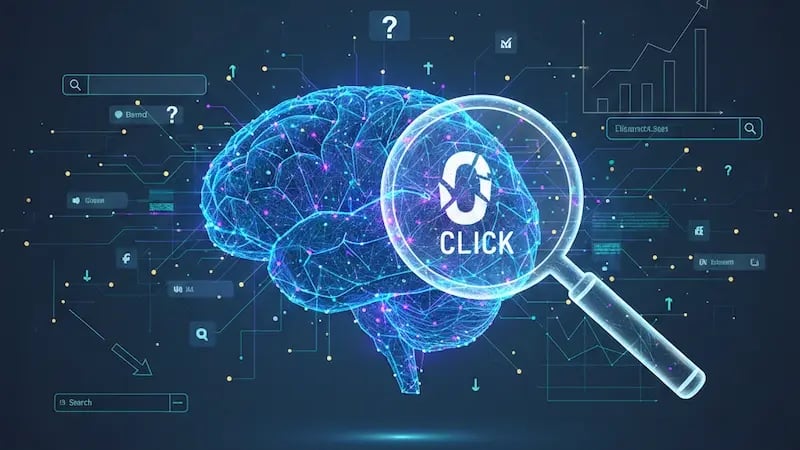 The answer lies in a massive shift in how people find information. We have officially entered the era of zero-click search. **A zero-click search is a search query where the answer is provided directly on the results page, making a click to a website unnecessary.** This is a world where Google, Bing, and AI-powered platforms like ChatGPT or Perplexity provide the full answer directly on the results page. The user gets what they need without ever having to click a single link. For a decade, we optimized for the click. Today, we must optimize for the answer.
This evolution is known as Answer Engine Optimization (AEO). **AEO is the practice of optimizing content to be featured in AI-generated answers, focusing on visibility over clicks.** If you want to stay relevant, you have to stop measuring success solely by sessions and start measuring your AI Visibility. But how do you track something that doesn't always result in a visit to your website?
The Big Shift: Why the Click is Fading
For years, the goal of SEO was simple: rank high, get the click, and convert the visitor. Today, in the world of AEO vs SEO, that linear path is broken. According to data from Similarweb and SparkToro,
As of early 2025, an estimated 69% of Google searches are zero-click, up significantly from 56% just a year prior.
When a user asks, "What are the best CRM features for a small law firm?", Google's AI Overviews (AIO) or a specialized Answer Engine will synthesize a perfect list. The user reads it, takes a screenshot, and moves on. They got the value, but you didn't get the "hit" on your server.
Is this bad news? Not necessarily.
While Semrush reports that AI Overviews can cause organic click-through rates (CTR) to drop by 34% to 61% on informational queries, there is a hidden benefit.
The traffic that reaches your site is often much more qualified. They have already seen the AI summary and are clicking because they want your specific expertise, unique data, or your product.
In fact, RankScience research indicates that AI-referred traffic can convert at rates 4 to 5 times higher than traditional search traffic—averaging a 14.2% conversion rate compared to the standard 2.8%.
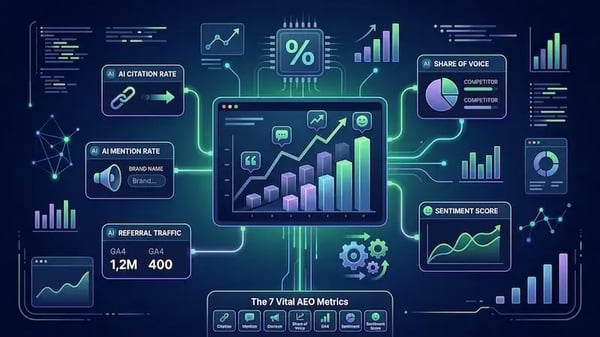
To thrive in this environment, we need a new set of metrics. Let's look at the four critical pillars of AI visibility.
1. Share of Model (SoM): The New Share of Voice
In traditional marketing, we talk about "Share of Voice"—how much of the total conversation in your industry is about your brand. In the age of AEO, we track Share of Model (SoM).
What is Share of Model?
Share of Model (SoM) is a metric that measures how frequently a specific Large Language Model (LLM)—like GPT-4o, Claude, or Gemini—mentions or recommends your brand when prompted with relevant industry questions.
Imagine you sell project management software. If you ask ChatGPT, "Which tools are best for remote creative teams?" and it lists five options, you want to be one of them. If the AI lists you 30 times out of 100 similar prompts, your Share of Model is 30%.
How to Measure It
Since AI models don't provide a public dashboard for this, marketers are turning to "AI/ego prompting" and specialized AEO tools. You can run batches of prompts related to your top keywords and see:
How often is your brand mentioned?
Are you listed as a "top recommendation" or a "runner-up"?
Does the AI link to your site as a primary source?
This metric is vital because even if the user doesn't click, your brand is being verified by the AI. This builds significant trust and keeps you in the user's consideration set when they are ready to buy.
2. Citation Frequency and Position Prominence
In the world of zero-click search, your website becomes an AI reference library. Think of AI platforms like a student writing a research paper. They scan the web, find the best info, and then (hopefully) cite their sources.
The Value of the "Digital Footnote"
When Google AI Overviews or Perplexity provide a summary, they usually include a few key links. Being one of these citations is the new "Position Zero." It provides a stamp of authority that traditional organic rankings can't match.
According to Seer Interactive, sources cited in AI Overviews can see a 35% higher organic CTR compared to links that are buried further down in the traditional blue-link results.
Measuring Prominence
To track this, look at your Impressions in Google Search Console. If your impressions are rising or holding steady while your clicks drop, it's a sign you are being used as a source in AI Overviews. You are being seen; you just aren't being "clicked" yet. This visibility remains high-value because it primes users for your brand.
3. Brand Sentiment and Entity Alignment
It isn't just about whether the AI mentions you; it's about how it describes you. AI models categorize the world into "entities." An entity is a person, place, or thing that the AI understands as a distinct concept.

The Risk of Hallucinations
If an AI summary says, "Brand X is a great budget-friendly option," but you (Brand X) are actually a premium enterprise provider, you have a visibility problem. The AI has hallucinated your brand position.
In the zero-click search era, your reputation is managed by algorithms. You need to monitor:
Adjective Alignment: What words does the AI use to describe you? (e.g., "fast," "expensive," "reliable," "complex").
Category Accuracy: Does the AI list you in the right category? If you sell "Customer Success Software" but the AI keeps calling you a "Help Desk," your AEO strategy needs a pivot.
How to Fix It
To improve sentiment, your content must be incredibly clear and structured. Use simple, direct language. Avoid corporate jargon that might confuse a machine. Use schema markup to tell the AI exactly what you are: "We are a [Premium] [Enterprise] [Software Provider]."
4. The "Pull Effect": Branded Search Volume
One of the most interesting side effects of zero-click search is that it actually encourages users to search for you by name later.
Think about your own behavior. You ask an AI, "How do I fix a leaky faucet?" The AI gives a great answer and cites "PlumbingPro.com" as a source. You don't click the link right then, but ten minutes later, you go to Google and type in "Plumbing Pro tutorials."
This is the "Pull Effect." Data from Amsive shows that,
While general informational clicks are down, branded keyword CTR actually increased by 18.68% when an AI Overview was present.
Measuring the Pull
Watch your Google Search Console for your own brand name. If you see a spike in people searching for "[Your Brand] + [Topic]," it means your AEO and zero-click visibility are working. You have moved the user from "searching for a solution" to "searching for YOU."
Adapting Your Marketing Dashboard for 2026
If you are still reporting on sessions and bounce rate as your primary KPIs, you are missing half the story. To win in the AEO era, you need to update your dashboard to include these three focus areas:
1. Assisted Conversions (The Long Game)
Standard attribution often gives all the credit to the last click. But in 2026, the first touch might have happened inside a ChatGPT window. Use multi-touch attribution models to see if users who eventually buy from you had their first interaction through a branded search or a direct visit—both of which are often triggered by AI visibility.
2. Information Impressions
Track your impressions for your most important "how-to" and "what is" keywords. If impressions are deep, you are winning the visibility game. You are the silent teacher in the user's journey. Don't punish your content team because those impressions didn't turn into clicks; celebrate that your brand was the one that educated the buyer.
3. LLM Audit Scores
Once a quarter, run an LLM Audit. Ask the top three AI models 20 questions about your industry. Score yourself:
Presence: Were you mentioned? (Yes/No)
Accuracy: Was the info correct? (1-10)
Citation: Did they provide a link? (Yes/No)
Content Strategy for the Zero-Click Era
To stay visible, your content strategy has to change. It's no longer enough to write a long-form blog post and hope for the best. You need to create content that is machine-readable and human-engaging.
Be the Direct Answer
Start your articles with a clear, concise answer to the primary question. This is often called the inverted pyramid style of writing. If your blog is about
"The cost of solar panels,"
The very first paragraph should say,
"The average cost of solar panels in 2026 ranges from X to Y."
This makes it easy for an AI to grab that snippet and cite you.
Use Structured Data
Schema markup is like giving an AI a map. It tells the search engine exactly what the page's data represents. Use it for FAQs, product prices, reviews, and "How-To" steps. The more structured your data, the more likely you are to appear in those coveted zero-click summary boxes.
Focus on Original Data
AI models are trained on the internet. If you just rewrite what everyone else is saying, the AI doesn't need to cite you—it already knows that info from a thousand other sites. But if you publish a "2026 Industry Report" with original statistics and unique case studies, the AI has to cite you because you are the sole source of that specific information. Originality is your best defense against being "summarized away."
Why Quality Leads Are Rising While Traffic Falls
Let's go back to that "Search Paradox" we mentioned at the start. Why is lead quality going up if traffic is going down?
In the old days of SEO, you would get a lot of window shoppers. These were people who clicked your link, realized it wasn't exactly what they wanted, and left. Today, the AI does the window shopping for them.
When a user finally clicks through to your site in 2026, they have already been "pre-vetted" by the AI. They know you have the answer. They know you are a top-rated provider. They aren't there to browse; they are there to act. This is why your conversion rates are likely rising. You are getting less "fluff" and more "intent."
The key is not to panic when you see your traffic numbers dip. Instead, look at your bottom-line results. Are your demos increasing? Is your "Contact Us" form getting more hits? If so, your AEO strategy is working perfectly. You are winning the battle for visibility in the zero-click world.
Winning the Answer Engine Era
The rules of the game have changed, but the goal remains the same: be the most helpful, most trusted authority in your space. The shift from SEO to AEO isn't a threat; it's an opportunity to cut through the noise and speak directly to your customers, even if you're speaking through an AI.
Success in 2026 is measured by how often you are the "trusted source" for the machines that your customers trust. It's about being the definitive answer in a world of endless questions.
Navigating this transition requires a partner who understands the nuances of AI-driven search. At Aspiration Marketing, we specialize in helping brands move beyond traditional metrics to find true success in the age of AEO. Whether it's auditing your current AI visibility or building a comprehensive strategy for navigating the shift to 2026, we ensure your brand doesn't just survive the zero-click era—it thrives in it.
The "click gap" is widening every day. Is your brand prepared to be the answer, or will you be left out of the conversation? It's time to stop chasing clicks and start building authority.



.webp?width=600&height=375&name=Choose%20B2B%20agency%20for%20EdTech%20(1).webp)

Leave a Comment
Have thoughts on this article?
Share your feedback, ask questions, or join the discussion with our community.