





Marketers measure everything: open rates, clicks, impressions, scroll depth, and followers. While these activity metrics fill dashboards, they often obscure true business impact. This is where Outcome-Focused KPIs come into play. Outcome-Focused KPIs are key performance indicators that directly measure the impact of marketing efforts on core business goals like revenue, customer retention, and long-term value.
Sometimes we look at numbers that are easy to pull and present. Clicks look reassuring in a slide deck. Impressions feel like momentum. Even follower growth can sound like progress if no one asks the next question. But sooner or later, someone does. Usually finance. Usually at the worst time.
 That's where KPIs are supposed to come in. They're signals that tie your work to something the business actually cares about: money coming in, customers sticking around, value compounding over time.
That's the real question heading this year: not whether you should track outcomes, but which outcomes are worth defending when someone asks why this work deserves to exist.
The Difference Between Reporting Metrics and Decision Metrics
Most marketing metrics exist to be reported, but fewer are used to make decisions. It's crucial to distinguish between them.
Reporting metrics are the numbers that explain what happened. They show activity, volume, and direction—such as clicks, impressions, opens, and traffic by channel. They're useful for context and diagnostics, but they don't tell you what to do next on their own.
In contrast, decision metrics are the key performance indicators you are willing to act on—to cut spend, double down, or change strategy, even when the data isn't perfect.
The confusion starts when reporting metrics are treated like decision inputs.
A few common signs:
- Success is declared before revenue, retention, or value moves
- A metric looks good in a deck, but doesn't change any behaviour
- Teams debate attribution instead of deciding what to stop or start
Outcome-Focused KPIs tend to work better as decision metrics because they force tradeoffs. Revenue growth, retention, and lifetime value don't explain why something happened, but they make it clear whether it mattered.
That's the separation most teams miss:
- Reporting metrics help you investigate
- Decision metrics help you choose
You still need both. Channel metrics help diagnose performance shifts. Outcome-Focused KPIs decide whether those shifts justify a change in strategy or budget.
Why Outcome-Focused KPIs Matter Today
Marketing budgets aren't expanding. Scrutiny is.
Gartner puts marketing spend at about 7.7% of company revenue.
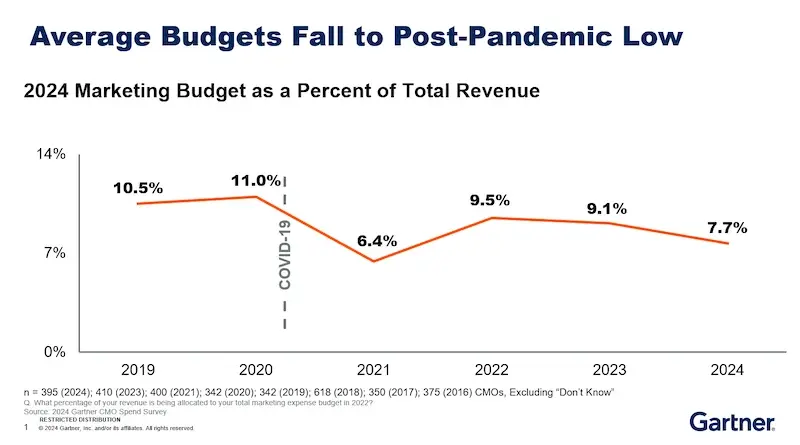 Marketing budgets are holding steady, but leaders want to know what moved revenue, retention, or market share. Activity reports don't answer that.
Outcome-Focused KPIs do.
When marketing tracks the same things the business cares about, such as revenue growth, profitability, and customer value, it's easier to defend decisions and easier to cut what isn't working. The conversation shifts from "what did we do?" to "what did this change?”
There's also less room to hide behind channel metrics. Privacy changes, weaker attribution, and signal loss have made clicks and impressions less reliable. Google’s Privacy Sandbox is just one example. You can model around gaps, but only if the end metric is worth modeling toward.
That's why outcome-focused KPIs matter now. Not because they’re sophisticated, but because they hold up when the numbers get questioned.
Key Outcome-Focused KPIs for Marketers
Outcome-Focused KPIs are metrics that exist to answer one question: Did marketing help the business move forward? These metrics matter because they tie your work to growth, retention, and long-term value.
Revenue Growth Rate
Revenue Growth Rate is a measure of the increase in a company's sales over a specific period. This KPI keeps marketing honest.
Use it to check:
- Whether campaigns are creating demand where the business actually makes money
- Which segments, channels, or product lines are pulling their weight
- Whether rising activity is backed by real growth or just noise
If engagement is up but revenue isn't moving, the problem is usually alignment.
Adrian Iorga, Founder and President of Stairhopper Movers, runs a high-volume moving operation where lead quality matters more than raw demand.
Iorga explains,
We can generate a lot of inquiries, but that doesn’t mean the business is growing. What matters is booked moves, deposits, and jobs we can actually service well. Revenue growth tells us whether marketing is bringing in the right customers, not just more noise.
Customer Lifetime Value (CLV)
Customer Lifetime Value (CLV) is a metric that represents the total net profit a company can expect to generate from a single customer account. Most profit doesn't show up at acquisition. It shows up later.
CLV helps you decide:
- How much acquisition spending makes sense in the first place
- Which customer segments are worth prioritising
- Where retention work has a real financial impact
Tracked alongside retention, CLV makes it clear which campaigns build durable value and which create one-off conversions.
Wang Dong, Founder of Vanswe Fitness, sells premium home fitness equipment where long-term customer value matters more than one-time purchases.
Wang says,
We care less about cheap conversions and more about customers who keep their equipment, use it, and come back for accessories or upgrades. Lifetime value shows us which campaigns bring in serious buyers versus people who were never a good fit to begin with.
If you want to understand why many teams calculate CLV correctly but still use it badly, read Harvard Business Review’s take on it.
Net Promoter Score (NPS)
Net Promoter Score (NPS) is a customer loyalty and satisfaction metric that measures the likelihood of customers to recommend a company's products or services. NPS is intentionally blunt.
It tells you:
- Whether customers would recommend you
- Whether marketing promises line up with the real experience
- How well expectations are being set
When marketing owns NPS, messaging usually gets tighter faster. Overpromising shows up immediately. Brand sentiment still matters, but NPS keeps the focus on attracting the right customers, not just more of them.

Conrad Wang, Managing Director of EnableU, oversees in-home aged care, disability support, and allied health services across Australia, where trust and referrals directly affect growth.
Wang says,
In care services, you can't hide behind messaging. Families talk to each other. If what we promise doesn't match what someone experiences in their home, it shows up fast, in feedback, referrals, and retention. Tracking recommendation rates keeps us honest about whether our marketing reflects reality.
To put it simply, NPS bridges the gap between marketing promises and customer experiences.
Customer Retention Rate
Customer Retention Rate is the percentage of existing customers who remain customers over a specific period. This metric answers the question acquisition avoids: do people stay?
It reflects:
- Targeting quality
- Onboarding effectiveness
- Lifecycle marketing performance
Andrew Bates, COO of Bates Electric, works with commercial and residential clients who often return for maintenance, upgrades, and long-term electrical work.
Bates notes,
Retention tells us whether customers trust us enough to call again. One job is fine, but repeat work and referrals are where the business becomes predictable. When retention improves, it’s usually because expectations were set clearly and the experience matched what marketing promised.
It also ties directly to profit. Even small improvements in retention tend to outperform acquisition gains over time, which is why Bain has long documented its financial impact.
How to Implement Outcome-Focused KPIs
Changing your scorecard requires both strategy and new habits. Most organizations can follow this path:
- Start by listing everything you report today. Mark the metrics that connect directly to revenue, retention, or customer value. Move everything else into a "diagnostic" category and reduce how often you report it.
- Then speak to the rest of the business. Meet with finance, sales, product, and customer success teams. Agree on shared outcomes: revenue growth targets, net revenue retention, CLV by segment.
- Your data infrastructure needs work, too. You don't need an elaborate tech stack, but you do need clean data. Consolidate sources, define consistent IDs, and use tools that support modeled measurement. Signal loss has brought marketing mix modeling back into favor. Google provides a helpful overview.
- Set targets tied to company plans and review them monthly. Build a rhythm where teams examine outcomes first, then drill into channel and creative details when needed.
Treat your KPIs like a product: version them, test them, improve them as your business changes.
Read our quick guide on collaborating with other people to achieve growth.
Challenges in Adopting Outcome-Focused KPIs
Every transformation hits obstacles. Knowing what to expect helps you prepare.
Data Silos
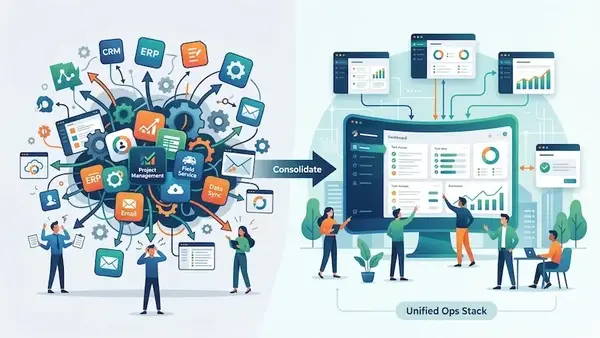
Fragmented systems make connecting the dots difficult, as shown below.
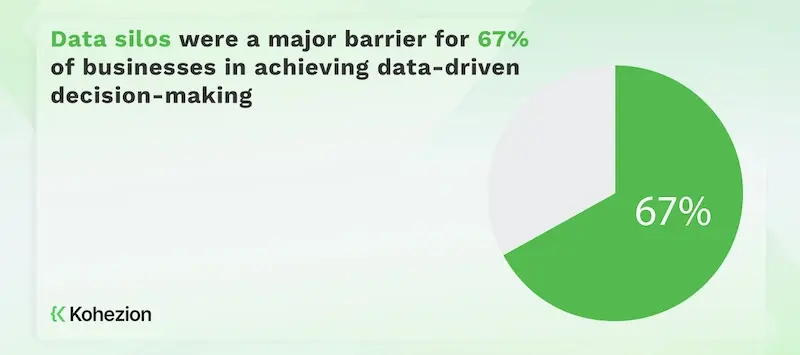 Most companies now run dozens of marketing and sales applications, which creates measurement headaches. Okta's Businesses at Work report shows how sprawling the average SaaS stack has become. Start by integrating core sources: ad platforms, web analytics, CRM, and billing systems. Create a shared ID strategy.
Organizational Buy‑in
If leadership still asks for impression counts first, your adoption will stall. Bring finance and sales into the design process early. Show them how the new scorecard ties to revenue planning and forecasting. Shared dashboards make impact visible and build support.
Skill Gaps
Outcome metrics require comfort with attribution, cohort analysis, and financial thinking. Lots of companies leave this to the last minute, as shown below.
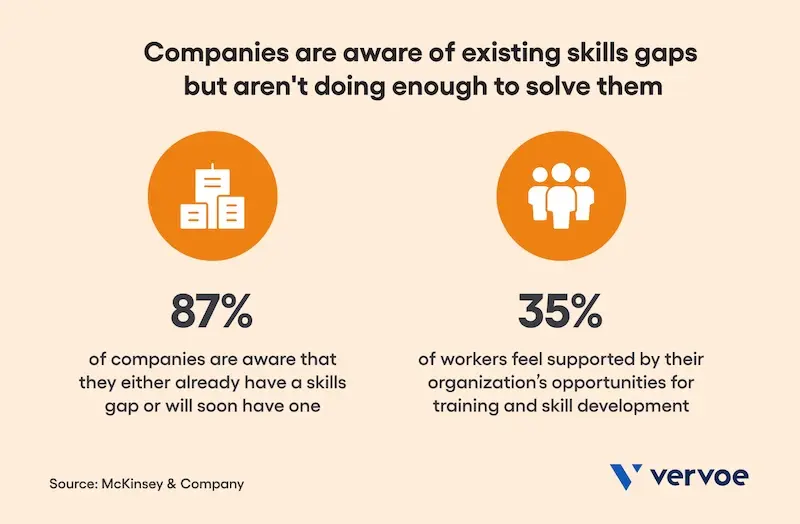
Close any skills gap with targeted training and a simple measurement playbook. If that feels overwhelming, start small: one segment, one product line, one cohort.
How to Work With Imperfect Data Without Guessing
Browsers cut off third-party cookies. Consent frameworks fragmented sessions. Platforms still show numbers, but fewer of them are directly observed. More is inferred, modeled, or delayed.
That’s why attribution feels weaker than it did a few years ago. You’re not missing dashboards. You’re missing signals.
This changes what's safe to rely on. Channel metrics can still be useful, but they're no longer precise enough to anchor decisions on their own. A clean-looking report doesn't mean the underlying data is clean.
What still holds up are outcomes that don't depend on full visibility:
- Revenue growth
- Retention
- Customer lifetime value
You don’t need to see every touchpoint to know whether revenue is growing or customers are staying. Those metrics move more slowly, but they’re harder to fake.
The mistake teams make is trying to recover certainty by adding more proxies. More dashboards. More blended attribution models. That often increases confidence without increasing accuracy.
The safer approach is narrower:
- Pick a small number of outcome metrics
- Watch them over time, not week to week
- Use channel data to explain changes, not to declare success
Imperfect data isn't the risk. Treating inferred signals as facts is.
Success Stories with Outcome-Focused KPIs
These companies are committed to fewer metrics and built decisions around them.
Enterprise Rent-A-Car and NPS
NPS gained traction largely because Enterprise tied it directly to growth. The company measured customers' willingness to recommend, shared results at the branch level, and required teams to act on feedback quickly. That closed the loop between frontline experience and business performance.
Harvard Business Review documented this approach, showing how a single outcome metric aligned incentives and behavior across the organisation.
Starbucks And Retention-led Growth
Starbucks uses retention and loyalty as core performance indicators, not supporting metrics. Its Rewards program sits at the centre of the growth strategy, with active membership and repeat engagement tracked alongside revenue.
In its fiscal 2025 results, Starbucks highlighted continued expansion in Rewards members and linked that growth directly to consistent sales performance.
The New York Times And Subscriber Value
The New York Times reorganised around subscriptions rather than one-off purchases. Lifetime value, retention, and bundle adoption became the primary indicators of success.
Earnings reports and public filings show how this focus translated into multi-product subscriptions and steadier long-term growth, rather than chasing isolated conversions.
Different industries, same pattern: choose a small set of outcome metrics, align teams around them, and reinforce those priorities through daily decisions.
What This Means for Your Work
Outcome‑focused KPIs give marketing teams clarity about what matters and evidence to improve with confidence. Revenue growth, CLV, NPS, and retention answer the question that counts: Is this work moving the business forward?
Marketing measurement will continue to evolve as data and channels evolve. Stay close to business outcomes, build shared dashboards, and keep refining your measures. You'll adapt to whatever comes next with real confidence that your work creates value.
For more practical guidance on building marketing programs that tie directly to business outcomes, visit Aspiration Marketing.

.webp?width=600&height=375&name=Choose%20B2B%20agency%20for%20EdTech%20(1).webp)



Leave a Comment
Have thoughts on this article?
Share your feedback, ask questions, or join the discussion with our community.