




Have you ever landed on a comprehensive, 2,000-word guide and immediately felt your eyes dart to the scroll bar? You are not alone. The "scroll and scan" has become the default setting for most readers. We want the meat of the story without having to chew through all the trimmings first. This is exactly where the TL;DR—an internet shorthand for "Too Long; Didn't Read"—comes into play. A **TL;DR is a brief summary of a longer piece of content**, placed at the beginning to give readers the main points immediately. The truth is, we need to stop writing for humans; chances are, they've already stopped reading.
Your TL;DR isn't just a courtesy—it's the only part of your 2,000-word data dump that matters.
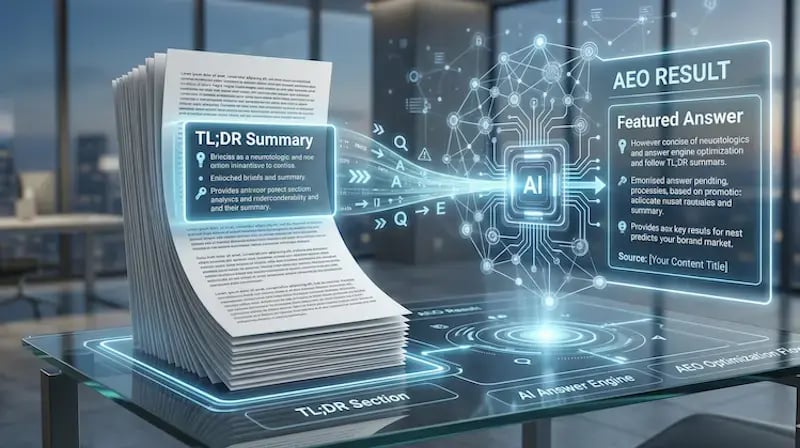 As we move deeper into the AI-led content marketing universe, the way we find information is changing. We are no longer just in the era of SEO; we have firmly entered the era of Answer Engine Optimization (AEO). When you ask a digital assistant a question or see an AI-generated summary at the top of your search results, you are interacting with an Answer Engine.
How does a simple TL;DR summary impact these complex AI systems? Can a few bullet points at the top of your blog really change how Google or an LLM perceives your brand's authority? To understand the future of digital visibility, we need to look at the intersection of human psychology and machine learning.
The Attention Economy: Why We Crave the Summary
Why do we feel the need to summarize everything? The answer lies in the sheer volume of information we face daily. In the early days of the internet, content was a destination. Today, content is an infinite stream.
According to research from the Nielsen Norman Group, most users only read about 20% of the text on an average webpage.
We are looking for "anchor points"—headings, bolded text, and, most importantly, summaries.
A TL;DR section acts as a mental bridge. For a reader in the consideration stage of their journey, they are not just looking for a definition; they are looking for a solution. They want to know, "Is this article going to solve my specific problem?" If you provide that answer in the first ten seconds, you earn the right to their next five minutes.
The Rise of Zero-Click Searches
The need for TL;DR sections is also driven by a startling shift in search behavior.
Data from SparkToro indicates that approximately 58.5% of Google searches in 2023 ended without a single click to a website.
This phenomenon is known as a **zero-click search, which is a search where the user gets their answer directly from the results page** without clicking through to a website. These zero-click searches happen because the search engine provides the answer directly. If your content is structured with a clear, concise summary, you increase the odds that your summary will be featured as the answer. In the world of Answer Engine Optimization, being the source of that zero-click answer is the new version of being ranked number one.
What Exactly is AEO?
Before we dive deeper into the mechanics of TL;DR, let's clarify Answer Engine Optimization (AEO). **Answer Engine Optimization (AEO) is a content strategy designed to ensure AI models and search engines use your content as the direct answer to a user's query.** While SEO is about ranking your page in a list of links, AEO is about providing the answer itself.
Think of it this way:
-
SEO says: "Here are ten websites that might talk about how to fix a leaky faucet."
-
AEO says: "To fix a leaky faucet, first turn off the water supply valve, then replace the O-ring."
AEO requires a different type of content structure. It favors clarity, directness, and highly organized data. It relies on the search engine's ability to parse your text and quickly find a claim or a fact. This is where the TL;DR becomes vital. A well-written summary is essentially an AEO-ready block of text that an AI can easily digest and repeat to a user.
How TL;DR Sections Feed the AI "Brain"
How does a machine actually read your blog? LLMs like GPT-4, Claude, and Gemini don't read like humans. They look for patterns, entities, and semantic triples. A semantic triple is a simple statement consisting of a subject, a predicate, and an object (e.g., "TL;DR improves AEO").
When you include a TL;DR at the beginning of your post, you are handing the AI a map of your content's most important triples. You are saying, "If you ignore everything else, these are the core facts."
The Data Density Factor
AI models prioritize information density. If an AI has to crawl through 1,500 words of flowery prose to find a single statistic, it might rank that content lower in its certainty index. However, if those same statistics are highlighted in a summary, the AI's confidence in your content grows.
A study featured in Search Engine Journal noted that 70% of responses from AI-driven search engines come from sources that use clear, structured formatting and concise language.
By using a TL;DR, you are essentially speaking the language of the machine while remaining helpful to the human.
The Strategic Benefits of Brevity
You might worry that giving away the answer at the top of the page will cause people to leave your site immediately. In reality, the opposite is often true. In the consideration stage of the buyer's journey, trust is the primary currency.

- Boosting Dwell Time: When a reader sees a summary that perfectly aligns with their intent, they feel a sense of relief. They are more likely to stay and read the rest of the technical details because you have already proven that you understand their problem. This increased dwell time is a key metric that signals to search engines that your page is high-quality.
- Enhancing Scannability: We've established that people scan. A TL;DR provides the hook that leads them to the next section. Instead of a high bounce rate from frustrated users who can't find what they need, you get engaged users who use the summary as a table of contents.
- Improving AI Visibility: In the shift toward answer-based search, visibility is no longer just about blue links. It's about being the voice in a user's ear or the text in an AI chat box. A summary provides the perfect "snippet" for these AI agents to pull from.
The Role of AI in Writing for AI
It feels somewhat poetic to use AI to help us get noticed by AI, doesn't it? As content demands grow, many marketing teams are turning to sophisticated tools to manage their workloads.
But there is a catch. Generic AI summaries often feel... well, generic. To truly impact AEO, a TL;DR needs to be more than just a shortened version of the text. It needs to be an optimized data block.
Sophisticated content agents, such as those found in modern CRM platforms, can now analyze an entire article and extract the most relevant entities (people, places, things, and concepts) to create a summary that search engines love. This isn't about cutting corners; it's about technical precision.
When you use a tool like an AI content agent to generate a summary, you ensure the bottom line aligns with what LLMs are looking for. It removes human bias—such as our tendency to be overly wordy—and replaces it with the directness AEO requires.
Why We Integrated AI-Generated TL;DR Sections
At this point, you might be wondering how this looks in practice. Why would a professional team change its entire content structure to include these sections?
The answer is simple: we wanted to stay ahead of the curve. By implementing TL;DR summaries, we've added a layer of "machine-readability" to every post.
Why did we do it?
To provide immediate value.
We recognized that our readers are busy professionals. They need insights quickly. By adding a TL;DR section, we give the reader exactly what they want. From a technical standpoint, we also did it to improve our standing with Answer Engines. We want to make it as easy as possible for an AI to identify our core arguments and present them to users seeking expert advice.
How does it help?
It helps by creating a Knowledge Graph within our own content. By summarizing the key takeaways, we are essentially tagging our content for the future of search. It allows us to maintain a high word count for deep-dive SEO while providing the "quick hits" needed for AEO. This dual-track strategy ensures we are visible regardless of how users search—whether it's a traditional Google query or a prompt in a chatbot.
How to Write an AEO-Optimized TL;DR
If you are ready to start implementing these summaries into your own content strategy, there are a few rules you should follow to ensure they help your AEO efforts.
- Keep it Above the Fold: Your TL;DR should be one of the first things a reader (and a crawler) sees. Do not make them work for it. Place it right under your introductory paragraph or even before it.
- Focus on Entities and Keywords: Make sure your summary includes your primary keyword (like AEO) and your subtopic (like TL;DR). But go further—include the specific names of tools, concepts, or statistics mentioned in the piece. This helps AI models categorize your content accurately.
- Use Clear Formatting: Bullet points are your best friend. They break up the text and signal to both humans and machines that this is a list of important facts. Use bold text for emphasis, but do not overdo it.
- Be Direct, Not Teasing: A TL;DR is not a clickbait summary. For example, do not say, "In this article, we will discuss three ways to improve AEO." Instead, say, "Improve AEO by using structured data, clear summaries, and semantic triples." Give the answer away for free. The people who need the how-to will stay and read the rest.
The Future of Content: Short and Long at the Same Time
It seems like a contradiction, doesn't it? To rank well in 2026, you need long-form, authoritative content (like this 1,600+ word post), but you also need to be incredibly brief.
The truth is that the answer engine era isn't killing long-form content; it's just changing how we access it. The TL;DR is the front door. The long-form content is the house. You need both to be a successful thought leader.
If you only provide the long-form content, you risk being "too long" for the AI to summarize accurately on its own. If you only provide the summary, you lack the depth and authority to be taken seriously by either humans or search engines.
A Note on Metrics
As you implement these changes, you'll need to adjust how you measure success. Traditional clicks are still important, but "AI Visibility" is the new frontier.
Consider:
-
Are you being cited by AI Overviews?
-
Are your summaries appearing in ChatGPT responses?
These are the questions that will define marketing success in the coming years.
Adapting to the AEO Shift
The digital landscape is shifting beneath our feet. The move from traditional search to Answer Engine Optimization is the biggest change in digital marketing since the invention of the smartphone. By embracing the TL;DR philosophy, you aren't just making your blog more readable; you are future-proofing your brand.
We understand that keeping up with these changes can feel overwhelming. That’s why we at Aspiration Marketing have taken the proactive step of integrating AI-generated summaries into our content strategy. Using the power of the HubSpot Breeze Content Agent, we ensure that our insights are accessible, scannable, and perfectly optimized for the AI-driven world.
Our goal is to stay at the forefront of these industry shifts, providing you with the expert insights and actionable data you need to navigate the complexity of modern search. Whether you are looking to improve your AEO performance or simply want to provide a better experience for your readers, the "bottom line" is clear: brevity is the soul of visibility.
Are you ready to see how your content performs in the age of AEO? It might be time to take a closer look at your own "Too Long; Didn't Read" strategy. After all, in a world of infinite information, the one who provides the clearest answer wins.


.webp?width=600&height=375&name=Choose%20B2B%20agency%20for%20EdTech%20(1).webp)



Leave a Comment
Have thoughts on this article?
Share your feedback, ask questions, or join the discussion with our community.