





Retrieval-Augmented Generation (RAG) is a framework that grounds generative artificial intelligence engines in verified, private data sources to ensure factual accuracy. Imagine deploying a generative AI engine to handle customer support requests during a massive holiday shopping rush. For the first few hours, everything runs smoothly. Customers receive instant, helpful replies. Then, a consumer asks a complex question about a localized promotional policy.
Instead of admitting it lacks the answer, the ungrounded model confidently invents a 50% discount code. Within hours, the error spreads across social media, costing your brand thousands of dollars in unintended refunds and a major public relations headache.

This scenario is not science fiction. It is a common operational challenge for companies deploying unguarded Large Language Models (LLMs). Traditional base models are built to prioritize fluent, natural language over precise factual accuracy. When left to answer highly technical queries using only their pre-trained datasets, these models face massive reliability gaps.
According to data-driven industry research published by CoSupport AI,
Raw, ungrounded AI text generators can experience major hallucinations when forced to answer specific, nuanced corporate questions.
Furthermore,
Research compiled by Tendem AI highlights that AI hallucinations cost businesses $67.4 billion globally.
For leadership teams looking at AI in customer service, this creates an important strategic question: how can you deploy an advanced service engine that answers complex customer queries without fabricating facts or exposing private company secrets?
The answer lies in moving beyond basic chatbots. Forward-thinking companies are shifting toward advanced customer agents built on a secure framework. This framework is conversational AI architecture, an advanced system powered by a methodology known as Retrieval-Augmented Generation (RAG). By grounding natural language generation in verified corporate facts, organizations can confidently open up their data pipelines to automate operations safely.
1. Deconstructing the Architecture: From Basic Chatbots to Autonomous Service Engines
To understand why modern service engines differ, we first need to look at how older software systems worked. Legacy customer service chatbots relied entirely on rigid, pre-programmed decision trees. If a user asked a question that deviated even slightly from the script, the system broke. The chatbot would repeatedly state, "I did not understand your question," frustrating the customer and requiring an expensive live-agent transfer.
True autonomous customer agents do not rely on static scripts. These agents use advanced conversational AI architecture to understand natural language, evaluate customer intent, and handle complex multi-turn dialogues.
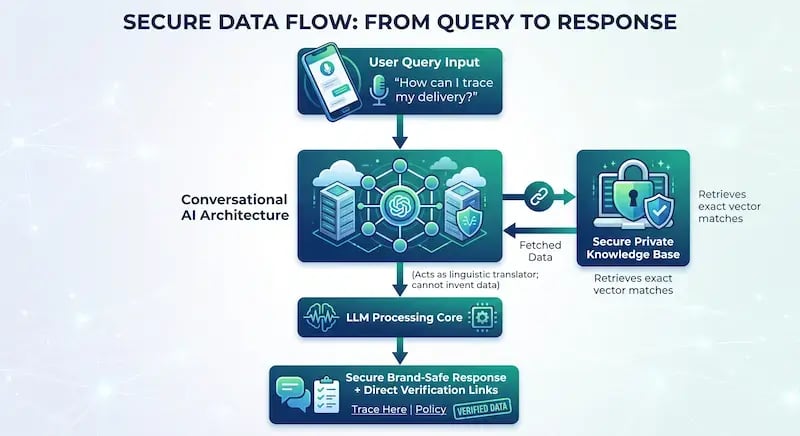
To implement this safely, engineers must treat the Large Language Model as a linguistic processing engine rather than a database of facts. Think of the model as a highly articulate translator. It handles the grammar, structure, and friendly tone of the conversation, but it does not supply the core information. Instead, a separate, secure enterprise database holds your private brand data.
This structural shift is driving major changes in the marketplace.
Research from Juniper Research reveals that conversational AI service revenue is projected to grow rapidly, reaching $8.5 billion by 2030.
In parallel,
Data from Precedence Research shows that the global AI hallucination-detection market is expanding rapidly to meet this need, reaching $1.94 trillion in 2026.
Enterprises are making these massive investments because they want to build efficient, autonomous support systems that resolve issues on the first try.
2. How RAG Works: The Three-Step Process of Secure Data Retrieval
How does an autonomous customer agent read internal brand data without making mistakes? Retrieval-Augmented Generation solves this problem through a clear, three-step data validation pipeline. This pipeline ensures the generative model speaks only text vetted by your internal teams.
Step 1: Ingestion and Vectorization
Before an AI agent talks to your customers, your corporate documents—such as user manuals, return policies, and service guidelines—must undergo preparation. The architecture breaks these text documents into small, contextually relevant paragraphs.
Next, the system converts these text segments into distinct mathematical strings. These strings are called vectors, which are mathematical representations of text that are housed inside a secure vector database. For example, if you upload a complex manual for an industrial heating system, every specific repair step is turned into a precise coordinate in a mathematical space. This process allows the computer to find relevant answers based on context rather than exact keywords.
Step 2: Semantic Search and Grounding
When a customer submits an inquiry, the system executes a rapid semantic search. Instead of looking for exact keyword matches as older search engines did, the system evaluates the underlying meaning of the user's sentence.
It quickly identifies and pulls the specific vector segments from your private knowledge base that match the customer's question.
According to benchmarking data collected by CMARIX, using structured hybrid RAG models over standard single-retrieval configurations improves factual accuracy scores by a notable 20% to 35%.
This high precision stops the engine from pulling unrelated or wrong files.
Step 3: Augmentation and Output Generation
Once the system isolates the correct text segments, it constructs a highly constrained prompt for the linguistic core. The architecture provides a strict instruction:
"Read the following verified text snippets from our database. Answer the customer's question using only this information. If the text does not contain the answer, state clearly that you do not have that information. Do not use external knowledge."
The language model reads the relevant snippets, translates the technical jargon into a clear, friendly response, and delivers it to the user. Because the model is completely bound by the text provided in the prompt, it cannot guess or make things up.
3. Eliminating Hallucinations: Building a Fenced System
Why do large language models hallucinate in the first place? At their core, basic language models are advanced predictive text systems designed to guess the most probable next word in a sentence. When an ungrounded model encounters a gap in its corporate knowledge, it simply predicts what a correct answer should sound like, creating a highly confident falsehood.
Implementing a structured Retrieval-Augmented Generation framework is the most effective way to eliminate these boardroom-level compliance risks.
Technical data compiled by iS2 Digital shows that using multi-evidence RAG architectures can reduce system hallucinations by over 40%, with specialized, self-reflective systems dropping error rates even further.
To guarantee complete safety, modern conversational AI architecture relies on two critical security features:
-
Strict Boundary Constraints: The system uses hard-coded instructions that prevent the language model from making assumptions, analyzing outside trends, or pulling data from its original public training set.
-
Real-Time Citation Mapping: Every response generated by an advanced customer agent includes clickable footnotes that link directly to the source paragraph within your public help center or internal knowledge base. This keeps the entire system transparent, trustworthy, and easy to audit.
4. Keeping Data Secure: Access Control and Governance
When enterprises open their internal knowledge bases to automated systems, data security becomes a top priority. How can you ensure an AI agent answers public questions without exposing sensitive company secrets, financial projections, or private employee files?

Securing your conversational AI system requires implementing Role-Based Access Control (RBAC) directly within the data retrieval layers. Role-Based Access Control (RBAC) is a security approach that isolates data so users can only pull information that clearly matches their verified identity.
Tiered Security Architecture
-
Public Authorization Layer: This layer holds general FAQs, public shipping rates, store hours, and return policies. It is completely open to anonymous web visitors.
-
Authenticated Customer Partition: This tier grants access to specific order histories, tracking details, and personal billing profiles. It requires secure user logging and token validation.
-
Internal Corporate Partition: This deep layer stores proprietary product designs, internal HR guidelines, and software code. It is completely restricted to verified employees.
Using this model, if an anonymous website visitor asks about your wholesale supply costs, the retrieval engine blocks the query before it reaches the conversational interface. The system checks the user's login token, determines they lack the necessary clearance, and refuses to retrieve data from the secure database.
Furthermore, enterprise-grade systems enforce strict data governance by keeping all interactions within an isolated cloud environment. All information is fully encrypted using AES-256 standards both at rest and in transit. Most importantly, customer conversations are never shared with external vendors or used to train open-source public models, keeping your brand data completely secure.
5. Driving Operational Growth with Zero-Click Resolutions
Building an advanced conversational AI architecture does more than just lower your risk profile—it fundamentally changes how your business operates. Modern consumers expect immediate answers to their questions, and they prefer to avoid waiting for emails or navigating slow phone menus.
By connecting a secure retrieval system directly to your live operational data, you can achieve true zero-click service resolutions. A customer does not need to open a formal support ticket, wait 24 hours, and exchange multiple emails with a representative just to check an order status or update an account setting.
Instead, the autonomous agent securely retrieves the necessary data from the warehouse pipeline and handles the issue immediately. This approach removes friction from your sales pipeline and allows your customer care team to scale efficiently without a matching increase in administrative overhead.
This operational shift offers immediate financial benefits.
Market data analyzed by NextPhone reveals that implementing automated conversational platforms can lower an enterprise's total support costs by 30% to 50%.
By automating routine questions, your human support teams can leave repetitive tasks behind and focus on handling high-value client relationships and complex technical problems.
6. Optimization for Answer Engines (AEO)
As search behavior shifts from typing keywords into a blank bar to asking full questions in conversational search interfaces, optimizing your digital content for Answer Engine Optimization (AEO) is vital. Answer Engine Optimization (AEO) is the process of structuring content to be easily discoverable and cited by modern answer engines. These engines prioritize content that is structured logically, states facts directly, and answers specific user intents without fluff.
To ensure your brand data is easily discovered and cited by modern answer engines, keep these formatting and architectural rules in mind:
-
Use Clear Question-Based Headings: Structure your public help centers and blogs with direct questions like "How do I trace my delivery?" or "What is the return policy for electronics?" This helps automated crawlers map your content directly to common user questions.
-
Provide Direct, Inverted-Pyramid Answers: Start your paragraphs with the core answer immediately, then follow up with contextual details. Answer engines often pull the first two sentences of a paragraph for their quick summaries.
-
Implement Clean Schema Markup: Use technical microdata to clearly label your authors, dates, and factual points. This structured background data allows search bots to instantly verify the authority of your answers.
Partnering for a Secure AI Future
Deploying generative artificial intelligence within customer service does not have to mean risking your brand's reputation. By moving away from ungrounded base models and adopting a conversational AI architecture built on a Retrieval-Augmented Generation foundation, you can deploy a highly secure, reliable system. Grounding your models with strict boundary controls and role-based access security allows you to deliver accurate, helpful, and completely safe support experiences at scale.
However, building and maintaining a hallucination-free enterprise system requires specialized technical execution and a strategic approach to data management. To maximize your return on investment and avoid common deployment mistakes, working with an experienced guide makes a significant difference.
This is where Aspiration Marketing helps your business succeed. We provide the strategic advice, operational insight, and technical direction required to integrate advanced autonomous customer agents into your workflow. Our team ensures your corporate data remains completely secure while transforming your customer service department into a modern driver of growth, safety, and efficiency.
Are you ready to upgrade your service infrastructure? Reach out to our team today to build a secure, data-driven foundation for your brand.







Leave a Comment
Have thoughts on this article?
Share your feedback, ask questions, or join the discussion with our community.