



How much of your enterprise pipeline is moving exactly when you need it to? As a Chief Marketing Officer, you face constant pressure to prove that every dollar spent turns into revenue. For years, content marketing operated on a predictable schedule: you published a few high-quality assets each month and hoped they drew in leads. Today, that slow approach leaves revenue on the table.
This is the CMO's Dilemma: Is it about volume or velocity?
 Modern B2B buyers execute the vast majority of their evaluation long before they ever talk to a sales representative. They look for deep, specific answers online without revealing their identity.
According to data from the 6sense 2025 Buyer Experience Report, 80% of B2B deals are won by the vendor that the buyer favored before making first contact.
If your brand lacks content to answer every granular question during this hidden research phase, your competitors win by default.
 This reality forces a shift in how we think about content creation. You cannot win in the modern market with just four blog posts a month. You need extensive coverage across dozens of user intents, technical requirements, and vertical use cases. This is where AI content volume is a strategic approach to creating an extensive library of targeted answers that compresses the sales cycle.
Scaling production with artificial intelligence enables you to meet the high information needs of modern buyers. The goal is not to flood the internet with generic noise. Instead, you must build an extensive library of targeted answers that compress the sales cycle. When you map a high-volume content engine directly to your pipeline stages, you turn information into velocity.
Decoupling "AI Content Volume" From Noise: The Enterprise Quality Floor
When revenue leaders hear the phrase "high-volume content," they often worry about quality control. They picture a sea of generic, shallow text that harms brand reputation. That fear is valid if you use AI carelessly. To drive revenue, you must separate strategic content scaling from automated spam.
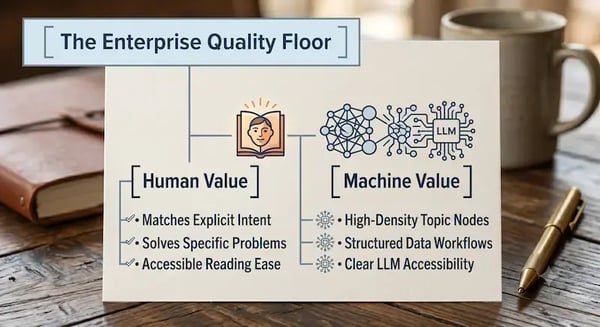 For an enterprise organization, scaling successfully requires establishing a strict quality floor. Every piece of content must provide real utility, feature accurate data, and follow a clear, accessible structure. High-volume AI content succeeds when it focuses on depth and coverage, rather than shortcuts.
This structural depth matters because of how modern discovery works. Buyers no longer rely solely on standard search engines.
Instead, 94% of B2B buyers use large language models (LLMs) to synthesize vendor research during their purchase paths, as noted in recent industry updates from the 6sense.
If your website lacks comprehensive coverage on a specific technical question, an LLM cannot find or recommend your solution.
To achieve Answer Engine Optimization (AEO), your content strategy must shift from isolated keyword targeting to constructing high-density topic nodes. Think of these nodes as deep, interconnected hubs of information. Each piece of content handles a specific question or a precise product comparison.

Consider a practical example. Instead of publishing a single broad guide about your software, your AI-assisted workflow can generate 30 targeted pieces. Each article covers a different specific angle, such as:
- How your platform integrates with specific legacy tools.
- Detailed compliance breakdowns for the financial sector.
- Specific operational comparison metrics for the manufacturing space.
This comprehensive approach ensures that whenever an AI crawler or a human buyer searches for an answer, your brand provides the definitive solution. By using AI to scale production safely, you build a visible, authoritative presence that aligns with how modern buyers find information.
The Mechanics: How High-Volume AI Engines Accelerate Mid-Funnel Deal Progression
How does a larger volume of content actually speed up a sales pipeline? The answer lies within the complex nature of the modern B2B buying committee. Deals rarely stall because a buyer loses interest. They stall because the buying committee cannot reach a consensus due to conflicting questions or missing information.
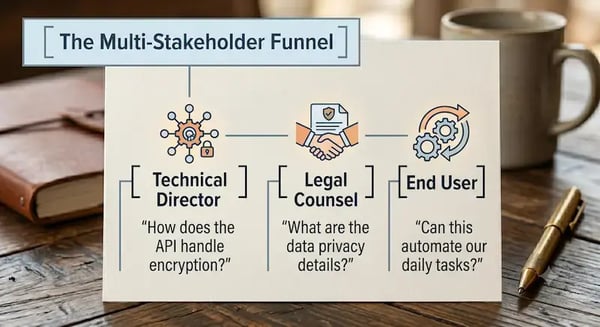
Information from the Dreamdata B2B Customer Journey Benchmarks Report shows that:
The average B2B customer journey spans 211 days. It involves roughly 76 tracked touchpoints and around 6.8 distinct stakeholders.
Each stakeholder looks at your solution through a completely different lens:
- The Technical Director wants to see API documentation and server specifications.
- The Legal Counsel needs to review data privacy details and compliance certifications.
- The End User looks for intuitive interfaces and automation of everyday tasks.
If your marketing engine produces only a small amount of content, you create an information deficit. A sales rep might send a single generic case study, but it will not satisfy all three individuals simultaneously. The deal loses momentum while stakeholders wait for answers.
A high-volume approach solves this issue by eliminating information gaps. By deploying targeted AI content workflows, you can build a library that addresses every distinct technical, operational, and financial question in advance. When a buying committee reviews your brand, every member finds exactly what they need immediately.
This extensive content footprint also powers real-time personalization hubs on your website. When a prospect interacts with an asset, your platform can suggest the next logical technical guide based on their behavior. This approach guides the user through multiple steps of their research in a single afternoon, rather than over several weeks.
Furthermore, this volume protects your brand against zero-click search patterns. AI-powered search engines often display answers directly on the results page, preventing users from clicking through to your website. By publishing clear, structured content designed for AI crawlers, your brand supplies those direct answers. Even if a buyer does not visit your site right away, your brand establishes itself as the clear market authority, driving them down the funnel faster.
The Revenue Attribution Framework for the CMO
To justify investing in a high-volume AI content strategy, you must measure its financial impact accurately. If you rely on basic metrics like page views or social shares, you cannot prove ROI to the CEO and CFO. You need a data-driven framework that connects content volume to revenue.

Traditional single-touch attribution models fail to capture the true value of middle-of-the-funnel content. For instance, if an enterprise deal closes after a sales call, a last-touch model awards 100% of the credit to the sales team. It completely ignores the fifteen AI-generated articles the buying committee read to prepare for that call.
To fix this, growth-focused CMOs use multi-touch attribution models, such as W-shaped or data-driven frameworks. These models distribute revenue credit across every touchpoint a buyer encounters. This approach ensures that technical guides, comparison pieces, and integration breakdowns receive appropriate credit for keeping the deal moving forward.
Implementing these advanced frameworks delivers measurable business value.
According to McKinsey, organizations that use accurate attribution frameworks reduce their customer acquisition costs (CAC) by 12% to 18%.
These savings come from teams stopping the waste of ineffective channels and investing heavily in content that actually converts.
When building your dashboard, focus on three primary metrics:
- Content-Influenced Pipeline Value: The total dollar value of deals that engaged with your content engine during their lifecycle.
- Pipeline Velocity Lift: The percentage reduction in days spent moving from Sales Qualified Lead (SQL) to a signed proposal.
- Organic-Sourced Conversion Rates: The rate at which anonymous search traffic converts into active sales opportunities.
Imagine tracking a cohort of prospective accounts. Upon measurement, the data shows that prospects who view three or more technical guides move from the evaluation stage to the proposal stage 25% faster than those who view only one. This simple metric clearly shows that your content volume is a direct driver of pipeline velocity.
Technical Execution: AI-Powered Workflows and Optimization Loops
Executing a high-volume content strategy successfully requires a modern, integrated technology stack. Trying to manage this scale using isolated documents and email chains creates operational chaos. Your tools and systems must work together seamlessly.
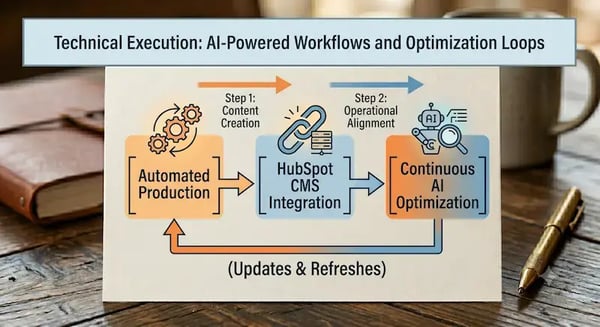 The foundation begins by connecting your content production tools directly with an enterprise content management system, such as HubSpot CMS. This integration allows you to automate workflows cleanly. Writers, subject matter experts, and editors can review, refine, and publish structured content without technical friction.
However, publishing content is only the first step. In a fast-moving market, technical information changes quickly. To keep your pipeline moving, you must implement a continuous optimization loop. You can use specialized AI agents to continuously monitor your published assets. When a statistic becomes outdated, or a search engine modifies its ranking criteria, the system flags the piece for a quick refresh. This ensures your content library remains accurate and valuable over time.
To ensure your scaled content ranks well in AI search engines and voice search tools, focus your writing on technical readability. Use clear, direct sentences and avoid overly complex language. Answer engines prefer clear, accessible explanations. You can structure your technical content using this simple approach:
- Ask direct questions: Use your section headings to state the exact question a buyer might type into an AI search tool.
- Provide immediate answers: Start the following paragraph with a concise, direct answer to that question.
- Support with structured data: Use clean bulleted lists, comparative tables, and clear technical summaries to make your data easy for AI engines to scan and understand.
When you structure your content for technical readability, you help human readers skim the text easily while making it highly accessible to AI crawlers. This clear format allows your high-volume engine to perform exceptionally well across all modern search channels.
The Velocity Imperative
Scaling your content production is not about chasing vanity metrics or inflating page-view statistics. It is a fundamental shift designed to align your brand with how modern enterprise buyers research and make decisions. By ensuring your website has answers to every question, you remove friction from the customer journey and help your sales team close deals faster.
Connecting high-volume workflows with clear quality standards and attribution models allows you to build a reliable revenue engine. When you provide buyers with direct, accessible information, you accelerate their decision-making process. Increased volume, when executed strategically, directly drives faster pipeline velocity.
Achieve this balance between massive operational scale and rigorous pipeline attribution with Aspiration Marketing. As your strategic growth partner, Aspiration Marketing architecturally maps AI-driven content ecosystems directly to your revenue goals—ensuring your volume always accelerates your pipeline velocity. Ready to scale? Partner with Aspiration Marketing to lead your industry's generative search revolution.






Leave a Comment
Have thoughts on this article?
Share your feedback, ask questions, or join the discussion with our community.