





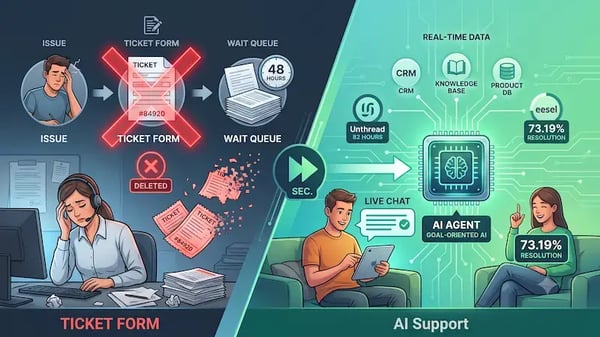
How do you transform a customer support team from an expensive cost center into a strategic growth engine? Many customer service leaders find themselves trapped in a reactive cycle. Teams spend hours handling identical tier-1 support tickets while high-value accounts wait for detailed help.
 The traditional answer has been to use rigid, keyword-matching chatbots to deflect these queries. However, traditional chatbots often frustrate users by offering prewritten scripts rather than real solutions. If a system cannot look up tracking details, modify an active order, or understand user intent, it simply creates another barrier between your company and your customers.
To fix this friction, modern companies are changing how they implement AI agents. An AI agent is an autonomous software program that moves past basic scripting. These AI agents can reason, review live databases, and complete multi-step tasks across your software stack.
Are your internal systems, customer documentation, and human handoff workflows ready for this transition? Let's walk through a structured, 5-step framework to launch autonomous agents that lower your ticket volume, increase retention, and protect your brand identity.
The 5-Step Implementation Framework
Before the agent can run with your customers, it needs to learn how to walk.
Step 1: Audit Ticket History and Choose Initial Use Cases
A common trap when adopting automation is trying to fix every channel and every complex issue at once. This approach often leads to unstructured conversational flows and poor performance. Instead, look for predictable, repetitive workflows with a clear resolution path.
Start by exporting at least 90 days of historical support ticket logs from your CRM or help desk platform. Analyze this data to group conversations by total volume, tag categories, and average handle time. You are searching for high-volume inquiries that require minimal human intervention yet consume significant team member time.
Focus your initial deployment on low-risk, high-volume tasks. Ideal entry-point scenarios include:
-
Providing real-time order status and tracking links.
-
Resetting passwords and resolving account access blocks.
-
Answering basic tier-1 product troubleshooting questions.
-
Processing simple returns, exchanges, or order cancellations.
Before creating any system prompts or connecting APIs, establish clear baseline success metrics. You need to know what your human team achieves today to accurately measure the agent's performance. Focus on three core metrics:
-
Deflection Rate is the percentage of inbound customer conversations that are fully resolved without creating a new support ticket.
-
First-Contact Resolution (FCR) is the share of queries completed during the very first interaction.
-
Customer Satisfaction (CSAT) is the post-interaction score given by the user, ensuring fast service does not hurt the customer experience.
Narrowing your initial focus lets you build a clear operational footprint. This helps you confirm the technology works safely before expanding it to more complex workflows.
Step 2: Clean and Restructure Your Knowledge Base
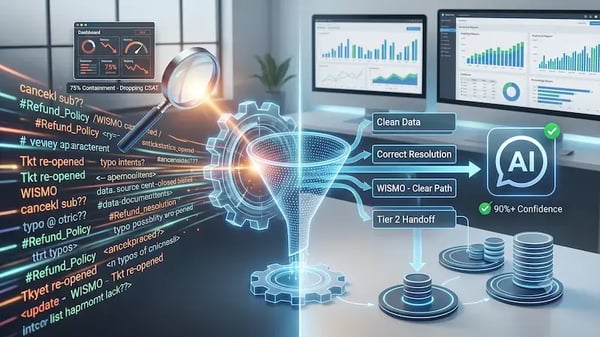
An autonomous agent is only as accurate as the reference data it reads. If your company documentation is messy, outdated, or spread across different platforms, your agent will struggle. Messy source files cause long response times and incorrect answers, commonly known as hallucinations.
To prepare your data, pull together all standard operating procedures (SOPs), product documentation, internal FAQs, and public help center articles into a single source of truth. Review this material to remove old policies, fix contradictory instructions, and standardize your brand terminology.
| Raw Unstructured Files (SOPs, PDFs, FAQs) |
|---|
| ↓ |
| Data Cleaning & Deduplication |
| ↓ |
| Markdown Conversion & Chunking |
| ↓ |
| Vector Database (Accessible by AI Agent via RAG) |
Next, organize this content for Retrieval-Augmented Generation (RAG). RAG is a method in which the AI agent searches for specific blocks of verified company information to answer a user's question, rather than relying on its general training.

To make RAG work well, break your documentation into clear, single-topic articles written in clean Markdown. For example, instead of saving a 50-page product manual as a single large file, break it into short documents focused on specific questions, such as "How to update billing information." This keeps the agent's context window clean and ensures it delivers exact, cited answers to the user.
Step 3: Choose Your Architectural Build Path
Deciding how to build your agent depends on your internal engineering resources, budget limits, and deployment timeline. Most organizations choose one of three main paths:
Build Approach |
Typical Timeline |
Core Advantage |
Best Suited For |
|---|---|---|---|
No-Code / Low-Code Platforms |
6 to 8 weeks |
Rapid deployment using visual workflow builders and built-in components. |
Standard use cases using out-of-the-box software integrations. |
Hybrid Ecosystems |
8 to 12 weeks |
Balance of fast implementation with custom development hooks. |
Teams with existing CRMs needing bespoke logic. |
Custom DIY Build |
3 to 6 months |
Total control over advanced routing, model selection, and deep proprietary architecture. |
Highly complex environments with strict data isolation rules. |
Low-code platforms work well for mid-market businesses looking to launch quickly without incurring high engineering costs. Hybrid ecosystems are ideal for companies that want to connect pre-built customer relationship management (CRM) software with custom backend tools.
Custom builds offer complete control over your architecture, but they require a dedicated engineering team to maintain data connections, update models, and manage infrastructure over time.
Step 4: Configure Actions, Integrations, and Guardrails
To be truly useful, an AI agent must move beyond just repeating text from a manual. The AI agent needs the ability to take action across your software stack. If a customer requests an address update, the AI agent should verify identity, check the fulfillment status, and update the database automatically.
Achieving this requires connecting secure webhooks and Application Programming Interfaces (APIs) between the agent and your internal software, such as your CRM, ticketing platform, and inventory tools. This lets the AI agent securely pull and push live account details during a conversation.
Once the technical connections are live, write clear system prompts to guide the AI agent's behavior. A strong system prompt should outline:
-
Identity and Persona: Define your brand's tone, style, and voice.
-
Core Objectives: State exactly what the AI agent should help the user accomplish.
-
Tool Definitions: Explain when and how to use specific APIs and databases.
-
Operational Boundaries: Set clear rules for what topics the AI agent must never discuss, such as competitor pricing or future products.
Finally, build solid safety guardrails. Program the AI agent to flag sensitive data such as credit card numbers and to handle system timeouts or API errors gracefully. If an external tool goes offline, the AI agent should never show raw code; it should politely explain the delay and route the user to a human teammate.
Step 5: Design Human-in-the-Loop Escalation
Automation should support your human staff, not replace them. No matter how smart an AI agent is, some situations will always require human empathy, complex problem-solving, or specialized approval. The transition from the agent to a live support representative must be smooth and invisible to the customer.
To build a seamless handoff workflow, focus on three main operational areas:
-
Comprehensive Conversation Summaries: When a conversation scales to a human, the agent should instantly pass over the full chat history, a short bulleted summary of the issue, identified user intents, and a sentiment analysis tag. This prevents the customer from having to repeat their problem to the human representative.
-
Internal Co-Pilot Testing: Before letting agents chat directly with customers, test it internally as an "Agent Assist" tool. In this setup, the AI reads inbound customer messages and drafts suggested answers for your human team to review, edit, and approve. This lets you test the system's safety and accuracy in the real world while helping your team lower their handle times by up to 35%.
-
Continuous Feedback Loops: Set up an ongoing process to save, review, and use human edits to correct AI responses to update your knowledge base. This continuous training loop ensures the agent's performance improves over time through real interactions.
The Growth Engine: Spotting Intent and Upsell Signals
When you integrate an AI agent deeply into your business software, customer service stops being purely reactive. It transforms into a proactive loop that helps identify opportunities for expansion and growth.
Because an agent processes conversations in real time, it can listen for specific language patterns and context clues that indicate a customer is ready for a higher tier or additional features.
![A business logic flow chart illustrating how an AI-powered Intent Detection Engine processes a customer service conversation to identify revenue expansion opportunities. The diagram shows the workflow starting from a Customer Conversation, feeding into the Intent Detection Engine, and leading to a binary decision node: 'Match Expansion Trigger?' If the answer is 'Yes,' the path automates commercial activity with two sequential steps: '[Yes: Log to CRM]' and '[Trigger Account Team Workflow],' moving toward a team of three professionals. If the answer is 'No,' the path routes to a call center representative and routes the user to '[No: Standard Support].' The entire automated process is contained within a white interface panel with a soft blue and green gradient glow.](https://blog.aspiration.marketing/hs-fs/hubfs/Customer%20Agent%20workflow.webp?width=800&height=436&name=Customer%20Agent%20workflow.webp) Train your agent to recognize key expansion indicators during everyday conversations. Common expansion signals include:
Train your agent to recognize key expansion indicators during everyday conversations. Common expansion signals include:
-
Inquiries about expanding seat limits, adding user profiles, or adjusting account permissions.
-
Questions regarding advanced API documentation or complex third-party software integrations.
-
Explicit interest in premium features that are locked behind your Pro or Enterprise plans.
When the agent identifies one of these triggers, it should avoid pushing an aggressive sales pitch. Instead, it should log the interaction inside your CRM, tag the account manager, and offer a helpful contextual prompt.
For example, the agent can provide a direct link to an educational case study or ask whether the user would like to schedule a quick call with their account executive to discuss premium options.
This proactive approach significantly improves the customer experience. According to verified industry data,
Organizations that provide proactive support experiences see a 9-point increase in their Value Enhancement Score (VES), which directly correlates with higher customer retention and long-term brand loyalty.
Navigating the Tool Ecosystem: HubSpot Breeze Agents
Building this type of connected architecture from scratch can create significant technical overhead, especially when trying to sync separate support, sales, and marketing databases. This complexity is why many high-growth teams look for platform-native tools like HubSpot Breeze Customer Agents to simplify their launch.
Because Breeze is built directly into the HubSpot Smart CRM, it eliminates the need to build and maintain complex custom middleware APIs. The moment a customer opens a chat or sends an email, the agent has instant access to their full timeline, including past purchases, open sales deals, and marketing interactions. This deep context allows the agent to deliver personalized answers that align with the customer's current status in your pipeline.
This connected setup also helps you achieve true zero-click resolutions. Instead of just pointing users to help articles, Breeze can update account records, log interaction outcomes, and trigger downstream automation workflows instantly. This automation keeps your company data perfectly clean and unified, giving your sales, marketing, and support teams a shared view of every account.
What Are The Next Steps?
Deploying autonomous agents is a clear, step-by-step journey. Success requires building a clean documentation foundation, setting up secure software integrations, and creating reliable human escalation paths. When executed correctly, you can scale your support capabilities 24/7, free your human team to focus on high-value conversations, and turn your everyday support interactions into a source of growth.
If your team is ready to move past basic chatbots and deploy smart, revenue-supporting AI agents, you don't have to navigate the implementation process alone. Planning data structures, writing system prompts, and designing CRM workflows requires specialized expertise.
The growth specialists at Aspiration Marketing are ready to help. Our team can audit your current data readiness, map out your technical architecture, and help you launch tools like HubSpot Breeze safely and efficiently. Reach out to Aspiration Marketing today to explore your automation options and build a scalable, modern customer experience.





Leave a Comment
Have thoughts on this article?
Share your feedback, ask questions, or join the discussion with our community.