





How are your prospective enterprise B2B buyers sourcing software and service solutions today? The traditional era of clicking through pages of "blue links" on standard search engines is rapidly giving way to direct, conversational answers. Large Language Models (LLMs) like ChatGPT, Claude, and Perplexity now serve as the primary research tools for buyers.
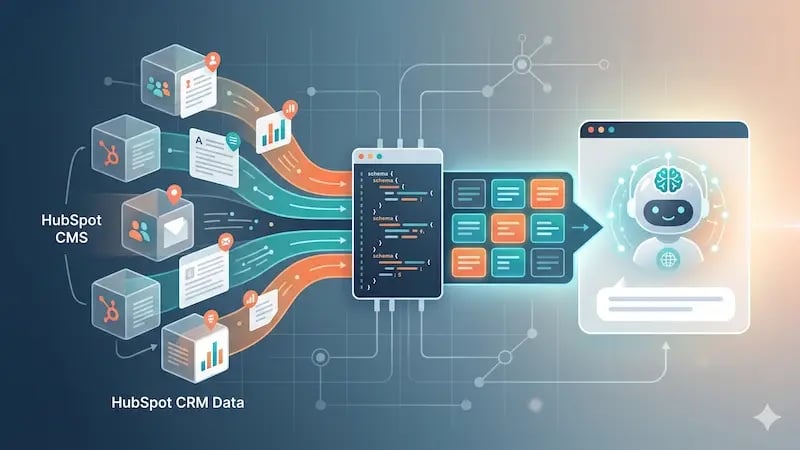 If an enterprise buyer asks an AI engine, "Which platform solves our specific problem and integrates with our tech stack?" will your brand be cited as the definitive answer? Or will you remain completely invisible to the language model?
Winning in this new answer economy requires moving beyond traditional search engine optimization. You must pivot toward technical Answer Engine Optimization and Generative Engine Optimization (GEO). Answer Engine Optimization (AEO) is the process of structuring and optimizing content to be directly retrieved and cited by Large Language Models (LLMs) and conversational AI.
| HubSpot CRM & CMS Data Variable | Machine-Readable Impact Delta |
|---|---|
| Data Personalization Activation | 40% Revenue Boost |
| Clean Database Deployment | 89% Departmental Productivity Increase |
| Legacy CRM Baseline | 47% Flawed Database Entries |
Data silos and fragmented technology remain a massive bottleneck for growth.
HubSpot data highlights that un-siloing marketing and sales data leads to an immediate 89% boost in cross-departmental productivity.
This guide breaks down exactly how to structure your HubSpot CMS content and architect your CRM database into a pristine, machine-readable dataset designed specifically for AI data extraction and private model training.
The Technical Blueprint: Structuring HubSpot CMS for AI Machine-Readability
To remain visible to autonomous bots, you must optimize HubSpot CMS content so that artificial intelligence can easily ingest it. LLM crawlers favor immediate semantic clarity over long, narrative introductions. They scan text for explicit facts that align with user prompts.
Why B2B Content Needs an Answer-First Architecture
An answer-first architecture is a content strategy where the primary answer to a user's query is placed in the first paragraph, providing a concise, extractable summary for AI crawlers. Traditional content strategies often rely on long introductions to build suspense or meet legacy keyword-density metrics. AI models do not read like humans; they process tokens. To optimize HubSpot CMS for these models, implement high-density, "answer-first" formatting across your website.
Open your top-performing blog posts, comparison matrices, and landing pages with a direct, comprehensive one-to-two sentence answer in the first paragraph. This paragraph should explicitly state the definition, problem, or solution in roughly 40-60 words. By putting the summary first, you provide a clear, bite-sized snippet that an AI crawler can scrape and use as a cited response. After giving this concise definition, you can dive deep into detailed commentary for your human readers.
Deploying Advanced Schema Markup via HubSpot
Metadata alone is no longer enough to win the top spot in conversational search. You need to use a structured data schema to precisely define the meaning of your website content. HubSpot makes it straightforward to inject custom schema code into individual pages or global templates. Focus on three primary types of schema markup:
-
FAQ Schema: Wrap your question-and-answer pairs in the FAQ schema. This tells search engines and LLMs exactly where a question ends and where a verified answer begins.
-
HowTo Schema: Use this schema for sequential, step-by-step tutorials and technical execution guides. Autonomous agents read this data to understand processes, allowing them to recommend your brand as a practical solution.
-
Organization Schema: Implement a comprehensive organization schema on your core corporate pages. This establishes a cohesive, verified digital entity map of your brand across the web, linking your main site to your social media profiles and product review pages.
Building Semantic Topic Clusters
Traditional keyword stuffing confuses language models because it lacks context. Instead, utilize HubSpot's native Content Strategy and SEO tools to build deep semantic topic clusters. Map out a central pillar page that answers a broad industry query, then write supporting cluster articles that target specific long-tail questions.
Interlink every page within the cluster using clear, descriptive anchor text. This clear internal link infrastructure helps AI bots discover your content and build an accurate knowledge graph of your corporate offerings. It shows the machine that your site is not just a collection of random posts, but a deeply connected repository of domain expertise.
Architecting the CRM Database: Establishing a Single Source of Truth (SSOT)
Optimizing your public-facing website content is only half the battle. To leverage the full power of modern business automation, you must also clean up the data hidden inside your CRM. When faced with messy, contradictory information, AI engines do not simply guess—they hallucinate. Inaccurate custom properties, duplicate contact entries, and chaotic sales notes turn your database into an expensive technical liability.
How to Run a HubSpot CRM Property Taxonomy Audit
Before launching an AI initiative, your first step must be HubSpot database optimization. Generative AI models rely entirely on the data fed into them, meaning a clean taxonomy within your HubSpot CRM and CMS is the foundation of successful B2B Generative Engine Optimization.
In fact, research from MIT Sloan shows that 47% of newly-created data records contain at least one critical error that impacts downstream processes.
When nearly half of your data is flawed at birth, any AI model trained on it will inevitably baseline its predictions on systemic errors.
To fix this bottleneck, run a rigorous property taxonomy audit inside your HubSpot portal. Eliminate open-ended text fields that should house standardized options. Replace them with: dropdown select fields, radio buttons, or checkbox properties.
For example, standardize industries, software tiers, geographic territories, and job functions. When your properties are uniform, language models can easily parse data relationships without getting confused by spelling variations or non-standard formatting.

Enforcing Strict Data Validation Guardrails
Human error is the leading cause of dirty data. You can prevent bad data from entering your ecosystem by setting up strict validation rules within HubSpot Enterprise.
Configure your system so that a deal cannot move to an advanced pipeline stage without the required information. For instance, block a sales rep from marking a deal as Closed Won until they select a standardized option from a Reason for Win dropdown menu and log the exact subscription tier. These guardrails protect your database from decaying into an unorganized digital junkyard.
Advanced Mapping with Custom Objects
Enterprise business operations rarely fit neatly into standard CRM objects like Contacts, Companies, and Deals. To give an AI model a clear map of your operational reality, you should build custom HubSpot objects.
Create dedicated custom objects to track metrics such as specific product usage, software subscriptions, or physical assets. This structural flexibility lets you link multiple accounts or products to a single enterprise company record. A private AI model can look across these clean relationships to predict metrics like customer churn or expansion potential with incredible accuracy.
According to Salesforce, manual data gathering and administrative bloat consume an astonishing 72% of a sales representative's typical workweek.
Transitioning to clean, AI-ready CRM data structures eliminates this friction, liberating your revenue teams to focus entirely on closing deals and building human relationships.
The Secure HubSpot Knowledge Base: Training Private B2B AI Models with RAG
Many B2B enterprise leaders hesitate to adopt artificial intelligence because of valid data privacy concerns. Pasting sensitive corporate documentation, proprietary source code, or confidential customer details into public AI tools presents catastrophic security risks. Fortunately, you do not have to expose your data to the public to leverage automation. You can train private B2B AI models inside a secure, closed-loop environment.
Utilizing Retrieval-Augmented Generation (RAG)
Retrieval-Augmented Generation (RAG) is a technique that enables an AI model to retrieve real-time facts from a secure, verified internal database before formulating an answer. Instead of relying purely on its static historical training data, the AI is explicitly instructed to search an internal, verified database first before answering a user prompt.
By using RAG, the model fetches real-time facts directly from your secure database to assemble its response. This approach eliminates the risk of public data leaks and wipes out algorithmic hallucinations. The output remains accurate because it only uses the facts you choose to provide.
Turning HubSpot Service Hub into an Enterprise Textbook
Your HubSpot Knowledge Base is a goldmine for AI training. Knowledge base articles are naturally short, task-specific, clear, and highly structured. This makes them ideal reference materials for a private language model.
To implement this safely, you must establish clear data access boundaries:
-
Public Customer Service Agents: Allow public-facing customer service bots to crawl your public help articles to handle common support tickets automatically.
-
Internal Sales Teammates: Lock down your sensitive internal documentation, such as pricing spreadsheets, competitive battle cards, and sales playbooks. Restrict access to internal AI tools, like HubSpot Breeze Sales Agents, so that proprietary data never leaks outside your company's firewall.
When securely trained directly on your internal HubSpot Knowledge Base,
Deploying a private B2B AI model has reduced employee internal search time by 85% while simultaneously driving a 37% improvement in customer support ticket closure rates, according to Deezer.
This allows your enterprise to scale its operations without dramatically increasing headcount.
Governance Workflows: Setting Up the "Human-in-the-Loop" Framework
While autonomous systems offer incredible efficiency gains, leaving content generation and database optimization completely to machines is dangerous. Pure AI content operations often lead to brand erosion, factual errors, and severe drops in search engine visibility. To protect your brand authority, you must establish a strict Human-in-the-Loop (HITL) governance workflow. A Human-in-the-Loop (HITL) workflow is a governance framework that combines machine automation with human oversight, ensuring that AI-generated output is fact-checked, personalized, and compliant before publication.
The Critical Role of the AI Orchestrator
To manage a modern tech stack successfully, you need an expert human manager. An AI Orchestrator is a professional role focused on managing and governing an organization's AI technology stack, ensuring that machine-generated content and data processing align with business strategy and quality standards.
The AI Orchestrator does not manually type every line of copy or manually delete old database rows. Instead, they act as system managers. They audit machine-generated drafts, monitor shifts in response quality, enforce data governance guidelines, and ensure your technology infrastructure remains aligned with your core business strategy.
The Four-Step Human-in-the-Loop (HITL) Workflow
To scale your marketing and sales outreach safely, enforce a dependable four-step operational workflow that balances speed with human quality control:
-
Intent and Strategy Setting (Human): Human strategists define the goals, research target buyer personas, and select core topic clusters. They establish the business logic that guides the machine.
-
AI Drafting (Machine): Automated engines quickly pull data from your clean CRM and CMS templates to build highly structured, data-backed technical drafts. This eliminates the writer's block associated with starting from scratch.
-
Fact-Checking and Personalization (Human): An experienced industry expert audits the machine's output. They check every single statistic, inject real-world case studies, add unique brand perspectives, and rewrite the copy to ensure a high readability score.
-
Compliance and Guardrail Review (Human): The final draft is checked against brand voice guidelines and legal privacy regulations, such as GDPR or CCPA, before publication.
Transitioning fully to HubSpot's unified, AI-supported architecture yields immediate bottom-line dividends after one year:
HubSpot reports a 129% scaling increase in overall inbound lead quantity alongside a 36% jump in total closed-won deal volume.
Preparing Your Data Architecture for the Future
Moving from the traditional world of basic web search to the modern answer economy is not a minor cosmetic change. It is a complete technical overhaul of your data architecture. If your website lacks proper schema markup, or if your CRM database is filled with messy, unorganized properties, AI models will simply skip over your company. The choices you make today regarding your data structure will determine your brand's digital visibility and market share for the next decade.
Transitioning your systems into an AI-ready powerhouse requires deep technical expertise. As an experienced HubSpot Solutions Partner, Aspiration Marketing specializes in exactly this intersection: marrying deep CRM RevOps engineering with advanced AEO and GEO strategies.
We help you eliminate costly technical debt, implement complex structured schema markup, organize internal knowledge bases for secure private AI model training, and establish robust human-in-the-loop governance workflows. Our mission is to ensure that whenever an enterprise buyer asks an advanced language model for a solution, your brand stands as the cited authority.
Ready to stop being buried on page two of old search results and start dominating the answer engine landscape? Contact Aspiration Marketing today to schedule your comprehensive AI search visibility audit. Let's transform your HubSpot portal into an intelligent, future-proof revenue engine.







Leave a Comment
Have thoughts on this article?
Share your feedback, ask questions, or join the discussion with our community.