





AI-powered answer engines like ChatGPT, Perplexity, and Gemini have changed how SaaS buyers find solutions. When your potential customers ask these platforms for product recommendations, your brand either shows up in the response or it doesn't. Tracking your visibility in AI search requires different metrics than traditional SEO, and many SaaS startups don't know where to start.
 Aspiration Marketing helps SaaS companies build data-driven strategies for answer engine optimization (AEO). In this guide, you'll learn which seven metrics matter most for measuring your AI search performance and how to act on the data you collect.
How We Chose The AEO Metrics for SaaS Startups
Selecting the right metrics to track requires understanding what actually moves the needle for early-stage and growth-phase SaaS companies. As a HubSpot AEO Partner, we focused on metrics that connect visibility to business outcomes rather than vanity numbers.
The 7 AEO metrics SaaS startups should track
1. Citation Rate: The Foundation of AEO Measurement
Citation rate measures how often AI engines link to your content as a source in their responses. A citation tells you that an AI platform considers your page authoritative enough to reference directly. For SaaS startups, this metric indicates whether your product pages, documentation, and blog content have earned the trust of AI systems.
According to the Martal Group,
The benchmark for early-stage companies is between 0% and 5%. Competitive SaaS brands typically achieve 5-15%, while category leaders reach 15% or higher.
Calculate citation rate by dividing the number of AI responses citing your domain by the total responses in your prompt set, then multiplying by 100.
At Aspiration Marketing, we've found that SaaS companies with strong technical documentation and regularly updated comparison pages tend to earn higher citation rates. Focus your content efforts on pages that answer specific buyer questions with clear, factual information.
Citation Rate Tracking Tactics
-
Build a prompt set of 50-100 queries that your target buyers ask AI platforms
-
Run each prompt through ChatGPT, Perplexity, and Gemini separately
-
Log which responses cite your domain versus competitor domains
-
Track weekly to smooth out answer volatility between individual runs
-
Segment by content type to identify which pages earn citations most often
2. Mention Rate: Tracking Brand Awareness in AI Answers
Mention rate tracks how often AI platforms name your brand in their responses, regardless of whether they include a link. You can be mentioned without being cited, and this distinction matters.
A high mention rate with a low citation rate indicates that AI engines recognize your brand but don't consider your content worth sourcing directly. This gap represents an opportunity.
According to research by similarweb,
Brands earning both citations and mentions have a 40% higher likelihood of reappearing in AI answers.
Mention Rate Features
-
Captures brand awareness signals that citation tracking misses
-
Reveals whether your company name appears in category comparisons
-
Helps identify prompts where you're known but not trusted as a source
3. AI Share of Voice: Your Competitive Position in AI Search
AI share of voice (SoV) measures the percentage of AI responses that mention your brand across your target prompt set. This metric tells you who owns the conversation in your category. If your share of voice sits at 5% while a competitor holds 25%, you know exactly where you stand.
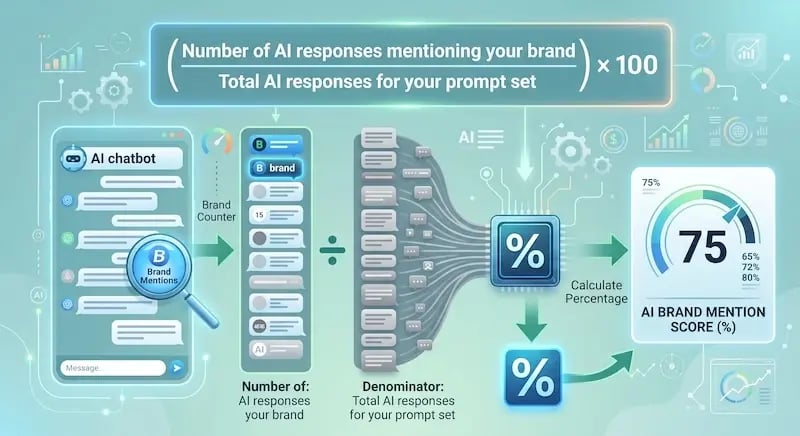 Consider tracking two versions separately.
Entity-based SoV: Counts every answer that names your brand, giving you the broader awareness metric.
Citation-based SoV: Counts only answers that link to your content, showing authority rather than just recognition.

A SaaS startup with 15% entity-based SoV and 3% citation-based SoV has a recognition-authority gap. Closing that gap requires improving content depth, adding structured data, and keeping published pages up to date.
AI Share of Voice Features
-
Compares your visibility directly against named competitors
-
Segments by AI platform to show where you win and lose
-
Tracks monthly to reveal whether your content strategy gains ground
4. Sentiment Score: How AI Describes Your Brand
An AI platform can mention your SaaS product frequently and still describe it negatively. Sentiment score adds a qualitative dimension to your visibility metrics. HubSpot's AEO tools score sentiment from -100% to +100%, separating a perception problem from a visibility one.
For SaaS startups, negative sentiment often stems from outdated product information, unaddressed review site complaints, or inaccurate third-party comparisons that AI engines pull into their responses. A high mention rate with a low sentiment score is worse than not showing up at all.
Sentiment Score Features
-
Identifies whether AI systems position you positively or negatively
-
Flags specific claims that damage your brand perception
-
Tracks sentiment shifts after product updates or PR events
5. AI Referral Traffic: Connecting Visibility to Website Visits
AI referral traffic measures the sessions arriving on your site after someone clicks a cited link from ChatGPT, Perplexity, Gemini, or Claude. This metric bridges visibility and business outcomes. Your leadership team cares about this number because it directly connects to the pipeline.
Setting up a GA4 custom channel group for AI traffic takes about 15 minutes. Create a new channel group called "AI Search" and add rules matching source values from AI engines: chatgpt.com, gemini.google.com, perplexity.ai, and claude.ai. This isolates AI referral traffic in all your acquisition reports.
One important note: traffic from AI platforms converts at higher rates than organic search.
Data from Semrush suggests that,
AI-referred visitors are worth 4.4x more than organic visitors because they've already done their research before arriving.
AI Referral Traffic Features
-
Direct measurement of users arriving from AI platforms
-
Integrates with existing GA4 and CRM attribution workflows
-
Enables comparison against organic and paid traffic sources
6. Prompt-Level Visibility: Which Questions Trigger Your Brand
Aggregate metrics indicate that your visibility has improved. Prompt-level tracking tells you why. This metric identifies which specific questions cause AI platforms to name or cite your brand, giving you a concrete explanation for any shift in overall numbers.
Build your prompt set from three sources:
-
Voice-of-customer data from sales calls and support tickets
-
Competitor heading analysis from their top-ranking pages
-
Search data from Google Search Console queries
These sources reveal the questions your buyers actually ask AI engines.
When your citation share jumps two weeks after publishing new content, prompt-level tracking shows exactly which queries you started appearing in. When a competitor's share grows, you can identify the specific prompts they captured.
Prompt-level Visibility Features
-
Maps specific buyer questions to your brand's appearance in AI responses
-
Connects content changes to visibility improvements
-
Reveals competitor gains at the query level
7. Citation-to-Conversion Rate: Tying AEO to Revenue
The final metric closes the loop between AI visibility and business impact. Citation-to-conversion rate measures the percentage of AI-referred visitors who take a meaningful action: signing up for a trial, requesting a demo, or becoming a customer.
Set this up by adding "AI Search" as an attribution touchpoint in your CRM. Add it as a picklist value in your lead source field and train your team to ask about it during discovery calls. Self-reported attribution captures visits that analytics tools miss, since many AI interactions don't generate trackable referral URLs.
Aspiration Marketing, as a HubSpot partner and AEO agency for Saas, helps clients build this attribution loop using HubSpot's CRM and attribution tools. The Smart CRM ties AI-attributed leads to the records your sales team already works with, so you can follow each contact from first AI touch to closed deal.
Citation-to-Conversion Rate Features
-
Connects AI visibility metrics directly to the pipeline and revenue
-
Combines analytics data with self-reported attribution for fuller coverage
-
Enables ROI calculations for AEO investment decisions
Comparison table: AEO metrics for SaaS startups
| Metric | Measures | Business Connection | Tracking Difficulty |
|---|---|---|---|
| Citation Rate | Content authority | Traffic source | Moderate |
| Mention Rate | Brand awareness | Brand recognition | Moderate |
| AI Share of Voice | Competitive position | Market positioning | Moderate |
| Sentiment Score | Brand perception | Reputation management | Low |
| AI Referral Traffic | Direct visits | Pipeline attribution | Low |
| Prompt-Level Visibility | Query-specific performance | Content strategy | High |
| Citation-to-Conversion | Revenue impact | ROI calculation | High |
How Often Should SaaS Startups Measure AEO Metrics?
Single-run snapshots mislead because AI answers shift between platform runs.
According to AirOps,
Only 30% of brands maintain consistent visibility from one AI response to the next, and about 57% of brands that disappear from an answer resurface within two runs.
This volatility is why measurement cadence matters.
We recommend this measurement schedule for SaaS startups:
- Daily: Monitor prompt sets tied to active campaigns or major content updates
- Weekly: Review all seven metrics across your full prompt set, comparing to the previous week
- Monthly: Build trend reports for leadership showing SoV movement, citation rate changes, and AI referral traffic growth
- Quarterly: Recalibrate your prompt set by removing outdated queries and adding new ones based on customer feedback
Each metric tells you something specific about what to do next. A low citation rate signals a content depth problem. A low mention rate with healthy citations indicates a brand authority gap. Declining SoV means a competitor is gaining ground. Negative sentiment shift points to inaccurate information circulating in AI responses that needs correction at the source.
What Tools Track AEO Metrics For SaaS Companies?
Tracking AEO metrics manually with spreadsheets works for initial audits, but quickly becomes difficult. AI answers vary by engine, session, model update, and retrieval source. For ongoing monitoring, use dedicated AEO tracking tools.
When evaluating any tool, look for these capabilities:
- Prompt-level granularity, not just domain-level summaries
- Multi-engine coverage, including ChatGPT, Gemini, and Perplexity at a minimum
- Integration with your existing analytics stack (GA4, Google Search Console, CRM)
- Historical trend data rather than just point-in-time snapshots
- Competitor tracking to measure share of voice
The HubSpot platform offers AEO tracking that connects visibility data to CRM records, letting you follow contacts from first AI touch to closed deal. This integration matters for SaaS companies because it ties marketing metrics to sales outcomes within a single system.
How Can Aspiration Marketing Help With AEO Measurement?
Aspiration Marketing helps SaaS companies build AEO tracking systems integrated with HubSpot's CRM and analytics tools. Our team sets up prompt tracking, configures AI referral attribution, and creates dashboards that connect visibility metrics to the pipeline. We also audit existing content to identify optimization opportunities that improve citation rates across AI platforms.
Short on time or looking for deeper expertise? Talk to our B2B consultants about building an AEO measurement framework for your SaaS company.





.webp?width=600&height=375&name=Choose%20B2B%20agency%20for%20EdTech%20(1).webp)

Leave a Comment
Have thoughts on this article?
Share your feedback, ask questions, or join the discussion with our community.