





How do your prospective buyers find your software platform today?
If you assume they scroll through ten blue links on Google, your growth strategy is already operating behind the curve. B2B buyer behavior has undergone a permanent shift. Modern software buyers no longer want to click through dozens of vendor websites, fill out demo forms, or skim long articles just to compare features.
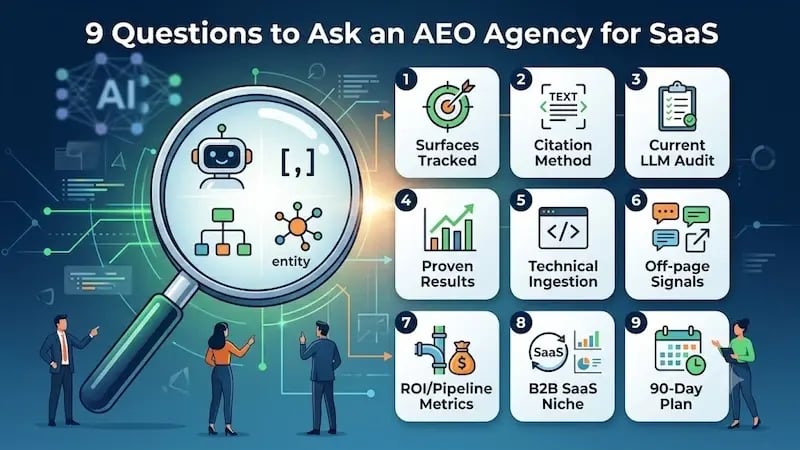
Instead, they turn to conversational AI platforms to synthesize options, evaluate trade-offs, and recommend the best tools for their needs. These platforms include:
- ChatGPT
- Perplexity
- Google AI Overviews
- Claude
This shift has created a critical new field. Answer Engine Optimization (AEO) is a digital marketing discipline focused on earning brand citations in the answers generated by AI platforms. This practice is also known as Generative Engine Optimization (GEO).
As generative search gains traction, digital marketing agencies have rushed to meet demand. A quick web search shows hundreds of agencies offering AEO services. Look closely at their deliverables, however, and you will notice that many simply repackage standard search engine tactics—like keyword density tweaks, link exchanges, and basic metadata audits—under a brand-new acronym.
Hiring a team that treats Answer Engine Optimization like traditional SEO is a costly mistake. The metrics, technical signals, and content layouts required to earn citations in Large Language Models (LLMs) differ fundamentally from traditional search engine algorithms.
If you are a SaaS founder or marketing leader evaluating an AEO agency for SaaS, you need clear criteria to make the right choice. Use this evaluation framework to ask the right questions and separate genuine AEO partners from traditional firms.
Why Standard Vendor Evaluation Fails for AEO
Standard Request for Proposals (RFPs) focus on metrics such as domain authority, organic keyword rankings, backlink counts, and web traffic. While these metrics matter for traditional search engines, they fail to measure your visibility inside generative AI engines.
The data behind this behavioral shift is undeniable:
- A major B2B Buyer Experience Report by 6sense reveals that 94% of B2B buyers use LLMs during their software purchasing process.
- Recent sales research from Gartner shows that 67% of B2B buyers prefer a rep-free experience, using self-directed digital channels to evaluate vendors.
- Data from the G2 Buyer Behavior Report confirms that AI chatbots are now the #1 source influencing B2B vendor shortlists (cited by 17.1% of buyers), outranking vendor sites (12.8%) and peer recommendations (8.9%).
Metric / Focus Area |
Traditional SEO |
Answer Engine Optimization (AEO) |
|---|---|---|
Primary Goal |
Rank on Page 1 of Search Engine Results |
Earn Direct Citations in Generated Answers |
Core Success Metric |
Clicks, Ranks, and Organic Traffic Volume |
Citation Rate & Share of Voice in AI Outputs |
Primary Signals |
Backlink Profiles & Keyword Density |
Entity Consistency, Schema, & Consensus |
User Action |
Browsing Multiple Web Pages |
Reading a Synthesized Multi-Source Summary |
When an AI engine answers a buyer's question (such as "What are the best SOC-2 compliant HR tools for mid-market SaaS?"), it does not return a list of links. It reads, synthesizes, and generates a direct answer, citing only three or four primary sources.
If an AEO agency measures success by where you rank on a standard search page rather than how often your brand is cited in AI outputs, they are tracking the wrong outcome.
The 9 Questions That Reveal Real AEO Expertise
Bring these nine specific questions to your agency evaluation calls. Their answers will tell you whether you are speaking with an actual generative search expert or a traditional account manager using a refreshed pitch deck.
1. How do You Measure AI Search Visibility, And Which Surfaces do You Track?
A surface-level agency will give a vague answer:
"We track your overall AI visibility across major platforms."
An expert AEO agency for SaaS will name specific surfaces they track, including:
- ChatGPT (OpenAI)
- Perplexity AI
- Google AI Overviews
- Gemini
- Claude (Anthropic)
Each model ingests, indexes, and cites content differently. For example, Perplexity relies heavily on real-time web-retrieval indexes, whereas ChatGPT combines its model training data with web-search plugins.
What to listen for:
- Tooling: Ask which specialized software tools they use to pull daily citation data. Look for named enterprise platforms like Profound, Peec AI, Otterly, or AthenaHQ, or custom proprietary tracking systems.
- Competitor Benchmarking: They should explain how they track your "Citation Share of Voice" relative to your top direct competitors on high-intent buyer prompts.
2. What's Your Methodology For Earning Citations in AI Answers?
If the agency answers: "We publish high-quality, keyword-optimized content," treat that as an immediate warning sign.
LLMs do not select citations based on keyword frequency. Earning a spot in an AI answer requires two parallel efforts: On-Page Structural Optimization and Off-Page Consensus Building.
On-page work requires clear Question-and-Answer formatting, semantic headers, and structured schema markup. Off-page work requires building your brand presence across third-party sources that LLMs trust.
Research on Generative Engine Optimization (GEO) strategies highlights clear tactics that boost AI model inclusion:
- Adding hard statistics and verified data increases AI model visibility by 27% -6%.
- Citing authoritative sources improves visibility by 20% to 34%.
- Including direct expert quotes boosts the probability of citations by 20% to 35%.
- Keyword stuffing reduces AI visibility by 10%.
A capable partner will explain how they optimize content using these exact citable patterns.
3. Can You Show me an Audit of How Our Brand Currently Appears in LLMs?
Never sign a contract without a baseline audit. A qualified partner should run an initial report mapping your brand's footprint across relevant buyer prompts.
This audit must cover two distinct query types:
- Product-Specific Queries: "What is [Your Product Name] and what integrations does it support?"
- Category/Consideration Queries: "What are the top 5 customer success platforms for enterprise SaaS?"
The second query type is where the pipeline is won or lost. The agency's audit should show where your brand is cited, where competitors replace you, and where AI models generate inaccurate details about your features or pricing.
4. Which Clients Have You Worked With, and What Changed in Their LLM Citations?
Because AEO is a new discipline, be cautious of agencies making broad claims like "we grew traffic by 300% using AI."
Demand concrete, prompt-level proof. Ask for:
- A specific client vertical or category.
- The exact buyer prompt tracked (e.g., "best automated billing software for SaaS").
- A clear before-and-after baseline (e.g., "Client had zero citations in ChatGPT in Q1; after 90 days, they reached a 45% citation recurrence rate").
Because AI outputs are publicly accessible, you can verify these prompt examples during your evaluation process.
5. How do You Handle The Technical Layer For AI Ingestion?
Unlike search engine web crawlers, LLM web scrapers parse site code differently. Many SaaS sites built on complex JavaScript frameworks present ingestion problems for AI bots, leaving the main content unparsed or ignored.

An experienced technical team will focus on four critical elements:
- llms.txt File Setup: Creating markdown-formatted text files in your root directory structured specifically for LLM ingestion.
- Advanced Schema Markup: Implementing nested Organization, Product, SoftwareApplication, FAQPage, and HowTo schema with clear entity identifiers.
- Direct Answer Placement: Structuring core landing pages so that concise, direct answers appear in the first 100 to 200 words of every section.
- Machine-Readable Code: Ensuring clean server-side rendering or static HTML so AI scrapers do not have to process complex client-side code.
6. How do You Build The Off-Page Citation Footprint That LLMs Trust?
This question separates surface-level content teams from true AEO strategists. AI models do not rely solely on your website to figure out what your product does. When an LLM evaluates whether your software is worth recommending, it validates your claims against third-party web sources.
LLMs heavily weight specific source types:
- Discussion Platforms: Reddit, Quora, and niche software communities.
- Software Review Directories: G2, Capterra, Gartner Peer Insights, and TrustRadius.
- Entity Knowledge Bases: Wikipedia, Wikidata, and industry trade publications.
- Executive Thought Leadership: Digital PR, guest podcast transcripts, and expert posts on LinkedIn.
If an agency's off-page strategy consists only of basic guest posts or link building, they do not understand how AI consensus works. Ask how they plan to build your presence across review platforms and community channels.
7. What Does Reporting Look Like, And How Do You Tie AEO to Pipeline?
Sharing static screenshots of a ChatGPT output is not real reporting. AI responses vary by location, session context, and prompt wording. Single screenshots tell you very little.
A professional reporting dashboard tracks:
- Citation Recurrence Rate: The percentage of time your brand appears when a prompt runs across multiple test variations.
- Share of Voice (SoV): Your brand's percentage of total mentions compared to direct competitors.
- Answer Accuracy & Sentiment: Whether the AI model accurately describes your positioning, features, and target market.
Connecting generative search directly to pipeline attribution is challenging because AI tools rarely pass standard referrer tags. However, the commercial impact of AI traffic is clear.
Data from the HubSpot AEO Guide shows that,
Visitors arriving via chat-based AI answers achieve 3x higher lead-to-opportunity conversion rates than those from standard search channels.
Because these buyers have already researched features using AI, they arrive on your site with high purchase intent. An experienced agency will help you measure this impact through self-reported attribution ("How did you hear about us?") and direct path tracking.
8. Do You Specialize in B2B SaaS, or is This One of Many Verticals?
B2B SaaS purchasing decisions are unique. SaaS buyer queries follow distinct prompt patterns across the buyer's journey:
- Comparison Queries: "HubSpot vs. Salesforce for a 50-person B2B SaaS sales team."
- Alternative Queries: "Top open-source alternatives to Zendesk with native API integrations."
- Use-Case Queries: "Best churn prediction software that connects directly with Stripe and Snowflake."
A generalist agency serving restaurants, retail stores, and law firms will spend your budget learning the details of SaaS buying cycles. Make sure your agency understands software unit economics, multi-stakeholder decision groups, and complex integration ecosystems.
9. What's The Engagement Structure for The First 90 Days?
Answer Engine Optimization builds long-term compounding authority, but a qualified partner should deliver clear milestones during the first 90 days.
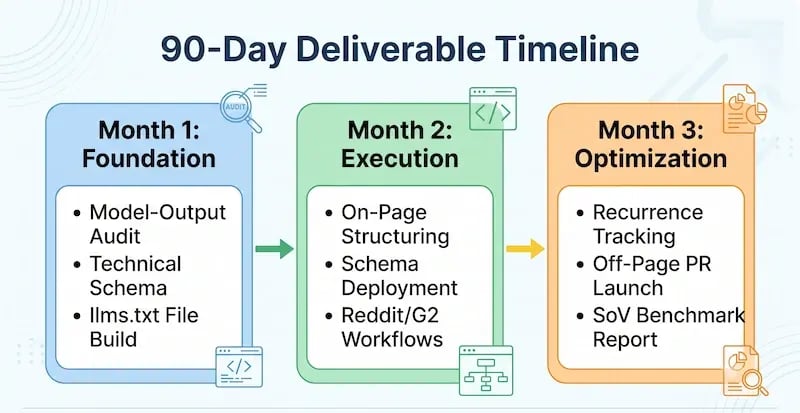
Watch for two common agency pitch traps:
- The 30-Day Guarantee: Any agency promising guaranteed top AI recommendations within 30 days is setting unrealistic expectations. AI model indexing cycles take time.
- The Unstructured Retainer: Agencies that suggest open-ended monthly hours without clear deliverables (such as schema deployment, page restructuring, and off-page campaign launches) are likely building their process on the fly.
Red Flags That Signal a Traditional Agency in Disguise
As you interview potential agency partners, watch for these warning signs. If an agency shows two or more of these flags, they have likely rebranded traditional services without building real AEO capabilities:
- Success metrics focus only on clicks and organic ranks: They talk endlessly about web traffic volume without offering a way to track AI citation rates or share of voice.
- Vague claims of "AI-Driven Content Creation": Their pitch focuses on using generative AI tools to write blog posts quickly, rather than on structuring content for machine readability.
- No dedicated AEO tracking tools: They cannot demonstrate how they measure citations across ChatGPT, Perplexity, and Claude.
- Complete focus on your website blog: They have no plan to manage third-party presence across Reddit, review platforms, trade publications, or industry forums.
- Unrealistic timelines or rigid annual contracts: They promise top AI placement in three weeks or demand a 12-month contract before delivering a baseline audit.
A Realistic Timeline for B2B SaaS AEO Results
To set clear expectations with your executive team, keep this timeline in mind when launching an AEO program:
- Weeks 1–2 (Technical & Indexing Phase): As technical schema, llms.txt files, and Q&A content are published and indexed, live-retrieval AI engines (like Perplexity and Google AI Overviews) begin recognizing updated entity parameters.
- Months 1–3 (Citation Rate Growth): Through consistent on-page answer optimization and off-page footprint building, your citation rate across the target category prompts expands. Baseline performance often moves from a 5–15% citation rate up to 30–50%+ share of voice.
- Months 3–4+ (Pipeline & Revenue Impact): As buyers discover your product cited consistently in AI search tools, qualified referral traffic scales, driving higher conversion rates and measurable pipeline growth.
Taking the Next Step in Your AEO Strategy
Evaluating agency partners for Answer Engine Optimization requires looking past buzzwords and demanding data-driven methodologies. By asking the nine core questions in this guide, you can confidently choose a team capable of building sustainable brand visibility across generative search engines.
At Aspiration Marketing, we help B2B SaaS leaders navigate this changing landscape. We combine deep technical SEO experience with Answer Engine Optimization strategies tailored to modern software buying journeys.
Our team delivers detailed model-output audits across ChatGPT, Perplexity, and Google AI Overviews, implements technical schema built for AI crawlers, and executes off-page citation strategies that establish category authority.
Ready to see how your SaaS platform appears across AI answer engines? Talk to our B2B marketing consultants at Aspiration Marketing to run your baseline citation audit and build an AEO strategy focused on real pipeline growth.






Leave a Comment
Have thoughts on this article?
Share your feedback, ask questions, or join the discussion with our community.