





Are you paying a heavy monthly retainer for generic content that barely makes a dent in your target market?
For marketing executives at EdTech companies, this frustrating scenario happens far too often. You sign a contract with a general B2B marketing firm, pass along your detailed product specs, and wait for high-impact content.
It never comes.
.webp?width=800&height=450&name=Choose%20B2B%20agency%20for%20EdTech%20(1).webp) Instead, you get polished articles that miss the technical nuances of modern education. School superintendents scroll right past your posts. District technology directors laugh at oversimplified explanations. Worst of all, your sales team ends up building its own pitch decks from scratch.
Instead, you get polished articles that miss the technical nuances of modern education. School superintendents scroll right past your posts. District technology directors laugh at oversimplified explanations. Worst of all, your sales team ends up building its own pitch decks from scratch.
The reality of business-to-business buying has fundamentally changed. Today, buyers complete most of their software evaluation long before they ever fill out a form or talk to a sales representative.
Data from the 6sense Buyer Experience Report reveals
That 95% of winning vendors appear on a buyer's Day-One shortlist before direct sales engagement ever begins.
On top of that,
Enterprise buyers consume an average of 13.4 content pieces across their buying journey, with 60% of that research occurring independently.
When your prospective buyers evaluate software solutions in isolation, your written assets act as your primary sales team. For education tech companies, general marketing advice will not cut it. You need a structured evaluation framework to pick a B2B marketing agency for EdTech brands based on clear capabilities rather than superficial online rankings.
Criterion 1: Deep Educational Domain Fluency Over Basic Copywriting
Why do generalist agencies constantly fall short when writing for education technology? The answer comes down to industry complexity.
Consider the purchasing environment in Education Technology. A sales cycle might involve public school district procurement gates, FERPA and COPPA compliance audits, state curriculum alignments, and multi-tier approval bodies.
A generalist writer might draft a blog post titled "5 Ways Technology Helps Teachers in the Classroom." A specialized agency, however, understands that a Chief Technology Officer in a K-12 district cares about student data privacy protocols, single sign-on (SSO) interoperability standards such as LTI, and E-Rate funding eligibility.
Research from Forrester shows that,
The average enterprise buying group includes 13 internal stakeholders and 9 external participants on complex technical purchases.
Each participant brings distinct technical concerns to the evaluation table.
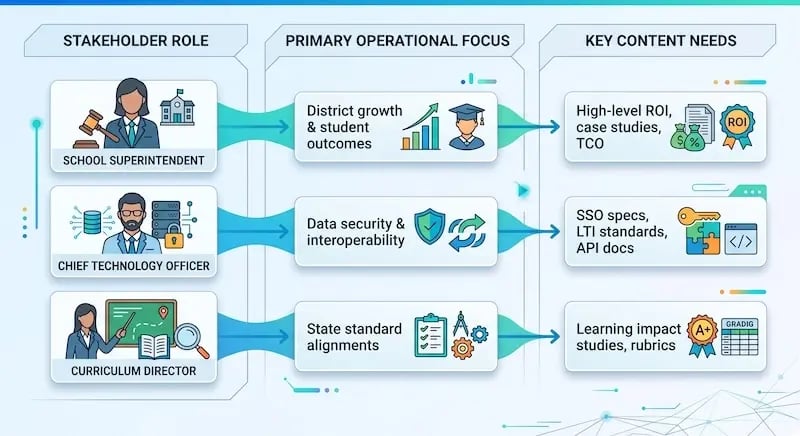 When interviewing candidate agencies, ask these direct questions to test their industry knowledge:
-
Subject Matter Extraction: "How do your writers pull deep technical insights from our internal developers, product managers, and legal teams without taking up hours of their day?"
-
Stakeholder Adaptability: "Can you show an example of how you explained one technical feature to both an IT Director focused on data security and a Superintendent focused on budget impact?"
-
Regulatory Compliance: "How do you guarantee that every published piece follows strict student data privacy standards like FERPA and COPPA?"
If an agency responds with vague promises to conduct thorough online research, treat it as an immediate warning sign.
Criterion 2: Alignment with Modern CRM and RevOps Architectures
High-quality articles sitting in isolated website folders build zero pipeline. To drive sustainable revenue growth, your content engine must connect directly to your Revenue Operations stack and Customer Relationship Management platform.
Many growing education tech firms use platforms like HubSpot to manage buyer interactions. However, basic CRM setups often fail in education because they assume a quick, linear sales cycle. In reality, education sales follow rigid institutional budget cycles, school board approval meetings, and grant allocation schedules.

A capable B2B marketing agency for EdTech brands knows how to connect published content directly to automated lead scoring, deal-stage updates, and dynamic lead routing.
According to the HubSpot State of Marketing report,
71% of marketing leaders state that directly connecting content assets to closed pipeline revenue remains their top operational challenge.
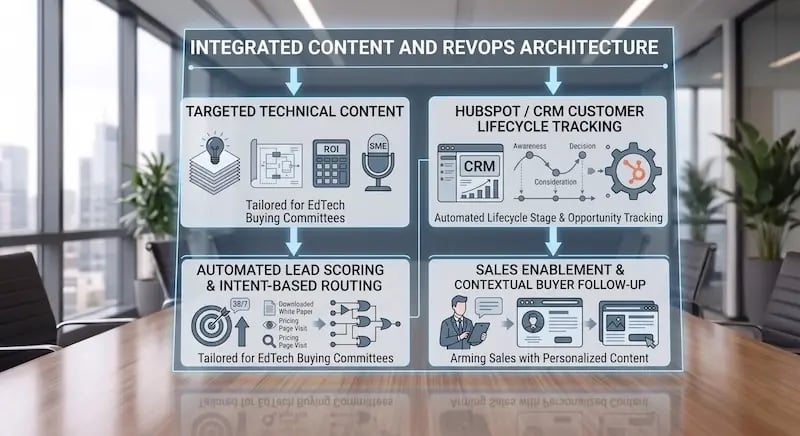 When evaluating prospective agency partners, test their technical skill set beyond copywriting:
-
CRM Expertise: Do they hold certifications in platform setup, workflow design, and sales stage automation?
-
Dynamic Personalization: Can they build smart content rules that show customized messages based on whether a visitor comes from a K-12 district or a higher education university?
-
Data Quality: Do they know how to design short form fields that gather strong buying intent without creating friction for busy educators?
An agency that connects editorial strategy with CRM automation helps you transform standard site visitors into a qualified sales pipeline.
Criterion 3: Full-Funnel Content Assets That Empower Buying Committees
A common mistake among education software brands is spending almost all their budget on top-of-funnel awareness blogs while ignoring mid-funnel and bottom-of-funnel enablement tools.
Short blog posts bring initial visitors to your website, but they rarely equip an internal buyer to convince a school board finance committee. High-performing organizations create structural assets that simplify complex purchase decisions.
Your agency partner must build a balanced mix of assets across every phase of the buying cycle:
| Buying Stage | main focus | Core assets |
|---|---|---|
| Top of Funnel (Awareness) | Educate the market on emerging educational shifts, district leadership challenges, and policy updates. | Industry research reports, district trend guides, and video interviews with education leaders. |
| Middle of Funnel (Consideration) | Help tech directors evaluate software frameworks, integration protocols, and privacy standards. | Technical white papers, system architecture maps, ROI calculators, platform comparison sheets. |
| Bottom of Funnel (Decision) | Prove operational fit, security compliance, and clear financial return for approval boards. | Implementation timelines, FERPA/COPPA compliance audits, customer success stories, and RFP response guides. |
Your content strategy must provide tailored assets for every voice on the purchasing committee.
-
The Economic Buyer (Superintendent): Demands total cost of ownership (TCO) models, risk mitigation data, and clear return-on-investment timelines.
-
The Technical Evaluator (CTO): Requires API documentation, security specs, and scalability benchmarks.
-
The End User (Educator): Wants intuitive onboarding guides, usability studies, and workflow automation examples.
If an agency's portfolio consists almost entirely of short-form blog posts and basic social media captions, they are not equipped to support complex B2B sales cycles.
Criterion 4: Outcomes-Based Attribution Over Vanity Metrics
Page clicks, social shares, and raw views look nice on monthly report slides, but they do not pay for software development or cloud hosting. When vetting an agency, demand a clear shift away from vanity numbers toward real revenue metrics.
Research published by Digital Applied shows that,
Enterprise B2B programs combining targeted content with disciplined Account-Based Marketing (ABM) decreased their average sales cycle length by 17 days year-over-year.
Conversely,
Organizations running unaligned, broad-reach content campaigns saw their sales cycles lengthen by an average of 9 days.
A modern B2B marketing agency for EdTech brands tracks performance using business metrics tied directly to company growth:
-
Pipeline Contribution: The percentage of qualified sales opportunities touched by published assets during the buyer journey.
-
Content-Influenced Revenue: Total closed-won contract value associated with contacts who engaged with specific content pieces.
-
Qualified Lead Velocity: The speed at which prospective accounts move from initial content reads to active sales conversations.
-
Search Intent Rate: The percentage of site traffic coming from high-intent commercial searches rather than broad informational terms.
During discovery calls, ask candidate agencies to share live reporting dashboards from current client campaigns. Look for clear attribution models that connect reader engagement directly to signed deals.
Criterion 5: Readiness for Answer Engine Optimization (AEO)
When school district buying committees start looking for new software, how do they find answers?
In the past, buyers typed short phrases into search engines and clicked blue links. Today, decision-makers rely heavily on conversational AI search engines and generative tools to summarize software capabilities, compare competing platforms, and draft RFP requirements.
This shift makes Answer Engine Optimization a vital capability to look for when choosing an agency partner.
While traditional search engine optimization focuses on ranking web pages on search result pages, Answer Engine Optimization structures your content so AI systems can easily read, process, and cite your insights directly in generated answers.
For technical education brands, ranking on page one is no longer enough. Your technical content must serve as the authoritative, direct answer that AI engines fetch when a Superintendent or CTO asks for a software comparison.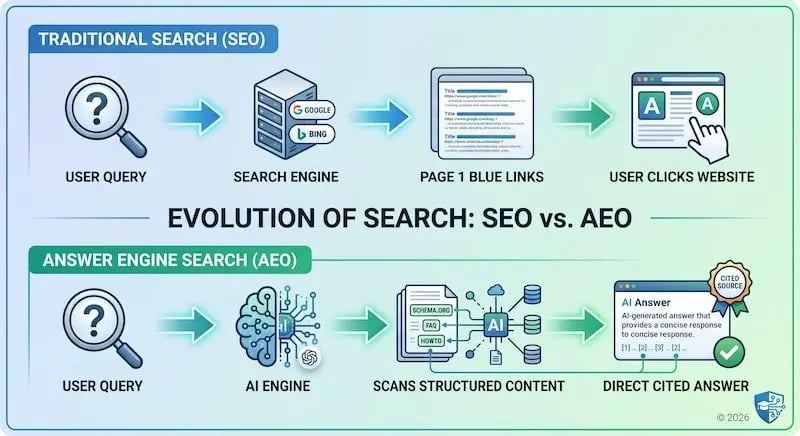
The Agency Evaluation Checklist for Decision Makers
Use this practical scorecard when interviewing content marketing agencies for your EdTech brand:
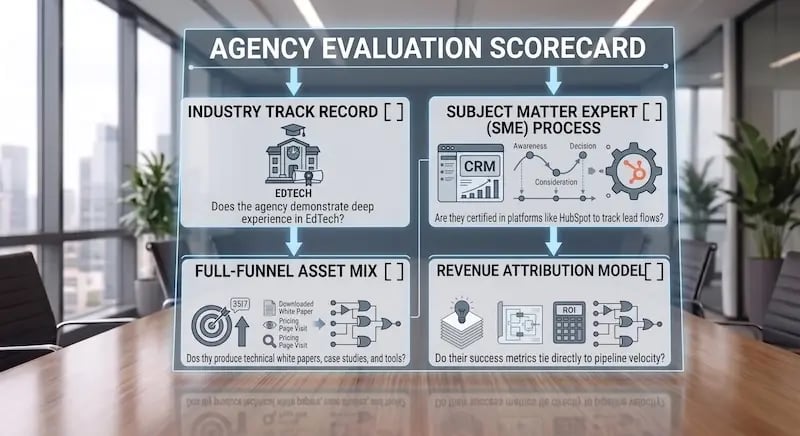
Building a Scalable Growth Engine
Picking the right agency partner requires looking past slick sales presentations and arbitrary vendor lists. For education technology companies, success depends on three essential factors: deep industry domain knowledge, tight integration with your MarTech stack, and a clear focus on revenue attribution.
When you work with an agency that understands the education space, content turns from a continuous operating expense into a predictable growth driver. Your published assets answer the exact questions district leaders are asking, building trust well before your sales team makes initial contact.
At Aspiration Marketing, we help growth-minded education technology companies build high-impact inbound systems. As a certified HubSpot partner, we align technical content strategies directly with your CRM architecture to help you capture market demand, shorten sales cycles, and drive measurable revenue growth.
Ready to upgrade your growth strategy? Reach out to our team at Aspiration Marketing today to request a comprehensive content and RevOps audit.







Leave a Comment
Have thoughts on this article?
Share your feedback, ask questions, or join the discussion with our community.