



Have you ever calculated the exact amount of recurring revenue that walks out the door while your frontline service agents are actively communicating with a client?
Every business recognizes that customer retention is vital for predictable growth. Yet, the vast majority of enterprise customer care departments remain entirely trapped in a reactive operations model. They handle hundreds of interactions daily, looking at individual tickets as isolated tasks to close quickly. That's it.
 It has many business leaders wondering:
Is there a way for live support to predict when a customer is about to leave?
Fortunately, the answer is yes. Within those active live support streams exists an unmined mountain of predictive data.
Customers rarely decide to sever a business relationship out of nowhere. Instead, they drop distinct, repetitive indicators of frustration long before they officially cancel a contract. They might adjust their tone, mention a competitor’s pricing structure, or express fatigue with a recurring software bug.
Unfortunately, standard customer success architectures are blind to these active signals. Most corporations rely almost exclusively on lagging metrics, such as:
-
Net Promoter Score (NPS) questionnaires
-
Post-interaction Customer Satisfaction (CSAT) emails
-
Scheduled quarterly account reviews
While these evaluation methods offer helpful retrospective perspectives, they fail as early-warning tools. By the time an enterprise buyer completes an annual survey and rates their experience as poor, they have typically already completed their evaluation of alternative market options. They are not asking for help; they are justifying a departure that they have already decided on.
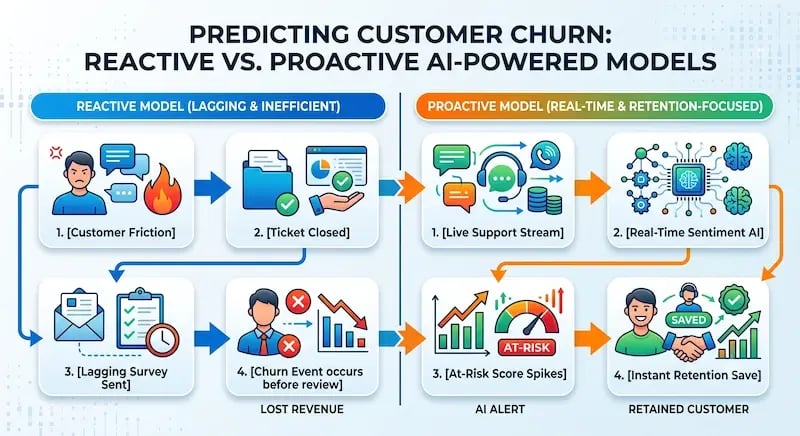 To solve this issue, forward-thinking organizations are changing how they use conversational data. By embedding advanced machine learning models directly into live text chats and phone channels, businesses can analyze customer sentiment in real time. These natural language processing engines read transcripts line by line or analyze audio second by second.
The software translates these inputs into a dynamic, shifting risk evaluation score. If a conversation shows signs of critical friction, the platform sends an automated alert to an account manager or a specialized retention team. Instead of analyzing why a customer left during a post-mortem review, your team can intervene to change the outcome before the customer even hangs up the phone or closes the chat window.
What is the Real Financial Impact of Customer Churn?
Customer churn is one of the most expensive operational inefficiencies an enterprise can experience. Replacing a lost client requires significant marketing budgets, extensive sales cycles, and long onboarding programs.
The financial data regarding the benefits of corporate customer retention proves how critical this issue is:
-
The Profit Multiplier: A classic study conducted by the Harvard Business Review established that improving your overall customer retention rate by a mere 5% can increase bottom-line corporate profits by anywhere from 25% to 95%
-
The Aggregate Global Loss: According to macroeconomic data published by CallMiner, U.S. enterprises lose an estimated $136 billion annually due to avoidable consumer churn.
-
The Scale of AI Investment: This immense financial drain explains why business leaders are pouring capital into automated support systems. Recent data from Gartner indicates that customer service and support executives invested a median of 12% of their total budgets into artificial intelligence tools, representing the highest percentage allocation across all ten major corporate business functions evaluated
The primary reason companies lose billions to avoidable churn is that they fail to connect their operational support channels with their strategic revenue teams. A customer experiencing technical issues does not view their problem as an isolated support ticket. To them, it is a failure of the vendor's core product promise.
If your internal systems treat that interaction as a standard task to be resolved within an arbitrary six-hour service level agreement (SLA) window, you miss the emotional context driving the conversation. Phone lines and text streams contain raw human sentiment. A long pause before answering an agent, a sudden increase in vocal volume, or phrases like:
"this is the third time I have called about this exact issue"
are clear warnings. When a company misses these signals, the customer feels ignored, making cancellation the logical next step.
How Does Machine Learning Read Customer Sentiment in Real-Time?
To build an automated retention framework, a business must understand how software extracts emotional meaning from a live stream of data. The technology relies on a combination of Natural Language Processing (NLP), Speech-to-Text translation algorithms, and predictive deep learning frameworks.

When an enterprise customer reaches out to an agent, the incoming data flows simultaneously into a machine learning evaluation pipeline. For phone conversations, specialized audio processing software creates a real-time text transcript while tracking acoustic cues. For web chat windows, the system ingests text as it is typed.
The machine learning model evaluates the interaction across three distinct operational layers:
1. Acoustic Stream Analysis
On voice channels, the software monitors variables that extend far beyond raw vocabulary. It tracks voice pitch, volume variations, speech pacing, and moments of conversational overlap—such as when a customer repeatedly cuts off an agent mid-sentence. Long patches of silence or sudden shifts in vocal energy are immediately flagged as indicators of growing customer agitation.
2. Semantic and Textual Ingestion
The NLP engine scans text strings for specific phrase matches, grammatical constructions, and emotional word choices. It isolates explicit expressions of dissatisfaction ("unacceptable," "completely broken," "disappointed") and identifies high-value risk phrases such as "cancel my account," "refund," or specific competitor product names.
3. Contextual Data Integration
The model does not evaluate an isolated conversation in a vacuum. True predictive intelligence requires pairing live conversational data with historical facts pulled from the company's customer relationship management (CRM) platform. The system checks how often the client has reached out recently, their total contract value, and their overall product usage trends.
| Technical Analysis Layer | Target Metrics Monitored | Churn Predictive Value |
|---|---|---|
| Acoustic Processing | Pitch variations, speaking rate, interruptions, and audio volume spikes. | Catches boiling frustration and anger that standard textual transcripts miss. |
| Semantic Extraction | Specific phrase matches, competitor name drops, policy inquiries. | Identifies explicit intent to leave or active comparison shopping. |
| Contextual Correlation | Open ticket volume, contract values, and historical dips in product usage. | Flags compound friction where a single bad call matches a pattern of account decline. |
As these three analytical layers process the live stream, the system continuously calculates an At-Risk Score. Rather than waiting for a ticket status to change to "resolved" or "closed," this score updates dynamically with every single sentence spoken or typed.
If the calculated risk index exceeds a predefined risk threshold, the software bypasses standard support channels and triggers an automated alert. The system sends this alert directly to an account manager or a dedicated customer retention specialist. Because the alert includes the full transcript, context, and reasons for the escalation, the specialist can step in to save the account while the customer is still engaged in the interaction.
How Can Businesses Use HubSpot Breeze AI to Spot Churn Signals?
Deploying real-time sentiment analysis once required massive software engineering investments, custom data pipelines, and a dedicated team of data scientists. Today, modern ecosystem tools make this enterprise-grade capability accessible to growing organizations. HubSpot's artificial intelligence engine, named Breeze, uses machine learning to analyze the sentiment and context of both voice and chat transcripts, allowing service, sales, and marketing teams to identify at-risk customers and evaluate feedback instantly.
Instead of deploying a rigid, single-score calculation that ignores the nuances of different accounts, Breeze provides customer-facing teams with a versatile toolkit. These tools surface clear churn signals directly within your daily workflow platforms:
Identifying At-Risk Accounts Proactively
Breeze evaluates a customer's relationship holistically. It simultaneously monitors account health metrics, active support ticket volumes, and historical call patterns. Looking across these different data points reveals subtle anomalies in account behavior.
For example, if a historically high-volume enterprise customer suddenly stops opening support tickets while their text chat sentiment scores drop, Breeze flags the account as a churn risk, providing teams with the context they need to plan an intervention.
Processing Customer Feedback at Scale
Manually auditing thousands of historical interaction logs or survey replies is impossible for lean customer success teams. Breeze solves this bottleneck by using automated machine learning models to analyze extensive text databases, extracting macro-level satisfaction trends, common product complaints, and widespread customer service friction points in seconds.
Maximizing Conversation Intelligence (CI)
HubSpot's Conversation Intelligence (CI) platform changes how leadership handles voice interactions. The system automatically captures voice data from your live support streams, creates clean textual records, and syncs tracked terms directly to individual contact profiles within your HubSpot Smart CRM.
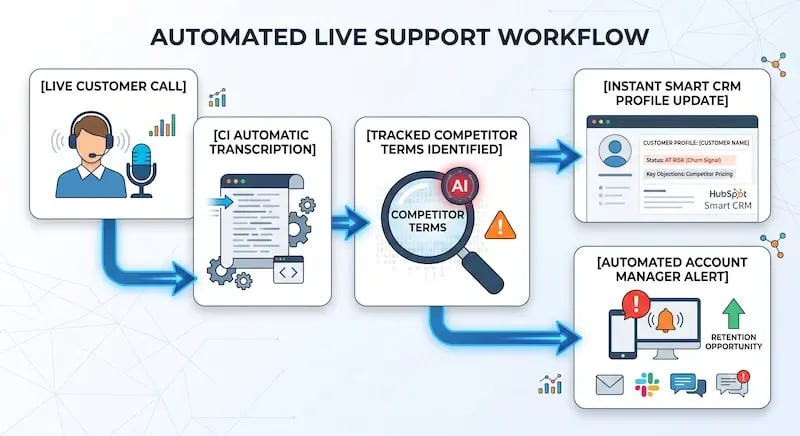
This direct connection between support channel sentiment and your central CRM architecture keeps your entire front office aligned. Sales representatives are automatically alerted to customer friction before they attempt a renewal conversation. At the same time, marketing teams can see exact customer objections in real-time, helping them refine their messaging to address common pain points.
How Do You Turn Live Sentiment Data into Real-Time Action?
Deploying advanced artificial intelligence models to uncover customer frustration is only the first half of a successful retention strategy. The true value of real-time sentiment data depends entirely on your organization's ability to build internal workflows that act on those insights instantly. Finding out a high-value customer was furious during a support call does little good if the notification sits unread in a manager's inbox for days.
To convert live support insights into real-world account saves, enterprise operations must optimize three structural pillars:
1. Build Smart Routing Workflows
When a live support stream generates an At-Risk Score indicating high frustration, the system must handle the conversation differently than it would for a standard ticket. Instead of keeping a high-value customer waiting in a general support tier queue, smart routing workflows automatically escalate the live chat or phone call.
The system routes the interaction directly to senior-tier managers or dedicated customer retention experts who have the training, tools, and authority to offer immediate solutions, such as contract modifications, billing adjustments, or custom software fixes.
2. Design an Effective Escalation UX
Frontline customer support agents need a clean, focused user experience (UX) when the system flags an ongoing interaction as high-risk. If an agent has to navigate a clunky, complex software interface while trying to calm an upset client, their performance will suffer.
A well-designed escalation interface surfaces helpful suggestions directly on the agent's screen, providing real-time talking points, links to relevant resolution workflows, and a simple mechanism to transfer the conversation to a specialist without interrupting the customer's live stream.
3. Track Retention Metrics and Software ROI
Implementing advanced machine learning models within your support channels requires a clear financial justification. To prove the ROI of your sentiment analysis tools, your operations team must actively monitor key performance metrics over time:
-
Customer Lifetime Value (CLV): Track changes in total customer lifetime value across accounts that received real-time interventions.
-
Alert Resolution Efficiency: Measure the exact percentage of high-risk automated alerts that successfully resulted in a saved account relationship.
-
Overall Customer Churn Rate: Compare historical account abandonment rates with your current retention rates to quantify the total revenue saved.
Shifting from Reactive Support to Proactive Growth
Waiting for a client to say they are unhappy in an annual email survey is an outdated business strategy. In today's fast-moving enterprise environment, protecting your revenue requires real-time action. By listening closely to your live support channels and using machine learning models to analyze customer sentiment in real time, you can catch friction early and prevent customer churn.
Deploying these advanced artificial intelligence utilities, setting up automated routing workflows, and optimizing your CRM infrastructure requires a clear technical strategy.
This is where Aspiration Marketing helps your organization grow. We specialize in helping companies implement strategic inbound frameworks, maximize their HubSpot ecosystems, and integrate advanced AI tools like Breeze into their daily workflows.
Our team ensures that your support channels feed clean, actionable data directly into your business strategy, transforming your customer service team into a proactive revenue protection engine.







Leave a Comment
Have thoughts on this article?
Share your feedback, ask questions, or join the discussion with our community.