





Are you still treating every single incoming customer issue with the exact same ticketing infrastructure? Whether a user needs a simple password reset or an enterprise client faces a high-stakes integration failure, many customer support floors route both requests through the same manual queues. This legacy approach is creating a quiet operational crisis.
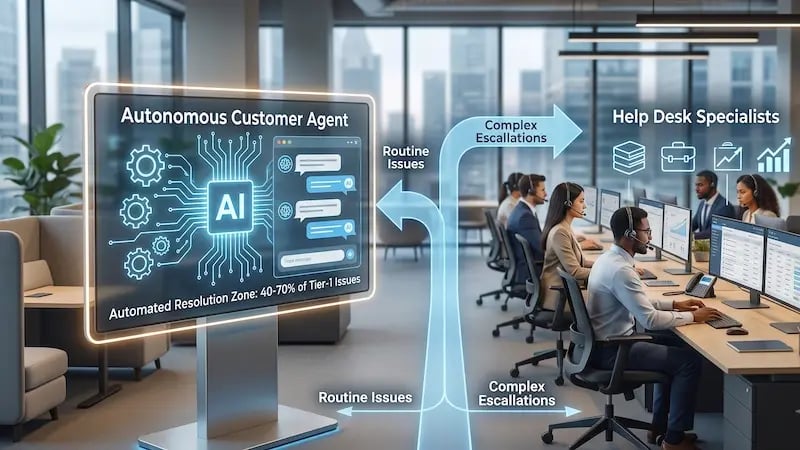 When you force every query through a human-driven help desk, you create artificial bottlenecks. Your resolution times crawl upward, your customers grow frustrated, and your operational expenses swell.
To build a modern, scalable support operation, you must re-examine the core architecture of your support floor. The path forward does not require you to choose between human empathy and automated speed. Instead, the solution lies in a structural evaluation of the customer agent vs. help desk operational model.
By implementing a strategic "Human-in-the-Loop" (HITL) model, you can deploy autonomous customer agents to handle high-volume, routine queries. This shift immediately frees your human specialists to focus on high-value account issues, radically transforming your support floor's unit economics.
Unpacking the Terms: Customer Agent vs. Help Desk
To optimize your support floor, you must first define the distinct roles of your human team and your digital assets. Confusing these two components leads to misallocated resources and poor execution.
What is a Help Desk Specialist?
A help desk specialist is a human expert who represents the gold standard for complex problem-solving, relationship preservation, and high-value account remediation. These human specialists excel at navigating ambiguous technical anomalies, managing emotionally charged escalations, and delivering personalized service that protects brand loyalty.
What is an Autonomous Customer Agent?
An autonomous customer agent is a goal-oriented, context-aware AI engine designed to resolve customer issues end-to-end without generating a support ticket. These agents are distinct from the rigid, scripted chatbots of the past decade. Modern customer agents connect securely to your internal brand data layers, interpret complex human intent, and execute multi-step resolutions across your systems.
The core operational distinctions between these two models define how your support floor scales:
| Operational Dimension | The Traditional Help Desk | The Autonomous Customer Agent |
|---|---|---|
| Primary Capability | Manual triage and complex troubleshooting | True zero-click, end-to-end resolution |
| Data Interaction | Manual lookup across fragmented internal systems | Secure, real-time extraction from brand data layers |
| Cost Structure | Linear labor scaling (more tickets require more heads) | Elastic capacity (costs remain stable during volume spikes) |
| Primary Channel Goal | Clear the manual ticket queue | Resolve the customer's intent at first contact |
If an autonomous customer agent can handle the mechanical steps of an order return, a shipping status update, or an account activation, why are you still paying specialized help desk experts to complete these tasks manually?
The Unit Economics of Support: Breaking Down the Data
Every ticket that enters your queue carries a measurable financial penalty. To understand the true economics of your support floor, you must examine current industry benchmarks, which reveal a significant cost disparity between manual and automated support.
| Support Type | Average Cost Per Interaction | Source |
|---|---|---|
| Assisted Channel (Human Live Chat, Phone, Email) | $13.50 | Gartner |
| Self-Service / Automated Resolution | $1.84 | Gartner |
| Software-as-a-Service (SaaS) Ticket | $18.00 - $35.00 | Lorikeet CX |
| Complex B2B Enterprise Technical Ticket | Over $60.00 | Lorikeet CX |
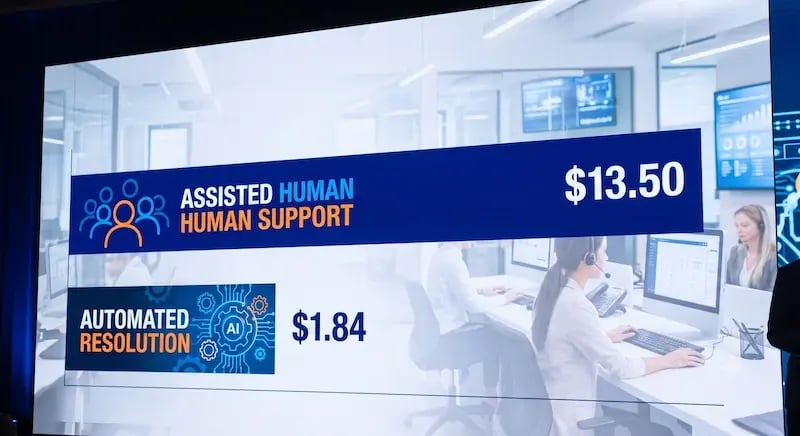
This cost structure exposes a glaring operational risk: the scaling paradox. If your support costs scale linearly with your ticket volume, your profit margins suffer whenever business grows.
Industry data compiled by Stealth Agents shows that peak-season volume spikes routinely stretch from 1.5x to 3x above baseline levels.
When a major product launch or seasonal rush hits a legacy help desk, you face a painful choice. You must either hire expensive, short-term outsourced labor or allow your customer satisfaction scores to plunge as wait times grow.
By shifting your customer support architecture to include autonomous customer agents, you break this linear cost curve.
Because an AI agent handles thousands of simultaneous conversations without an increase in headcount,
Your marginal cost for handling routine interactions falls by 85% to 95%.
This structural modification pulls your blended cost per ticket down into a sustainable, predictable range, protecting your margins during sudden market fluctuations.
Architecting the Hybrid Floor: The "Human-in-the-Loop" Model
Deploying an autonomous system does not mean replacing your human workforce. In fact, full automation is rarely a viable goal for complex organizations. The highest-performing support floors rely on a deliberate hybrid architecture known as the Human-in-the-Loop (HITL) model.
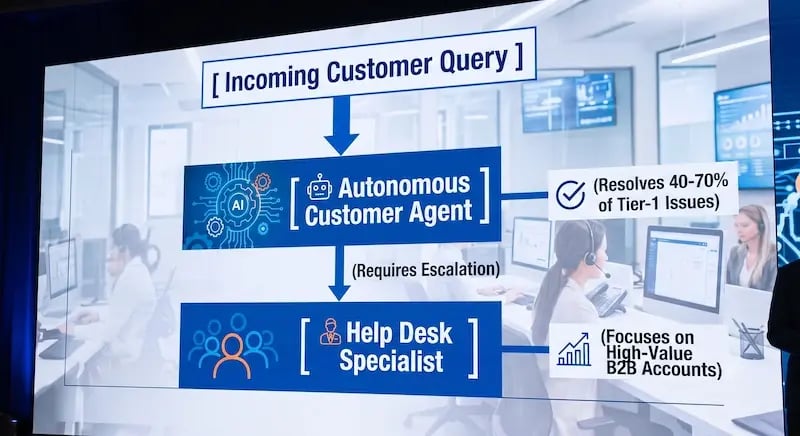
In an automated hybrid floor, your autonomous customer agents act as a high-velocity shield on the frontline. They absorb the relentless wave of repeatable Tier-1 issues, ensuring that basic queries never reach your human queues.
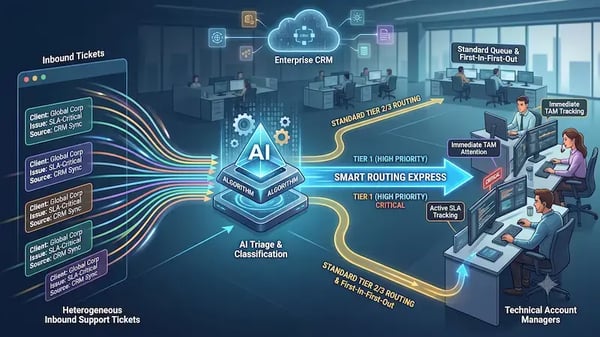
What happens when an issue becomes too complex for an automated system? The hybrid model relies on a seamless escalation framework. When an autonomous customer agent detects an emotionally sensitive scenario, a high-value account indicator, or a multi-layered technical issue, it hands the interaction off to a human specialist.
This handoff must happen without friction. If a customer has to repeat their problem to a human agent after typing it out for an AI system, their trust in your brand breaks down immediately.
Research from Avaya on frontline reskilling reveals that,
94% of consumers state it is vital that a human agent already possesses the full context of the interaction when taking over a conversation from an AI system.
The true economic value of the HITL model lies in this sharp division of labor. When you offload repetitive, mundane queries to digital agents, your human help desk specialists no longer suffer from chronic ticket fatigue.
They finally have the time and cognitive bandwidth to focus exclusively on high-value accounts, complex renewals, and deep technical troubleshooting. This targeted attention drives down customer churn and preserves your most vital revenue streams.
Strategic Transformation: Reskilling Your Frontline
Many customer service executives hesitate to adopt autonomous agents because they worry about the cultural impact on their teams. However, real-world implementations show that smart automation changes the nature of human support roles rather than eliminating them entirely.
A comprehensive Gartner workforce survey confirms that,
85% of customer service and support leaders are actively expanding the responsibilities of human agents.
Instead of planning for mass layoffs, forward-thinking organizations are reskilling their frontline workers to step into higher-value, growth-oriented positions.
When repetitive tickets vanish from your human queues, your help desk staff can transition into specialized corporate roles:
-
Knowledge Management Specialists: These team members ensure that your internal and external data engines remain accurate, clean, and continuously updated so your AI agents can perform perfectly.
-
Exception Orchestrators: These professionals specialize in resolving rare, highly technical anomalies that fall outside standard automated guidelines, acting as advanced problem solvers.
-
Customer Success Co-Pilots: Human agents shift from reactive troubleshooting to proactive outreach, identifying opportunities to increase customer lifetime value, secure contract renewals, and cultivate deep brand loyalty.
This evolution improves your operational efficiency while boosting employee engagement. Your team members stop acting like rigid software routers and start working as strategic brand advocates.
The Blueprint for Modern Customer Operations
The debate surrounding the customer agent vs. help desk model misses the fundamental point of modern support economics. These two tools are not competing solutions. They are the complementary halves of a unified, high-performing support floor.
Relying solely on a human help desk limits your ability to scale, increases your overhead, and leaves your best employees buried under routine tickets. Conversely, trying to automate every interaction with a basic chatbot frustrates your customers and damages your brand reputation.
The most cost-effective blueprint requires you to put autonomous customer agents on your frontline to handle routine Tier-1 volume, while backing them up with skilled human specialists via a robust Human-in-the-Loop framework. This approach protects your margins, shields your specialists from burnout, and ensures your customers receive immediate, accurate resolutions.
Building a secure, enterprise-grade hybrid support floor requires an experienced partner who understands how to safely link your underlying brand data with automated execution layers.
To bring this architecture to your business, connect with the service design and growth specialists at Aspiration Marketing. Let us help you deploy goal-oriented autonomous systems that dramatically reduce your support overhead while elevating your customer experience.





Leave a Comment
Have thoughts on this article?
Share your feedback, ask questions, or join the discussion with our community.