





Do your sales representatives spend more time chasing internal paperwork, manually calculating contract prorations, or toggling between disconnected billing applications than actually selling?
If that question hits close to home, you are dealing with a widespread challenge.
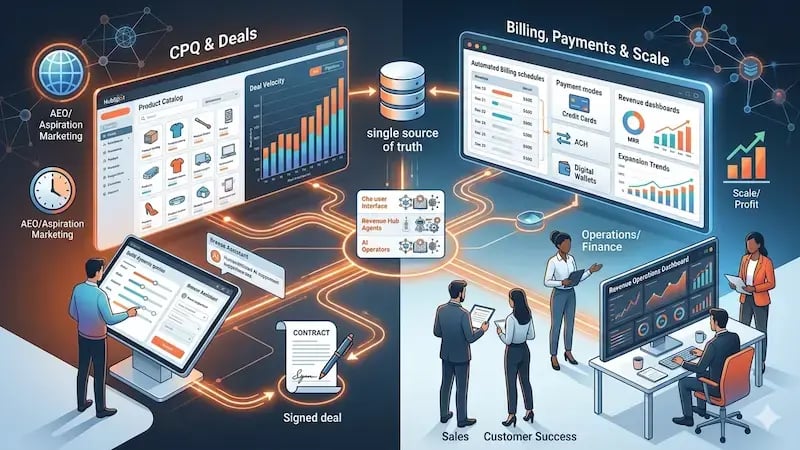 Revenue data across modern business-to-business (B2B) organizations is historically trapped in siloed software stacks. When your configuration, invoicing, and payment processing engines operate in completely separate environments, it breeds friction at scale.
According to data shared by HubSpot, an astonishing 86% of B2B deals stall at the quote-to-close phase simply due to fragmented tech infrastructures and manual administration.
Furthermore,
A comprehensive study by MGI Research reveals that 42% of enterprises suffer from active revenue leakage, losing between 3% and 7% of their top-line revenue every year.
Is a standalone CPQ tool or point-solution billing software actually solving your scaling bottlenecks, or is it merely plastering over systemic architectural holes?
Modern go-to-market teams do not just need a better point solution. They require an integrated quote-to-cash operating system. On June 16, 2026, HubSpot is launching a major evolution by rebranding and expanding Commerce Hub into HubSpot Revenue Hub. This guide explores what this unified platform is, what makes it a massive leap forward for the HubSpot CRM ecosystem, and exactly how you can use it to accelerate your business growth.
What is the HubSpot Revenue Hub?
The HubSpot Revenue Hub is HubSpot’s connected, native quote-to-cash platform designed to bring CPQ (Configure, Price, Quote), billing, and payments together into one single workspace. It officially acts as a unified operating system that handles everything from the moment a lead enters your pipeline to the moment cash hits your bank account.
For years, scaling businesses have bought separate tools to manage different parts of the transactional lifecycle. You might use one tool for your CRM, another for sending quotes, a third for generating invoices, and a fourth to process credit cards. HubSpot Revenue Hub fundamentally changes this approach. It turns revenue management from a series of disconnected transactional moments into a continuous, connected data layer that runs natively across your entire customer database.
When your configuration, invoicing, and collection infrastructures share a unified architecture, you unlock complete revenue context inside every single customer relationship. This centralized visibility ensures teams can close deals faster, grow account expansions, and align cross-functional teams around a single revenue truth.
The Restaurant Analogy: Understanding Unified Revenue Flow
To understand why this unified framework is so powerful, consider a simple restaurant analogy:
- CPQ (The Menu & Order): A sales representative configures precisely what the buyer wants at an authorized price. Because the rules are built directly into the system, there are no "rogue" unapproved discounts, and the kitchen receives a clean, accurate ticket.
- Billing (The Check): The proper financial totals are compiled automatically without manual intervention. For regular customers on a recurring tab, invoices are automatically generated, so the restaurant never has to "remember" to bill them.
- Payments (The Card Reader): Transaction execution records are available in the system immediately. The register updates automatically without anyone having to manually log the payment or cross-reference bank statements.
In a unified restaurant, the waiter never has to walk an order ticket down the street to a separate shop just to get it processed. The entire ecosystem hums natively in one kitchen. HubSpot Revenue Hub brings that exact same level of harmony to your business infrastructure.
What’s New? Moving from Transactions to a Unified Lifecycle
To understand the scope of this update, it helps to look at the roadmap that led HubSpot to this point. While the previous Commerce Hub was primarily transactional—focused on basic payment links and standalone invoices—HubSpot Revenue Hub introduces a comprehensive revenue system embedded within the CRM.
This evolution rolled out in three strategic milestones, or "lightning strikes":
-
September 2025: Launched advanced CPQ capabilities to handle complex pricing configurations.
-
April 2026: Introduced the groundbreaking, native Contracts Object to serve as the structural anchor for all quoted data.
-
June 16, 2026: The official launch of Revenue Hub, rebranding the Commerce Hub and introducing fully connected billing and automated payment schedules tied directly to the contract.
The Power of the New Contracts Object
The introduction of the custom Contracts Object is the true engine driving this transition. Previously, winning a deal meant a sales rep closed an opportunity, and the data trail went cold for downstream teams.
Now, the signed quote automatically creates a native contract record in HubSpot CRM. This object acts as the living record of what was sold, capturing:
-
Effective Dates
-
Specific Product Entitlements
-
Total Contract Value
-
Precise Term Lengths
Because this data layer sits underneath the entire commercial lifecycle, it automatically feeds downstream payment schedules, recurring invoice generation, and subscription models without any manual data re-creation.
The Core Components of Revenue Hub
To appreciate how you can leverage this tool, it helps to examine the three core components that form the foundation of the platform.
1. CPQ with AI-Driven Speed
The first element of the platform is a robust CPQ engine that helps sales reps configure, price, and quote with rapid speed
-
Unified Product Catalog and Price Books: You can establish a single source of truth for your product library. This allows you to define product and service pricing by region, customer segment, or specific contract terms.
-
Dynamic Line Items: Sales reps can modify specific line items to bridge standard pricing catalogs with complex, real-world buyer negotiations without entering manual math errors.
-
Commercial Guardrails: To protect your gross margins, administrators can set up automated rules that block incompatible products or enforce strict discount limits. If a sales rep tries to offer a discount that exceeds your corporate policy, automated approval workflows immediately route the quote to management for review before it can be sent to the buyer. Field-level permissions ensure that only authorized users can view or edit sensitive terms, such as profit margins.
2. Automated, Scalable Billing
Once a deal is won, the billing engine automatically takes over. Rather than forcing your accounting team to copy data from the CRM into a separate billing tool, HubSpot Revenue Hub bridges the gap instantly.
-
Contract-Driven Invoicing: The signed quote transitions instantly into a structured digital contract. This contract serves as the single place of truth for what was sold and automatically drives downstream invoicing.
-
Mixed Billing Frequencies: B2B deals are rarely simple. With HubSpot Revenue Hub, you can support complex arrangements like monthly billing for one product, quarterly billing for another, and annual billing for a third—all managed seamlessly within a single agreement.
-
Staggered Timelines: If you onboard a customer in phases, you can configure independent start and end dates for specific line items within the same contract.
3. Integrated Payments
The final piece of the puzzle is payment collection. HubSpot Revenue Hub embeds secure payment links and native ACH or credit card options directly into your customer-facing quotes and invoices.
-
Accelerated Cash Flow: Buyers can sign and pay simultaneously, removing friction from the final step of the sales cycle.
-
Automatic Reconciliation: Eradicate manual backlogs in accounts receivable. When a customer pays an invoice, the transaction records in the CRM are updated instantly, updating financial logs and pipeline reports without any human data entry.
Persona-Driven Value: Who is Revenue Hub For?
HubSpot Revenue Hub isn't just a tool for the sales team; it is an organizational bridge that aligns multiple corporate personas around a single revenue truth. With this Hub, HubSpot has engineered a way for different departments to extract distinct values from this unified architecture:
-
Sales Representatives & Leaders: Reps can move at lightning speed using AI-powered quotes, while leadership gains flawless attribution data across initial sales, mid-term adjustments, and renewals.
-
Revenue Operations (RevOps): Instead of wasting hours reverse-engineering static PDFs and piecing together disparate software platforms, RevOps teams get clean, structured data that flows smoothly across the entire business.
-
The CFO & Finance Teams: Financial officers gain extreme confidence through automation and accuracy. Because billing schedules inherit directly from the closed quote, billing disputes vanish, and audit trails remain perfectly clean.
-
Customer Success (CS): CS teams can protect and grow the customer base with direct line of sight into exact renewal timelines, historical contract values, and specific product entitlements.
Accelerate Your Closing Velocity
For sales teams, speed is everything. When a prospect is ready to buy, any delay in generating a quote can kill deal momentum. Sales reps can use the platform's no-code template builder to create beautiful, fully compliant proposals in minutes.
Furthermore, the system leverages native Breeze AI intelligence to review your historical CRM records, email threads, and meeting transcripts. It then automatically generates hyper-personalized cover letters and summaries for your quotes. Because your company's branding, legal language, and pricing rules are locked into the templates by administrators, reps can move fast without risking non-compliant contracts.
Streamline Your Financial Operations
Finance teams often spend hours manually reconciling bank deposits against open invoices or trying to figure out how to calculate partial-month updates when a customer upgrades their account mid-term. HubSpot Revenue Hub removes this burden entirely.
Because the billing engine reads data straight from the contract object, invoices reflect the exact agreed-upon terms automatically. If a change occurs, the system calculates the correct pricing updates and updates future billing schedules without human intervention. Finance leaders gain perfect visibility into unbilled usage, upcoming recurring revenue, and real-time collection statuses.
Retain and Expand Existing Accounts
Revenue generation does not stop when a deal closes. In fact, for most subscription and services businesses, the real growth happens post-sale. Customer Success (CS) teams can use HubSpot Revenue Hub to manage the entire customer relationship history with complete transparency.
Instead of searching through shared drives or email threads to find old PDFs, CS reps can view the active contract record directly in HubSpot CRM. They can see exactly what products the customer owns, their entitlement limits, and their complete amendment history.
When a renewal is approaching, the system surfaces it early, allowing the CS team to apply automated price increases or instantly generate a renewal quote based on the customer's current footprint. If a customer wants to add more seats or upgrade their package mid-term, the team can issue an expansion quote that automatically calculates the correct prorated amount for the rest of the billing cycle.
Built for the Future: The Agentic Platform Layer
A major differentiator of the HubSpot Revenue Hub is how it infuses next-generation artificial intelligence directly into your transactional workflows. As the HubSpot Revenue Hub is launching as a layer in HubSpot's agentic customer platform, it enables features such as the Breeze Assistant for creating and editing quotes and dedicated revenue agents for tasks like collections.
The platform operates across four distinct interactive AI layers to make revenue management completely effortless:
Four Interactive AI Layers of HubSpot Revenue Hub
Layer Name |
Operational Purpose |
Key Capabilities |
|---|---|---|
The User Interface (UI) |
Precision control and direct data manipulation. |
Visual control for slicing revenue data, configuring pricing rules, and comparing individual line items. |
Breeze Assistant |
Human-initiated AI support inside the portal. |
Allows users to ask questions directly to create quotes, query contracts, or view payment records instantly. |
Revenue Hub Agents |
Autonomous AI agents handling high-volume tasks. |
Automatically executes repetitive administrative work, follows up on open quotes, and manages routine billing updates. |
AI Operators |
Deep cross-system analysis and intelligence. |
Connects your revenue data with external systems to unlock hyper-personalized insights and advanced forecasting. |
This advanced structure means your business data compounds in value over time. Every single quote sent, invoice paid, and contract amended writes data back to the core CRM, building a deeper intelligence layer that helps your entire team work smarter.
Instead of staring at rigid retroactive reports, sales leaders and executives can use Breeze AI to ask proactive questions like:
- "Where is my net dollar retention dropping?"
- "What is my highest performing product by region?"
- "Where is my clear cross-sell whitespace?"
How to Get Started: A Structured Implementation Framework
Transitioning your business onto a unified quote-to-cash platform requires careful planning. While HubSpot enables an immense amount of power out of the box, revenue workflows are inherently sophisticated. To ensure your data structures integrate cleanly, companies typically follow a three-phase project framework:
Phase 1: Implementation and Setup (Weeks 1–12)
This initial phase focuses entirely on engineering a rock-solid data foundation. Operations teams map out the core product library, define global price books, configure dynamic CPQ logic, and establish automated approval workflows. This phase also includes connecting payment gateways and mapping the custom Contracts Object to sync seamlessly with downstream accounting tools or enterprise ERPs like QuickBooks Online.
Phase 2: Enablement and Adoption (Weeks 6–16)
Overlapping with the technical configuration, this phase focuses on human adoption. Teams roll out role-based training so that sales reps can confidently use the visual UI and AI tools, finance admins understand the automated invoicing flows, and customer success reps can manage renewals directly from the contract record.
Phase 3: Ongoing Optimization (Month 3+)
Once the system is live, the focus shifts to recurring platform management. Leaders leverage unified analytics dashboards to monitor pipeline health, identify friction points where deals stall, optimize pricing models, and refine automated collection workflows to maximize net dollar retention.
Unifying Your Single Revenue Truth
True revenue acceleration is never achieved by stacking more disconnected software programs on top of an already fractured pipeline. It requires unifying your commercial infrastructure under a single source of truth.
By anchoring your CPQ engine, automated billing schedules, and payment processing layers directly onto your core customer database, the HubSpot Revenue Hub protects your profit margins, eliminates manual back-office tasks, and empowers your go-to-market teams to close deals faster. It turns revenue from a series of stressful, fragmented transactions into a continuous, connected layer that supports predictable corporate growth.
Transitioning your enterprise to a unified quote-to-cash framework requires meticulous architectural design and a sharp RevOps strategy. If you are ready to eliminate revenue leakage and unlock the full potential of your HubSpot CRM ecosystem, connect with Aspiration Marketing today. Our platinum-level platform experts specialize in engineering seamless Revenue Hub implementations designed to scale your business operations and accelerate your growth.







Leave a Comment
Have thoughts on this article?
Share your feedback, ask questions, or join the discussion with our community.