





When expanding into international markets, global marketing teams face a critical choice. Are you genuinely establishing a localized brand presence, or are you simply inflating your foreign-language word count?
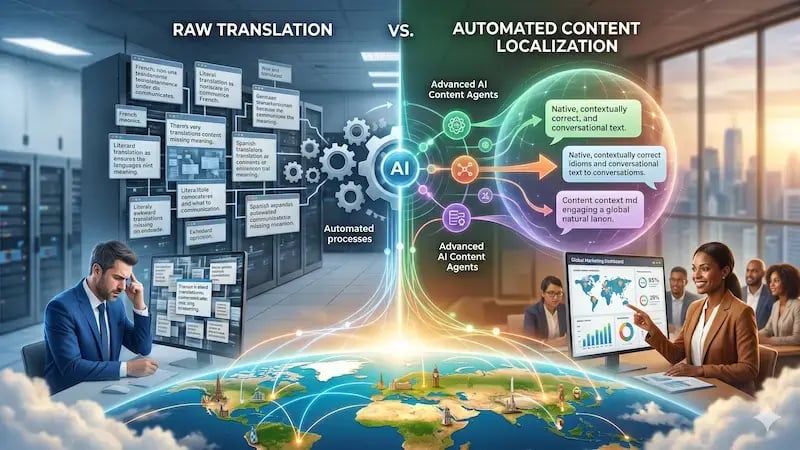 Many enterprise digital marketing organizations assume that using raw translation for a high-performing English blog post or whitepaper into German, Spanish, or Japanese is sufficient to capture global market share. However, a massive operational and psychological chasm exists between a foreign prospect merely understanding your text and that same prospect actually trusting your brand.
Traditional raw translation approaches to cross-border growth treat language like a basic substitution math problem. In contrast, modern international marketing requires a deep, systematic understanding of local culture, search engine behavior, and specialized business logic. This reality is why the strategic debate between automated content localization and raw translation has taken center stage for enterprise growth leaders.
1. What is Raw Translation? Understanding the Baseline
Raw translation is the literal, surface-level substitution of text from one language to another using algorithmic machine translation (MT) models without contextual adjustment. It focuses purely on basic syntax and linguistic equivalence rather than cultural resonance, audience intent, or industry-specific business nuances.
The traditional raw translation process follows a simplistic, linear flow:
- Input: Source Text
- Action: Algorithmic Word Substitution
- Output: Literal Target Output = Text that may not even be linguistically or culturally correct.
To fully understand the operational limitations of raw translation, consider standard machine translation (MT) engines. These systems analyze text on a line-by-line basis. While these MT models have become highly efficient at processing simple sentences, they remain fundamentally blind to the underlying context. They operate within isolated language silos, ignoring the cultural environment of the person reading the final asset.
For a decade, digital marketing teams used this predictable, rigid formula to scale content across borders. This raw translation approach relies heavily on tools that cannot process external variables such as localized search intent, regulatory vocabulary requirements, or regional behavioral traits.
Where Literal Subventions Fall Short
When you deploy raw translation in a high-stakes B2B or complex B2C market, the automated output immediately runs into several distinct points of failure:
-
The Breakdown of Metaphors: Common American business idioms like "hit it out of the park," "touch base," or "circle back" sound completely nonsensical—and often highly unprofessional—when converted literally into French, Mandarin, or Korean.
-
The Formatting Disconnect: Basic translation algorithms routinely overlook local formatting conventions. They frequently leave dates in the wrong order, fail to convert imperial measurements to metric units, and keep currencies native to the origin market.
-
The "Foreign Brand" Red Flag: These formatting and structural mistakes act as an immediate warning sign to your international readers. The moment a sophisticated buyer notices mismatched idioms or broken grammar, their trust in your product or service evaporates.
While raw translation appears highly efficient because it is cheap and instantaneous, the long-term editing and cleanup costs make it incredibly expensive. If your regional sales managers have to spend hours rewriting clunky, automated drafts, your content pipeline is broken.
2. What is Automated Content Localization? The AI Evolution
Automated content localization is an advanced, AI-driven content framework that automatically adapts original text to match the cultural, structural, and search-optimized preferences of a target market. It looks past literal text translation to modify regional metaphors, local business idioms, and structural reading levels.
In contrast, the modern AI process for automated content localization is more sophisticated:
- Input: Source Text
- Action: AI Content Agent Contextual Filter
- Output: Natively Aligned Local Asset = Trusted brand and thought leader.
The core driver behind this evolutionary shift to automated content localization is the rise of autonomous, context-aware AI Content Agents. These advanced models do not simply swap words. Instead, they ingest your master brand guidelines, target audience personas, and regional data layers before altering a single line of text.
By analyzing the broader context, these intelligent AI Content Agents ensure that your international marketing assets read as though they were originally written by a native subject-matter expert living in Berlin, Tokyo, or Mexico City.

The Mechanics of Autonomous Contextual Alignment
Modern automated localization engines handle the complex, heavy lifting that traditional machine translation tools miss entirely:
-
Idiom Swapping: Instead of translating an origin metaphor literally, an AI Content Agent identifies the core business meaning and swaps it for an equivalent native expression. For example, the American corporate phrase "bring to the table" is naturally adapted to relevant localized business idioms rather than translated word-for-word.
-
Tone Regulation: Communication styles vary widely by country. A direct, aggressive sales tone that converts well in North America may feel incredibly abrasive in Japan, where business culture prioritizes humility and consensus. Localization automation adjusts these tonal frequencies seamlessly.
-
Structural Re-engineering: Paragraph lengths, sentence structures, and content layouts are modified to match the reading behaviors of the target demographic, driving high technical readability.
3. Head-to-Head Comparison: Raw Translation vs. Automated Localization
To help your marketing organization evaluate raw translation versus automated content localization during the consideration stage of your buying journey, let us contrast their performance across five critical operational vectors.
| Performance Vector | Raw Translation | Automated Content Localization |
|---|---|---|
| Primary Objective | Surface-level text substitution and syntax accuracy. | Deep audience resonance and localized cultural alignment. |
| Idioms & Metaphors | Translated literally, resulting in awkward or broken messaging. | Automatically swapped for equivalent native business expressions. |
| International SEO Value | Minimal. Misses regional keyword intent and semantic search variations. | High. Tailors content architectures for local-answer-engine discovery. |
| Structural Layouts | Keeps rigid source structures, leading to text overflow or spacing issues. | Restructures paragraphs, data tables, and formatting for native comfort. |
| Workflow Scalability | Requires slow, expensive human rewriting to become market-ready. | Scalable, high-speed output with context-aware precision built-in. |
4. The Critical Data: Quantifying the Impact of Localized Content
In digital marketing, making decisions based on assumptions is a recipe for wasted budgets. To understand why automated content localization is no longer optional for global enterprises, we must analyze verified global data.
The financial stakes of language optimization are incredibly high. According to extensive international consumer research published by CSA Research,
76% of global online consumers prefer to purchase products when marketing information is available in their native tongue.
More importantly,
The data reveals that 40% of global consumers will never buy from a website that contains content in another language.
When businesses move past raw machine tools and deploy tailored localization strategies, the financial return is measurable.
Industry benchmarks from the Technavio Language Services Market Analysis show,
That implementing native-language localized support across international customer touchpoints lifts digital conversion rates by up to 70%.
Furthermore, planning your core digital properties with proper automated localization frameworks
Reduces technical market-entry rework by 35%, drastically protecting internal engineering resources.
This clear preference for native-feeling content is driving a massive surge in enterprise technology spending. Market data tracking global business investments compiled by Coherent Market Insights indicates that:
The Global Localization Strategies Market is valued at $70.2 million in 2026 and is projected to grow at a Compound Annual Growth Rate (CAGR) of 12.0% through 2033.
This aggressive acceleration is fueled directly by organizations' replacement of legacy translation tools with AI-driven, context-aware content localization engines.
5. Driving Pipeline Value: Why Localization Wins the Consideration Stage
During the consideration stage of the buyer's journey, prospects are actively evaluating vendor capability and technical expertise. If a European or Asian enterprise executive downloads your whitepaper and encounters a clunky, literal machine translation, they will naturally conclude that your product engineering and customer support teams are equally unpolished.
True localized automation preserves your global brand identity while allowing your regional marketing messages to feel deeply custom-built.
Dominating the International AEO Landscape
The digital discovery ecosystem is undergoing a fundamental transformation. Traditional Search Engine Optimization (SEO) is quickly being upstaged by Answer Engine Optimization (AEO). Modern buyers are moving away from typing static keywords into a search box; instead, they ask highly complex, contextual questions to conversational AI assistants, Large Language Models (LLMs), and semantic search engines.
This structural shift introduces the concept of the zero-click reality. Industry panel insights compiled by SparkToro report that:
68.01% of all web searches now terminate without a single click to an external website because the user finds their answer directly inside the search engine results page.
When an artificial intelligence engine produces an AI Overview,
The probability of a user clicking a traditional organic web link decreases by 47%.
To win citations and traffic in this new AEO landscape, your international content assets cannot simply be translated word-for-word. They must be structurally engineered so localized AI scrapers can parse, extract, and reference your data effortlessly.
While only a small fraction of users click directly on inline summary citations,
Brands that consistently earn those AI citations experience 35% more organic clicks overall than un-cited competitors targeting the exact same query space.
Raw translation changes the words, but it leaves your keywords tied to the origin country's search habits. Automated content localization maps regional search variants, ensuring your content uses the precise terms local buyers actually use when querying conversational search tools.
6. Implementing Localized Content Workflows Without the Operational Chaos
How do you scale an international content strategy across multiple countries without creating massive administrative bottlenecks, project delays, or content sprawl? The secret lies in pairing high-velocity automation with strategic human oversight. This modern configuration is known as a human-in-the-loop workflow.
| UNIFIED ENTERPRISE FRAMEWORK |
|---|
| ↓ |
| Central Repository Content |
| ↓ |
| AI Content Agents (90% Work) |
| ↓ |
| Local Expert Review (10% Polish) |
| ↓ |
| Live Global Release |
Instead of running completely isolated content-generation tracks for each target country, your core marketing team creates an authoritative parent asset in your primary language. This could be a comprehensive guide, an expert technical brief, or a transcribed video webinar.
Next, the asset is passed to your automated localization layer. The AI Content Agent takes over the heavy operational lift, handling roughly 90% of the structural formatting, idiom translation, and local keyword matching.
Empowering the Human Layer
Once the AI engine finishes its initial processing pass, your local regional managers or native-speaking editors step in to handle the final 10% of the workflow. They do not have to spend days drafting from scratch. Instead, their role shifts to that of a high-level creative curator. They review the pre-localized copy, verify subtle brand alignments, and add final contextual touches.
This strategic division of labor eliminates the classic operational bottlenecks of global expansion. It stops your subject-matter experts from wasting hours on manual editing, prevents message drift, and provides absolute global brand consistency across every market you enter.
7. Strategic Synthesis: Choosing the Path to Scalable Global Growth
Relying on raw machine translation is a legacy approach from a bygone digital era when software could only process text syntax rather than human context. In today's sophisticated global marketplace, winning buyer trust requires an intelligent framework that honors the cultural nuances, search behaviors, and idioms of your international audience.
Transitioning from simple word substitution to a scalable, automated content localization model requires a powerful combination of strategic alignment and modern marketing technology.
This is the exact operational space where Aspiration Marketing provides enterprise-grade value . By leveraging sophisticated HubSpot Content Agents and advanced international content governance blueprints, Aspiration Marketing helps global enterprise organizations build highly efficient, scalable multilingual marketing footprints.
From transforming high-value video webinars into deeply connected, international AEO blog clusters to managing complex technical product documentation without sacrificing accuracy or user trust, Aspiration Marketing ensures that your brand message resonates perfectly in every single corner of the globe.







Leave a Comment
Have thoughts on this article?
Share your feedback, ask questions, or join the discussion with our community.