





You know the feeling. You just wrapped up a discovery call that felt perfect. You uncovered the pain, the prospect admitted they needed a change, and you agreed on the next steps.
Then… silence. Days turn into weeks, and your follow-up emails disappear into thin air. This phenomenon, known as ghosting in sales, is when a prospect suddenly ceases all communication without explanation.The traditional sales instinct is to chase harder—sending "just checking in" emails or re-sending the presentation. However, this often pushes the buyer further away and tanks the ROI of your email marketing efforts.
 The philosophy behind modern sales methodology suggests a shift in perspective: Sales is not just about selling software or services; it is about helping buyers navigate their internal decision-making milestones. When a prospect goes silent, it is rarely because they don't see the value.
Of course, sometimes a prospect isn't ghosting you; they just never saw your email. Ensure that your contact data is accurate and your sender reputation is up to par to have your email actually land in their inbox.
However, more often than not, it is usually because they are stuck. To revive the deal, you must stop appealing to their logic and start speaking to their psychology.
Key Statistics on Sales Follow-Up
- The "Rule of Five" Statistic: 80% of sales require five follow-up calls after the meeting, yet 44% of sales representatives give up after just one follow-up. Consistency is often the missing ingredient in deal revival, especially when you consider that 80% of sales require five follow-up calls after the initial meeting to close successfully.
- The "Multi-Channel" Statistic: Multi-channel campaigns result in 287% higher purchase rates than single-channel campaigns. If your emails are being ignored, it might be time to switch lanes; switching to a multi-channel approach can generate 287% higher purchase rates than relying on a single method of communication.
- The "Persistence Pays" Statistic: 60% of customers reject an offer four times before saying yes. Don't let silence discourage you from continuing the conversation, particularly since 60% of customers reject an offer four times before they are finally ready to say yes. Build lead nurturing sequences to maximize engagement.
- The "Need for Speed" Statistic: Sales representatives who follow up within a day of their initial outreach receive a reply rate of approximately 25%. When trying to trigger a response, speed is your ally; data shows that sales reps who follow up within a day of their initial outreach achieve an average response rate of 25%.
- The "Reality Check" Statistic: Only 2% of sales are made on the first contact. It's easy to feel ghosted after one unreturned message, but keep in mind that only 2% of sales are made on the first contact, meaning the vast majority of deals require a longer nurturing process.
The Psychology of Silence: Why They Ghost
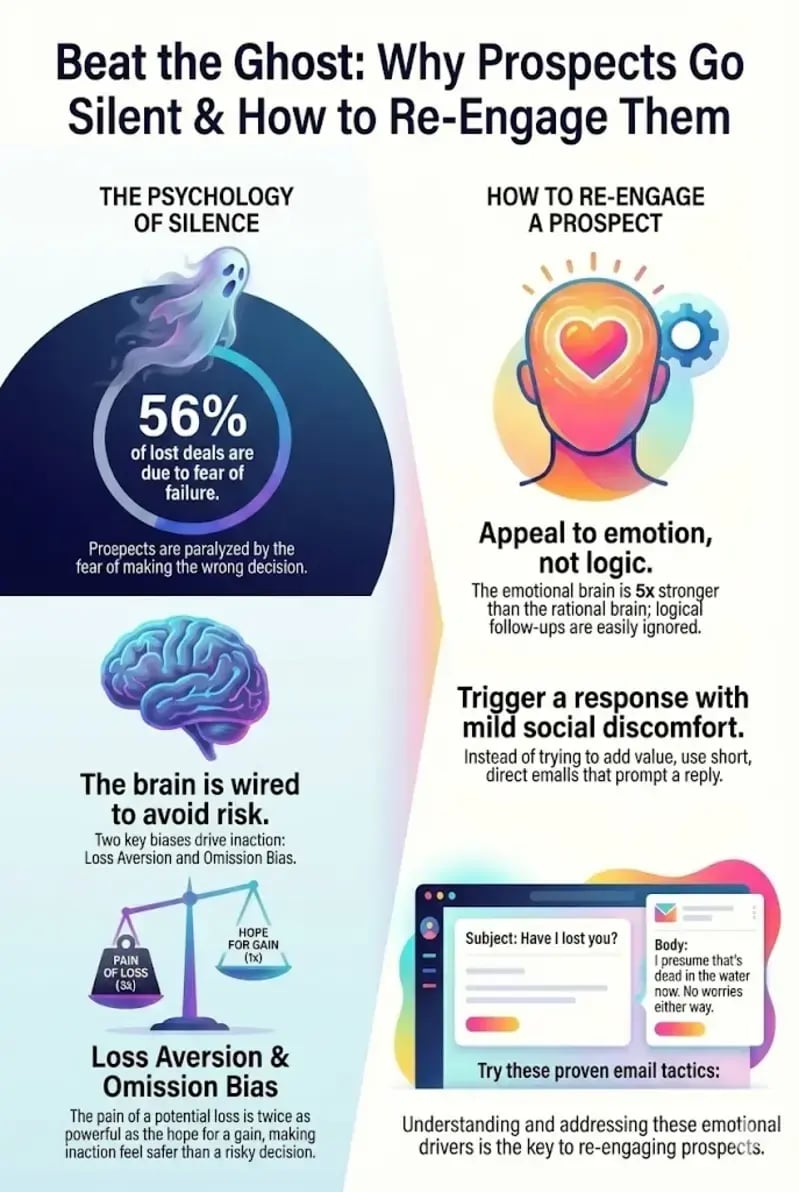
To understand why a deal stalls, you have to understand the two minds at work in your buyer's head. Humans battle between the "Rational Brain" (focused on ROI and logic) and the "Emotional Brain" (focused on safety and fear).
Here is the critical quantification:
The emotional brain is 5x stronger than the rational brain.
When a buyer goes silent, the emotional brain has taken the wheel. Research shows that up to 58% of deals in your funnel are lost to the status quo, and 56% of those lost deals are due to a fear of messing up.
Two powerful cognitive biases paralyze your buyer:
- Loss Aversion: Loss Aversion is the cognitive bias where humans weigh potential losses much more heavily than potential gains. The fear of making a wrong decision outweighs the hope of business growth.
- Omission Bias: Omission Bias is the human tendency to prefer inaction over taking an action that might make things worse. They would rather live with their current pain than risk a failed implementation that damages their reputation.
The strategy? To break the silence, you must trigger a response through mild social discomfort or by handing control back to the buyer. As with the entire campaign, you want to ensure that you personalize your communications.
Automate the Follow-up Sequence
The 7 Ways to Trigger a Response
1. The "Break-Up" Email
When you chase a silent prospect with logic, they feel hunted. This tactic is effective because it leverages loss aversion—the fear of losing an opportunity. By threatening to take the offer away (closing the file), you force the emotional brain to react.
The Concept:
You aren't being rude; you are asking for "permission to close the file".
Template Idea:
- Subject: "Have I lost you?" or "Closing the file?"
- Body: "I haven't heard back, so I assume this project is dead in the water. I will close this file on my end. No hard feelings either way."
2. The "No-Oriented" Question
Buyers are conditioned to defend against "Yes" questions (e.g., "Do you have time to meet?"). These questions can trigger defensive reactions known as the "yes trap". Conversely, people feel safe and protected when they say "no".
The Concept:
Frame your question so that "no" is the answer you want. This gives the buyer a feeling of control.
Template Idea:
- Subject: "Given up?"
- Body: "Have you given up on solving [Specific Root Cause Problem]?"
- Alternative: "Would it be a terrible idea to put this on hold for now?"
- Alternative: "Is this week too early to schedule a brief chat?"
3. The Humbling Disclaimer
Sometimes the deal stalls because something in the sales process didn't go as planned, but the buyer is too polite to express their concerns. If you sense a "polite brush-off," you need to label the awkwardness to lower their guard.
The Concept:
Use "labels" to articulate what the buyer is feeling but isn't saying. This calms the fear center of the brain.
Template Idea:
- Body: "Do you mind if I make a clumsy observation? It feels like something didn't quite meet your expectations during our last conversation. Am I wrong in thinking we might have missed the core issue?"
4. The "Root Cause" Callback
Generic emails are often ignored because they fail to resonate with the recipient's pain points. You must link the silence back to the Root Cause—the specific blocker standing between their current pain and their desired outcome.
The Concept:
Remind them that the problem (and the "growth leaks" such as speed, adoption, or visibility) still exist.
Template Idea:
- Subject: "Thinking about [Specific Problem]"
- Body: "I was thinking about our conversation regarding the [Specific Leak/Blocker]. Usually, when this stalls, it's because the team is concerned about the disruption that a migration would cause. Is that what's happening here?"
5. The "Third Party" Validation
If the decision-maker is stalled by fear, you need to "Ease the Fear" by offering a safe way to explore solutions without commitment.
The Concept:
This leverages the power of Story. Facts and stats don't stick, but stories do. Reference a peer who had the same fear but succeeded.
Template Idea:
- Body: "I know moving to a new platform can feel risky. Would it be helpful to speak with [Role at similar company] who felt the same way, but is now seeing [Specific Outcome]?"
6. The "Internal Pressure" Check
Sometimes your contact is blocked by an internal stakeholder whom they haven't mentioned. You need to expand the stakeholder group to build consensus.
The Concept:
Framing this as a help rather than a sales tactic builds trust.
Template Idea:
- Body: "Who else on the team is losing sleep over [Specific Business Pain]? Would it be crazy to loop them in to see if we can take the pressure off you?"
7. The Administrative Nudge
This is a strictly procedural email that implies finality. It strips away sales emotion and relies on the human desire for order.
The Concept:
It triggers a response through mild social discomfort.
Template Idea:
- Body: "Can you just confirm that this is no longer a priority? I need to update my forecast and want to be accurate. A simple 'yes' or 'no' is perfect."

Analyzing Your Results
Just as with your marketing campaigns, you must rely on data-driven insights.
- Open Rates vs. Response Rates: If you see high open rates but no replies, your subject line worked, but your content failed to build Decision Confidence. Optimize the Subject Line for Re-engagement.
- The Confidence Metric: Research indicates that buyers with high Decision Confidence are 2.8 times more likely to complete the deal. If your emails aren't getting replies, you likely haven't done enough to make the buyer feel safe in their decision.
Conclusion
Reframe your goal. You aren't trying to "close" the deal; you are trying to build Decision Confidence.Ghosting is a signal. It signals that the emotional brain—the "Chimp"—has taken over. The buyer is afraid of making a mistake. Use these templates to calm that fear, give control back to the buyer using "No-oriented" questions, and get to the truth. Whether that truth is a "yes" or a "no," getting an answer allows you to stop chasing and start helping.
You can take control of your prospecting process by understanding your buyer's motivations, the factors that drive ghosting, monitoring your metrics, and implementing a proactive strategy. Your emails will increasingly drive engagement and better conversions.
At Aspiration Marketing, we believe that understanding your buyer is the first step toward building an email program that not only gets noticed but also drives real, tangible results for your business. Let us help you create an effective email marketing plan.



Leave a Comment
Have thoughts on this article?
Share your feedback, ask questions, or join the discussion with our community.