





Growing tech companies face a specific challenge: your CRM needs to support subscription revenue, product-led motions, and complex buying committees all at once. A default HubSpot setup won't cut it. You need a HubSpot implementation configured for how tech companies actually sell.
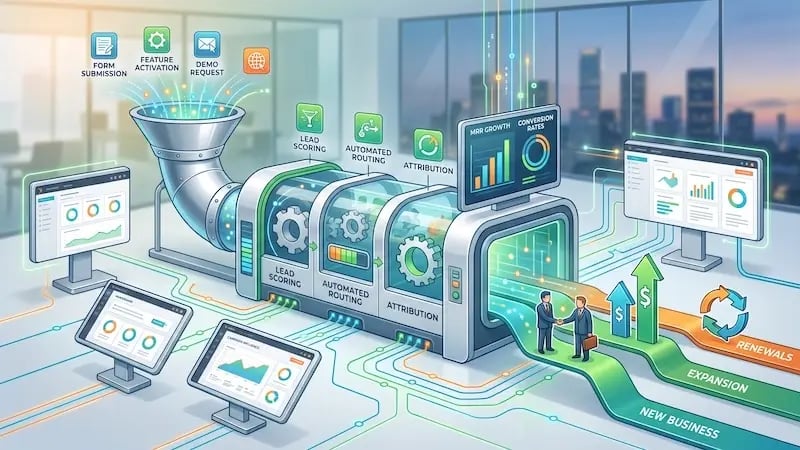 This guide covers exactly how HubSpot implementation services help tech companies build a scalable lead-generation engine. From pipeline architecture to automation workflows to attribution reporting, you'll walk away with a tactical playbook for your own implementation.
What Are HubSpot Implementation Services?
HubSpot implementation services are a professional service that helps you configure, customize, and deploy HubSpot to align with your specific business processes. For tech companies, this means building a revenue system that supports subscription metrics, multi-touch sales cycles, and the full customer lifecycle from first touch through renewal.
A HubSpot implementation goes beyond basic setup. You're creating custom properties for MRR and ARR tracking, building lead-scoring models based on product usage data, configuring automation workflows to route leads to the right salespeople, and setting up dashboards that connect marketing activity to revenue. This is why a HubSpot Solutions Partner like Aspiration Marketing brings hands-on experience with these SaaS-specific configurations.
Why Do Growing Tech Companies Need Professional HubSpot Implementation?
Tech companies run on subscription revenue and measure success in MRR, churn, and net revenue retention. A generic CRM setup misses all of this.
According to HubSpot,
70% of B2B marketers say account-based strategies are effective or very effective. But those results require a CRM configured to support them.
Professional HubSpot implementation addresses three core challenges:
- You need a pipeline architecture that reflects how tech revenue actually moves, with separate pipelines for new business, expansion, and renewals.
- You need lead scoring that combines firmographic fit with behavioral signals from both marketing and product usage.
- You need automation that ensures the right actions happen at the right time without creating manual bottlenecks.
Without this foundation, you're flying blind. You'll report revenue from spreadsheets nobody trusts, miss expansion opportunities buried in your existing customer base, and waste time on leads that don't match your ideal customer profile.
How HubSpot Implementation Services Improve Lead Generation
Lead generation for tech companies isn't just about capturing contact information. It's about identifying the right accounts, routing them to sales at the right time, and nurturing the rest until they're ready. HubSpot implementation services build the infrastructure for each of these steps.
Building a Lead Capture Foundation
Every important form needs a clear follow-up process. For tech companies, that includes demo requests, content downloads, webinar registrations, and free trial signups. Each form should have defined rules for what confirmation the contact receives, which lifecycle stage applies, whether sales gets notified, and who owns the contact record.
This sounds basic. That's exactly why it matters. Many CRM problems start with small form decisions that nobody documented. HubSpot implementation services create this documentation upfront and configure HubSpot to follow it consistently.
Configuring Lead Scoring That Reflects Tech Buying Behavior
Traditional lead scoring measures marketing engagement. For tech companies running product-led motions, you also need to score product engagement. A trial user who's activated three core features and invited two teammates is a hotter lead than someone who downloaded your whitepaper last week.
Implementation services build a scoring model that uses custom properties and HubSpot's lead-scoring tools.
- Fit Scoring: Evaluates company size, industry, job title, and technology stack.
- Intent Scoring: Layers in behavioral signals such as pricing page visits, email engagement, product usage milestones, and sales meeting activity.
The combined score determines whether a lead becomes marketing-qualified, sales-qualified, or product-qualified.
.webp?width=800&height=508&name=Lead%20Scoring%20(1).webp)
Creating Automation Workflows for Faster Response
According to HubSpot Research,
Companies that respond to leads within five minutes are 100x more likely to connect with the buyer.
HubSpot implementation services configure workflows that make a fast response automatic.
When a demo request comes in, the workflow immediately notifies the right salesperson with useful context:
- Company Name
- Pages Viewed
- Content Engagement
- Lifecycle Stage
When a lead isn't sales-ready, they enter a nurture sequence with relevant content based on their interests and stage. When a target account returns to your website, sales gets an alert before the buyer moves on.
The Core Components of a Tech-Focused HubSpot Implementation
A proper HubSpot implementation for tech companies covers six interconnected areas. Each component builds on the others to create a unified revenue system.
What Pipeline Architecture Works for Tech Companies?
You need a pipeline architecture that reflects how tech revenue actually moves. A single default pipeline won't capture the nuances of SaaS sales.
New Business Pipeline
Your new customer pipeline should reflect how software is actually bought. A clean journey follows distinct milestones:
- Discovery (Confirming fit, budget, use case, and technical requirements).
- Demo (Capturing stakeholder feedback).
- Trial/POC (Tracks hands-on product evaluation).
- Proposal Sent, Negotiation, and Closed stages complete the journey.
Every stage should have entry criteria and required properties. To keep this data accurate, every stage needs strict gatekeeping. If a rep can drag a deal forward without recording the required information, your pipeline metrics are pure fiction.
Expansion Pipeline
Your expansion pipeline gives Customer Success and Account Management a dedicated workspace for upsells, cross-sells, and seat additions. Because expansion revenue is far cheaper to acquire than net-new business, blending the two distorts your acquisition cost and inflates your growth metrics. Keep them separate to maintain clean data.

Renewal Pipeline
Your renewal pipeline ensures no contract quietly expires. Using HubSpot's Operations Hub, you can automate renewal deal creation 90 days before contract end dates—giving your team the runway needed to address churn risks early.
How Do You Track MRR and Subscription Metrics in HubSpot?
Monthly recurring revenue is the number your board cares about. HubSpot doesn't track MRR natively, but implementation services configure custom properties and calculated fields to enable it.
At a minimum, build these custom properties on your deal object:
With these properties in place, you can build reports for net new MRR by quarter, expansion versus new business MRR, churned MRR with reason analysis, and net revenue retention rate. This is your financial telemetry. At Aspiration Marketing, our HubSpot implementation services include setting up subscription-specific reporting dashboards to give you visibility from day one.
How Do You Integrate Product Data with Your CRM?
If your company runs any product-led growth motion, whether free trials, freemium tiers, or self-serve signups, your HubSpot implementation needs to capture product usage data and connect it to sales and marketing processes.
Use HubSpot's API or a middleware tool like Segment, Census, or Hightouch to sync product usage data into HubSpot contact and company records. The properties you push should reflect activation signals, the behaviors that correlate with conversion and retention.
High-performing tech teams track specific product properties to trigger timely sales outreach:
- Account Basics: Signup date, plan type, and total seat count.
- Engagement: Usage frequency, percentage of seats active, and last login date.
- Milestones: First project created, first team member invited, or reaching a PQL score.
When a user hits these activation milestones, it sends an immediate buying signal. Route these PQLs directly to your sales team through automated workflows so reps can engage while intent is high.
What Automation Workflows Should Tech Companies Build?
Automation should support your buyer journey and sales process, not replace human judgment. Start with automations that improve speed, clarity, and data quality.
Form Follow-up Workflows
Ensure every inquiry gets a response. Define what confirmation the contact receives, which list they join, which lifecycle stage applies, and whether sales should be notified. Document these decisions and configure HubSpot to follow them consistently.
Lifecycle Stage Workflows
Keep marketing and sales aligned on where each contact sits.
- A newsletter signup becomes a subscriber.
- A guide download becomes a lead.
- A target-account contact visiting your pricing page becomes an MQL.
- Sales acceptance moves them to SQL.
These rules need agreement between teams. Otherwise, lifecycle stages become decorative CRM furniture.
Sales Notification Workflows
Alert reps when meaningful intent appears. Demo requests, pricing page visits, return visits from open opportunities, and multiple visits in a short period all warrant attention. The notification should include useful context so sales can follow up like a human, not like someone reacting to a dashboard alert.
Nurture Workflows
Keep you useful while buyers research. Send related guides, webinar invitations, case studies, and practical checklists based on content interest and buyer stage. The goal is to help, not chase. If every nurture email says, "Book a meeting," people learn to ignore you.
How Do You Build Customer Success Workflows?
For tech companies, the sale isn't the finish line. It's the starting line. Your HubSpot implementation needs to support onboarding, adoption, health monitoring, and renewal.
Customer Health Scoring
Combines product usage trends, support ticket volume, NPS scores, engagement with CS touchpoints, and contract renewal proximity. Use workflows to trigger alerts when health scores drop below the threshold. A CS rep who finds out a client is at risk 30 days before renewal has too little time.
Onboarding Workflows
Automate your post-sale sequence. When a deal closes, trigger a workflow that creates onboarding tasks, enrolls the new client in an email sequence, sets milestone checkpoints at day 7, 30, and 60, and flags stalled onboarding based on product activation data. Companies that nail onboarding have dramatically better retention, and retention is the engine of SaaS economics.
What Attribution Reporting Should Tech Companies Set Up?
Attribution connects marketing activity directly to pipeline and revenue—without it, you are guessing which campaigns drive growth and which waste budget. By tracking key touchpoints, funnel conversion rates, and influenced revenue, you gain total visibility into ROI.
However, these reports are only as good as the underlying data. Correct HubSpot implementation establishes the consistent naming conventions, field definitions, and workflows needed to make your dashboards fully trustworthy.
Which HubSpot Hubs Do Tech Companies Need?
Not every tech company needs every hub on day one. Here's a practical guide tailored to your company's stage and priorities.
Essential Hubs to Start With
Sales Hub Professional or Enterprise gives you pipeline management, deal tracking, sequences, and forecasting. This is your core revenue platform.
Marketing Hub Professional adds email automation, lead scoring, landing pages, and campaign attribution. You'll use it to capture leads, score them, and nurture those who aren't sales-ready.
Operations Hub Starter or Professional enables data sync, custom-coded workflows, and data quality automation. For tech companies running product-led motions, this hub is not optional. It's the infrastructure that connects product usage data to your CRM.
Hubs to Add as You Scale
Service Hub Professional makes sense when you formalize customer success with ticketing, feedback surveys, and knowledge base management.
CMS Hub is valuable when you want your website and CRM on the same platform to deliver personalized content experiences.
How Do You Choose the Right HubSpot Implementation Partner?
The right implementation partner understands your business model, not just the HubSpot platform. For tech companies, look for partners with experience configuring MRR tracking, product-led growth integrations, and multi-pipeline architectures.
What Questions Should You Ask?
Before you evaluate a HubSpot partner, ask about their experience with tech and SaaS companies specifically.
- Can they share case studies with measurable outcomes?
- How do they approach lead scoring for product-led motions?
- What's their process for integrating product usage data?
Ask about their implementation timeline and what resources you'll need to commit. A rushed implementation creates technical debt you'll spend years fixing. A thoughtful timeline with proper documentation sets you up for long-term success.
What Makes Aspiration Marketing Different?
Aspiration Marketing is a certified HubSpot Solutions Partner with deep experience in B2B tech implementations. Our approach starts with a needs assessment to understand your specific processes, identify areas for improvement, and define key performance indicators.
Our HubSpot-certified consultants configure your CRM to align with your business workflows. We customize templates, workflows, lead scoring, and reporting dashboards. We integrate HubSpot with your other critical systems to streamline data flow. And we train your team to use HubSpot effectively from day one.
Common Implementation Pitfalls to Avoid
Even with a solid plan, these pitfalls catch tech companies off guard. Avoid them proactively.
Building Only for Today
Your implementation should accommodate 2x your current team and deal volume. Tech companies that scale fast break rigid systems. Build for where you'll be in 18 months, not where you are today.
Ignoring Data Governance
Tech companies generate massive volumes of data from product usage, marketing automation, and sales activity. Without naming conventions, property ownership, and cleanup workflows, your CRM becomes a data swamp within a year. HubSpot implementation services establish these governance rules from the start. HubSpot partners for SaaS are experts at this.
Treating HubSpot as a Silo
Your CRM needs to integrate with your product analytics, billing system, and support tools. Plan your data integration architecture during implementation, not after. Retrofitting integrations is expensive and error-prone.
Skipping the Adoption Plan
The best configuration fails if your team doesn't use it. Build training, enablement, and accountability into your implementation timeline. A CRM that sales ignores is just an expensive database.
How Long Does HubSpot Implementation Take?
HubSpot implementation timelines vary based on complexity, but most tech companies should plan for 8-12 weeks for a thorough implementation. Rushing creates technical debt you'll pay off for years.
A typical timeline includes:
- Discovery and planning in weeks 1-2
- Core configuration and data migration in weeks 3-6
- Automation and workflow setup in weeks 7-9
- Training and enablement in weeks 10-12
Consider your team's bandwidth when planning. An implementation that disrupts daily operations does more harm than good.
What Results Can You Expect from Professional Implementation?
Companies that implement HubSpot with their specific business model in mind see measurable improvements across the sales and marketing funnel.
Clean data and proper lead scoring mean your sales team focuses on qualified opportunities instead of chasing poor-fit leads.
Automation workflows reduce response time and ensure consistent follow-up.
Attribution reporting connects marketing spend to pipeline, so you can double down on what works.
According to Demandbase,
Companies using HubSpot's ABM tools see a 100% increase in lead quality.
But those results require the foundation that a proper HubSpot implementation creates. Without it, you're leaving performance on the table.
Getting Started with HubSpot Implementation for Tech
Your revenue platform should accelerate growth, not hold it back. Tech companies that implement HubSpot with their specific business model in mind build a foundation for scalable, predictable revenue. Companies that take the generic route spend years patching gaps and rebuilding from scratch.
The key is starting with the right architecture: separate pipelines for new business, expansion, and renewals; custom properties for subscription metrics; lead scoring that combines fit and intent; automation that supports your buyer journey; and attribution that connects marketing to revenue.
At Aspiration Marketing, we help growing tech companies configure HubSpot for their specific needs. Our HubSpot implementation services include needs assessment, custom configuration, integration setup, and team training. Short on time or looking for deeper expertise?
Talk to our B2B consultants about your implementation requirements.



.webp?width=600&height=375&name=Choose%20B2B%20agency%20for%20EdTech%20(1).webp)



Leave a Comment
Have thoughts on this article?
Share your feedback, ask questions, or join the discussion with our community.