





Why are your sales teams spending millions chasing cold inbound leads when your highest-value revenue opportunities are already talking to your support team every single day?
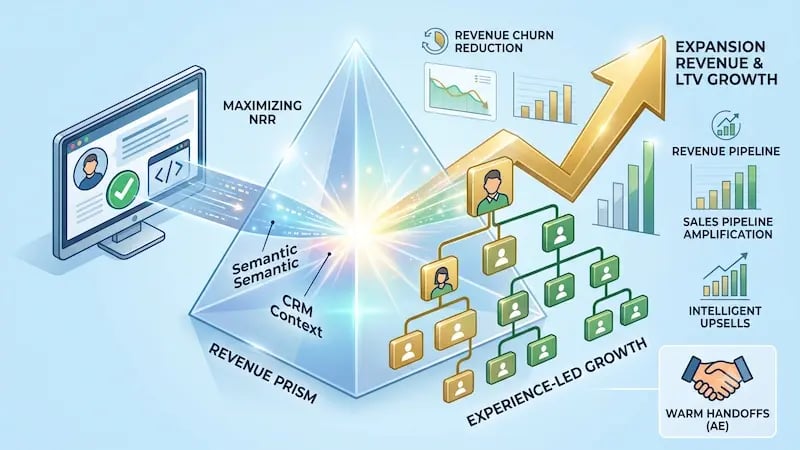 For decades, businesses have treated customer support as a cost center. The primary goal was simple: close tickets as fast as possible. When a customer reaches out, the metrics that management cares about are usually Average Handle Time and First Contact Resolution. But what happens to the valuable context hidden inside those conversations? When a support ticket is closed and archived, the critical business insights buried within it often disappear too.
This traditional approach creates a massive blind spot for B2B companies. Your customers frequently drop subtle hints about their growing business needs, upcoming budget changes, or software limitations during routine support interactions. When these hints are ignored, you miss out on easy revenue.
It is time for a paradigm shift. By shifting the narrative from simple issue resolution to proactive revenue expansion, you can transform your support queue into a growth engine. When customer service operations transition to proactive listening systems powered by artificial intelligence, the identification of account-expansion signals becomes fully automated. This shifts the focus from a basic service-to-sales handoff, which is the process of transferring a customer from a support interaction to a sales representative, to a continuous, data-driven system for increasing your customer lifetime value.
The financial impact of focusing on your existing customer base is clear.
According to research by Bain & Company, returning customers spend an average of 67% more in their third year with a business than in their first six months.
Furthermore, a study published by Harvard Business Review reveals that,
Customers who contact support are 18% more likely to stay loyal if their issue is effectively resolved.
This means a great support experience creates the perfect psychological runway for account expansion.
Deciphering the Blueprint: What Are Account Expansion Signals?
An account expansion signal is a subtle verbal or written clue from an existing customer that indicates an opportunity for upselling, cross-selling, or upgrading their current plan. To build an automated growth engine, you first need to understand exactly what an expansion signal looks like in a B2B environment. It rarely looks like a customer explicitly sending a message that says, "We have extra budget, please upgrade our plan." Instead, these signals are hidden inside everyday technical questions and administrative adjustments.
True account expansion signals usually fall into one of three distinct categories:
-
Capacity Bottlenecks: A customer might send a message saying, "We are running out of user seats this month," or "We keep hitting our API call limit before the weekend." A traditional support agent might simply reset the temporary counter or explain how to delete old data. An AI system, however, recognizes this as a clear signal that the client has outgrown their current tier.
-
Functional Limitations: Consider a support ticket that asks, "Does your software allow for cross-departmental compliance reporting? Our corporate enterprise team needs to review our data next month." The customer is telling you that a higher-value department within their organization is now interacting with your product.
-
Strategic Scaling: When a client asks, "We are opening a new office in Europe next quarter; how do we handle multi-currency configurations or localized data compliance?" they are signaling rapid corporate growth. This is a prime opportunity for an account executive to step in and offer an enterprise-grade global architecture package.
Why do human support agents regularly miss these golden opportunities? The answer is simple: cognitive overload. Support floors are fast-paced environments. Agents are often evaluated on the number of tickets they resolve per hour. When an agent is working through a heavy queue, they focus entirely on solving the immediate technical issue. They clear the cache, unlock the account, or send the help documentation article. They simply do not have the time or training to consider the broader commercial implications of the conversation.
Data from Salesgenie shows that 42% of sales professionals agree that understanding customer goals is the top driver of successful upsells.
If your support team cannot pause to analyze those goals, your business loses money. This is exactly where artificial intelligence steps in to bridge the gap, mapping raw conversational text directly to strategic growth metrics.
Enter Agentic and Conversational AI: Systemizing Intent Detection
How does an automated system catch these subtle clues without hurting the customer experience? The answer lies in the evolution of Conversational AI and machine learning. Old-school chatbots relied on rigid keyword matching. If a customer did not type exact terms such as "buy," "price," or "upgrade," the bot remained completely blind to the sales opportunity.

Modern AI systems use advanced Natural Language Processing (NLP) and Large Language Models (LLMs) to understand semantic context, sentiment, and intent. This means the AI does not just read the words; it understands the underlying meaning of the conversation. It can tell the difference between a frustrated customer complaining about a software bug and an engaged customer asking a technical question because they want to use your product for a larger internal project.
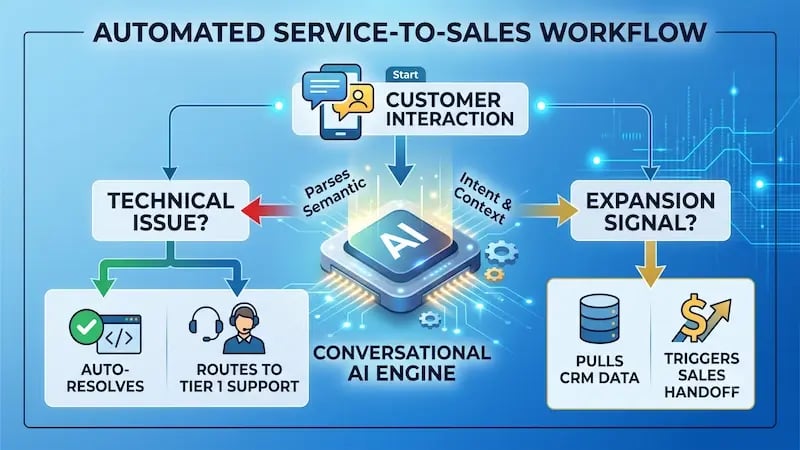
This capability is driven by autonomous customer agents. These agents go far beyond the basic chatbots of the past. They do not just follow static, predictable decision trees. Instead, they operate as goal-oriented systems. While they help a customer resolve a routine support issue, they also evaluate the account's history, recent website activity, and current engagement with specific product pages.
To make an accurate decision, the AI engine must safely pull internal brand data, historical CRM records, and contract constraints in real time. For example, if a customer asks about an advanced security feature, the AI immediately checks the CRM. If the client is already on your highest enterprise plan, the AI simply provides the documentation. But if the client is on a basic starter plan, the AI flags this interaction as a high-priority account expansion opportunity. This entire process happens securely in the background without creating data privacy vulnerabilities or exposing sensitive company records.
The corporate world is investing heavily in these intelligent workflows.
Research by Neomanex shows that enterprise generative AI software spending tripled in a single year, reaching $37 billion.
This massive investment shows how quickly organizations are moving to operationalize deep AI data intelligence.
Furthermore, IBM reports that two out of three business leaders state AI adoption has successfully boosted their overall revenue growth rate by more than 25%.
This revenue growth is not just coming from operational cost savings; it is driven by using AI to capture expansion opportunities that used to slip through the cracks.
The Mechanics of a Perfect Service-to-Sales Handoff
Identifying an expansion signal is only half the battle. The real challenge is passing that information to the right person without ruining the customer experience. In many companies, the traditional service-to-sales handoff is broken and rife with friction.
We have all seen what happens when an opportunity is handled manually. A busy support agent notices a sales opportunity and sends a quick, informal email to an account executive: "Hey John, Mike from Account X asked about our advanced reporting tools today. You should probably give him a call."
This manual method fails for several reasons:
-
The email gets buried in the account executive's crowded inbox.
-
By the time the sales rep reads it three days later, the lead has gone cold.
-
The sales rep lacks context and has to ask the customer to repeat everything they already explained to the support agent.
As documented by SaleAI,
A successful handoff ensures the buyer feels remembered, not restarted.
If an account executive forces a client to repeat answers they just provided in a support chat, it creates immediate friction and damages trust.
An AI-driven upselling automation workflow eliminates this friction through a seamless, three-step process:
Automatic Qualification: The moment a customer mentions a capacity limit or an advanced feature, the AI evaluates their statement against your Ideal Customer Profile (ICP). It checks their current subscription tier, contract renewal date, and total usage metrics stored in your CRM. If the account meets your business criteria, it is instantly qualified.
Contextual Summarization: Instead of forcing a sales rep to read through a long chat transcript, the AI creates a short, clear summary dossier. This dossier outlines exactly what the customer asked, what technical issues were already resolved, what commercial questions remain open, and provides a calculated urgency score.
Direct Sales Task Injection: The AI automatically pushes a high-priority task directly into your CRM platform, such as HubSpot or Salesforce. It notifies the assigned account executive and gives them recommended next steps. This might include a customized pricing quote or a relevant case study tailored to the exact feature the customer asked about.
This structured workflow turns a clumsy, manual handoff into an automated, precise business process. The customer experiences a smooth transition from a helpful support interaction to a highly relevant strategic conversation with their account representative.
Strategic Advantages: Lower Churn, Higher Efficiency, and Global Scale
Building an AI-powered pipeline provides major strategic benefits that go far beyond simply closing a few extra deals. It fundamentally changes the economics of your entire customer experience platform.
When you blend Conversational AI with human talent, you optimize your entire team. Human support agents are excellent at building relationships, managing emotions, and resolving complex, ambiguous problems. AI is exceptional at processing huge amounts of data, finding patterns, and working at lightning speed.
By automating routine troubleshooting, you give your human agents the time they need to focus on high-value client relationships. Meanwhile, the AI works in the background 24/7 across every single time zone. It scans every chat, email, and ticket for revenue opportunities, enabling you to scale your support infrastructure globally without adding headcount rapidly.
| Traditional Support Model | AI-Powered Support Model |
|---|---|
| Focuses entirely on fast ticket resolution | Focuses on issue resolution and growth signals |
| Treats customer service as a cost center | Transforms customer service into a growth engine |
| Relies on manual, inconsistent sales handoffs | Uses automated, CRM-integrated workflows |
| Misses revenue opportunities due to agent fatigue | Scans every interaction 24/7 at a global scale |
This approach also changes how your customers view your sales efforts. Traditional outbound sales pitches often feel intrusive. But when an upgrade is offered as a direct answer to a problem a customer is currently facing, it does not feel like an aggressive sales pitch. It feels like high-tier, proactive customer service.
The data strongly support this approach to revenue growth.
According to Salesgenie, experience-led growth strategies can increase cross-sell rates by 15% to 25%.
Furthermore,
Companies that lead in customer experience generate 49% more cross-sell revenue than those that fall behind.
At the same time, this proactive approach keeps your customers from leaving.
Gartner research cited by Pylon indicates that
Companies that execute a proactive support approach achieve a 9% higher score for customer value enhancement.
By anticipating your clients' needs before they encounter operational issues, you protect your accounts from churn and build long-term brand loyalty.
Turning Support Infrastructure into Your Primary Growth Engine
Maximizing your Net Revenue Retention (NRR) requires breaking down the walls that separate your support and sales teams. Your customer service queue is not just a list of problems to be solved; it is a rich source of commercial insights. By using conversational AI to continuously monitor customer interactions for subtle signals of account expansion, businesses can build a highly predictable sales pipeline.
Take a close look at your current customer service operations. Are your software tools built simply to close tickets and lower costs, or are they designed to capture customer intent and drive growth? If you are still relying on manual processes to share information between support and sales, you are leaving valuable revenue on the table.
To navigate this digital transformation successfully, it helps to work with experts who understand how to connect automated customer support with revenue expansion. At Aspiration Marketing, we help businesses implement goal-oriented autonomous customer agents and modern growth strategies that seamlessly link your service floor to your sales pipeline. Let's discuss how you can transform your support infrastructure into a reliable revenue driver today.






Leave a Comment
Have thoughts on this article?
Share your feedback, ask questions, or join the discussion with our community.