





Imagine this scenario: It is 2:15 PM on a Tuesday, and your core cloud platform suffers an unexpected database timeout. Within 120 seconds, incoming support tickets spike by 800%. Your live chat queue jumps from a normal 3-minute wait to a grueling 4-hour backlog. Email inboxes fill with duplicate queries, and social channels explode with frustrated users asking the exact same question: "Is the system down?"
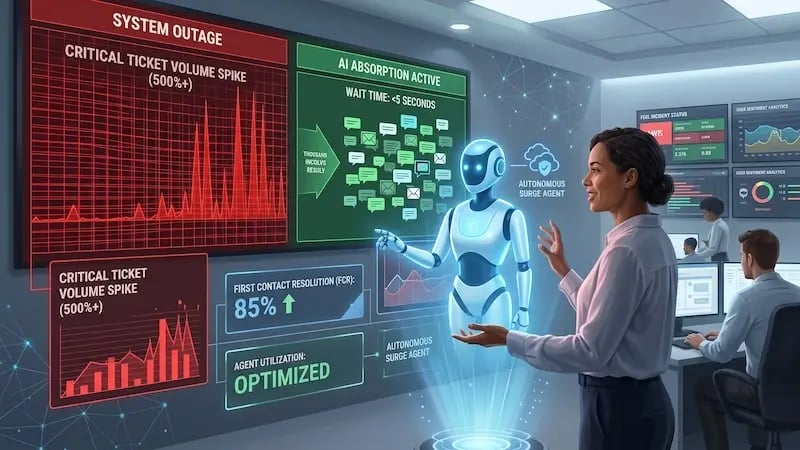 How does your support team respond when a sudden technical crisis overwhelms your operations?
For most enterprise operations, a major outage creates an operational nightmare. Support representatives are instantly buried under thousands of identical tickets. Response times collapse, customer satisfaction (CSAT) plummets, and your team burns out trying to manually clear a backlog that grows faster than they can type.
This is where traditional customer service infrastructure breaks down. Static auto-responders fail because they do not provide real-time updates. Meanwhile, human-only teams simply cannot scale instantly to absorb a 1,000% volume surge without adding massive overhead.
To manage system crises without fracturing your operational metrics, you need an elastic, intelligent response system. Deploying autonomous customer surge agents offers a modern way to transform how enterprise organizations handle unexpected traffic spikes, protect live support streams, and maintain trust during high-stakes outages.
What Happens During an Incident Surge?
When a server, API, or software platform experiences downtime, the impact moves rapidly from engineering to customer operations. While site reliability engineers (SREs) race to fix the root cause, customer support teams bear the brunt of user panic.
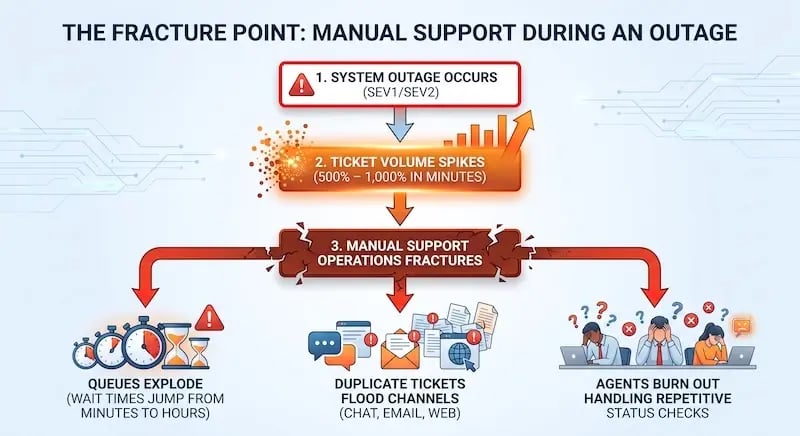
Why do traditional support systems fracture so quickly under the weight of an incident? The answer lies in how legacy workflows handle traffic volume spikes.
1. The Duplicate Ticket Avalanche
When users do not receive an immediate response on one channel, they rarely wait patiently.
In fact, research shows that,
56% of customers immediately switch to a second support channel when their initial contact misses a quick response window, with 75% attempting two to three separate contacts before waiting.
During an unexpected system outage, this behavior causes incoming ticket volume to grow exponentially, as a single customer experiencing a 10-minute issue creates three or four duplicate tickets across chat, email, and social media.
2. The Cost of Static Deflection
Traditional support platforms rely on static auto-replies or generic banner alerts. While these tools confirm an issue exists, they rarely provide account-specific details or definitive answers. Customers view static messages as unhelpful deflection tactics. As a result, they bypass the banner and submit a ticket anyway.
3. The Financial and Operational Toll
Unplanned downtime carries a steep financial cost for modern organizations.
Research shows that,
Unplanned IT downtime costs large enterprise organizations an average of $15,000 per minute.
When you add the operational expense of handling surge tickets, the financial impact grows significantly.
Gartner reports that,
Live-assisted support interactions cost an average of $13.50 per interaction, compared to just $1.84 for automated self-service channels.
When 10,000 users reach out during a two-hour outage, relying on manual triage can cost over $130,000 in support operations alone—all to answer simple, repetitive status questions.

The issue is not just financial. When human agents spend 80% of their time answering simple status inquiries, high-value enterprise clients with complex issues get stuck in the exact same queue. This creates severe friction where your business can least afford it.
What Are Autonomous Customer Surge Agents?
An autonomous customer surge agent is an advanced AI system designed to handle massive, unexpected spikes in customer support volume. Unlike traditional chatbots that rely on rigid decision trees, autonomous surge agents use natural language understanding (NLU), dynamic system integrations, and real-time event triggers to resolve complex customer inquiries independently.
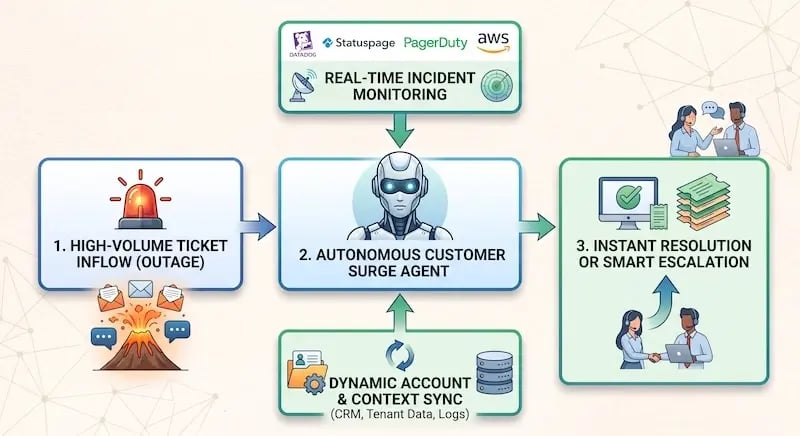 These AI agents sit quietly alongside your support engine during normal operations. However, when ticket velocity exceeds a specific threshold—such as a 300% increase in inbound messages over five minutes—the surge agent automatically activates to absorb the incoming volume.
Key Capabilities of Autonomous Surge Agents
| Feature | Legacy Chatbots | Autonomous Surge Agents |
|---|---|---|
| Activation | Always on with fixed scripts | Elastic activation based on real-time traffic velocity |
| Data Access | Static FAQ knowledge base | Live API connections to system monitoring and status tools |
| Context | Basic keyword matching | Account-level context (tenant ID, tier level, system status) |
| Resolution | Redirects users to articles | Resolves inquiries end-to-end and provides accurate status updates |
| Escalation | Generic handoff to live agents | Smart routing based on customer sentiment and VIP priority |
How Surge Agents Function in Real Time
Consider what happens when a SaaS provider experiences an internal API failure:
-
Detection and Triggering: The support platform detects a sudden influx of tickets containing keywords like "connection error" or "404 page." The autonomous surge agent initializes in under five seconds.
-
Context-Aware Verification: The surge agent connects directly to internal monitoring tools like Datadog, Statuspage, or PagerDuty. It verifies that an active SEV1 incident exists for the user's specific server region.
-
Account-Level Personalization: When a user opens a chat, the surge agent reads their login context and tenant ID. Instead of giving a generic response, it says: "Hello, Sarah. We see your primary workspace on Server East-2 is currently experiencing an API outage. Our engineering team is working on a fix, and we expect systems to recover within 35 minutes."
-
Instant Resolution: The agent asks whether the user wants an automated notification as soon as the system is restored. Once the user accepts, the agent logs the preference and closes the ticket.
By handling these status interactions instantly,
The autonomous surge agent can resolve up to 85% of outage-related tickets without human intervention.
How Autonomous Surge Agents Protect Core CX Metrics
During an operational crisis, maintaining customer trust depends heavily on how quickly and clearly you communicate. A service outage is frustrating, but poor communication during an outage is what causes customers to leave permanently.
A consumer survey by Xurrent shows that,
35% of consumers reach out to customer support during a digital outage, while another 34% are forced to hunt for updates themselves when channels fail.
If those customers encounter long hold times or unhelpful replies, churn increases rapidly.
Here is how autonomous customer surge agents protect your core operational and experience metrics during an incident.
1. Preserving First Response Time (FRT)
During a major surge, standard live support queues stall, driving First Response Times from 45 seconds to several hours. Autonomous surge agents respond in under five seconds, regardless of whether 50 or 50,000 customers write in at the same time. This immediate response reduces user anxiety and stops people from submitting duplicate tickets on other channels.
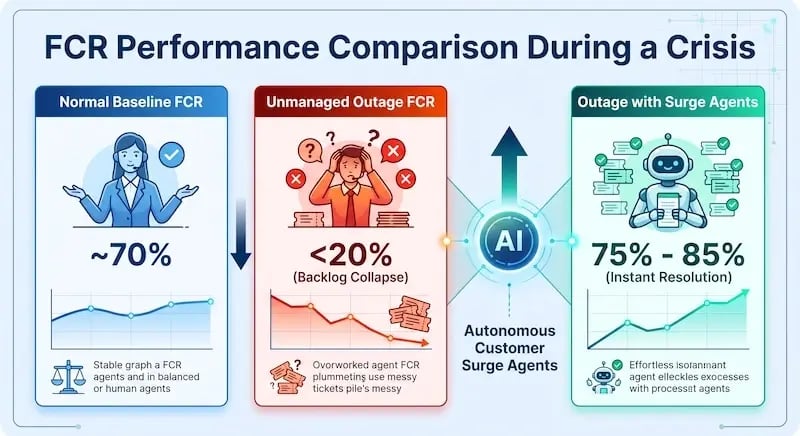
2. Protecting First Contact Resolution (FCR)
Industry benchmarks show that,
Normal First Contact Resolution rates sit around 70% for high-performing teams.
During an unmanaged outage, FCR can drop below 20% as representatives get overwhelmed and promise follow-ups they cannot track. Autonomous surge agents maintain high FCR by providing accurate, real-time answers on the very first touch.
3. Preventing Customer Churn in Live Support Streams
When systems go down, customer frustration rises quickly.
Research indicates that,
33% of customers will switch providers after a single service outage accompanied by poor communication.
Furthermore,
32% of users leave a brand after two or three recurring service issues.
Autonomous customer surge agents help prevent churn by using real-time sentiment analysis. If an incoming message contains intense frustration or comes from a high-value enterprise account, the agent flags the conversation immediately. It bypasses standard queues and routes the user directly to a senior account manager.
A Step-by-Step Blueprint for Implementing Surge Infrastructure
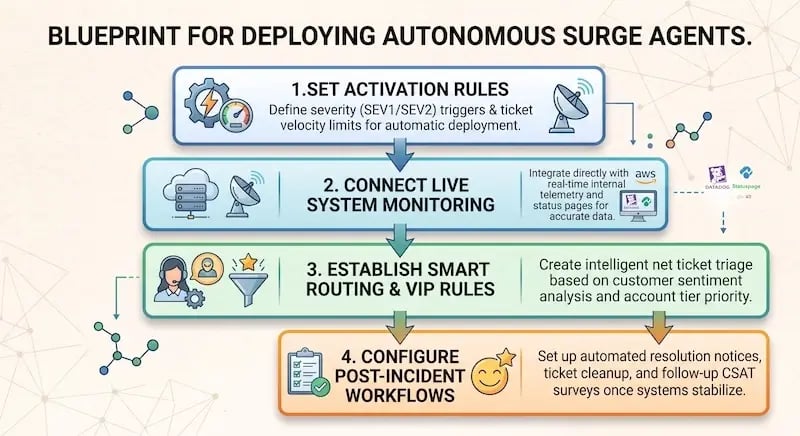
Deploying autonomous customer surge agents requires clear planning across your customer support infrastructure, CRM, and system monitoring tools. Follow this step-by-step implementation guide to prepare your team before an incident occurs.
Step 1: Set Activation Triggers
Define the exact operational metrics that activate your surge agent. For example, configure rules in your support engine so that if ticket creation velocity increases by 250% over the baseline within a 10-minute window, the surge protocol is automatically triggered.
Step 2: Connect Live Telemetry and Status Tools
An autonomous surge agent is only as helpful as its underlying data. Use secure APIs to connect your AI agent directly to your public status page and internal monitoring dashboards. This ensures the agent always communicates verified details rather than static, out-of-date answers.
Step 3: Establish Smart Routing Rules
Not all support tickets should be handled entirely by AI during a crisis. Create precise escalation pathways based on customer account value and issue complexity:
-
Tier 3 (Low Complexity): General status inquiries, basic app load issues, and standard service checks.
-
Path: Resolved entirely by the Autonomous Surge Agent.
-
-
Tier 2 (Medium Complexity): Account billing questions impacted by downtime or custom workflow errors.
-
Path: Triaged by AI and placed in an organized queue for human review.
-
-
Tier 1 (High Complexity / High Value): SLA-backed enterprise accounts, security concerns, or severe business-critical failures.
-
Path: Immediate priority routing to a dedicated live human representative with full conversation context attached.
-
Step 4: Configure Post-Incident Cleanup
When engineering marks an incident as resolved, your surge agent should automatically handle post-incident communications. The agent can:
- Send automated restoration notices to every user who reached out during the outage.
- Update ticket statuses to "Resolved" across all connected channels.
- Distribute brief CSAT surveys to collect feedback on how well the situation was handled.
This automated cleanup saves your support team dozens of hours of manual work after an incident, allowing them to focus on normal operations right away.
Building a Resilient Support Infrastructure
System outages and technical disruptions are an inevitable part of operating a modern digital business. However, metric-destroying support backlogs and long wait times do not have to be the case.
By deploying autonomous customer surge agents, enterprise organizations can scale their support operations instantly during an emergency. These intelligent agents protect your core CX metrics, reduce operational support expenses, and ensure your customers receive clear, accurate information when they need it most.
To build a resilient, AI-powered customer service infrastructure that scales smoothly through outages and rapid growth, partner with the enterprise support experts at Aspiration Marketing.
From designing smart routing engines to integrating advanced CRM agents, Aspiration Marketing helps your business deliver exceptional customer experiences on every channel.





.webp?width=600&height=375&name=Choose%20B2B%20agency%20for%20EdTech%20(1).webp)
Leave a Comment
Have thoughts on this article?
Share your feedback, ask questions, or join the discussion with our community.