





You can assemble a collection of expensive, talented pieces, but without a unified system, success is never guaranteed. Eventually, execution falls apart.
Go-To-Market (GTM) revenue leaders face this reality every day. Organizations invest heavily in top-tier software—buying one point solution for AI email drafting, another for lead scoring, and yet another for meeting transcription. Yet, despite having a stack full of high-priced tools, there is no coordination. Workflows break, customer data gets duplicated, and trust across the sales pipeline erodes.

High-performing GTM teams understand a fundamental truth: winning isn't about collecting the "best players." It's about executing the "best plan."
According to the Salesforce State of Sales Report,
Top-performing sales organizations are 1.9x more likely to use unified intelligence platforms than low-performing organizations that rely on disconnected apps.
At UNBOUND 2026, HubSpot introduced a major evolution to solve this tool fragmentation: the shift from a static database to an Agentic Customer Platform. Inspired by the theme of "Growth Context," this evolution shifts how human teams and AI agents collaborate, giving your organization a coordinated system designed to execute your best plan and win deals consistently.
What Exactly is Growth Context?
AI without context produces output without value. Historically, GTM teams adopted early AI solutions with enthusiasm, only to get burned when the results fell short. This breakdown wasn't due to the underlying technology being bad, but because isolated AI models simply didn't know their business. When AI tools hallucinate or output generic responses, it breaks trust across revenue operations—yet it doesn't have to be that way.
To move past shiny tools and buzzwords toward verifiable business results, Growth Context is a foundational architecture that anchors AI plays and autonomous agents in a cohesive system of deep, unified business intelligence. By grounding AI in real-time, cross-platform intelligence, HubSpot ensures every output is based on actual customer behavior.
When paired with a full agentic workforce covering every GTM motion, Growth Context turns unpredictable AI tools into a transparent, provable growth engine that drives verifiable outcomes.
What Is an Agentic Customer Platform?
An Agentic Customer Platform (ACP) is a unified software environment where human teams and autonomous AI agents operate from a shared model of customer data and business context. Unlike traditional CRMs that act as static databases, an Agentic Customer Platform actively executes workflows, manages deal progression, and responds to real-time buyer signals across the customer lifecycle.
The Three Platform Layers & Growth Context
To build an AI-first GTM engine, software must do more than store contact records. As an ACP, HubSpot has reconfigured the platform to give humans and agents what they need to drive real outcomes with complete access (for both), to customer contexts.
For over a decade, we have stored data in HubSpot and relied on humans to populate the CRMs and supply context using our information and human judgment. This was enough when humans were doing the real work.
Now that agents can do the real work for us, the same context isn't there. A system of record isn't sufficient anymore. Neither are properties and other records in isolation. An agent can't always go off of those. This is why HubSpot has reconfigured the platform and invested in 3 integrated layers.
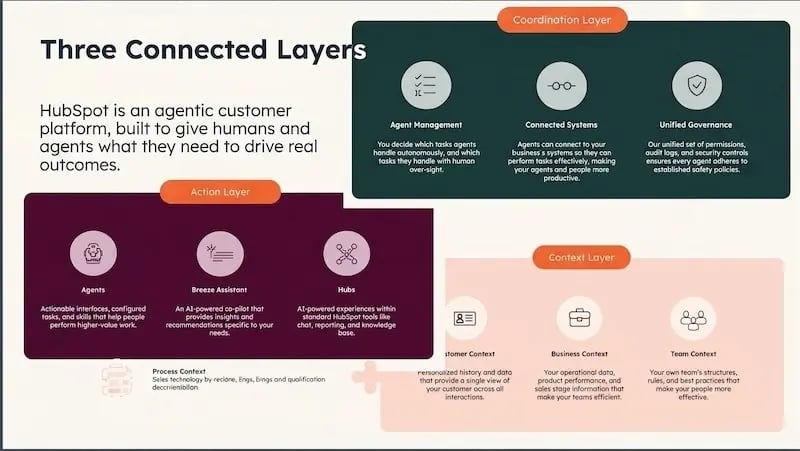
The Core Platform Architecture
- The Context Layer (Smart CRM): The primary repository for customer understanding, buyer intent signals, and historical context. It gives every team member and AI agent the background knowledge needed before taking action.
- The Action Layer: The execution hubs—including Sales Hub, Marketing Hub, Service Hub, active AI Agents, and Breeze Assistant—that directly engage buyers and execute routine tasks.
- The Coordination Layer: The central workspace where humans and agents collaborate and understand what they're working on. This layer governs agent permissions, all the connected systems, integrations, and united governance.
Data vs. Growth Context: Why Details Matter
Standard CRM data logs what happened—for example, a call was logged, an email was opened, or a deal stage was changed.
Growth Context explains why it happened, what it means, and what to do next.
For example, standard data logs show that a customer opened three support tickets in two weeks. Growth Context analyzes conversation sentiment, flags product usage drop-offs, identifies a hidden churn risk months before renewal, and alerts the account manager with a clear action plan.
Preventing AI Drift with Context Home
AI models are only as good as the data feeding them. Stale ideal customer profiles (ICPs), outdated buyer personas, or mixed sales methodologies cause AI agents to make poor recommendations and draft generic outreach.
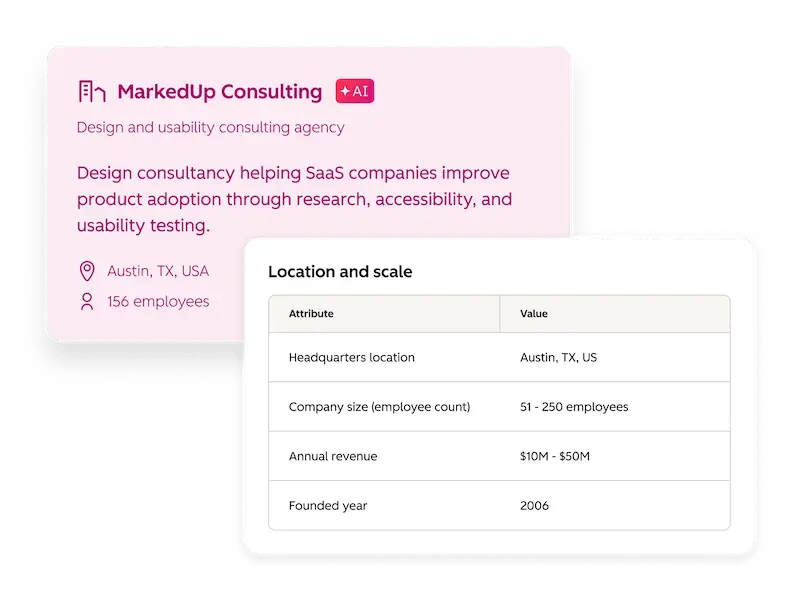
HubSpot is introducing Context Home, a dedicated space where RevOps leaders review, curate, and validate core business context. This is where you drive outcomes. This is a living, agentic context resource that integrates ICP, call transcripts, sales methodology, business models, external systems, and whatever other context you want to include.
By standardizing ICP definitions, company revenue ranges, and target industries in Context Home, you ensure every AI agent across your portal operates from verified data. HubSpot calls this their "high leverage door opener," and it's not hard to see why.
Agent Hub & Agent Builder: Centralized Control
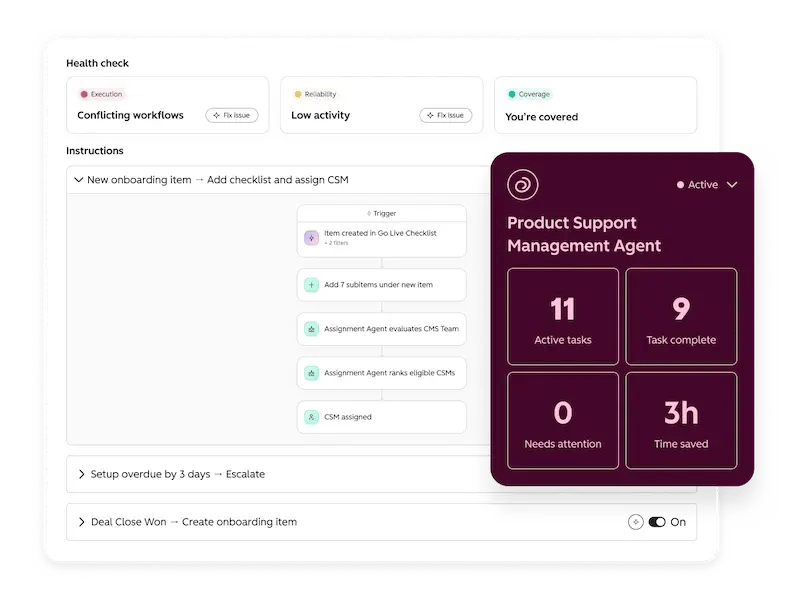
Managing separate AI tools across departments creates security risks and operational blind spots. HubSpot centralizes agent management through two key features: Agent Hub and Agent Builder.
Agent Hub: The Unified Control Center
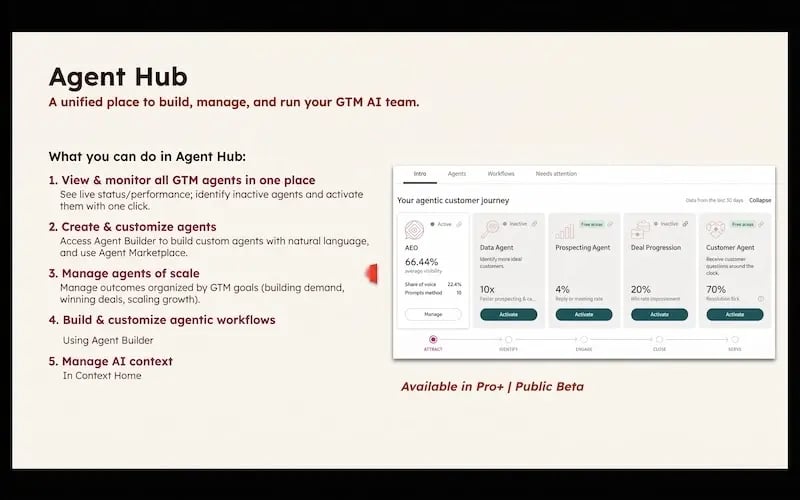
Agent Hub provides revenue leaders with a single dashboard for viewing, deploying, and governing their AI workforce. Operations teams can monitor specialized agents across every phase of the customer journey:
- Answer Engine Optimization (AEO) Agents: Track brand presence across AI search engines and optimize content discovery.
- Prospecting Agents: Identify high-intent leads, research target accounts, and draft personalized outreach.
- Deal Progression Agents: Monitor pipeline health, recommend next steps, and update deal stages based on buyer engagement.
- Customer Service Agents: Automate resolution of routine support requests and route complex issues to human reps.
Centralization provides clear operational visibility.

Research by McKinsey & Company on AI in Sales shows that
Organizations deploying centralized AI orchestration reduce sales cycle duration by up to 30%.
Agent Hub tracks performance metrics directly in the CRM, measuring reply rates, win rates, and resolution times.
Agent Builder: Tailored Execution Without Code
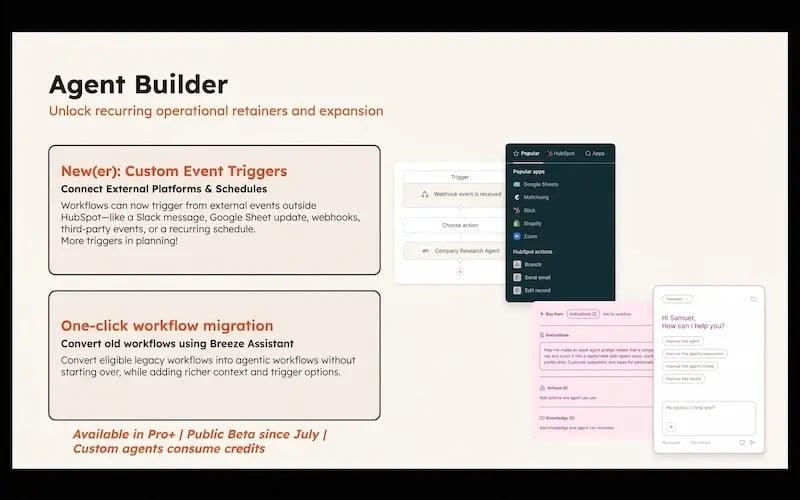
Off-the-shelf AI tools rarely fit custom sales processes. Agent Builder allows RevOps managers and sales leaders to construct custom AI agents using plain-language prompts—without writing code.
- Custom Event Triggers: Initiate agent actions in response to signals from within or outside the CRM. An agent can be triggered by a Slack message, a Google Sheets edit, an incoming webhook, or a scheduled event.
- One-Click Workflow Migration: Rigid legacy workflows often fail when lead behavior changes unexpectedly. Using Breeze Assistant, teams can convert standard HubSpot workflows into flexible, agentic workflows with one click, enabling agents to adapt to complex customer interactions.
HubSpot Work & Breeze Assistant: The Operational Engine
Sales representatives waste hours switching between external project tools, spreadsheets, and email threads. HubSpot Work brings operational tasks directly into the CRM.
HubSpot Work is a new tool, an AI-first workspace that connects all of your CRM and operational work in one place. No more spreadsheets, Slack channels, ClickUp, or Notion Docs needed to keep track of campaign assets, deadlines, responsibilities, or team communications.
Replacing Fragmented Tools with a Native Workspace
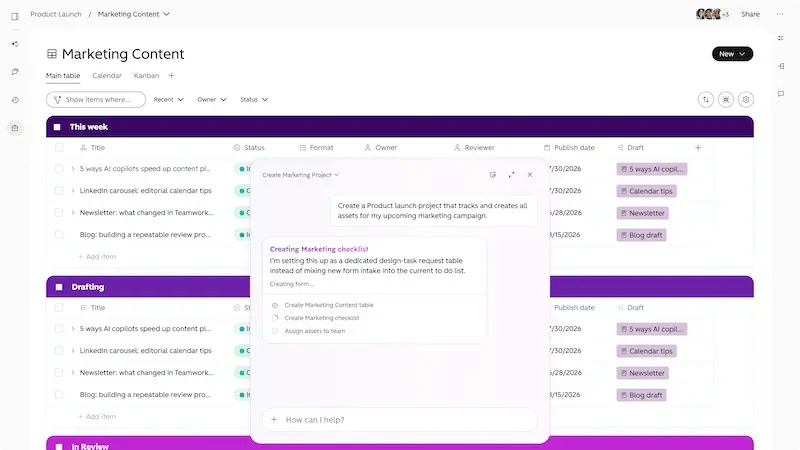
HubSpot Work replaces external point tools by providing revenue teams with a shared workspace:
- Smart Creation: Build project tables, strategy documents, custom forms, and automated tasks using plain language.
- Live CRM Context: Every project, task, and document automatically connects to live contact, company, deal, and support ticket records.
- Human-AI Collaboration: Sales reps, managers, and AI agents assign tasks, review drafts, and track deliverables in one shared view.
Say Goodbye to Breeze
Perhaps the most dramatic change in the Fall Spotlight 2026 is the sunsetting of Breeze. When HubSpot introduced its AI layer, it made sense to give it a name to differentiate it from other products. Then, HubSpot was a CRM with AI that lived within individual Hubs. Breeze was a name used for key tools, such as the Breeze Assistant, Breeze Studio, and Breeze Agents.
Much like all good things, however, HubSpot has evolved. Now, it's an Agentic Customer Platform. AI is no longer a layer; it's the whole product. The only part of the HubSpot ecosystem that will keep the Breeze name going is the new and improved Breeze Assistant.
Key Breeze Assistant Enhancements
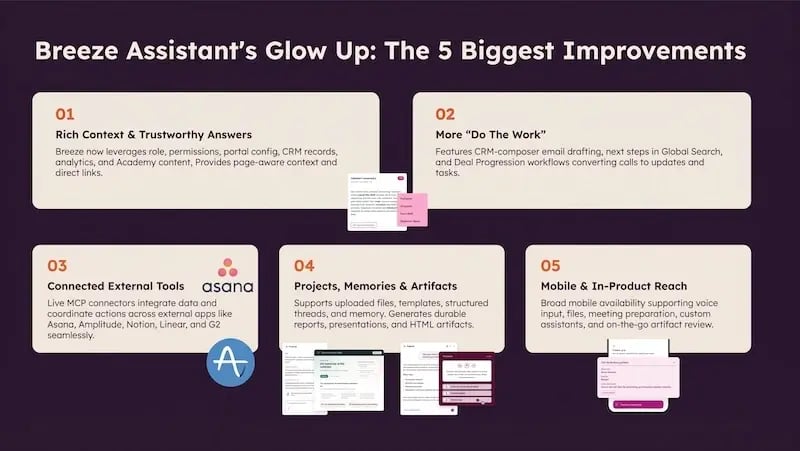
HubSpot's AI assistant operates inside daily workflows to reduce administrative friction and accelerate deal velocity:
- Role-Aware Context: Breeze Assistant checks user permissions, portal configurations, and CRM records to deliver accurate advice.
- Action-Oriented Execution: Draft emails inside the CRM composer or trigger bulk record updates using Global Search.
- Model Context Protocol (MCP) Connectors: Open integration connectors that sync data and trigger actions across external tools such as Asana, Amplitude, Notion, Linear, and G2.
- Projects, Memories & Artifacts: Convert raw data files and chat threads into reusable executive reports, slide decks, and visual HTML pages.
- Mobile Reach: Use voice commands on mobile devices to review deal summaries and update records between prospect meetings.
Verifiable Revenue Impact
Combining human expertise with AI execution delivers measurable growth.
According to data from HubSpot,
Organizations that fully adopt integrated agentic workflows generate 2.2x more leads and close 3.4x more deals than teams using basic CRM setups.
Advanced Developer & Platform Capabilities
As enterprise companies expand, their platform infrastructure must scale. HubSpot has also made a few under-the-hood changes, adding developer features to support custom extensions on top of the Agentic Customer Platform.
Enterprise Infrastructure Upgrades
- Expanded MCP & Partner Access: Developers can grant AI agents read and write access across custom objects, landing pages, marketing campaigns, quotes, and complex workflows.
- HubSQL Endpoint: Developers can query aggregated CRM data using standard SQL syntax via a public analytics endpoint, enabling faster custom BI integrations.
- Vibe Code With The Lovable Connector: Teams can build custom, no-code web applications powered directly by live HubSpot data streams.
- Multiple-Account Management: Enterprise administrators can manage permissions, enforce security policies, and switch between global portals from one view.
- The Self-Updating CRM: Automatic background capture logs emails, calendar meetings, and call transcripts directly to the correct record.
- New Data Agent Features: Answers complex business questions using CRM, transcripts & web, and is able to write directly to the CRM.
With this, HubSpot is now powering advanced customization, developer control, and automated data architectures.
The Benchmarking & Outcomes Framework
Deploying an Agentic Customer Platform requires a clear framework for tracking progress and measuring return on investment (ROI). RevOps teams can follow a four-step methodology for implementation:
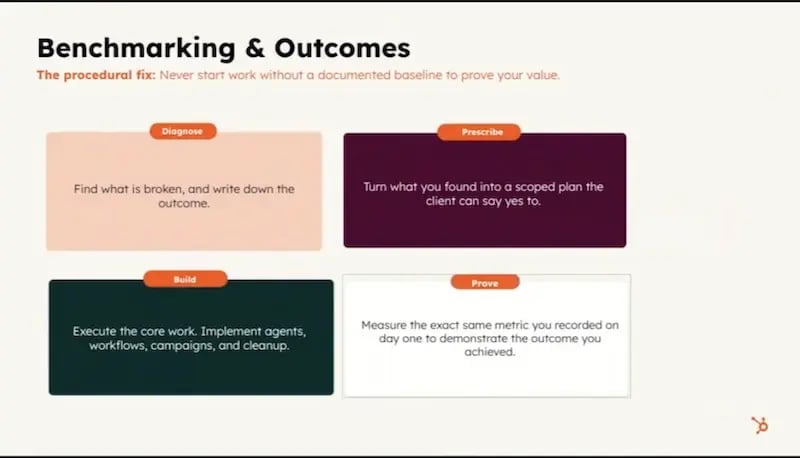
Diagnose: Establish Your Baseline Metrics
Identify operational bottlenecks in your pipeline. Record key day-one metrics, including lead response time, deal cycle length, administrative hours, and win rates.
Prescribe: Design Your Agent Strategy
Translate diagnostic gaps into a targeted rollout plan. Decide which tasks belong to human reps, which require autonomous agents, and which external tools need MCP connectors.
Build: Clean Data Launch Agents
Standardize customer data inside Context Home. Deploy custom agents using Agent Builder, migrate legacy workflows, and set up team workspaces in HubSpot Work.
Prove: Measure Performance Against Initial Baselines
Re-evaluate the baseline metrics set in step one. Quantify time saved, pipeline growth, and closed revenue to confirm platform ROI.

Transforming Your GTM Engine
Moving from isolated point tools to an Agentic Customer Platform inside HubSpot Work and Agent Hub transforms scattered software into a predictable revenue engine. By unifying sales execution, business context, and AI automation, revenue teams spend less time managing software and more time building buyer relationships.
Strategic Recommendations for RevOps Leaders
To prepare your organization for agentic sales execution, focus on three initial steps:
- Audit Context Home: Review your ICP definitions, target personas, and sales methodology data inside HubSpot to prevent AI drift.
- Identify Conversion Targets: Review legacy HubSpot workflows and flag repetitive routines to convert into agentic workflows with Breeze Assistant.
- Build Your First Custom Agent: Select a simple administrative task—such as post-call follow-ups or account research—and launch a targeted agent in Agent Builder.
Scaling revenue requires a clear strategy, clean data, and aligned platform architecture. Partnering with experienced RevOps specialists helps organizations configure HubSpot, build custom AI workflows, and achieve predictable growth. Aspiration Marketing provides end-to-end HubSpot consulting, onboarding, and RevOps optimization to help GTM teams maximize their software investment.






Leave a Comment
Have thoughts on this article?
Share your feedback, ask questions, or join the discussion with our community.