





Are you leaving money on the table by overlooking the unsung heroes of influencer marketing? When most people hear about influencer marketing, they think of a brand collaboration with a macro influencer who boasts millions of followers. Talk about the likes of Khaby Lame and Nikkie.
Sure, large follower counts are amazing—you can reach a broader audience and generate truckloads of engagement with a single post. However, macro influencers comprise only a portion of the influencing market, and they are not necessarily the best go-to for your business at all times.
.webp?width=800&height=450&name=ChatGPT%20Image%20Jul%208%2c%202025%2c%2002_05_18%20PM%20(1).webp)
With the growing demand for affordability and much more genuine promotions, nano and micro-influencers have gradually come into the spotlight. According to Shopify, nano-influencers make up 65% of the influencer count on Instagram, and 71% of marketers say micro-influencers are at the top of their list of ideal influencers.
Below, via examples and insights from business owners who've relied on influencers, we'll show why you should choose nano and micro-influencers over their macro counterparts and how to use nano and micro-influencers to boost your business leads and revenue generation.
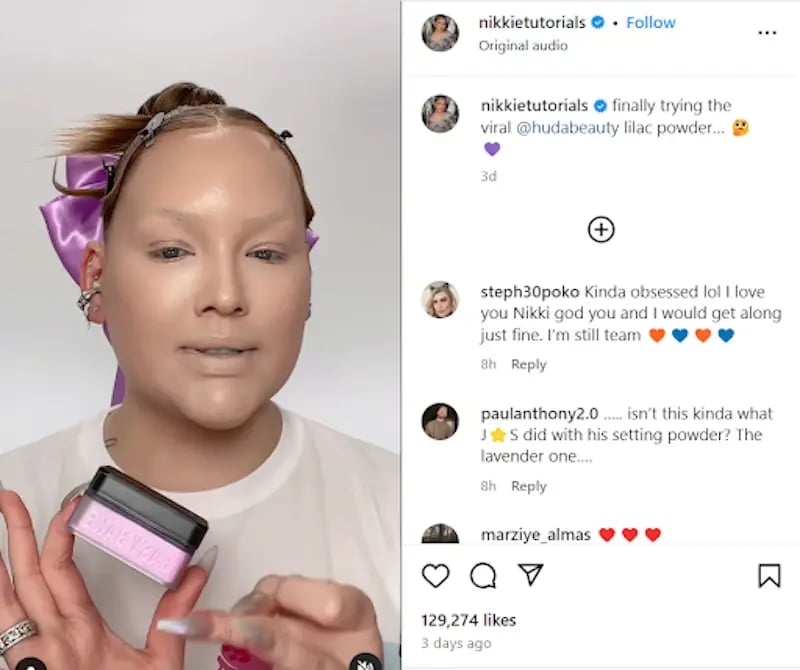
What are Micro and Nano Influencers?
Nano-influencers are social media creators who have between 1,000 and 10,000 followers. Micro-influencers are creators with a following of 10,000 to 100,000 people. In contrast, macro-influencers have follower counts that exceed 100,000, often reaching into the millions.
A growing number of brands are choosing to partner with nano and micro-influencers for several key reasons, including higher engagement, lower costs, and greater audience trust. The table below compares the different influencer tiers:
| Influencer Tier | Follower Count | Average Engagement Rate | Approximate Cost Per Post | Audience Trust Level |
|---|---|---|---|---|
| Nano-Influencer | 1,000–10,000 | High | Up to $850 | Very High |
| Micro-Influencer | 10,000–100,000 | ~7% | Up to $3,000 | High (Trusted by 70% of consumers) |
| Macro-Influencer | 100,000+ | ~0.98% | $20,000+ | Lower |
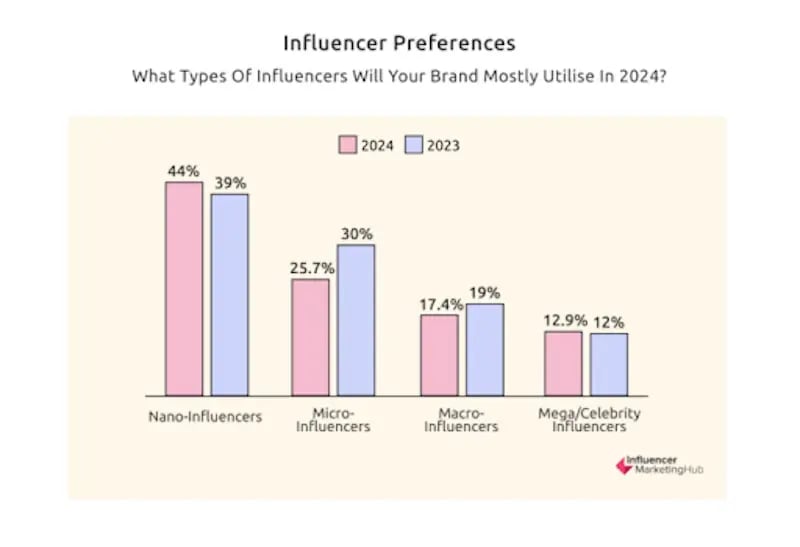
While these reasons do not place micro and nano influencers over macro in every scenario, you can use them as a benchmark for choosing which influencer category best suits your needs.
7 Tips to Maximize Business ROI With Micro and Nano Influencers
While micro and nano influencers have a smaller audience, you can leverage them for macro results. Let's see how to do that below.
1. Spend Less by Defining Goals And a Budget
Partnering with an influencer can increase your brand visibility, generate more engagement, expand your brand into new markets, or boost holiday sales.
“To increase brand visibility, micro-influencers are a perfect fit since they have a fairly segmented population—not too thin, not too broad. Flip the coin around, nano influencers will be best for generating engagements since they have a much more targeted audience,” Jeffrey Zhou, CEO and Founder of Fig Loans says.
Knowing your goals thus helps determine which influencer category works well for your business, while reducing the trial-and-error process that can be costly.
When creating these goals, ensure they are SMART:
Specific: Clearly define what you want to achieve (e.g., increase Instagram followers by 20%).
Measurable: Set metrics to track progress (e.g., gain 500 new leads from the campaign).
Achievable: Keep goals realistic based on your budget and influencer reach.
Relevant: Align goals with your overall marketing and business objectives.
Time-bound: Achieve the goals within 3 months.
You also need to consider your budget and how much you can afford to stretch it. If you’re looking to increase visibility, consider budgeting a yearly total of $10,000 to $30,000, based on Fiverr rates, for ten campaigns featuring different micro-influencers. Rates also depend on the competitiveness of your business niche.
Pre-documenting these costs helps prevent irrational spending and ensures proactive resource allocation without stifling the growth of other marketing channels.

2. Identify The Right Influencers
Ben Bouman, Business Owner at HeavyLift Direct, says, “Not all beauty influencers—whether nano or micro—are a good fit for your beauty business. The same thing applies to other niches. You have to check their track record based on previous partnerships with other brands, engagement rates they garnered, audience sentiment, and content focus.”
Otherwise, you may not get value for the money invested. To assess audience sentiment, look at the tone of comments, repeated positive or negative feedback, and how the influencer responds to their community.
Manually going through thousands of micro- or nano-influencer repositories is a daunting task. But you can use tools like Afluencer and Captiv8 to automate the vetting and selection process. These tools employ advanced algorithms to find and filter influencers based on your intended demographics, engagement score, and cost, among other criteria.
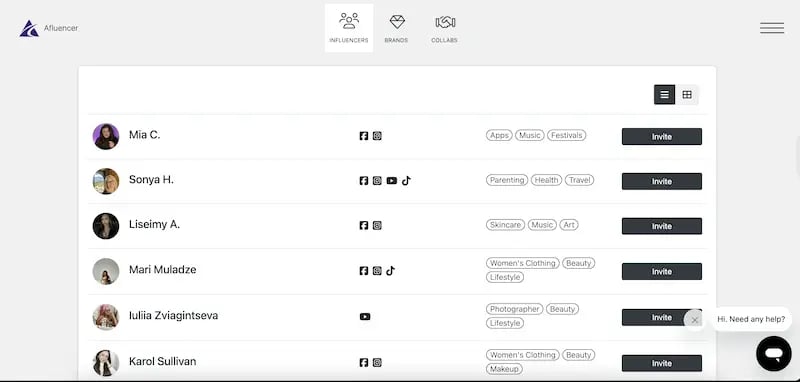
Extract at least a dozen influencers that fit your requirements and do a manual vetting for double confirmation before reaching out to them. Once in contact, ensure you ask for previous campaign results, beyond likes and comments, if they are disclosable.
At the same time, cheaper is not always better. Audience quality and relevance to your niche are top must-haves to consider. Still, try negotiating with multiple vendors to secure a good bargain.
3. Offer Creative Freedom
“Nano and micro-influencers often know more about their few thousand followers than you do. They’ve tried out different content types and seen the worst, experimenting with various ideas. So, while you can guardrail your campaigns to fit in your brand materials and designs, it’s essential to give them a degree of flexibility,” Sean Shapiro, Managing Partner at Axia Advisors, advises.
Influencers' insights should significantly inform decisions on content format, posting time, appropriate hashtags, and engagement strategies. This adds a sense of authenticity and boosts engagement for each campaign since they are crafted just like any other day-to-day post.
4. Go Omnichannel With Multiple Platforms
Peter Čuček, Owner at Tuuli, says, “Nano and micro-influencers charge less, so you don’t have to worry about breaking the bank by working with more than one. However, avoid focusing solely on influencers from a single platform. This limits your reach to certain segments.”
For instance, you’re more likely to reach more Gen Zs on Instagram compared to TikTok, while Millennials and older demographics may be more engaged on Facebook or YouTube.
TikTok & Instagram: Best for Gen Z and younger Millennials who prefer short-form, visually engaging content.
YouTube: Great for in-depth product reviews and tutorials, appealing to Millennials and Gen X.
Facebook: Still relevant for older Millennials, Gen X, and even Baby Boomers, particularly for community-driven discussions.
LinkedIn & X (formerly Twitter): Effective for B2B brands, professional discussions, and thought leadership content.
“Be versatile and work with influencers from relevant channels, as this helps to reach different segments of your target audience. This, in turn, can encourage broader reach and also prop up earnings from your campaigns,” Anna Zhang, Head of Marketing at U7BUY, adds.
An example is Dunkin’s National Day Campaign in 2016, which involved collaboration with over 8 influencers from different platforms. The campaign garnered nearly 40,000 social mentions and over 6.5 million engagements.
5. Collaborate For Holiday Campaigns
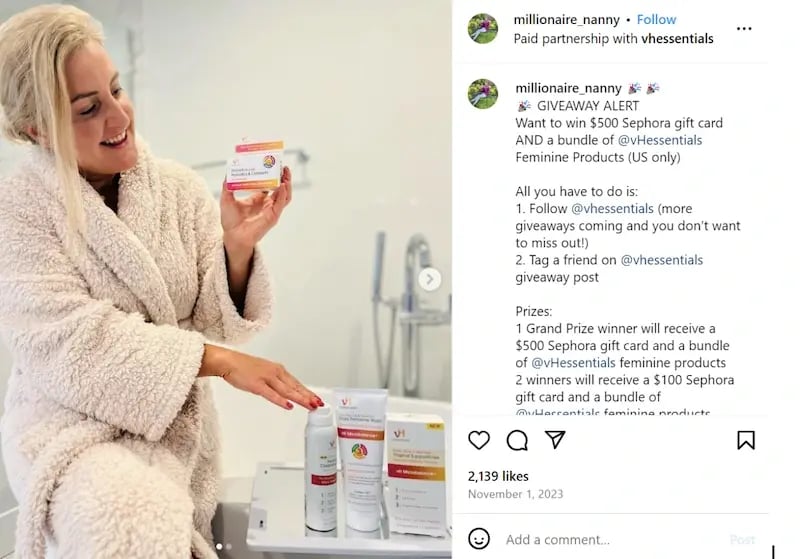
Holidays such as Christmas, Valentine's Day, and Black Friday are seasonal opportunities to generate an all-time high ROI. To maximize each, create highly segmented campaigns using nano- and micro-influencers.
This collaboration can include giveaways, discounts, time-limited deals, and holiday specials or promotions. See how VHessentials did that with Millionaire_nanny below.
6. Work With Multiple Influencers
If you’re collaborating with macro influencers, just one is sufficient, as they have a large follower base and charge a substantial fee per promotion. However, it’s a different case for micro- and nano-influencers. There’s no hard and fast rule against collaborating with multiple influencers if you have the budget.
This is particularly important when you’re trying to penetrate a market more quickly, despite working with limited capital. First, it helps you create enough hype and buzz to match that of macro influencers. Second, you can connect strongly with a highly niche target audience. For example, a small independent bookstore might collaborate with five different book nano-influencers, each specializing in a different genre (e.g., sci-fi, romance, literary fiction) to reach diverse reader communities.
Of course, you shouldn’t overdo it. Consider your budget and duration of the campaign. For instance, running multiple influencer campaigns with dozens of influencers all within a month will make it difficult for the impact of your investments to spread out.
Instead, stagger your collaborations over a more extended period. This allows your brand to maintain a consistent presence in your target audience’s feed, keeping engagement high without overwhelming your budget. A phased approach also provides room to measure performance, learn from early results, and optimize subsequent partnerships for better ROI.
Additionally, ensure that each influencer in your circle complements the next. This is often difficult since each influencer boasts different creative ideas. So, you need to bring them on the same platform for collaborative marketing effort, or simply get an influencer marketing manager to maintain synergy.
7. Collect Reports And Track Performance
“Most influencers provide performance reports on each campaign so you can know what’s working and what’s not, or if the campaign is even working at all. Request it if they don’t. Benchmark each report against performance from other influencers and sieve out sources that contribute below the baseline to your ROI,” Stanislav Khilobochenko, VP of Customer Services at Clario, says.
Additionally, assess which of the two—nano or micro-influencers—has a greater impact on your revenue. If micro-influencers help you achieve your goals better, you can consider dropping nano-influencing in order to save costs.
Wrapping up
Most consumers trust influencer content over branded content. While you should aim to bridge that trust gap, you can also leverage nano and micro-influencer marketing to boost your ROI simultaneously.
For a start, reduce costs by defining your marketing goals and budget. Then, identify influencers who fit within your budget, follower size, niche, and other requirements. Offer creative freedom for authenticity and embrace omnichannel campaigns for a more diversified reach.
Collaborate with nano and micro-influencers for targeted promotions during holidays. Lastly, collect performance reports for each campaign and use them to make informed decisions.
Ready to unlock the full potential of micro and nano influencers for your business? Aspiration Marketing can help. Start implementing these strategies today!





Leave a Comment
Have thoughts on this article?
Share your feedback, ask questions, or join the discussion with our community.