





A friend of mine runs a small skincare brand. Last year, she spent 3 weeks building her first Facebook campaign - the creative, the targeting, the copy. She hit publish on a Monday morning. By Tuesday afternoon, Meta had rejected all five ads and flagged her Business Manager for review.
She hadn't done anything wrong. No misleading claims. No banned content. Her landing page was clean. But her account was brand new, and the platform treated her like a stranger.
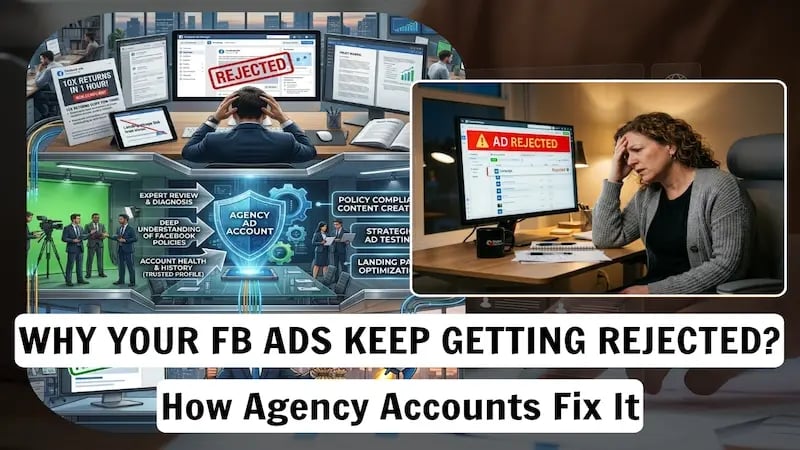
That story is more common than most paid media guides acknowledge. Ad rejections and account suspensions are one of the biggest silent killers of paid advertising performance. Most advice tells you to "fix your creative" or "read the policies." But the real problem often runs deeper, and it has everything to do with account trust.
This article explains why ad rejections occur, how platform trust scores work, and how agency advertising accounts help advertisers overcome these barriers and run campaigns with greater stability.
Why Platforms Reject Compliant Ads: The Platform Trust Score Factor
A Platform Trust Score is the algorithmic reputation record assigned by ad networks like Meta or Google to an ad account based on historical compliance, verified business registration, and cleared billing pipelines.
You can think of it like a credit score for your advertising account. A brand-new account with no history, no payment track record, and no established business signals is treated with much more suspicion than an account that has been running clean campaigns for years.
The Problem With New Ad Accounts
| Account Trust Metric | Self-Managed New Accounts | Verified Agency Accounts |
|---|---|---|
| Automated Review Scrutiny | Aggressive (High false-positive rate) | Lenient (Established trust ledger history) |
| Daily Spending Thresholds | Strict initial daily caps imposed | Uncapped or highly elevated limits |
| Billing Settlement Reliability | Verification loops triggered immediately | Pristine, long-term cleared clearing lines |
When you create a fresh Business Manager on Meta or a new Google Ads account, you start with zero trust. Platforms flag new accounts more aggressively because bad actors create new accounts all the time to get around bans.
Here's what that looks like in practice:
- Ads get rejected for vague policy violations with no clear explanation
- Payment methods trigger verification loops even when cards are valid
- Campaigns get paused mid-flight suddenly
- Account-level restrictions appear without any warning
These issues frustrate legitimate advertisers the most, because they're doing nothing wrong. The platform just doesn't know them yet. This is one of the most common Facebook ad delivery failures.
How Platform Trust Scores Work
Meta, Google, and TikTok all use trust signals to decide how much scrutiny to apply to an account. The main ones include:
- Spending history - Accounts with a track record of spending consistently over time earn more platform trust. New accounts have no history to reference.
- Payment consistency - Accounts with verified business payment methods and no failed charges score higher. Repeated payment failures - even minor ones - drag trust down.
- Policy compliance record - A clean history of approved ads builds trust. Frequent disapprovals, even for minor edits, can damage your account's standing over time.
- Business verification status - Meta Business Verification, Google's Advertiser Verification program, and similar checks add legitimacy to an account.
- Account age - Older accounts simply get more benefit of the doubt. Age alone is a trust signal.
A brand-new account has none of these. It starts at the bottom and has to earn its way up, which takes months of consistent activity.
The Most Common Reasons Ads Get Rejected
Understanding the specific triggers helps you avoid them. Here are the categories that cause the most trouble.

Policy Violations (Real and Perceived)
Both Meta and Google use AI to scan ad content. The AI catches clear violations well, but it also produces many false positives. Common triggers include:
- Before-and-after imagery in health or fitness ads
- Financial services language that sounds like guaranteed returns
- Phrases associated with restricted categories, even in unrelated industries
- Landing pages that don't match the ad content closely enough
- Personal attribute language ("Are you struggling with debt?" reads as targeting based on personal characteristics)
The frustrating part is that the AI can flag perfectly compliant ads because they match patterns from previously banned content.
In fact, according to a 2026 study by TripleLift, this mismatch creates a massive operational drag: 74% of advertising professionals report spending hours every single week validating and correcting AI execution errors—a roadblock commonly referred to as the "review tax."
Appeals take time, and these repeated automated flags, even when successfully dismissed, still quietly degrade your account's underlying reputation score.
Landing Page Experience Pitfalls That Trigger Ad Rejections
Your ad can be clean, and your landing page can still get you rejected. Google in particular scrutinizes destination URLs closely.
Landing pages that trigger rejections often have:
- Slow load times or broken mobile experiences
- Mismatched content (the ad promises X, the page delivers Y)
- Thin or low-quality content
- Unclear privacy policies
- Pop-ups that block the main content immediately on load
Meta also reviews landing pages and will reject ads that point to pages it considers low-quality or misleading.
Payment and Billing Problems
Payment failures are one of the fastest ways to tank a new account's trust score. Meta, in particular, is aggressive about this. A single failed payment can pause all active campaigns. Repeated issues can trigger manual reviews or restrict the account's ability to run certain ad types.
This creates a frustrating cycle for advertisers: payment fails, campaigns pause, you fix the billing, campaigns need re-approval, and by the time everything is running again, you've lost days of momentum.
A Real Situation:
Another marketer I know - a freelance media buyer managing campaigns for three ecommerce clients - ran into exactly this cycle. One client's card hit its monthly limit mid-campaign. Meta paused everything. By the time billing was sorted and ads were re-approved, the campaign had missed a four-day weekend sale window. That window represented roughly 30% of the campaign's projected monthly revenue.
Why the Fix Isn't Just "Better Creative"
Most advice about ad rejections focuses on the creative. They rewrite the copy, swap the image, and change the headline. That advice has its place, but it misses the bigger issue.
If your account has low trust, even good creative gets scrutinized harder. The creative is the visible part of the problem. The underlying issue is the account's standing with the platform.
This is why some advertisers notice that the same ad runs fine in one account but gets rejected in another. The creative didn't change. The account did.
As Brett Curry, CEO of OMG Commerce and a frequent speaker on paid advertising strategy, puts it:
"The health of your ad account is the foundation everything else sits on. You can have the best creative in the world, but if your account has accumulated trust issues, the platform is going to hold you to a higher standard on every single submission."
Getting out of this cycle on a self-managed account takes time. You need months of consistent spending, clean compliance history, and verified business information before the platforms start treating your account like a trusted advertiser. That timeline is a real cost - especially for businesses that need campaigns running now.

How Facebook Agency Advertising Accounts Solve This Problem?
A Facebook Agency ad account is an established, high-trust advertising account owned by a verified agency that advertisers can use to run campaigns, bypassing the limitations of new, self-managed accounts. These Facebook Agency ad accounts give advertisers access to established accounts with established trust histories, rather than starting from scratch.
Here's how they work: advertising agencies that have been active on Meta for years build up strong account histories. Their accounts have verified business status, long payment histories, and clean compliance records.
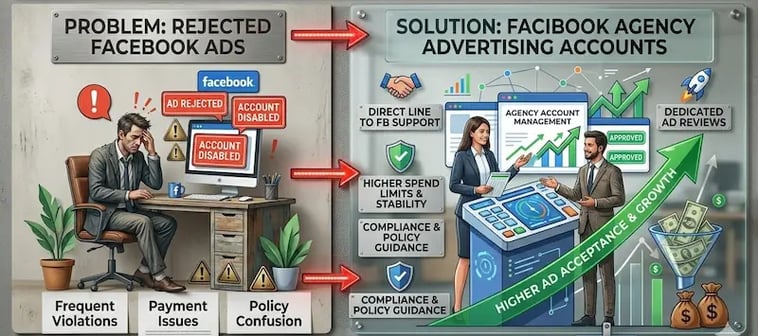
Some agencies offer access to these accounts through a rental model - advertisers run their campaigns through the agency account rather than a self-managed new account.
The practical benefits are significant:
- Faster approvals - Campaigns submitted through high-trust accounts are reviewed faster. The automated systems treat them with more leniency from the start.
- Higher spending limits - New accounts come with low daily and lifetime spending caps. Established agency accounts have proven they can handle volume, so the limits are much higher.
- Fewer payment interruptions - Agency accounts with long, clean payment histories don't trigger the same billing verification loops that new accounts do.
- Better stability during campaigns - Accounts with strong trust scores are less likely to get flagged mid-campaign for re-review, which means your delivery stays consistent.
A Real Example: From Constant Rejections to Stable Campaigns
Going back to my friend with the skincare brand, after 3 weeks of fighting rejections on her self-managed account, she switched to running through an agency account. Her next campaign went live within a few hours of submission. No policy flags. No payment loops. The same creative that kept getting rejected before sailed through review.
She ran that campaign for 6 weeks without a single interruption. Her cost per purchase came in 22% lower than her benchmarks from the previous year, when she had been running on a different platform entirely. A chunk of that improvement came down to delivery consistency - her ads ran on schedule, without the gaps that rejections and re-approvals had been creating.
That's not a dramatic turnaround story. It's just what stable campaign delivery looks like when the account trust problem is solved.
Who Benefits Most From This Approach
Agency accounts aren't the right tool for every situation. They make the most sense for:
- Businesses in restricted or sensitive categories - Health, finance, legal, and similar industries face stricter ad review by default. Running through an established account that has a clean history in these categories provides a real advantage.
- New businesses that need results fast: building account trust from scratch takes months. If you need campaigns running at scale before then, an agency account bridges the gap.
- Advertisers who've been banned or restricted - If a self-managed account has accumulated policy issues or an outright ban, an agency account provides a clean path forward.
- Media buyers managing multiple clients - Running client campaigns through high-trust agency accounts reduces the constant overhead of managing account health issues across dozens of accounts.
What to Look for in an Agency Account Provider
Not all agency account providers operate the same way. The quality of the account history, the provider's relationship with the platforms, and their support processes vary a lot.
Here are the factors that matter most:
- Official platform partnership status: Providers who are verified Meta Business Partners, Google Partners, or official TikTok partners have direct relationships with the platforms. This means better account quality and a real escalation path when problems arise.
- Rental model vs. account sale: A provider who rents accounts has an ongoing incentive to keep those accounts in good health, because they retain ownership. A provider who sells accounts outright has no stake in what happens after the transaction. Rental models typically produce better long-term account stability.
- Refund and balance policy: Understand what happens to your remaining ad balance if you need to pause or stop. Legitimate providers have a clear refund policy. The standard is the return of the unspent balance within a defined window.
- Support availability: Ad issues don't happen on a 9-to-5 schedule. Look for providers with responsive support during campaign-critical moments.
- Account history transparency: A reputable provider should be able to provide information on the account's overall spending history, compliance record, and platform verification status.
GDT Agency, for example, operates as an official partner of Meta, Google, and TikTok. They use a rental model, which means their incentive is to maintain account health over time - not just at the point of sale. They work with advertisers across 18 countries and manage over $10 million in monthly ad spend, which gives their accounts significant standing with the platforms they operate on.
A Practical Approach to Reducing Ad Rejections
Agency accounts address the trust layer, but they work best when combined with strong fundamentals on the creative and compliance side.
Here's a straightforward checklist to reduce rejection rates:
Compliance Checklist Before You Publish Facebook Ads
- Match your landing page content directly to your ad's promise
- Avoid personal attribute language in copy ("Are you a small business owner?" is fine; "Are you struggling with your business?" can trigger flags)
- Use real business imagery over stock photos in restricted categories
- Verify that your landing page loads in under 3 seconds on mobile
- Make sure your privacy policy is visible and up to date
How to Build Ad Account Trust For Your Meta Business Manager
- Complete business verification on Meta and Google before spending
- Use a consistent primary payment method that won't hit card limits
- Keep your ad account active, even at low spend, to maintain account age
- Don't make large, sudden changes to audience targeting or budgets, as this can trigger automated review
What to Do When Your Facebook Ads Get Rejected
- Request a human review rather than just resubmitting the same ad
- Document the rejection reason and check the specific policy section it references
- Make targeted edits rather than rewriting everything, so you can identify what actually triggered the flag
Take Control of Your Paid Media Stability
Ad rejections and sudden account restrictions are rarely just about a single word in your headline or a minor image change. The hidden roadblock is almost always platform trust. If you start from zero with a brand-new account, you are forced to play by a much stricter set of automated rules.
Leveraging established agency advertising accounts changes the game entirely. By plugging your campaigns into an account that already boasts a pristine payment history, verified business status, and years of compliant spending, you bypass the platform's suspicion. Faster approvals, higher spending caps, and uninterrupted delivery let your budget do exactly what it was meant to do: drive revenue without losing days of momentum to a robot's false positives.
Ultimately, scaling your paid media performance requires pairing great creative with an unshakeable backend infrastructure. If you are ready to stop fighting automated compliance loops and start building a stable, high-performance advertising foundation, we can help you map out the path forward.
At Aspiration Marketing, we specialize in audit strategies, data sovereignty, and aligning advanced enterprise workflows with secure, resilient platform architectures. Reach out to Aspiration Marketing today to discover how to insulate your marketing funnels from delivery gaps and maximize your paid media ROI.






Leave a Comment
Have thoughts on this article?
Share your feedback, ask questions, or join the discussion with our community.