




The HubSpot Marketing Hub is a leading platform for inbound marketing, a business methodology that attracts customers by creating valuable content and experiences tailored to them. Built upon a robust CRM foundation, the HubSpot Marketing Hub offers a comprehensive suite of tools for assessing, evaluating, and aligning marketing strategies across teams.
But many marketers are unsure of how the HubSpot Marketing Hub can specifically benefit their efforts. We explore ways in which the HubSpot Marketing Hub can enhance your marketing performance, providing insights into its key features and functionalities.

HubSpot Marketing Hub allows your firm to attract, engage, and convert customers from leads through an effectively operated marketing campaign. This occurs as the software helps target the best demographic, working to increase website visits by the targeted audience and offering ways to retain customers and build loyalty.
Essential elements of the Marketing Hub include lead generation, the automation of marketing processes, and the use of analytics. Fully integrating with the overall HubSpot Sales and Marketing Platform, HubSpot Marketing Hub supports a unified suite of products on which to base business operations:
-
Content Hub: HubSpot Content Hub is the content management system providing a firm foundation for successful CRM as prospective, current, and longtime customers access your website. This hub includes easy-to-edit features, website themes, and powerful SEO recommendations.
-
Operations Hub: HubSpot Operations Hub creates awareness, allowing your firm to attract customers within the chosen demographic and build brand loyalty. These tasks are accomplished by syncing apps, curating and cleaning customer data, and automating processes.
-
Sales Hub: Allows teams to align and get a detailed revenue picture throughout the sales campaign. HubSpot Sales Hub is essential for improved communication between marketing and sales teams through advanced CRM, meeting scheduling opportunities, payment processing, and aligned marketing and sales.
-
Service Hub: Creating a customer service experience that builds brand loyalty and creates an environment where long-lasting relationships thrive is essential for the HubSpot Service Hub. The goal is to maintain two-way connections with customers, track service tickets and feedback, and develop a knowledge base that benefits many areas of operations, including marketing.
-
Revenue Hub: The HubSpot Revenue Hub is a product bundle that helps small and mid-sized businesses sell products or services online. It includes features like a shopping cart, checkout, payment processing, and integrations with other HubSpot products. It offers different pricing plans to fit various budgets and is a comprehensive and user-friendly solution for growing your business.
Functions, Options, and Uses
The HubSpot Marketing Hub places all the marketing tools a firm needs on a single platform. By integrating customer data, social media outreach, advertisements, blogging, and other resources, the Marketing Hub creates a powerful, personalized experience that allows customers to feel involved, engaged, and enlightened about the products or services offered by a business.
Hubspot's core features in the Marketing Hub focus on inbound marketing or building customer relationships through helpful and relevant interactions and content, not outward campaigns that may seem aggressive, interruptive, or annoying.
HubSpot pioneered in using and perfecting inbound marketing that relies on targeted offers that allow customers to make decisions rather than spend time wading through mountains of digital promotions and emails of little interest. The goal is to provide easier ways for current and future customers to locate your business through search engines, relevant advertisements, social media, and other content.
The suite of Marketing Hub resources allows your business to attract attention, convert more leads, create reports, and customize features for potential leads and customers.

Attracting Attention
New customers can notice you and bring attention to added products or services to your existing client base. Essential functions in this part of the Marketing Hub include:
-
Fully-Integrated Blogging Software: The blog editor allows quick content creation, automatically optimizing for mobile devices. Personalized calls to action can encourage visitors to subscribe, promote relevant content, and handle emails to notify users of new content.
-
Search Engine Optimization (SEO): HubSpot helps you target clients through SEO, so your marketing efforts have the greatest impact. No coding is required when using HubSpot's content strategy tool, making it easier to determine which terms people search for and how your website ranks for them.
-
Personalize Ads: HubSpot software focuses on personalized marketing. Custom lists allow you to develop ad campaigns for cohorts as they make their journeys based on data collected, allowing you to construct ad sequences and get a better return on ad spend (ROAS).
-
Social Media Management: Easily create and publish content across your social media networks, adding keyword monitoring to back these interactions to your CRM. Connect, engage, and amplify your message.
Other ways to attract attention through engagement include live chat and video hosting software available through the platform.
Converting More Leads
After getting their attention, the HubSpot Marketing Hub allows your business to convert more leads to improve marketing performance through these functions:
-
Free Landing Page Builder: Build your CRM database with prospects and conduct A/B testing of CTAs through a powerful landing page builder. Helpful templates and an easy-to-use editor allow you to develop and preview displays that work on various devices; allow you to gather information, test variations, and build more leads, helping you create better, more effective pages.
-
Free Online Form Builder: This helpful tool allows you to grow your database, turn anonymous visitors into leads, get contact information, and connect this data with your CRM so you can build and share personalized messages. Forms may be developed in a matter of minutes rather than hours.
-
Helpful Marketing Automation: Make your automated messages personal with customized automation options that help you create compelling campaigns that rise above standard messaging. You can develop messages that add customization by tapping into your CRM.
-
Free Email Marketing Tools: You want to wow the recipient of your email campaigns, not have your efforts end up in spam. Connecting with your CRM allows you to customize email campaigns with explicit content visible on any device. The editor allows you to create customized layouts, CTAs, and proven methods for branding.
Other tools to help attract more leads include Lead Management and Tracking Software and Account-Based Marketing Software.
The HubSpot mobile CRM app allows you to check things on the go.
Reporting and Customizing
As you collect, analyze, and translate data, your firm can develop thorough marketing reports that you can analyze data to create successful marketing strategies:
-
Marketing Analytics and Dashboard Software: Analytics allows you to assess how your marketing campaigns perform by evaluating the data you have generated through HubSpot and working through the customer lifecycle. The analytics and dashboard software tools allow you to create reports based on properties included in the CRM or database, permitting you to assess which campaigns are the most impactful and which initiatives have generated the most valuable web traffic.
-
Custom Objects: This tool helps you organize your marketing data within your CRM, define their properties, and build associations with other things. Using the custom object builder, you can perform sophisticated levels of analysis without the need to understand coding.
-
Integration with Salesforce: For firms that also use Salesforce, HubSpot's Marketing Hub can integrate with your instance of Salesforce without needing detailed technical knowledge. The setup process is straightforward, with synchronization between Salesforce and HubSpot in both directions.
Core Features of the HubSpot Marketing Hub
HubSpot's Marketing Hub is a powerful platform that empowers businesses with the tools they need to attract, engage, and delight their target audience. The core elements that make up all HubSpot hubs are as follows: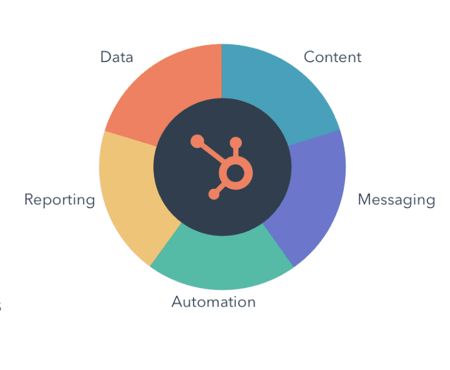
-
Data
-
Content
-
Messaging
-
Reporting
-
Automation
The five components work cohesively to create a seamless and effective marketing ecosystem.
1. Data
At the heart of HubSpot's Marketing Hub lies the importance of data-driven marketing. This element enables businesses to collect and analyze valuable customer information, including their behavior, preferences, and interactions across various touchpoints. By leveraging this data, marketers can gain deep insights into their audience's needs and pain points, allowing them to tailor their marketing strategies more precisely. Additionally, HubSpot's robust data management system ensures that businesses maintain a comprehensive view of their contacts and marketing performance, ultimately enhancing the overall marketing strategy.
2. Content
Content is about creating and managing valuable, relevant, and engaging content to attract and retain the target audience. HubSpot's Marketing Hub offers a wide array of content creation tools, including a user-friendly content editor, customizable templates, and multimedia integration. Marketers can effortlessly design blog posts, landing pages, emails, and social media content, making it easier to deliver the right message at the right time to the right audience. Moreover, the platform's content management capabilities streamline content creation, organization, and optimization, ensuring businesses maintain a consistent brand voice and message across all channels.
Ads
Creating compelling ads is vital to attracting and engaging the target audience. With its user-friendly ad creation tools, businesses can design visually appealing and highly targeted advertisements across various platforms, such as Google Ads, LinkedIn Ads, and Facebook Ads. The platform allows marketers to set specific audience segments based on demographics, interests, and behavior, ensuring that the ads reach the right people at the right time.
Moreover, HubSpot's integrated data analytics enable marketers to track ad performance, measure key metrics like click-through rates and conversions, and optimize campaigns for maximum impact. By leveraging the power of HubSpot's ad creation and tracking capabilities, businesses can enhance their online visibility, drive traffic, and ultimately increase their ROI on advertising efforts.
Blogs
HubSpot empowers businesses to create engaging and informative blog posts that resonate with their target audience. With its intuitive content editor and customizable templates, marketers can craft visually appealing blog posts that align with their brand identity. The platform also supports seamless collaboration among team members, making it easy to brainstorm ideas and draft content collaboratively.
Additionally, HubSpot's blogging tools facilitate search engine optimization (SEO) by offering suggestions to improve the blog's visibility and ranking on search engines. By publishing consistent and valuable blog content, businesses can establish thought leadership, attract organic traffic, and nurture leads throughout their buyer's journey.
Forms
Forms play a crucial role in capturing valuable information from website visitors, and HubSpot provides a comprehensive solution for creating and managing forms effortlessly. Marketers can design and customize lead capture forms using HubSpot's intuitive drag-and-drop form builder. The platform also allows for dynamic form fields, enabling businesses to ask relevant questions based on a visitor's previous interactions or profile data.
Additionally, HubSpot's forms integrate seamlessly with the CRM, ensuring that lead data is captured and organized efficiently. By leveraging HubSpot's form capabilities, businesses can convert website visitors into leads, gather crucial data, and optimize lead nurturing strategies for better engagement and conversions.
Landing Pages
HubSpot's Content element empowers businesses to create high-converting landing pages with ease. Marketers can design visually appealing pages that align with their marketing goals and campaigns using the platform's intuitive landing page builder and customizable templates. HubSpot also offers A/B testing features, enabling businesses to test different page elements and layouts to optimize for maximum conversion rates.
Furthermore, the landing pages are mobile-responsive, ensuring a seamless user experience across various devices. By utilizing HubSpot's landing page capabilities, businesses can drive targeted traffic, capture leads, and deliver personalized offers that compel visitors to take the desired action.
Social Media
Businesses can efficiently manage their social media presence and engage with their audience across different platforms. The platform allows marketers to schedule and publish social media posts in advance, ensuring consistent and timely communication. HubSpot's social media tools also provide valuable insights into post performance, audience engagement, and follower growth, enabling businesses to refine their social media strategy.
Additionally, the platform facilitates social listening, allowing marketers to monitor brand mentions and customer feedback in real time. By leveraging HubSpot's social media capabilities, businesses can build a solid online presence, foster brand loyalty, and connect with their audience on a deeper level.
3. Messaging
Effective communication is critical to building strong customer relationships, and the Messaging element within HubSpot's Marketing Hub facilitates just that. With features like email marketing, marketing automation, and lead nurturing campaigns, businesses can reach their audience with personalized and timely messages. The platform's automation capabilities enable marketers to nurture leads throughout the buyer's journey, delivering relevant content and offers that align with individual customer preferences. This personalized approach enhances customer satisfaction, boosts conversion rates, and drives long-term loyalty.
Marketing email
Marketing email is a powerful tool that enables businesses to deliver personalized and targeted messages directly to their leads and customers' inboxes. With HubSpot's email marketing capabilities, marketers can create visually appealing and engaging email campaigns using customizable templates or by designing emails from scratch with the user-friendly drag-and-drop editor. The platform also allows for dynamic content, which tailors the email content based on the recipient's preferences or previous interactions, resulting in a more personalized and relevant experience.
HubSpot's email marketing tools extend beyond just creating emails. Marketers can segment their email lists based on specific criteria, ensuring that the right message reaches the right audience. Furthermore, the platform offers automation features, enabling businesses to set up drip campaigns, automated follow-ups, and lead nurturing sequences. By automating the email workflow, businesses can maintain consistent communication with their leads throughout the buyer's journey, keeping them engaged and informed. Robust email analytics in HubSpot allow marketers to track open rates, click-through rates, and conversion rates, providing valuable insights into the effectiveness of their email campaigns.
4. Reporting
The HubSpot Marketing Hub provides businesses with comprehensive insights into their marketing performance. Marketers can measure the success of their campaigns, track website traffic, monitor lead conversions, and assess the impact of various marketing initiatives. Armed with this data, businesses can identify strengths and weaknesses in their marketing strategies and make data-driven decisions to optimize their efforts continually.
Tracking code
HubSpot's Reporting element offers a powerful tracking code feature that plays a fundamental role in understanding website visitors' behavior and interactions. The tracking code is a JavaScript snippet that is easily installed on a website, allowing businesses to capture valuable data about user activities. Once implemented, the tracking code monitors various actions, including page visits, form submissions, clicks on specific elements, and more. This data is then sent back to HubSpot, where it's integrated with the CRM and other marketing tools.
With the tracking code, businesses gain comprehensive insights into their website's performance and how visitors engage with their content. Marketers can track the effectiveness of their landing pages, blog posts, and calls-to-action, enabling data-driven decision-making to optimize their online presence. Moreover, the data collected through the tracking code helps businesses understand visitor behavior and preferences, allowing them to tailor their marketing strategies to better align with their audience's needs.
The tracking code can be placed on non-HubSpot sites to allow the tracking of visitor analytics and use of HubSpot elements on non-HubSpot sites, such as CTAs or forms.
Reporting and Dashboarding
HubSpot's Reporting element goes beyond just collecting data; it offers robust reporting and dashboarding functionalities that consolidate and visualize key performance metrics in a user-friendly manner. Marketers can create custom reports and dashboards tailored to their specific goals and KPIs. These reports can include data from various sources, such as website analytics, email campaigns, social media, and more, providing a comprehensive view of marketing efforts in a single location.
The reporting and dashboarding features enable businesses to track progress, identify trends, and accurately measure marketing campaigns' success. Marketers can analyze the data to understand which strategies and tactics work effectively and which areas require improvement. Visualizing data in real-time empowers businesses to make data-driven decisions promptly, optimize their marketing efforts, and demonstrate the impact of their strategies to stakeholders. Additionally, HubSpot's reporting and dashboarding features can be easily customized and shared with team members or clients, facilitating collaboration and aligning everyone on shared goals.
5. Automation
Automation is pivotal in HubSpot's Marketing Hub (on the Professional and Enterprise tier), enabling businesses to streamline repetitive tasks and focus on high-value activities. By leveraging automation, marketers can trigger personalized responses based on customer actions, schedule social media posts in advance, and segment contacts dynamically, among other tasks. This efficiency saves time and effort and ensures a consistent and timely customer experience.
Workflows
Workflows revolutionize how businesses engage with their leads and customers throughout their journey. Workflows are automated sequences of actions triggered by specific events or conditions, enabling businesses to deliver personalized and timely communications at scale. Marketers can design workflows using a visual, drag-and-drop interface, making creating complex automation sequences without coding or technical expertise easy.
With workflows, businesses can nurture leads, onboard new customers, and engage with existing clients seamlessly. For example, when a lead fills out a form on a website, a workflow can be triggered to send a welcome email, add the lead to a specific email nurturing campaign, and assign follow-up tasks to sales representatives. Workflows can also be set up to adapt to each individual's behavior, sending different messages based on their interactions with previous emails or website visits.
Moreover, workflows can automate routine tasks, such as lead scoring, list segmentation, and updating contact properties, freeing up valuable time for marketing and sales teams to focus on high-value activities. The data collected from workflows also provides valuable insights into lead behavior and campaign performance, enabling businesses to refine their strategies for better results.
Each component works harmoniously to empower businesses with the tools and insights they need to create impactful marketing campaigns, nurture customer relationships, and achieve sustained growth in today's competitive digital landscape. By harnessing the full potential of these elements, businesses can unlock the true power of HubSpot and revolutionize their marketing approach.
Marketing Can Thrive with the HubSpot Marketing Hub
Our team of certified and accredited professionals has experience leveraging the HubSpot platform suite to increase your website's visibility, convert anonymous website traffic into leads, and nurture prospects into satisfied customers. Various subscription levels are available up to the Enterprise level, starting with Free.
Are you looking into a HubSpot Marketing Hub implementation?







Leave a Comment
Have thoughts on this article?
Share your feedback, ask questions, or join the discussion with our community.