



Is your website actively helping your business grow, or is it just sitting there looking pretty?
Many businesses start their online journey with Squarespace. Squarespace is a website builder known for its attractive design templates, a simple drag-and-drop interface, and low upfront costs. It makes complete sense as an ideal tool for building a digital brochure. New users have often gone through the Wix vs. HubSpot and WordPress vs. HubSpot debates before landing on a solution.
 However, as your business grows, your goals naturally evolve. You need much more than a pretty home page. You need a site that actively generates qualified leads, captures detailed buyer data, and directly supports your sales team.
This operational shift reveals a real boundary: the Squarespace growth ceiling. The Squarespace growth ceiling is the functional limit businesses encounter when their need for lead generation and data integration surpasses the platform's native capabilities.
When you evaluate Squarespace vs. HubSpot Content Hub, you are not comparing two identical website builders. You are choosing between a visual-first design tool and a fully integrated inbound lead-generation engine. In essence, HubSpot Content Hub is an integrated platform focused directly on revenue generation, customer data storage, and marketing automation.
Understanding the Squarespace Growth Ceiling
Why do growing companies hit a wall with standard site builders?
To answer that question, we must examine how businesses use their web platforms as they scale. Squarespace works exceptionally well for startups, solo business owners, and small brands. It handles basic hosting, visual styling, and simple content posting without requiring complex technical upkeep.
As your marketing strategy matures, however, those same simple features start to hold you back.
Where Simple Platforms Limit Growth
- Siloed Data: Form submissions often end up in basic email feeds or simple spreadsheets. They do not automatically connect to customer profiles or sales track records.
- Lack of Dynamic Content: Every visitor sees the exact same page, whether they are a first-time visitor, a warm prospect, or a long-time client.
- Integration Clutter: To run basic lead-generation campaigns, you often need to connect several external tools via Zapier. This setup can break easily and creates frequent data gaps.
- Basic Analytics: Page views and click counts tell you what happened on a page, but they fail to show which specific blog posts or resources drive actual revenue.
A Real-World Example
Imagine a growing software consultancy that receives 3,000 monthly site visits on Squarespace. They capture a few contact form fills every week.
However, their marketing team cannot see which specific pages those visitors read before filling out the form. Their sales team receives an email alert, but they have no context for the specific problems the buyer wants to solve.
The website looks great, but it operates like a static paper flyer. It simply cannot power a modern, revenue-focused marketing plan.
Squarespace vs. HubSpot Content Hub: A Direct Comparison
What truly separates a standard brochure site from an integrated content management platform?
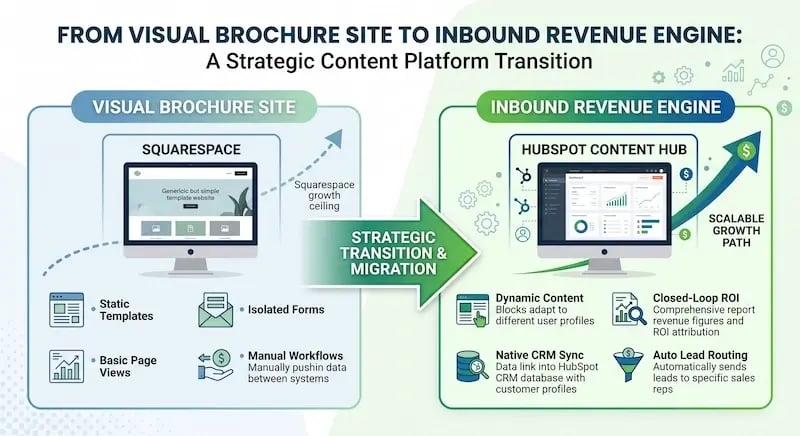
The main difference comes down to the core focus of each platform. Squarespace prioritizes simple visual setup and design layout. HubSpot Content Hub focuses directly on revenue generation, customer data storage, and marketing automation.
Key Differences at a Glance
| Strategic Capability | Squarespace | HubSpot Content Hub |
|---|---|---|
| Primary Core Focus | Visual presentation & rapid visual setup | Business scaling & lead generation |
| CRM Connection | Requires third-party webhooks & connectors | Native, real-time connection to HubSpot CRM |
| Content Personalization | Static pages rendered for all visitors | Smart Content tailored by lead stage & location |
| Lead Capture Tools | Basic contact forms & simple pop-ups | Smart forms, conversational bots, & dynamic CTAs |
| Search Engine Optimization | Basic metadata & clean code structure | Built-in SEO strategy tools & topic cluster mapping |
| Reporting & Attribution | Traffic counts & page metrics | Closed-loop revenue reporting & conversion paths |
Converting Visitors into Revenue: Building an Inbound Engine
How does your web platform directly affect your overall sales numbers?
When your marketing team uses isolated software tools, they lose valuable buyer context. Connecting your website directly to your central customer relationship management (CRM) database solves this problem completely.
The Power of an Integrated Platform
Data shows that modern buyers expect fast, helpful, and highly tailored interactions across every digital touchpoint.
- Research demonstrates that companies with fully aligned sales and marketing systems achieve 36% higher customer retention rates and 38% higher sales win rates.
- Converting web traffic requires personalized user journeys. Personalized call-to-action buttons convert 202% better than generic, static alternatives.
- Businesses using integrated inbound platforms generate 54% more qualified leads than those relying on disconnected point solutions.
Moving to HubSpot Content Hub turns your website from a passive digital storefront into an active lead engine.

Key Tools for Inbound Lead Generation
- Smart Content Rules: You can show targeted CTA buttons based on a visitor's industry, past site visits, or lifecycle stage. A new visitor sees a link to an introductory guide, while an active lead sees an option to book a live demo.
- Automated Nurturing Workflows: When a user downloads a resource, the platform instantly assigns them to the right sales representative. It also sends targeted follow-up emails without using any external connector tools.
- Closed-Loop Analytics: You can track every step of the buyer journey. You will know exactly which blog post brought a prospect to your site and which case study persuaded them to buy.
Deep Dive: Beyond Templates to Strategic Marketing Assets
Why are traditional templates falling behind modern content demands?
When you build a site using basic templates, your layout options are locked into rigid containers. Changing a page structure often requires editing code or redesigning entire page blocks from scratch.
The Power of Modular System Architecture
Modern growth marketing requires constant testing and rapid iteration. You need to create landing pages, launch campaign assets, and test copy variations without waiting weeks for a developer to be available.
- Drag-and-Drop Global Modules: HubSpot Content Hub relies on reusable global modules and flexible design themes. Your marketing team can update headers, footers, and content sections across hundreds of pages in a single click.
- A/B and Adaptive Testing: Rather than guessing which headline converts best, you can test up to five page variations simultaneously. The platform automatically serves the best-performing version to future visitors based on machine-learning conversion data.
- Multi-Language Content Management: As your business expands globally, managing separate regional sites becomes a nightmare on basic platforms. Integrated content hubs allow you to manage multi-language variants directly within the same page editor.
Search Engine Optimization and Topic Clusters
How does your site structure influence organic search visibility?
Search engines have evolved significantly over the past few years. Algorithms no longer reward sites that simply target isolated keywords. Modern search engines prioritize contextual authority, internal link structures, and comprehensive topical coverage.
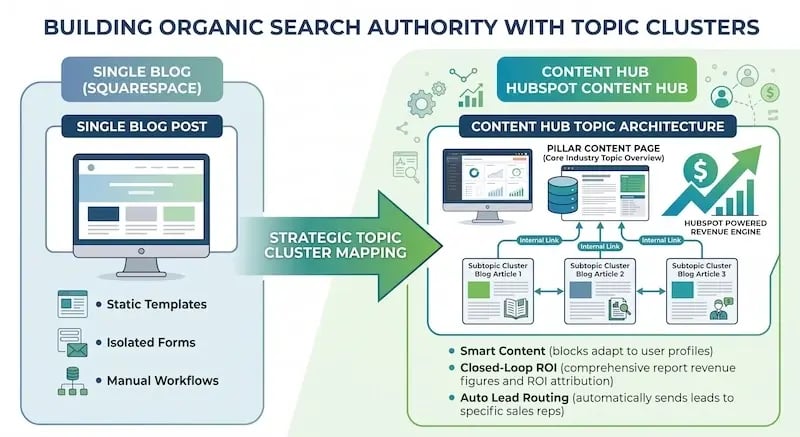 Building Organic Search Authority
- Topic Cluster Architecture: Instead of publishing scattered blog posts, Content Hub helps you structure content around core pillar pages and related subtopic clusters. This clean architecture signals deep subject-matter authority to search engines.
- Actionable SEO Recommendations: As you write content inside the native editor, the system checks your page against built-in optimization rules. It highlights missing meta tags, broken link structures, and content readability issues in real time.
- Canonical Link Protection: Managing duplicate content across campaigns can accidentally hurt your search rankings. Native content tools automatically set up correct canonical tags, protecting your organic search positions.
Key Signs It Is Time to Migrate Your Website
How can you tell if your business has outgrown its current site platform?
You do not need to wait for your website to break down or for server downtime to take action. Look out for these four clear operational signs within your organization.
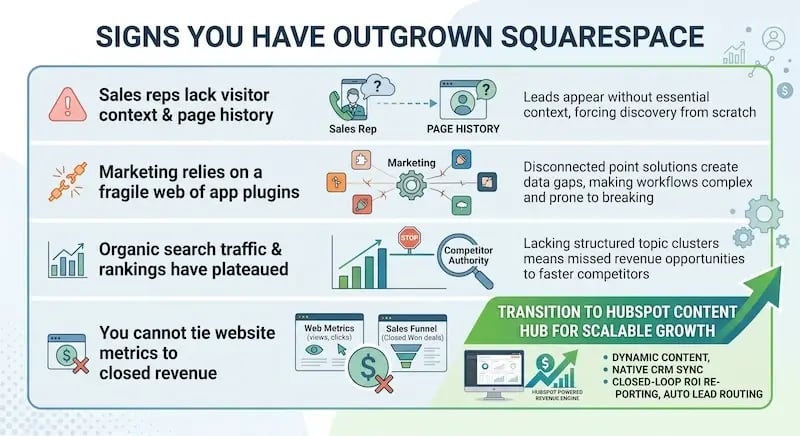 Sign 1: Your Sales Team Lacks Visitor Context
Your sales representatives receive form submissions, but they must ask basic discovery questions to understand what the prospect actually needs. They cannot see which pricing pages, service overviews, or case studies the lead reviewed before reaching out.
Sign 2: Your Tech Stack Feels Fragile
You rely on four or five different software tools just to handle form redirects, lead scoring, live chat messaging, and automated email sequences. Every time an application programming interface (API) updates, you risk losing valuable lead data.
Sign 3: Your Search Traffic Has Stagnated
Standard site templates often lack structured topic-cluster mapping capabilities. Without built-in SEO guidance, it becomes increasingly difficult to outrank larger competitors for valuable high-intent search terms.
Sign 4: You Cannot Prove Marketing ROI
Your leadership team asks which specific marketing campaigns drive actual company revenue. You can share basic traffic numbers, but you cannot directly connect page views to closed sales.
What to Expect During a Website Migration
Is moving from Squarespace to HubSpot Content Hub difficult?
Many business leaders put off site migrations because they fear losing existing search rankings, breaking site links, or experiencing costly web downtime. However, following a structured process keeps your search equity safe and ensures a seamless transition.
Taking the Next Step in Your Growth Journey
Beautiful website templates can help launch your business, but they cannot scale it on their own. When your goals shift from simple brand awareness to predictable lead generation, your web platform must evolve too.
By addressing the Squarespace growth ceiling, you remove the technical friction holding back your sales and marketing teams. Transitioning to an integrated platform connects your site traffic directly to your sales pipeline, turning passive visits into real business opportunities.
At Aspiration Marketing, we help growing companies move away from basic website tools and build high-performing digital marketing ecosystems. Our expert team manages the entire migration process carefully from start to finish. We preserve your hard-earned search authority, streamline your data flows, and configure HubSpot Content Hub to turn your website into an active revenue-generating engine.







Leave a Comment
Have thoughts on this article?
Share your feedback, ask questions, or join the discussion with our community.