





Have you ever looked at your marketing tech stack performance and wondered why, despite deploying more sophisticated tools than ever, your revenue operations still feel disconnected?
It is one of the most persistent ironies in modern B2B business.
 Organizations invest heavily in top-of-funnel campaign suites, roll out autonomous AI agents, and upgrade their CRMs—yet sales cycles drag on, leads go cold in the handoff between marketing and sales, and executive teams struggle to connect software spend directly to net revenue growth.
According to Highspot’s 2026 GTM Performance Gap Report,
While 96% of revenue leaders report having a clear business growth strategy, only 53% believe their company has realized strong ROI from their commercial execution over the past year.
The missing piece is rarely a lack of effort or tool budget. Instead, it is the absence of a unified context across the buyer journey.
At HubSpot UNBOUND 2026, the strategy for solving this performance gap was revealed. It does not come down to simply adding more standalone AI features to your portal. Instead, it requires binding your entire Go-To-Market (GTM) strategy around a single, underlying architectural core: Growth Context. This is fully realized with HubSpot's evolution from a CRM with AI features into a CRM/AI hybrid - an Agentic Customer Platform.
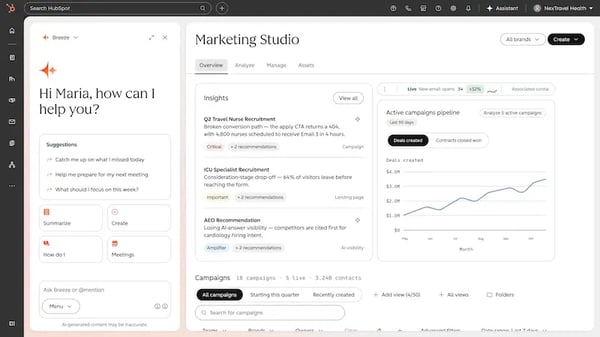
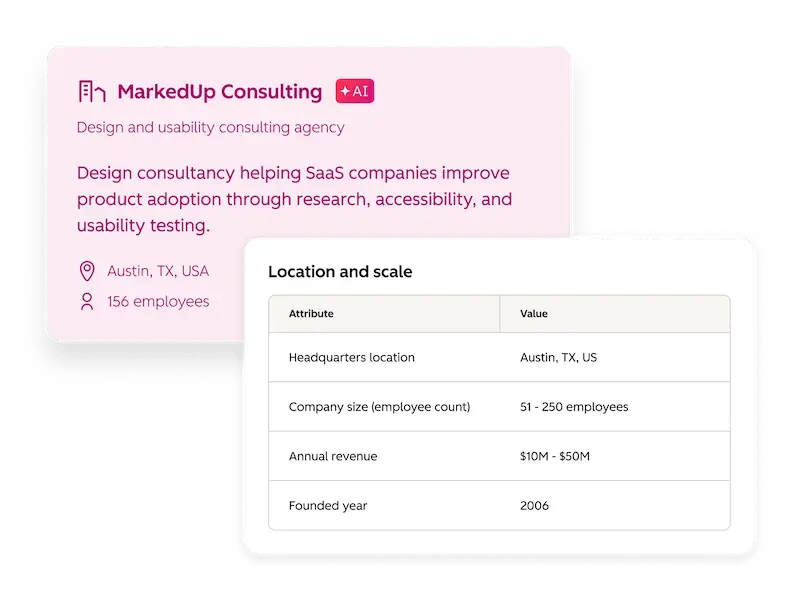 Here is how unifying HubSpot's latest releases—specifically Marketing Studio 2.0 and Agent Hub—under the umbrella of Growth Context creates a connected GTM journey that accelerates deal velocity and drives measurable revenue.
Understanding Growth Context: The Invisible Thread of the GTM Engine
To understand why traditional GTM execution breaks down, we have to look at how customer data traditionally moves through an organization.
Historically, marketing teams capture engagement on landing pages, email clicks, and content downloads. That data is recorded, bundled into a score, and pushed over the fence to sales.
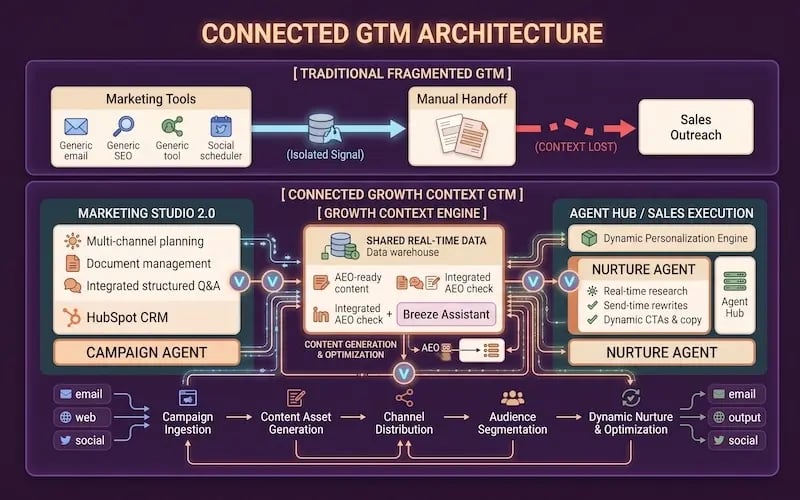 By the time a sales representative (or an automated outreach tool) engages the prospect, the granular details of why that prospect was interested are lost. The representative reaches out with a generic pitch, effectively forcing the buyer to start their discovery process from scratch.
This disconnect is more than just an operational nuisance; it is an expensive structural flaw.
Research from Gartner indicates that
Data silos and poor data quality cost organizations an average of $12.9 million annually in lost productivity, misaligned execution, and wasted acquisition spend.
What Is Growth Context?
Growth Context is the continuous underlying data and logic layer that makes historical interactions, intent signals, campaign engagements, and customer attributes visible and actionable across every tool in the HubSpot ecosystem.
Rather than treating your CRM as a static database where records are manually updated, Growth Context turns your system of record into an active intelligence engine. It ensures that every touchpoint—whether a blog view, an Answer Engine Optimization (AEO) search prompt, or a pricing page visit—is indexed and instantly accessible to both human reps and automated workflows.
For RevOps executives and Chief Revenue Officers (CROs), Growth Context bridges the gap between top-of-funnel demand generation and bottom-of-funnel sales execution. It transforms isolated user actions into a continuous narrative.
Capturing High-Intent Signals with Marketing Studio 2.0
If Growth Context is the engine powering your GTM journey, Marketing Studio 2.0 is one of its primary fuel sources.
Modern buyers do not follow linear funnels. They conduct research across AI search engines, interact with targeted content streams, evaluate product comparison pages, and engage with social ads long before they fill out a "Contact Sales" form. Standard marketing platforms capture these events as isolated transactions. Marketing Studio 2.0 captures them as a cohesive behavioral profile.
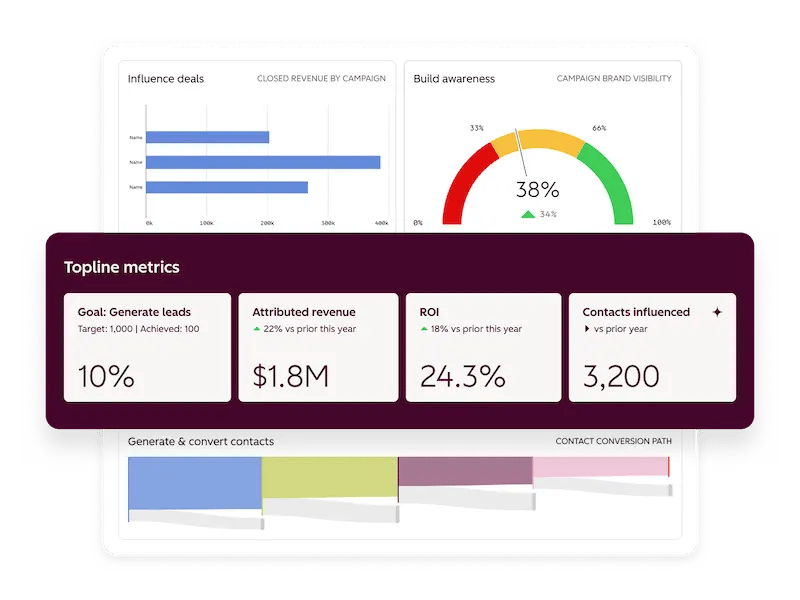 Key Capabilities Driving GTM Alignment
-
Omnichannel Behavioral Mapping: Marketing Studio 2.0 tracks multi-touch buyer journeys across traditional and emerging channels (including AI answer engines like ChatGPT and Perplexity via AEO tracking).
-
Dynamic Buyer Intent Scoring: Instead of relying on static point values (e.g., "+5 points for opening an email"), the system evaluates the recency, frequency, and specific relevance of content consumed to gauge immediate purchase intent.
-
Unified Campaign Context: Marketers can design campaigns in which every creative asset, lead magnet, and landing page shares unified metadata. When a contact engages, the system records not just that they converted, but which specific business pain point drew them in.
By aggregating these rich behavioral signals in real time, Marketing Studio 2.0 gives revenue teams full visibility into what a buyer cares about before any direct conversation takes place.
The Handoff: Connecting Marketing Studio 2.0 to Agent Hub & Agent Builder
The true power of HubSpot UNBOUND 2026 lies in what happens after Marketing Studio 2.0 captures a signal.
In traditional tech stacks, passing a lead from marketing to sales is where deal velocity dies.

Research from CSO Insights shows that
The average B2B sales cycle stretches to 84 days, with up to 50% of qualified deals ending in "no decision" simply due to slow or generic follow-ups.
HubSpot UNBOUND 2026 solves this by connecting Marketing Studio 2.0 directly to Agent Hub and Agent Builder.
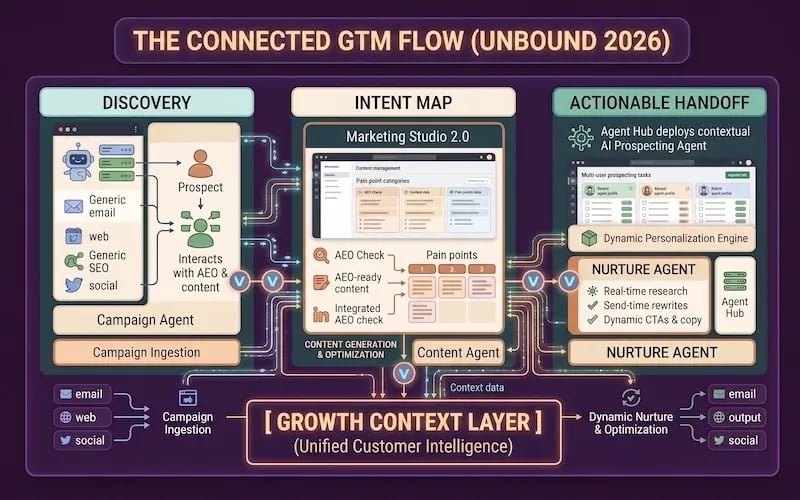 Transforming Point-Solution AI into Contextual Execution
Many organizations have experimented with autonomous AI agents for prospecting or customer support over the past year. However, most point-solution AI tools operate in a vacuum: they pull basic contact names and company titles, then fire off cold, semi-personalized templates.
Recent research from Gartner reveals that,
75% of new analytics content will be contextualized for intelligent applications through generative AI (GenAI) by 2027, enabling composable connection between insights and actions,
When you deploy AI agents inside Agent Hub—powered by Growth Context—the execution changes entirely:
-
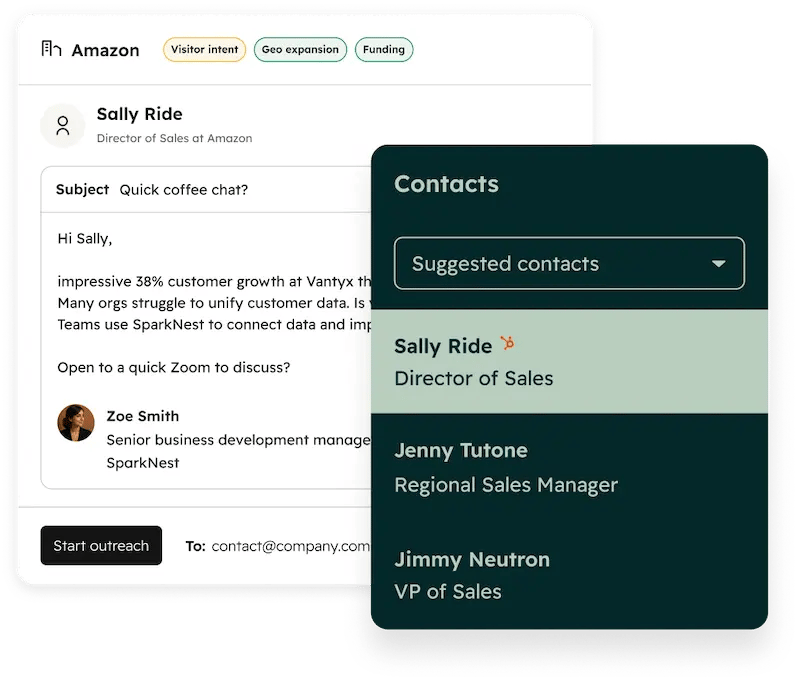
Real-Time Context Transfer: When a prospect demonstrates high buying intent inside Marketing Studio 2.0, an AI agent configured via Agent Builder is triggered instantly.
-
Tailored Messaging: Instead of sending a generic "Touch base" email, the Prospecting Agent reviews the full Growth Context profile. It notes that the prospect recently spent four minutes reading a case study on enterprise data security and references that exact challenge in its outreach.
-
Measurable Performance: Sourced data from HubSpot's 2026 product rollouts reveals that AI agents operating with embedded, business-specific CRM context achieve outreach response rates up to 2x the industry benchmark compared to non-contextual outreach.
|
Operational Approach |
Data Source | Outreach Relevance | Average Performance Impact |
| Traditional Point-Solution AI | Static contact lists & third-party enrichment | Generic, template-driven messaging based on job title | Standard cold outreach response rates (~2-4%) |
| Connected Growth Context (UNBOUND 2026) | Real-time behavioral data from Marketing Studio 2.0 + CRM history | Dynamic outreach tailored to actual content consumed and buyer intent | 2x higher response rates over industry benchmarks |
Strategic ROI: Transforming GTM Execution into a Measurable Engine
For Chief Revenue Officers and RevOps leaders, unifying your technology is not just about adopting modern tools—it is about building a scalable revenue model.
Gartner predicts that,
75% of the highest-growth B2B organizations will fully transition to a unified RevOps structure to align their revenue-generating functions.
The reason is straightforward: alignment drives margin efficiency and predictable pipeline growth.
When you connect demand generation in Marketing Studio 2.0 to sales execution in Agent Hub, your GTM strategy benefits in three core areas:
1. Shorter Sales Cycles
When sales reps (and AI agents) enter conversations equipped with exact buyer context, discovery calls are more efficient. Buyers do not need to re-explain their problems, allowing reps to move directly into solution mapping.
2. Elimination of Disconnected Tool Costs
Running separate platforms for marketing automation, intent data tracking, autonomous sales agents, and CRM analytics inflates your tech stack budget while creating data sync errors. Consolidating these functions under HubSpot's Growth Context reduces integration overhead and ensures consistent data governance.
3. Predictable Revenue Attribution
Instead of arguing over whether marketing or sales deserves credit for a deal, RevOps executives gain full visibility into the end-to-end journey. You can map exact pipeline velocity from the initial Marketing Studio 2.0 touchpoint through to the closed-won deal managed via Agent Hub.
 Actionable Roadmap: Preparing Your Stack for Connected GTM Execution
Ready to move your organization away from point-solution tools toward a connected GTM model? Follow this four-step implementation framework to build your foundation for Growth Context.
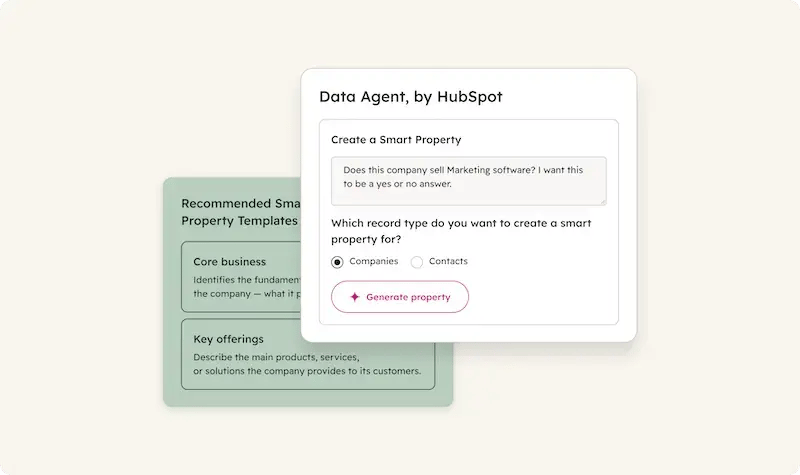
1. Audit Your Current Data Foundation: Prerequisite for accurate AI agent execution.
Before turning on agentic workflows, audit your CRM data quality. Clear out duplicate company profiles, standardize property fields across marketing and sales, and ensure custom event tracking is correctly configured. AI agents are only as accurate as the data layer underneath them.
2. Map Your End-to - End Buyer Intent Triggers:
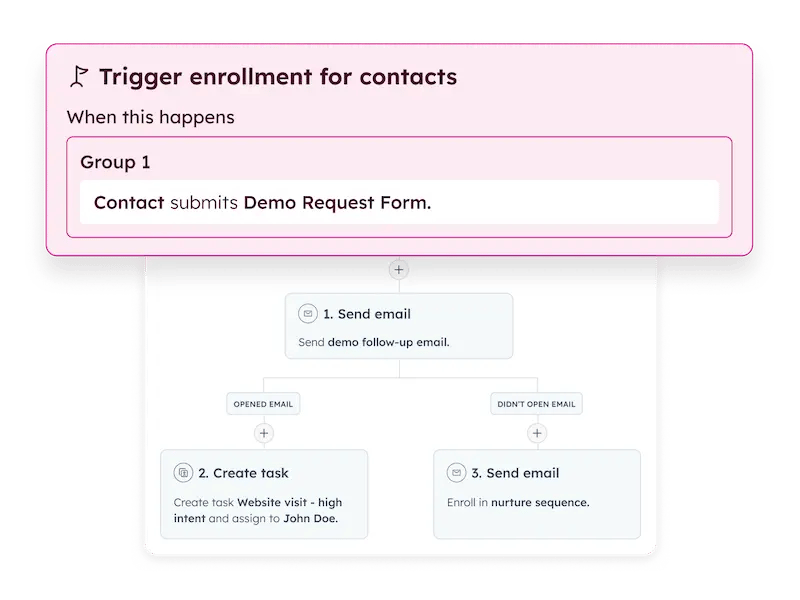
Document the specific behavioral signals in Marketing Studio 2.0 that indicate high buyer intent. Determine which actions should trigger automated agentic follow-up in Agent Hub versus which actions warrant direct, human sales outreach.
3. Configure Custom Guardrails in Agent Builder:
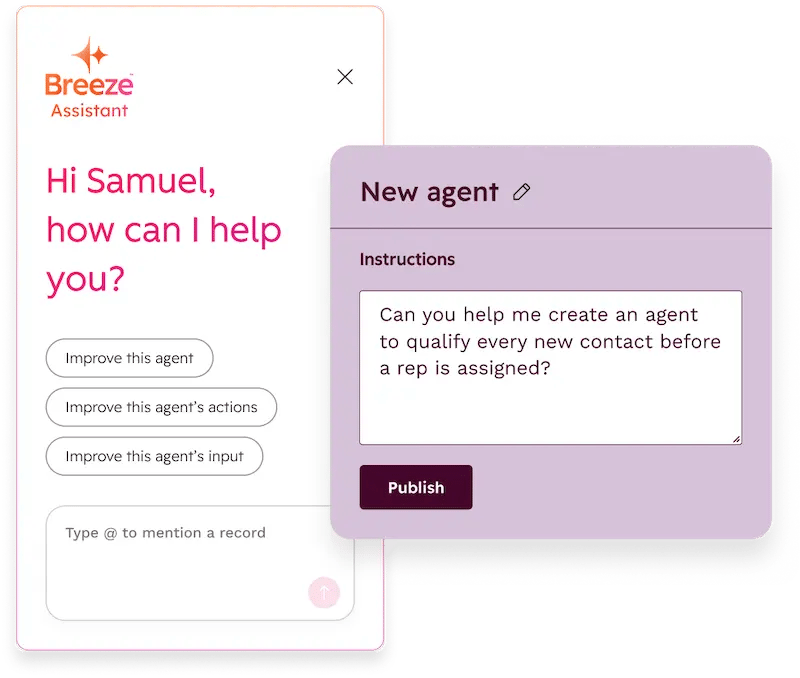
Use Agent Builder to define clear rules of engagement for your AI agents. Set tone guidelines, working hours, channel preferences, and monthly credit limits to maintain complete operational control over automated communications.
4. Align RevOps Leadership Around Shared KPIs:
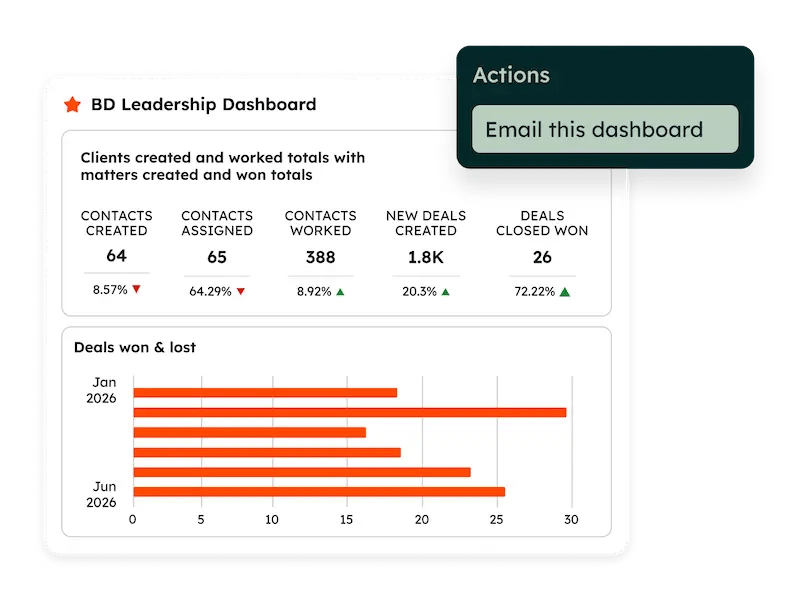
Replace team-specific vanity metrics (like raw email opens or top-of-funnel form fills) with shared revenue metrics: pipeline coverage, lead-to-opportunity conversion velocity, and customer acquisition cost (CAC) efficiency.
Taking the Next Step in Your GTM Journey
HubSpot UNBOUND 2026 marks a clear shift in how successful B2B organizations scale. The era of buying disconnected software tools for separate departments is over. To build predictable revenue pipelines in today's market, RevOps leaders must unify marketing context, AI capabilities, and sales execution under a single, context-rich architecture.
However, aligning your tech stack, restructuring team workflows, and configuring advanced platforms like Marketing Studio 2.0 and Agent Hub requires strategic expertise.
This is where working with a specialized growth partner makes all the difference. Aspiration Marketing helps scaling organizations design, implement, and optimize full-stack HubSpot ecosystems.
By aligning your Revenue Operations with HubSpot's Growth Context framework, Aspiration Marketing ensures your GTM strategy delivers shorter sales cycles, higher conversion rates, and provable ROI.





Leave a Comment
Have thoughts on this article?
Share your feedback, ask questions, or join the discussion with our community.