




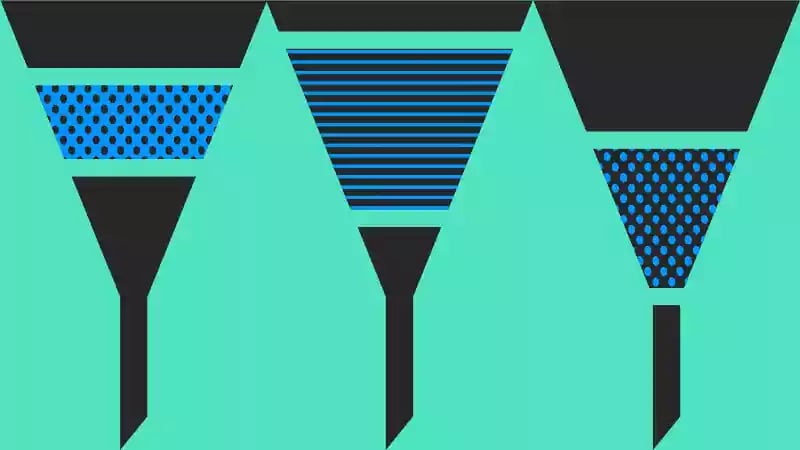
A conversion funnel is a marketing framework that outlines the journey a potential customer takes from their first interaction with your brand to becoming a paying customer. The marketing funnel has stood the test of time for organizing marketing objectives and campaigns. However, by rebranding it as a conversion funnel, we emphasize its ultimate objective: converting visitors into customers.
Using this term, we stay focused on achieving our primary goal and streamline our efforts. We'll review the key elements of a successful conversion funnel.

Key Objectives of a Conversion Funnel
The ultimate goal of a conversion funnel is to turn visitors into customers. This goal seems pretty straightforward, right? But it can be a long road from website visitor to customer, especially for B2B businesses that offer more complex products or enterprise solutions.
A conversion funnel isn't about one monolithic, substantial conversion from visitor to customer. Instead, a conversion funnel is a series of more incremental conversions: a visitor to contact; contact to lead; lead to prospect; and prospect to customer.
These conversions are most likely when the content in your funnel addresses your ideal customer's business challenges. If you think about this goal, you can break down the process of building the funnel more easily.
- Identify the buyer persona you are looking to attract. A buyer persona is a fictionalized version of your ideal customer. You may have multiple buyer personas, but choose one for your conversion funnel. What is that buyer's most pressing problem or challenge regarding your product or service?
- Create an offer that highlights your solution. That offer could be a white paper, a checklist, a case study, or another downloadable, gated asset that offers an in-depth look at solving the buyer's problem. Whatever you choose should seem like a "fair trade" for a website visitor's email address.
- Create a "story" around your offer. Every other content element of your conversion funnel should directly relate to your offer. Imagine you're using a white paper on how to protect against emerging cybersecurity threats. You'll need at least one blog article on that topic (preferably several) and a case study or customer success story to use in your funnel. In other words, the whole funnel should have a cohesive topic and message, with each element exploring a different facet of your topic.
- Build a seamless path to discovering your offer. How will your buyers find that brilliant cybersecurity white paper? The most common path is via your blog. Visitors might arrive at a blog post directly from their search or via a PPC ad (more on this later). Most importantly, the blog article is tightly related to your offer. The next most important is a simple path to taking your offer: the blog post should have a prominent call-to-action (CTA) that leads to a clean, simple landing page where visitors can get your offer in exchange for their email address.
- Follow up. Follow up. Follow up. The end goal isn't just to email people your brilliant white paper! It's to get them to convert into customers. Once they've received your offer, the next step is to follow up authentically and relevantly. We've found that the best way to do this is with a short series of emails (maybe three to five) that each offers additional value to the recipient. You might include a customer success story, a case study, or even an introduction video in that series. Be sure to invite the recipient to engage further each time you follow up--perhaps by scheduling a demo or a brief consultation.
- Make a smooth handoff to your sales team. This part sometimes gets neglected since it's technically after the "end" of a marketing funnel. But the last step in your conversion funnel is when a prospect becomes a customer. Coordination between marketing and sales will ensure a more consistent experience for everyone.
Six Essential Elements of a Conversion Funnel
You might think this sounds like a lot of content to create and maintain. The good news is that you can build a simple funnel with content you may already have. Here's what you need in the order that they'll appear in your conversion funnel:
- A relevant blog post (at least one): Remember that it should align with your offer. Suppose you have many related blog articles; that's even better! Each article is another place for visitors to enter your funnel and offers opportunities to add value and drive engagement in each stage of the buyer's journey.
- A landing page to offer access to gated content: Everything about the design of this page should encourage people to sign up for the offer. Following a few best practices can help ensure a remarkable landing page design.
- Downloadable, gated content: The most common offers are longer-form content, such as case studies, white papers, or lengthy guides. But sometimes shorter items work, too; for example, a social media branding checklist is our most popular offer. It helps to think of this content as your "anchor" because it is the center of your funnel and should drive the rest of your content choices.
- An initial email: connect and follow through: In this message, your new contacts should receive a link to the content they have requested, along with a brief message about the value or relevance of the content. Also include an invitation to further engage, such as a CTA to schedule a demo or have a quick chat.
- A "check-in" message: Most companies skip this step, but it can be invaluable. Send a message asking whether your new contact found your downloadable content helpful. If so, would they like more information or have additional questions? And if not, what might be more helpful? Again, include an invitation for further interaction.
- A final message - Break up: Sometimes called the "breakup email," this is a last attempt to convert the contact into a prospect. The elements of this message are generally a brief introduction to your company and your value proposition.

For this simple conversion funnel, a website visitor would ideally follow this path:
Arrive at the website via a blog article.
Click on a CTA to get your offer.
Submit an email address on the landing page.
Open the email that includes your offer.
Agree to further engagement (e.g., schedule a consultation or demo).
"Bonus" Elements of a Conversion Funnel
At any point in the conversion funnel, a visitor might opt out of taking the next step. The first opportunity for that is at the second step of your conversion funnel, on the landing page. According to HubSpot, the average landing page conversion rate (the percentage of people who visit a landing page and submit their information) is 9.7%. So the average business doesn't engage 90% of landing page visitors--that's a huge number of missed opportunities!
Social Media Advertising
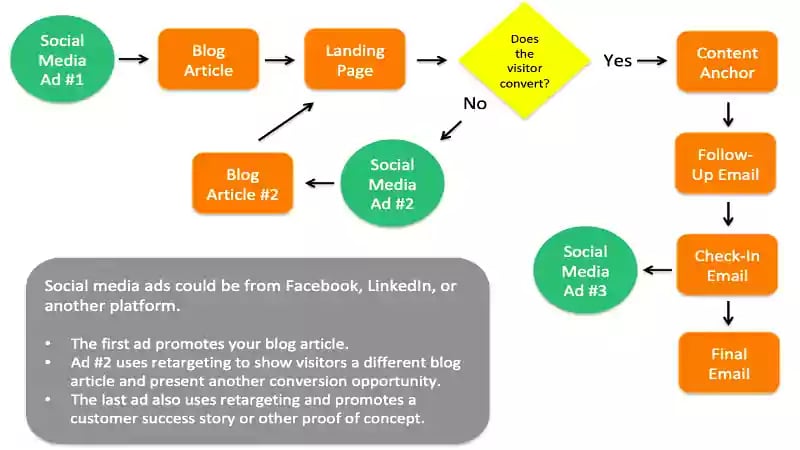
This is where advertising comes into play. You can supplement your primary conversion funnel with social media advertising at a few critical times to boost performance.
At the very beginning: Advertising your blog post can bring more people to the website, increasing the overall number of people who enter the conversion funnel.
When visitors don't convert on your landing page: Using ad retargeting, you can advertise to visitors who leave your site after a short time or don't submit their information on your landing page. These ads should promote content similar to what initially brought them to your website.
When contacts open your second email message: Another ad retargeting application is for contacts engaged with your message. For instance, people who open your second email message might see LinkedIn ads that promote a customer success story or highlight your company's unique solutions.
Pop-Up Forms
If they are incorporated wisely, pop-up forms and CTA's can increase the success of your conversion funnel. The key is to configure pop-ups based on website visitors' behavior.
Scrolling pop-ups appear when a visitor scrolls through a certain percentage of content on a page. For example, a scrolling pop-up might show up when a visitor has gotten through 75% of a blog article--which usually indicates high engagement. These pop-ups are best used on long-form content, such as pillar pages or lengthier blog articles.
Exit pop-ups appear when a visitor shows exit intent and seems ready to leave the site. For example, moving the cursor toward the "Back" button indicates exit intent. The right exit-intent pop-up can help decrease the bounce rate and increase conversion.
Time-based pop-ups appear once a visitor has spent a set amount of time on your website. Sometimes also called watchdog pop-ups, they can be triggered by active time on a site (the visitor is still exploring) or inactive time (the visitor has not scrolled or clicked on anything in a little while).
A well-designed conversion funnel is a superlative tool for lead generation. By keeping your objectives in mind and building content around buyer personas, you can build a conversion funnel that seamlessly leads your website visitors down the path to becoming customers.





Leave a Comment
Have thoughts on this article?
Share your feedback, ask questions, or join the discussion with our community.