





We are in the business of content marketing. However, we also know it's essential to understand paid advertising and pay-per-click campaigns. So what is it? And where and how can you use it effectively?
![What Is a PPC Campaign and How Do I Get the Best Results? [Video]](https://blog.aspiration.marketing/hs-fs/hubfs/Aspiration%20Marketing/Blog%20Images/PPC%20Campaigns.webp?width=800&height=450&name=PPC%20Campaigns.webp)
Paid advertising is paying for placing an online advertisement on a website, within search results, or on other platforms. This can take many forms, including pay-per-click (PPC) advertising, where the advertiser pays a fee each time their ad is clicked (cpc or cost per click) and cost-per-impression (CPI) advertising, where the advertiser pays a fee each time their ad is displayed to a user.
Paid advertising is a way for businesses to reach a larger audience and increase brand awareness. It can be an effective marketing strategy, but it can also be expensive, so it's essential for businesses to carefully consider their budget and goals before embarking on a paid advertising campaign.
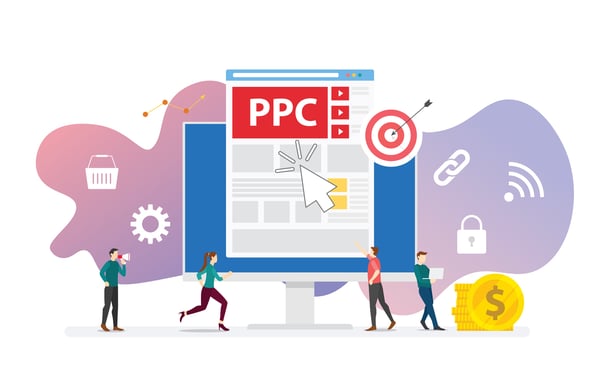
A pay-per-click (PPC) campaign is an online advertising model where advertisers pay a fee each time one of their ads is clicked. These PPC campaigns consist of several ads grouped by service, buyer personas, demographics, etc., and can be run on search engines, social media platforms, and other websites that offer advertising space.
In a PPC campaign, the advertiser creates an ad and chooses specific keywords relevant to their business and target audience. When a user searches for one of those keywords, the advertiser's ad may appear in the search results. With PPC, the advertiser is charged a fee each time the ad is clicked.
The main goal of a PPC campaign is to drive targeted traffic to a website and increase conversions, such as sales or leads. These campaigns can be effective, but they can also be expensive if not managed properly. It's crucial for businesses to carefully consider their budget and goals before launching a PPC campaign and to regularly monitor and optimize their campaigns to ensure they are getting the best return on investment.
Let's review the steps and processes and just plain old hard work that goes into running successful campaigns.
Launch a Successful PPC Campaign
Strategically crafted PPC campaigns can provide traffic, leads, and customers as soon as they start running, BUT they are complex and require careful planning. To have a successful campaign, you should complete the following steps:
Research
Start with customer research since you need to know what your customers want, what they’re looking for, and how they search for it. You can just load up with keywords and pull the trigger, BUT your campaign will be a bust if potential customers aren't using the phrases you're targeting. And you spend a lot of money with potentially no conversions.
Draw on whatever customer data you have, including detailed buyer personas, to help start brainstorming keywords. The initial seed list of keywords is made up of everything your customers might use to find you.
Compile Your Keyword List
An effective PPC keyword is:
- Relevant: Only bid on keywords closely related to what you sell.
- Exhaustive: Your research should include your niche's most popular and frequently searched terms and more specific, less common long-tail keywords. In total, the long-tail keywords add up to most search-driven traffic. They are less competitive and, therefore, less expensive.
- Expansive: PPC is iterative. You must constantly refine and expand your campaigns as the keyword list grows and adapts. Sort and filter for relevance to your site, widespread usage, and conversion history (or likelihood).
- Negative Keywords: Don't forget to flag keywords that may attract the wrong audience. These are negative keywords, and using them keeps the ad from displaying when somebody uses them in a search, saving you money and getting your ad in front of the right people.
Research Your Competition
You can see how other companies are positioning their ads using online tools. And if you see irrelevant businesses bidding for your keywords, reevaluate whether or not those keywords will reach your audience.
Write Compelling Ad Copy
Your audience and keyword research give you an understanding of your customers' psychology so you can write copy that most effectively converts them. Make sure the ad copy is compelling. After all, you've got limited space. Find the gap in your competitors' offers and leverage it.
Your offer should be irresistible, deliver your unique selling proposition (USP), and clarify what awaits a user on the other side of the click. Consider how you outshine competitors, what makes your customers buy from you, and what keeps them returning.
Beyond the USP, when you build a copy, remember to:
- Make it valuable: Don't compete on pricing. Whatever you're advertising, make it more attractive than the price.
- Make it believable: Don't make what you offer in an ad offer look too good to be true. Consumers are deal hunters, but they're careful where they spend money.
- Address risk aversion: Include guarantees or some other trust signal to help convert risk-averse customers.
- Include keywords: This is necessary so your ads will show. Make sure they fit naturally.
Create a Powerful Call to Action (CTA)
This point speaks for itself. You must inspire anyone coming across your PPC ad to take the next step, click through, and find out more.
Design a High-Converting Landing Page
And when they click through, don't send ad traffic to your homepage. As traffic funnels through your PPC ad, you want to send visitors to a custom-created landing page just for that campaign.
In deciding what will be the landing page:
- Craft specific content: Content and product descriptions should be specific to the target audience. Don't write for a general audience or be vague.
- Communicate value: Look to your audience research to craft targeted benefit statements that communicate value.
- Optimize for speed and mobile: Make sure to optimize a landing page to load quickly and ensure it works on mobile devices, too.
- Remove navigation: Remove navigation from the landing page to keep people's attention on the offer. Navigation should reappear on the thank you page once they're converted.
As much as your ad copy is essential to drive the right traffic to your website, an optimized landing page is critical to maximizing the conversion rates of your pay-per-click advertising.
After you've done all the work and your campaign is running, you still have work to do.
Successful PPC Management
If you set up your ad campaign incorrectly, you will be left with an empty wallet and low-quality leads or no leads at all. Most small businesses fall into this category. More ad campaigns fail than succeed.
Know what to DO and what NOT TO DO:
PPC Management: Best Practices (The "DOs")
- Pause your account before you spend money. Consider your goals. Don't settle for default settings unless you see that they benefit you.
- Adjust advertising settings to work for you. This sounds obvious, but it’s not generally intuitive in the tool's interface.
- Be realistic with expectations. PPC can be a great way to generate leads if you're willing to learn how to make it work and start with reasonable expectations. Be honest, thorough, and realistic.
- Know your numbers. Know which metrics are critical to your business and how you expect PPC to affect these numbers.
- Spend some money for testing. The first month of PPC advertising is about testing the market for the best long-term strategy and harvesting data on your target advertising market. Using broadly defined search terms to help you develop tighter keyword lists using real-world data is acceptable. Temporarily using broad terms provides keyword variations and negative keyword ideas that help build a well-rounded advertising campaign.
- Mine your search query reports. Spending time mining search query reports means each month will be more efficient. You use some money upfront to have better results long term. Focus on finding the best advertising opportunities. Monitor search query reports closely to see which keywords have the most promise and which waste money. As time goes by, you can better refine your strategy and eliminate broad match search terms.
- Tune up the funnel with optimizations. Define keyword lists, mine search query reports for negative keywords, identify new long-tail keyword opportunities, use ad testing to find the best-performing ads, and improve the relevance of your landing page to top-performing ads.
- Be more efficient. Use exact-match keywords and re-marketing lists.
- Get granular. Be the best match for the search and provide the best answer.
- Perform daily diligence. Your PPC accounts require daily maintenance to ensure you get the best results. It's this daily diligence that results in healthy, profitable campaigns.
PPC Management: Common Pitfalls (The "DON'Ts")
- DO NOT throw money at promoting a product that hasn't found an audience yet. PPC advertising won't get you there if you have not achieved product-market fit. The best PPC campaigns won't save a flawed product with no market for customers. You can do everything right with a PPC campaign, but if your target customers don't want what you're offering, PPC won't deliver the expected results.
- DO NOT enter into PPC advertising with an expectation that you can "set it and forget it." Maintenance is essential for a myriad of reasons, as discussed above.
And finally, a very brief word about channels and advertising platforms. Where do you go to do everything talked about in this post?
Facebook and Google ads more or less own the PPC space. Some smaller players can be viable under some circumstances. When in doubt, find a digital marketing pro to talk with about where you want to put your PPC energy, effort, and money.


.webp?width=600&height=375&name=Choose%20B2B%20agency%20for%20EdTech%20(1).webp)


Leave a Comment
Have thoughts on this article?
Share your feedback, ask questions, or join the discussion with our community.