





It's the end of the text-only era.
Think about the last time you used a search engine. Did you type a short, clunky phrase into a box? Or did you ask a question out loud to your phone? Perhaps you took a photo of a mystery plant to identify it, or shared a video clip to find a specific product.
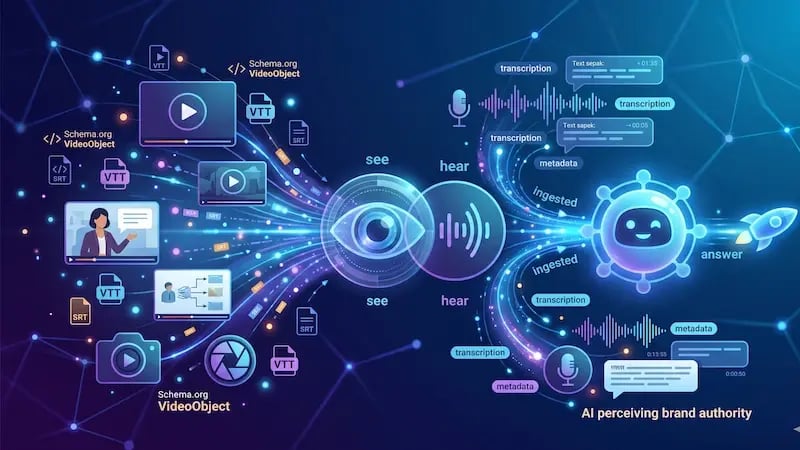 Search is no longer a "reading" task. It has become a sensory experience. Today, AI models do not just read your website's text; they see your images and listen to your videos. Multimodal Answer Engine Optimization (AEO) is the practice of optimizing these varied content formats to ensure AI models can understand and cite your brand as an authority.
If your brand only focuses on keywords in blog posts, you are leaving half of your authority on the table. Why? Because AI models like GPT-4o, Gemini, and Claude are multimodal. They process information simultaneously across multiple formats, including:
- Text
- Audio
- Visuals (images and video)
If your video content and images aren't optimized for multimodal AEO, the AI simply skips over them.
Are you ready to make your brand visible to the eyes and ears of the new internet? Let's explore how you can optimize your multimedia assets to ensure you are the answer the AI chooses.
The Multi-Sensory Shift: Why Multimodal is the New Standard
For decades, SEO was a game of text. We optimized headers, meta descriptions, and body copy. But the Answer Engine Era changes the rules. AI assistants aim to provide the most helpful answer in the most natural format. Often, that format is a video or a clear visual guide.
The data support this trend.
According to Personify, video content currently accounts for over 53.7% of total internet traffic, and it is expected to reach 82% by 2025.
If the majority of the web is video, AI models must be experts at watching those videos.
When an AI model "scrapes" the web to learn about a topic, it looks for the highest signal of authority. A high-quality video with a clear transcript is a massive authority signal for multimodal AEO. It tells the AI that you are willing to explain complex ideas in multiple formats.
But there is a catch. AI is smart, but it still needs a map. Without proper multimodal AEO, your 10-minute masterclass video is just a "black box" to a search bot. It knows a file exists, but it doesn't know the value inside. To win in this new era, we must open that box.
Visual Authority: Helping AI "See" Your Expertise
Images have always been part of SEO, but usually as an afterthought. We added "alt-text" mostly for accessibility or to stuff in a keyword. In the world of multimodal AEO, images are data points.
When a user uploads a screenshot to an AI and asks, "How do I fix this?", the AI searches the web for images that match the screenshot's visual context. If your brand's technical diagrams or product photos are properly tagged for multimodal AEO, you become the solution.
Moving Beyond Basic Alt-Text
Simple alt-text like "man working on car" is too vague for an Answer Engine. You need to be specific.
Better alt-text would be: "Lead technician at [Brand Name] demonstrating how to calibrate a 2024 torque sensor." This tells the AI who the authority is, what the action is, and what specific product is involved.
The Power of Structured Metadata
Metadata is the "behind-the-scenes" info that helps machines organize data.
Statistics from GigaScience show that AI-driven metadata standardization can increase the average dataset recall from 17.65% to 62.87% .
In plain English: when you use structured data, you make it nearly four times easier for an AI to find and use your content.
To achieve this, use Schema Markup. Schema Markup is a form of structured data that creates a rich, detailed description of your content for search engines. Specifically for images, you can use the ImageObject and VisualArtwork types. These tags allow you to tell the AI the creator's name, the date of production, and the specific "entities" (people, places, or things) within the image. This process turns a simple JPG into a verified source of truth for AI models.
Audible Authority: Why Video Transcripts are Non-Negotiable
Video is the most engaging way to consume information.
Research from Personify shows that 97% of marketers say video has helped increase users' understanding of their product or service.
However, AI models "listen" to videos differently than humans. They process the audio track and convert it into tokens. If you provide a high-quality, timestamped transcript, you are doing the heavy lifting for the AI.

The "Chapter" Advantage in AEO
Have you noticed how Google or Perplexity sometimes shows a video clip that starts at exactly the 2-minute mark? That isn't magic. It's the result of video chapters.
By breaking your video into clear sections—and providing a transcript for each—you allow the AI to "clip" your content for an answer. If a user asks, "How do I reset my software password?", the AI can pull the exact 30 seconds of your video where you explain that specific step.
Technical Integration: SRT and VTT Files
Don't just rely on auto-generated captions from platforms like YouTube, as they are often full of errors. For effective multimodal AEO, you should upload your own dedicated transcript files. The two primary formats are:
- SRT (SubRip Subtitle) is a plain-text file format that contains subtitle information, including the start and end timecodes for the text to appear.
- VTT (Video Text Tracks) is a more modern format that offers more advanced features like styling and positioning, built on the SRT foundation.
These files provide a text-based map of your audio. When search engines crawl your site, they read these files to understand the "semantic density" of your video. A video with a transcript is indexed as text, audio, and visual data all at once—a triple-threat for your multimodal AEO success.
Creating a Machine-Readable Content Ecosystem
One of the biggest mistakes brands make is keeping their content in silos. They have a blog team, a video team, and a social team. In the AEO world, these must merge.
Your video transcripts should use the same terminology as your technical white papers. Your image metadata should point back to your main service pages. This creates a "web of authority" that AI models find very attractive.
Consistency is Key
If your video says one thing and your blog says another, the AI gets "confused." AI models prioritize consistency. They look for consensus across different formats. If your brand's voice is the same across text, video, and audio, your Authority Score rises.
The Role of AEO Graders
How do you know if you are doing it right? You can use tools like the HubSpot AEO Grader to see how well your site provides answers. If your score is low, the culprit is often hidden content—videos without text or images without context. By fixing these multimodal AEO gaps, you instantly become more citeable for AI assistants.
Actionable Steps for Multimodal Optimization
Let's get practical. How can you start optimizing for multimodal AEO today?
-
Audit Your Assets: Look at your top-performing blog posts. Do they have videos? Do those videos have transcripts? If not, start there.
-
Transcribe Everything: Use tools like Descript or Otter.ai to get clean transcripts, then manually polish them to ensure brand names and technical terms are spelled correctly.
-
Implement Schema: Add "VideoObject" schema to your website. Include the transcript property in the code. This makes the text of your video directly readable by search bots.
-
Use High-Quality Thumbnails: AI "sees" your thumbnails. Use clear, high-contrast images that visually represent the answer the video provides.
-
Rename Image Files: Stop using IMG_0452.jpg. Use descriptive names like multimodal-aeo-strategy-diagram.jpg.
The Strategic Role of Repurposing
You don't always need to create new content. Often, multimodal AEO is about "unlocking" what you already have.
Take a long-form webinar. One hour of video can be turned into:
-
Five short "Question and Answer" clips for YouTube Shorts and TikTok.
-
A full-length blog post based on the transcript.
-
Ten high-quality infographics for Pinterest and LinkedIn.
-
A "FAQ" section for your website using the most common questions from the webinar.
Each of these pieces should be linked together using metadata. This tells the AI: "This brand is an expert on this topic across every possible format."
Metrics for Multimodal Success: How to Track Progress
Traditional SEO metrics like "clicks" and "impressions" are still important, but they don't tell the whole story in multimodal AEO. You need to look for "Citations."
Are You the "Source"?
The new goal is to be the source that the AI cites. When you ask Perplexity a question, look at the footnotes. Does it link to your video? Does it show your diagram?
Engagement Signals
AI models also look at user behavior. If a user clicks a video in an AI Overview and watches it to the end, that is a huge Value Signal.
-
Average Watch Time: This tells the AI your video is actually helpful.
-
Social Shares: This proves your multimedia content has human authority.
-
Voice Search Triggers: If your transcript answers a question perfectly, you may become the "read-aloud" answer for Siri or Alexa's AEO for voice search.
The Future: AI as a Perceptive Partner
We are moving toward a world where AI doesn't just find information; it understands it. As multimodal models become more advanced, they will be able to feel the tone of your videos and the quality of your brand's aesthetics.
If your videos are grainy and your transcripts are messy, the AI will perceive your brand as "low quality." But if your visuals are crisp, your metadata is structured, and your audio is transcribed with precision, you build a digital reputation for multimodal AEO that is hard to beat.
Is your brand ready to be seen and heard? The transition to multimodal AEO is not just a technical update. It is a fundamental shift in how we communicate with the world. By optimizing your video and image data, you aren't just helping an algorithm. You are helping your future customers find the answers they need in the way they want to see them.
Why Brand Authority Matters in the Age of AI
One last thing: in a sea of AI-generated text, human authority is the most valuable currency. Users—and the AI models that serve them—want to know that information comes from a real, trusted source.
By providing high-quality video and visual evidence of your expertise, you prove that you aren't just repeating data. You are creating it. This "Originality Signal" is what separates the leaders from the followers in the AEO landscape.
When an AI sees a video of your CEO explaining a concept or a detailed chart created by your engineering team, it assigns a higher Trust Score to that information. Text can be hallucinated by AI; a video of a real person or a complex, proprietary diagram is much harder to fake. This is why multimodal AEO is the ultimate tool for building long-term brand authority.
Leading the Way in the AEO Frontier
The "search box" is slowly fading into the background. In its place is a digital ecosystem that is conversational, visual, and always listening. To stay relevant, your brand must adapt its multimodal AEO strategy.
Optimizing your video transcripts and image metadata for multimodal AEO is no longer optional. It is the bridge between your brand's expertise and the AI assistants that your customers use every day. By making your content machine-readable, you ensure that your voice is the one that gets heard.
This journey into AEO can feel complex, but you don't have to navigate it alone. At Aspiration Marketing, we specialize in helping brands future-proof their digital presence. Whether it's structuring your video data, implementing advanced schema, or crafting an AEO-driven content strategy, we ensure that your brand stands out as a true authority.
The future of search is multimodal. Is your brand ready to lead the conversation? Contact us today to see how we can turn your multimedia assets into your greatest competitive advantage.







Leave a Comment
Have thoughts on this article?
Share your feedback, ask questions, or join the discussion with our community.