





You've probably seen this happen inside your own team: tools multiply, reporting drags, and half the week disappears into fixing things that were supposed to automate work in the first place. At some point, you look around and realize you're maintaining a system, not running a growth engine. You spend more time maintaining the tools than the tools are worth.
When you're planning next year's roadmap, the real question isn't "What's the new trend?" It's "What will actually move revenue?" A lot of the noise won't. However, a few shifts in marketing technology can genuinely alter how a team works on a day-to-day basis. Those are worth paying attention to.
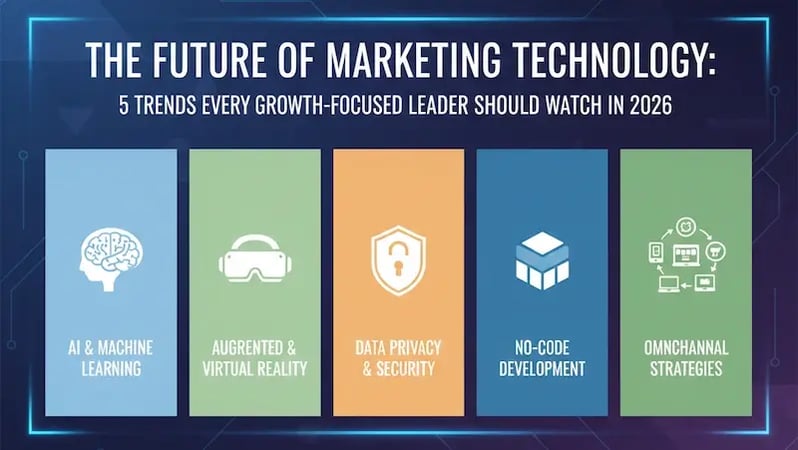
That's what this piece focuses on: the five marketing technology trends to watch and shifts that will affect throughput, clarity, and the amount of duct tape your stack requires to function. Treat it like a filter. What's worth investing in, what to ignore, and what your team needs to operate like a modern growth organization in the years ahead.
Trend 1. The Increasing Role of AI and Machine Learning in Marketing
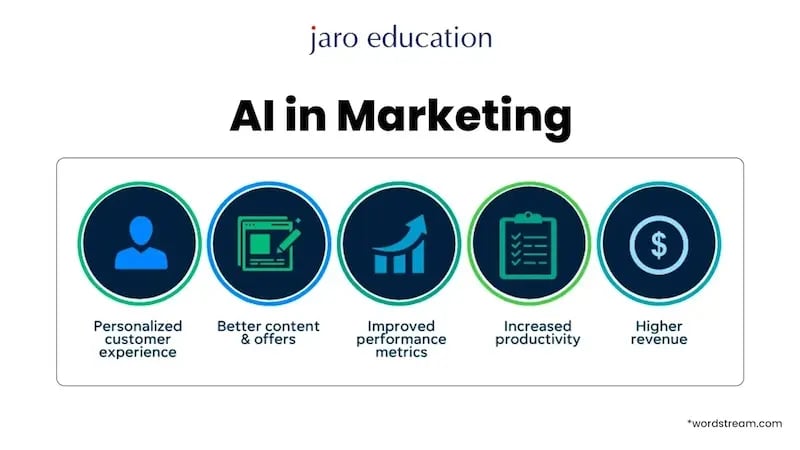
Artificial Intelligence (AI) in marketing is the use of algorithms and machine learning models to analyze complex customer data, predict what people want, and personalize experiences without burning out your team. AI can help you make sense of messy customer data, but there's more to this than meets the eye. In fact, Jaro Education cites that AI marketing is best for:
- Personalized customer experiences (CX)
- Better content creation
- Improved performance measurement
- Increased team productivity
- Higher overall revenue
Instead of guessing what will resonate, AI models can identify patterns across touchpoints (web, app, email, support, and store visits) and recommend the next steps in real-time.
McKinsey found that 76% of customers expect personalization now and get frustrated at run-of-the-mill, generic brand interactions.
So, how does AI help you personalize your experience? There are two ways you can immediately apply to your business.
- Deep pattern recognition and personalization: AI connects behavioral patterns across every touchpoint, enabling the prediction of what customers need based on past interactions and likely scenarios.
- Faster creative production and experimentation: Generative AI now produces on-brand ad variations, dynamic product descriptions, automated A/B tests, and rapid insights from reviews and transcripts. The point isn't "AI wrote this." It's "AI helped us test five versions this week and learn twice as fast.”
Paul McKee, founder of ReadingDuck.com, has spent decades developing tools that adapt to the way children actually learn, rather than how a traditional curriculum dictates they should. Breakthroughs always come from meeting learners where they are.
McKee says,
Personalization works because it responds to the moment. In education, that means adjusting difficulty or pacing based on how a child is doing right now. Marketing is no different, teams need systems that can adapt messages, timing, and channels dynamically. Whether it’s a student or a customer, people engage more when the experience feels tailored to them.
Trend 2. Augmented and Virtual Reality: Enhancing Customer Experience
Augmented Reality (AR) and Virtual Reality (VR) in marketing are immersive technologies that allow customers to visualize and interact with products in a digital or hybrid environment, effectively bridging the gap between online shopping and physical experience. Better devices and more 3D content pipelines have made immersive experiences practical for everyday shopping. For marketers, they're rewriting the "try before you buy" moment, right in someone's living room or on their phone.
Here's how AR/VR is transforming customer experience:
- AR/VR becoming practical everyday tools: Better hardware and browser-based AR make immersive experiences accessible anywhere. They shift product exploration from imagination to visualization. Fortune Business Insights forecasted the global VR market to grow from $20.83 billion in 2025 to $123.06 billion by 2032 at a 28.9% CAGR.

- Emotional connection through immersive experiences: Online shopping often relies on imagination, leaving room for uncertainty. AR/VR removes that gap by letting someone visualize a sofa in their living room or walk through a hotel suite before booking. The moment they see it in context, browsing becomes more impactful.
- Hybrid physical-digital experiences through spatial computing: Apple's Vision Pro and similar VR tools make it easy for shoppers to scan a product, see key details floating beside it, drop furniture into their home, or compare finishes on the spot. The spatial computing market is growing rapidly, and these interactions are transitioning from "cool demo" to genuine purchasing behavior.
Nicolas Breedlove, CEO of PlayGround Equipment, has helped schools and municipalities design playgrounds for over 20 years, long before AR or spatial computing existed. He’s seen firsthand how difficult it used to be for buyers to visualize scale using only PDFs and static renderings.
Breedlove explains,
When a city planner can drop a full play structure onto a site and walk through it in AR, the decision becomes immediate. They understand everything in seconds. Spatial computing removes uncertainty from a process that used to take weeks of back-and-forth.
Trend 3. The Evolution of Data Privacy and Security in Marketing
Third-party cookies are disappearing, and with the introduction of Privacy Sandbox alternatives, GDPR, CPRA/CCPA, and new state laws, you must prioritize transparency. Privacy-Enhancing Technologies (PETs) are a class of tools and methods, such as data clean rooms and differential privacy, that enable marketers to analyze data and personalize campaigns without exposing raw personally identifiable information (PII). Here's a simple breakdown of the principles every brand needs to prioritize as privacy laws become increasingly stringent.
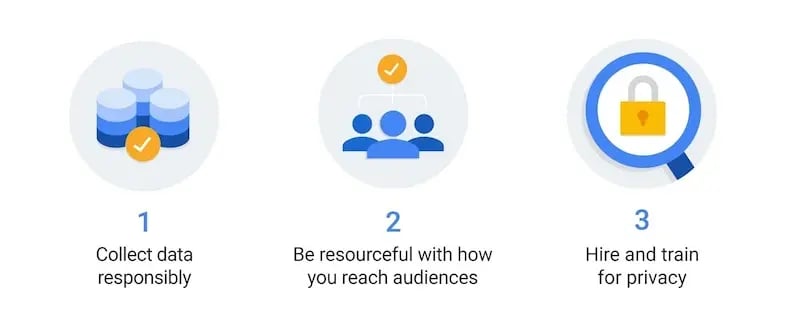 The quickest way to achieve this is to invest in value exchanges that customers actually want, such as loyalty perks, exclusive content, and genuine utility, while making consent centers clearer, simpler, and more user-friendly. The goal is to give people control in a way that feels honest and usable.
Utilize privacy-enhancing technologies like data clean rooms, differential privacy, on-device processing, and federated learning to analyze and activate data without exposing raw PII. These tools preserve personalization without sacrificing user trust.

Jeff Zhou, CEO of Fig Loans, has spent the last decade building products for borrowers whom traditional lenders often overlook. He's seen how trust, clarity, and data hygiene shape real financial outcomes far more than flashy targeting ever could.
Zhou explains,
Personalization only works when the customer trusts every part of the process. If someone is applying for a loan, they shouldn't have to wonder how their information is used or why a decision was made. When you design around that level of honesty, engagement goes up and the relationship lasts longer.
So user-level tracking is becoming harder. But this only means you have to rebalance how you measure performance. Perhaps this is a road to happier prospects and less spammy marketing methods.
Trend 4. Marketers Become Builders in a No-Code World
No-code and low-code platforms are visual software development environments that allow marketers to build applications, automate workflows, and manage data using drag-and-drop interfaces instead of traditional programming. These tools enable marketers to design pages, build workflows, connect data, launch microsites, and develop internal tools without waiting in the development queue.
This shift is becoming the norm across marketing ops and RevOps. Gartner projects that no-code tools will become increasingly popular and,
Will reduce development time by 90%. The global no-code development market is forecast to reach $187 billion by 2030.
This highlights how rapidly these platforms are becoming integral to modern marketing operations.
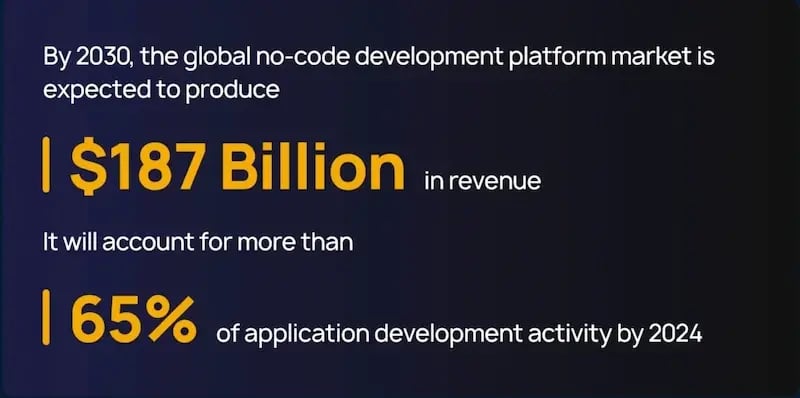 That prediction is already visible in how teams operate: workflow automation replaces manual tasks, visual builders replace custom scripts, and AI-powered assistants handle setup that once required technical skills. Let's examine how no-code is transforming the marketing world.
Faster execution and shorter cycle times
Instead of waiting days or weeks for engineering support, marketing teams can build landing pages, workflows, routing rules, and internal dashboards themselves. This shortens time-to-launch for experiments and campaigns.
Built-in AI assistants for workflow generation
These assistants will auto-complete tasks, recommend complete automation sequences, map data fields between tools, suggest experiments based on real performance patterns, and flag bottlenecks before they slow down a campaign.
Instead of spending hours designing workflows, marketers will be able to approve and refine what the AI drafts in minutes.
Wang Dong, Founder of Vanswe Fitness, has started applying this. His team now utilizes no-code tools to launch product pages, update feature guides, and test offers, all without relying on engineering resources.
Dong explains,
When you sell large equipment online, customer questions change constantly. One week it’s weight capacity, the next it’s adjustability or footprint. No-code tools let us update pages, build comparison blocks, and ship new explanations in hours instead of weeks.
Governance systems like roles, approvals, and versioning
Enterprise-grade controls will become standard. Teams can grant granular access (creator, editor, approver), manage publishing rights, and roll back to previous versions when needed. This keeps experimentation high while preventing rogue automations, unapproved assets, or inconsistent branding from slipping into production.
Smoother connections with data warehouses, CDPs, and analytics tools
Integrations will become more seamless and less dependent on manual setup or engineering support. Platforms will offer real-time syncing, automated schema detection, and native compatibility with warehouse-first architectures, making it easier to move data across systems without breaking pipelines.
The need for structured maker programs
As more marketers build workflows and internal tools, companies will need structured programs that teach the basics, such as how to design automations, avoid duplicating logic, maintain consistent naming conventions, and adhere to brand and compliance rules.
Templates for everyday use cases (welcome flows, lead scoring, routing, enrichment, reporting) help teams start quickly without reinventing the wheel. Regular review sessions serve as lightweight “code reviews,” ensuring new builds align with best practices and don't create long-term debt.
Trend 5. The Growing Importance of Omnichannel Marketing Strategies
Omnichannel marketing is a strategy that creates a seamless and integrated customer experience across all touchpoints and devices, ensuring continuity whether a customer is shopping online, on mobile, or in-store. People move between phone, laptop, store, chat, and social media without thinking about channels. They expect the experience to follow them, not reset. That's why being omnichannel-savvy is becoming increasingly essential.
Seamless customer journeys are now the baseline. When someone starts shopping on their phone, continues on their laptop, and finishes in-store, every step needs to feel connected. This is the default expectation.
Anna Zhang helped U7BUY scale from hundreds of thousands to over a million monthly visitors. As Marketing Lead, she has seen firsthand how fast gamers move between devices and channels, and how unforgiving this audience is when something feels slow or disconnected.
Zhang explains,
A gamer might discover an offer from a creator video, check prices on desktop, switch to mobile to compare items, and complete the purchase through our app. They expect everything to sync instantly. If even one step resets or loads slowly, they leave. Omnichannel continuity is the foundation for trust and repeat business.
There's also a clear commercial payoff. Harvard Business Review found that omnichannel shoppers spend more both online and in-store than single-channel customers, resulting in an immediate and measurable financial upside.
To deliver that level of continuity, modern omnichannel systems rely on three core foundations: a clean, consented identity spine; real-time orchestration that adapts to browsing, buying, or calling; and a composable architecture where email, mobile, ads, POS, service, and web all work together instead of operating in silos.
And because journeys now span multiple channels, measurement has shifted accordingly. Incrementality testing, lift studies, and MMM provide teams with a clearer understanding of what's actually driving outcomes and where budgets should be allocated.
Final Note: Preparing for a Future of Rapid Change
If this year was rehearsal, next year is showtime. AI will feel normal, not experimental. AR/VR will shift from cool to useful. Privacy will become a brand promise. No-code tools will give marketers more control. Omnichannel will shape customer journeys.
Growth-focused leaders need adaptable teams. Treat your stack like a living product. Invest in consent and data quality. Measure what matters. Keep some budget for intelligent risks.
What trends are you watching most closely for next year? Drop your thoughts in the comments.
Want more deep dives like this? Subscribe to Aspiration Marketing for practical, usable guidance with no fluff, and a keen focus on what helps you grow.


.webp?width=600&height=375&name=Choose%20B2B%20agency%20for%20EdTech%20(1).webp)


Leave a Comment
Have thoughts on this article?
Share your feedback, ask questions, or join the discussion with our community.