




Have you ever wondered whether your current business tools are actually helping you grow, or if they are just digital filing cabinets? In the renewable energy sector, this is a critical question. The global shift toward 24/7 carbon-free energy is moving at a lightning pace. If your team is still digging through messy spreadsheets or fighting with rigid, old-school databases, you are likely losing power.
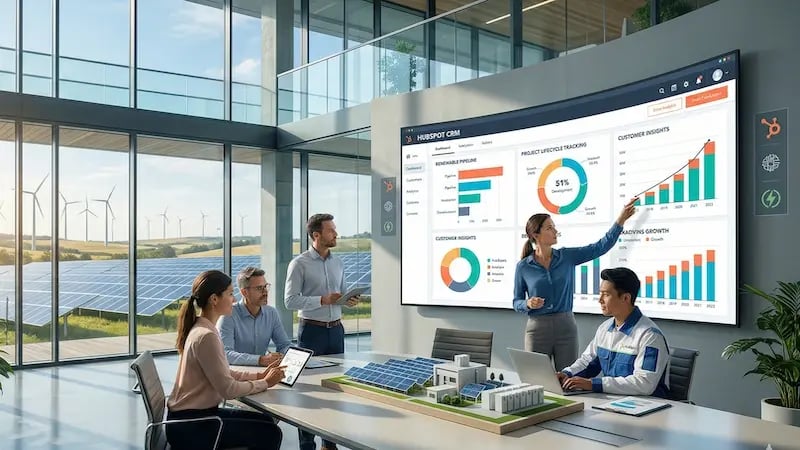 To win in this industry, you need more than just a place to store phone numbers. You need a growth engine. A CRM for the renewable energy sector is a growth engine that understands long project cycles, complex rules, and the need for deep trust. This is where HubSpot comes into play. HubSpot is a comprehensive platform designed to align your entire front office so that every customer feels seen and valued.
The Current Landscape: Why a "Standard" CRM Fails Green Tech
The renewable energy field is unique. Unlike selling a simple app or a pair of shoes, renewable energy projects involve many stakeholders. You have landowners, local government bodies, technical contractors, and the final users. Each person has different needs and different timelines. A "standard" CRM often fails because it treats every lead the same way.
Most renewable energy firms today are sitting on a data gold rush. You have names, emails, and notes from trade shows or website visits. But this data on its own is useless. To make it work, you must harness it. You need to know who is just "browsing" green incentives and who is actually ready to sign a contract for a new solar farm.
According to research from Nucleus Research, every $1 spent on CRM software yields an average of $8.71 in revenue.
That is a massive return on investment, but only if the CRM system is used correctly. If your system is too hard to use, your team will not enter data consistently. If they do not enter data, you lose that potential $8.71 gain. HubSpot solves this problem by being easy to use while still being very powerful.
Dynamic Segmentation: Managing the Move to Green Power
One of the biggest hurdles in renewable energy is the changing nature of the work. One week, a new state law might change solar incentives. The next week, a supply chain issue might delay the delivery of wind turbine parts. If you use a static "list" of leads, your information is out of date almost immediately.
HubSpot uses Active Segments instead of static lists. An Active Segment is a dynamic grouping of contacts that updates in real-time based on specific criteria, unlike a static list which is a fixed snapshot. For instance, a static list is like a printed photograph, while an Active Segment is like a live video feed.
For example, imagine a prospect visits your Solar ROI Calculator three times in one week. In a basic system, nothing happens. In HubSpot, that person is automatically moved into a High Intent segment. This triggers an alert for your sales team to reach out with a specific case study.
The data shows that using CRM segmentation to tailor your messages can lead to a 300% improvement in lead conversion rates.
You are not just guessing who to call; you are letting the data guide your outreach strategy.
Aligning the "Front Office" and "Back Office"
A common mistake in the energy sector is like confusing your kitchen with your dining room. For a business to run smoothly, these two areas must communicate effectively but serve different functions. An Enterprise Resource Planning (ERP) system is the operational 'kitchen' of your business, while a CRM for renewable energy is the 'dining room'.
Think of your business like a high-end restaurant. Your Enterprise Resource Planning (ERP) system is the kitchen. Your CRM for renewable energy is the dining room.
| System Type | Primary Function | Focus | Business Area |
|---|---|---|---|
| ERP System | Manages inventory (solar panels, batteries), payroll for installers, and logistics. | Internal Efficiency | Back Office (The Kitchen) |
| CRM for Renewable Energy | Tracks customer preferences, previous interactions, and project-related feedback. | Growth and Revenue | Front Office (The Dining Room) |
Many energy firms try to force their ERPs to manage customer data, resulting in a cold, rigid experience for the buyer. On the flip side, trying to manage complex logistics in a CRM leads to chaos. You need both systems, and they need to talk to each other. Using the HubSpot Connector, you can bridge this gap. This integration ensures that your sales team knows if an installation is delayed before they call to ask for a referral.
HubSpot's own data shows that 89% of customers report higher productivity when marketing and sales work in a unified system rather than in silos.
Winning the Consideration Stage with Trust
In the buyer's journey, the Consideration Stage is the phase where a prospect evaluates solutions to their known problem. In the renewable energy world, this is a risk-mitigation exercise. The buyer is asking: "Is this company a safe choice for a 20-year project?"
To win, you must prove your competence. You don't do this by sending generic sales pitches. You do it by providing clear, helpful information that answers their specific questions.
- Case Studies: Show how you solved a similar power problem for another firm.
- Whitepapers: Explain the technical side of grid parity or energy storage.
- Smart Content: HubSpot lets your website adapt based on who is viewing it. A residential lead sees a Home Savings guide, while a utility-scale developer sees a Grid Integration report.
By using HubSpot's content tools, your company becomes a thought leader rather than just another vendor. You are providing value before you ever ask for a check.

Scaling with AI: The Future of Green Energy Sales
AI is no longer just a buzzword. It is the backbone of a modern CRM for the renewable energy industry. In HubSpot, AI helps your team work smarter, not harder.
Predictive Lead Scoring
Predictive Lead Scoring is an AI-powered feature that analyzes your last 1,000 "Won" deals. It finds patterns you might miss—like a specific job title or a sequence of page views—and then scores new leads automatically so your team knows who to call first.
- Breeze AI: This tool can "listen" to sales calls. If a prospect sounds worried about "regulatory hurdles," the system flags the deal as "at risk." This allows a manager to jump in and help before the deal is lost.
- Inbound Growth: Companies that switch to a unified platform like HubSpot see a 129% increase in inbound leads after just one year. This isn't magic; it's the result of having all your data in one place.
Why HubSpot Stands Out Against Competitors
You might be looking at other tools like Salesforce or Outreach. While those are powerful, they often come with an Integration Tax. The Integration Tax is the hidden cost of paying developers to make different software tools talk to each other.
HubSpot offers zero friction. Because your marketing, sales, and service tools are all in one platform, there is no data lag. If a customer opens a support ticket, your sales rep sees it instantly. This prevents the awkward sales call to an unhappy customer.
Also, user adoption is much higher with HubSpot. A CRM is only as good as the data in it. If your field technicians and project managers find the tool too hard to use, they will not use it. HubSpot is designed for humans, not database experts. This leads to cleaner data and better business decisions.
Solving the "Messy Middle" of Energy Projects
In the energy sector, there is often a messy middle between finding a lead and finishing a project. This gap is where revenue is often lost. Lead scoring and automated handoffs in HubSpot ensure that no lead falls through the cracks.
When a marketing lead becomes a Sales Qualified Lead (SQL), the handoff should be instant. HubSpot automates this process, routing the lead to the right rep based on territory or project type. This speed is vital. Research shows that responding to a lead within five minutes makes you much more likely to close the deal.
A Data-Driven Approach to Marketing Success
Let's look at the numbers again. If you are not using a modern CRM for your renewable energy business, you are likely wasting a large part of your marketing budget.
Personalized emails—which are easy to send via HubSpot—get 14% higher click rates than generic ones. Furthermore, firms that use CRM data for their strategy see a 29% increase in revenue.
These aren't just guesses; these are verified facts. When you have a single source of truth for all customer data, you stop guessing what works and start doing what works.
Key Questions to Ask Your Team
Before you move forward, ask your leadership team these three questions:
- Do we know our hottest leads? Or are we just calling through an alphabetical list?
- Is our data siloed? Does marketing know what sales is doing? Does service know what marketing promised?
- Can we scale? If we doubled our leads tomorrow, would our current system break?
If the answer to any of these questions is "No" or "I'm not sure," it is time to look at your CRM choices within the renewable energy industry more closely.
Powering Your Path Forward
The renewable energy industry is helping to build a better future for the planet. To do that work, you need tools that are as forward-thinking as your technology. Transitioning from a digital filing cabinet to a dynamic growth engine is not just a technical change; it is a strategic one.
When you choose a system that unifies your data, automates your tasks, and puts the customer first, you remove the friction that slows you down. You allow your team to focus on what they do best: creating clean energy solutions.
HubSpot stands out because it balances power with ease of use. It gives you the deep insights you need to win big deals while keeping your team's daily work simple. From predictive scoring to real-time segments, HubSpot is built for the complexity of modern energy markets.
Aspiration Marketing understands this journey. As a certified HubSpot Solutions Partner, we specialize in building the digital architecture that high-growth energy firms need. We help you move past basic onboarding into deep strategy. Whether you are a tech startup or an established energy provider, we ensure your CRM isn't just a cost, but a revenue-driving machine. Our goal is to help you grow not just bigger, but better.
Ready to see how your growth engine could be performing? Let's talk about how we can help you harness the full power of your customer data today.





Leave a Comment
Have thoughts on this article?
Share your feedback, ask questions, or join the discussion with our community.