




Have you ever opened your inbox, scrolled through a dozen "Checking in" or "Just touching base" emails, and felt... absolutely nothing? Not anger, not excitement, just a deep, soul-crushing sense of boredom? If your marketing feels like a wet paper towel, you might be haunted by a ghost from 1924.
His name is Caspar Milquetoast.
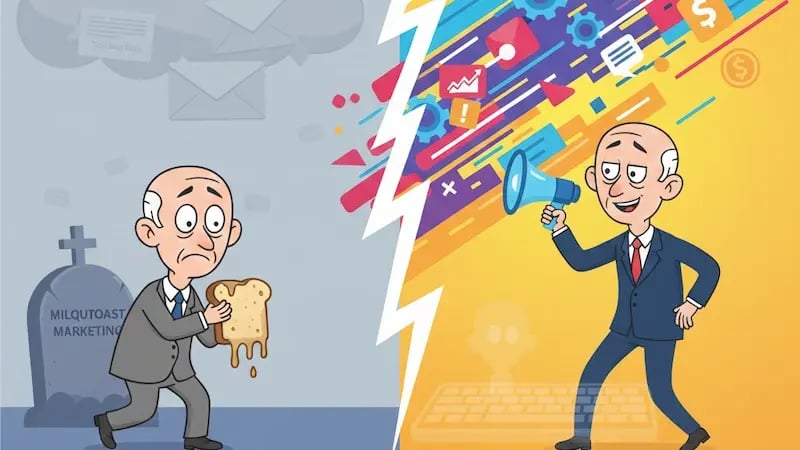 While the term is often misspelled as "milktoast," the origin of this word is far more interesting than a soggy breakfast. Understanding who Caspar Milquetoast was—and why he is currently sabotaging your AI-generated emails—is the first step toward reclaiming your brand's voice. We're going to dive into the history of this timid soul, why AI naturally defaults to his personality, and how you can stop your marketing from fading into the background.
"If you apologize for 'taking up time,' you've already admitted your value is zero."
The Legend of Caspar Milquetoast: The Man Who Apologized to Walls
In 1924, a cartoonist named H.T. Webster introduced the world to a character in the comic strip "The Timid Soul." Caspar Milquetoast is a character who embodies the ultimate "soft" man. He was the kind of person who would apologize to a lamppost for walking into it. He lived in constant fear of offending anyone, breaking a minor rule, or drawing any attention to his own presence.
In one famous strip, Caspar Milquetoast is seen waiting at a "Stop" sign for hours because the sign didn't change to "Go"—it just stayed blank. He was too afraid to move without explicit permission. In another, he gets stuck in a revolving door because he doesn't want to push too hard against the person in front of him.
The character was such a cultural hit that his name entered the English language as a common noun. A "milquetoast" is a person who is feeble, timid, or submissively unassertive.
In the world of 1920s comedy, Caspar Milquetoast was a hilarious figure. He represented the anxieties of a changing world. However, in modern email marketing, he is a disaster. "Milktoast" emails are marketing messages so afraid of being perceived as "salesy," "pushy," or "offensive" that they end up completely invisible. If your email doesn't have a heartbeat, it's probably because Caspar Milquetoast wrote it.
Identifying "Milquetoast Marketing" in the Wild
How do you know if Caspar Milquetoast has taken over your marketing department? You don't need a detective to find him; you just need to look for the absence of energy. Milquetoast marketing is marketing defined by its lack of a "point"—it exists, but it doesn't do anything.
Look for these three specific symptoms in your outreach:
1. The Passive Voice Trap
Instead of saying, "Our software saves you ten hours a week," a Milquetoast email says, "It is hoped that some time might be saved by using this tool."
The passive voice is the official language of the timid. It removes the actor from the action.
Data from HubSpot shows that personalized, direct (active) emails can see a 20% increase in sales opportunities compared to passive, generic templates.
When you use the passive voice, you aren't promising a result; you are merely suggesting that a result might happen to occur at some point in the future.
2. The Hedging Habit
Do your emails use words like "perhaps," "possibly," "maybe," or "if you have a moment"? These words are verbal apologetic shrugs. They signal to the reader that your message isn't actually important. If you don't believe your message is worth their time, why should they?
Caspar Milquetoast would never dream of telling a prospect, "You need this." He would say, "You might want to consider looking at this, if it isn't too much trouble."
3. The Hidden Ask (or the Non-Existent CTA)
A timid emailer is too shy to ask for the sale. They end an email with "Let me know if you ever want to chat," rather than a clear, direct call to action. This is the marketing equivalent of standing at the door of a party and waiting for someone to notice you, rather than walking in and introducing yourself.
Action words are the drivers to a click. According to Moosend, emails that focus on "Action Verbs" see a significantly higher click-through rate (CTR) than those with passive CTAs.
| CTA Type | Average CTR | Performance Impact |
|---|---|---|
| Active Verbs (e.g., "Get," "Claim," "Start") | 4.01% | Baseline |
| Passive/Descriptive (e.g., "Information is available here") | Below 2.3% | ~74% lower performance |
The cost of being timid is high.
According to research from OptinMonster, the average business professional receives about 121 emails every single day.
If your email is as shy as Caspar Milquetoast, it will be deleted before the first sentence is finished. Data shows that you have roughly 10 seconds to grab someone's attention. You cannot afford to spend those seconds being polite and vague. If you want to recoup the ROI of email marketing, you need to think outside the box.
Why AI Loves to Be a Milquetoast (The Training Trap)
Here is the irony of the modern age: many of us are using cutting-edge, trillion-parameter AI models to write our marketing, yet the AI keeps giving us Caspar Milquetoast. Why does a machine capable of solving complex math problems struggle to write a punchy email?
By design, AI models are trained to be helpful, harmless, and honest. This is beneficial for safety, but detrimental to creativity. By default, AI aims for a "middle-of-the-road" tone. It is programmed to avoid giving offense and to be as agreeable as possible. Essentially, AI is timid in its opinion.
Furthermore, AI pulls from a massive dataset of existing business writing. Unfortunately, the majority of business writing over the last twenty years has been... well, milktoast. AI analyzes millions of emails that start with "I hope this email finds you well" and concludes that this is the correct way to greet someone. It echoes the blandness it was fed.
If you ask an AI to write a sales email, it will likely give you the bland and unoffensive emails of yesterday and avoid anything that can be construed as being too persuasive or manipulative. It will use cliches like "In today's fast-paced world," or "leveraging synergies," or whatever the B2B buzzword of the day is. To get a result that actually converts, you need to explicitly leave Caspar Milquetoast at the door.
The Psychology of the Inbox: Why "Nice" is Failing You
We often think that being polite is the safest way to get a response. We don't want to bother people. But in the world of email marketing, nice is often a synonym for boring.
Think about your own behavior. When you see an email from a stranger that starts with a lengthy, rambling apology for taking up your time, do you feel respected? Or do you feel like your time is being wasted? Most people feel the latter.

Directness is a form of respect. When you get straight to the point, you are telling the reader, "I know you are busy, and I won't waste your time." This isn't being rude; it's being professional. Caspar Milquetoast thinks he is being polite by rambling, but he is actually being an anchor on the reader's productivity.
Application: How to Evict Caspar from Your Prompts
To improve your email marketing results and overall ROI, you need to adjust your approach to interacting with your AI tools. You have to give it "Anti-Milquetoast" instructions. You can't just ask for an email; you have to ask for a bold marketing email that maps our value onto the user.
Here are tangible ways to "de-Milquetoast" your AI prompts:
The 70-Word Maximum Challenge
One of the most effective ways to kill the spirit of Caspar Milquetoast is to impose a strict word count. Tell the AI: "The total length of your writing must be 70 words MAXIMUM."
Why does this work? Because it forces the AI to cut the fluff. You cannot "hope this email finds them well" and explain your entire company history in 70 words. You have to:
- Identify a pain point
- Offer a solution
- Provide a call to action.
Brevity is the enemy of the timid.
The "No Hedging" Rule
Explicitly tell the AI: "Do not use hedging language. Avoid words like 'perhaps,' 'possibly,' 'might,' or 'may.' Use active verbs and direct statements."
| Version | Example Text |
|---|---|
| Milquetoast | "We might be able to help you reduce costs." |
| Bold | "We reduce your overhead by 15%." |
Sit back and wait for the replies.
Pain > Solution > Result
Instruct the AI to follow this specific framework:
- Pain: "You are losing 20% of your leads to slow follow-up."
- Solution: "HubSpot automates your lead tracking instantly."
- Result: "You close more deals with less manual work."
This shifts the focus away from the company and onto the client, highlighting how YOU specifically have the tool to solve it.
The ROI of Being Bold: Data Doesn't Lie
Does being direct actually work, or is it just a stylistic preference? The numbers suggest that boldness is a financial necessity. Anything less is just a waste of time.
According to research by Epsilon, 80% of consumers are more likely to make a purchase from a brand that provides personalized, direct experiences.
Furthermore,
Statista reports that the number of global emails sent per day is expected to reach 392 billion by 2026.
In a world of 392 billion emails, "good enough" will be the same as "failed." When you stop being a Caspar Milquetoast with timid email outreach, your open rates and click-through rates (CTR) tend to climb because you are finally offering something of value instead of just making noise.
Tangible Examples: The Transformation
Let's examine a "Before and After" to see how removing the Milquetoast factor alters the energy of a message.
Before (The Caspar Approach)
"Dear Sarah, I hope you are having a wonderful Tuesday. My name is John, and I work for a company that does CRM software. I was wondering if you might have a few minutes later this week to perhaps jump on a call? We have some interesting features that I think you might possibly find useful for your team. Let me know if that sounds okay!"
Why it fails: It's 62 words of nothing. It's polite, but it's empty. It asks for Sarah's time without offering anything in return.
After (The Anti-Milquetoast Approach)
"Sarah, most teams lose 30% of their lead data because their CRM is too clunky to use. HubSpot fixes this by automating data entry, saving your reps 5 hours a week. I’ve attached a case study showing how we did this for [Competitor]. Do you have 10 minutes on Thursday to see how we can do the same for you?"
Why it works: It's shorter, identifies a specific pain (lost data), offers a solution (automation), and gives a result (5 hours saved). It is direct and professional.
Creating an "Anti-Milquetoast" Marketing Strategy
Evicting Caspar Milquetoast shouldn't stop at your emails. This mindset needs to permeate your entire marketing strategy.
-
High-Impact Subject Lines
Consider this:
47% of people open an email based on the subject line alone.
If your subject line is 'Monthly Update' or 'Introduction,' Caspar Milquetoast wrote it. A bold subject line asks a question or promises a result. "Stop Losing Leads" will consistently outperform "Checking in."
-
Focus on Reading Ease
One of the secrets to "kickass" copy is simplicity. High-performing marketing is easy to read. You should aim for a Flesch Reading Ease score of 70 or higher. This means using shorter sentences and simple, powerful words. You don't need "marketing prowess" when "marketing skill" works better. You don't need to discuss your "corporate ethos" when you can just talk about your "values."
-
Use Social Proof Instead of Adjectives
Caspar Milquetoast loves adjectives like "innovative," "world-class," and "industry-leading." These are "fluff" words. Instead of telling someone you are "world-class," show them a statistic:
Effective: "We helped 500 companies increase revenue by 20%."
This is much more powerful than saying:
Ineffective: "We are a leading provider of revenue solutions."
Stand Out or Fade Out
Caspar Milquetoast was an excellent character for a 1920s comic strip, but he has no place in your marketing strategy. To succeed in email marketing today, you must be direct, data-driven, and engaging.
The digital landscape is too crowded for "polite" silence. You have to be willing to stand for something. You have to be willing to tell a prospect exactly how you can solve their problem. You have to be willing to cut the fluff and get to the point.
Stop sending "milktoast" emails that apologize for their own existence. Start sending messages that provide clear, tangible value. Your readers will thank you for it, and your ROI will reflect the change.
At Aspiration Marketing, we specialize in helping brands find their authentic voice. We don't just "send emails"; we build strategies that focus on measurable results and high-impact communication. We help you move beyond timid AI defaults and create copy that actually drives results. If you are tired of your marketing being ignored, it's time to stop relying on Caspar Milquetoast and start leading your industry.
The era of the milktoast email is over. Are you ready to write what comes next?






Leave a Comment
Have thoughts on this article?
Share your feedback, ask questions, or join the discussion with our community.