





Have you ever wondered why some potential customers suddenly stop responding just as they appear ready to make a purchase? You have guided them through their initial problems. You have shown them why your solution matters. Yet, at the very last moment, they go silent. This is the challenge of the decision stage. The decision stage is the final phase of the buyer's journey, where a qualified prospect evaluates specific vendors before making a purchase. It is the final hurdle where a lead either becomes a loyal partner or a lost opportunity.
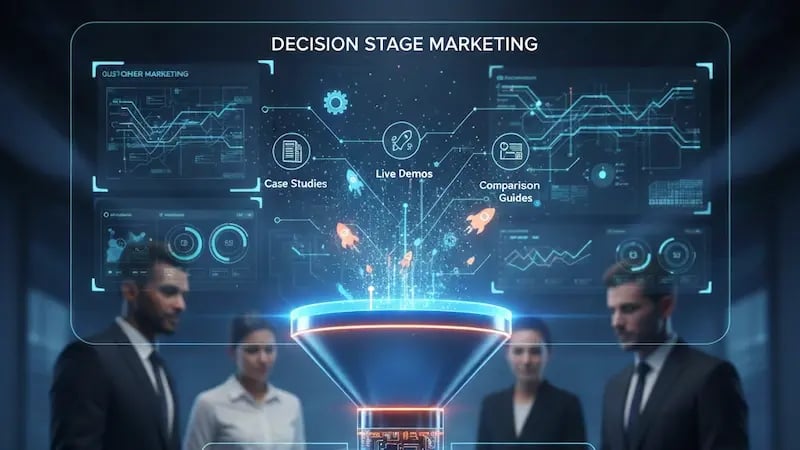 In the world of inbound marketing, we often focus heavily on the "top of the funnel." We spend hours crafting blog posts to attract strangers and ebooks to convert them into leads. However, decision stage marketing is where actual revenue is won or lost. At this point, the buyer is no longer asking, "What is my problem?" or "How do I fix it?" Instead, they are asking, "Which company is the best fit for me?" This makes the decision stage the most challenging part of navigating buyer decisions.
Let's explore how to master decision stage marketing with clear steps, data-driven insights, and intelligent automation.
Understanding the Decision Stage Mindset
To win at the decision stage, you must first understand the buyer's psychology. By this point, the prospect has narrowed their choices down to a handful of vendors. You've already guided them through the awareness and consideration stages of the buyer's journey. They are likely feeling a mix of excitement and anxiety. They want the benefits of your product, but they are also concerned about making the wrong choice that could cost their company time and money.
Recent data shows that the modern B2B buyer is more independent than ever.
In fact, a study by Gartner found that B2B buyers spend only 17% of their time meeting with potential suppliers.
The rest of their time is spent on independent research. This means your digital presence must do the heavy lifting for you.
When a lead enters the decision stage, their behavior changes. They stop looking at "how-to" guides and start looking at:
-
Pricing pages.
-
Product feature lists.
-
Customer reviews and ratings.
-
Implementation and onboarding processes.
Are you tracking these signals? If you aren't watching for these shifts in behavior, you are missing the most critical window of opportunity.
Content That Closes the Deal
At this stage, your content needs to provide proof, not just promises. You are moving from education to validation. The goal is to remove any remaining doubt. Here are the three most effective types of content for decision stage marketing:
1. Detailed Case Studies
Nothing builds trust like seeing a peer succeed.
Statistics show that 88% of B2B marketers view case studies as the most effective content for the decision-making stage.
A good case study should not just be a testimonial. It should outline a specific problem, the solution you provided, and the measurable results. Use real numbers. Instead of saying "we improved their sales," say "we increased their conversion rate by 22% in four months."
2. Comparison Guides
Your prospects will likely compare you to your competitors. If you don't provide a comparison, they will find one elsewhere—and it might not be biased in your favor. By creating a fair, honest comparison guide, you position yourself as a helpful expert.
Research indicates that over 50% of shoppers prefer brands that make it easy to compare options directly.
3. Live Product Demos or Trials
Sometimes, the buyer just needs to see the product in action. A live demo allows you to answer specific questions and address unique pain points in real-time. It is a powerful tool because it creates a personal connection.
Data suggests that 67% of B2B buyers are more likely to move forward after a successful live demonstration.
Overcoming Friction with Data
Even with great content, friction can kill a deal during the decision stage. Friction is any obstacle that makes the buying process too slow, complex, or impersonal. You can solve this by using data-driven marketing to meet the buyer exactly where they are.
One of the biggest mistakes companies make is waiting too long to follow up.
According to research, the odds of qualifying a lead drop by 400% if you wait more than 10 minutes to respond.
In the decision stage, speed is your greatest asset.
You can use lead scoring to identify these high-priority moments. For example, if a lead visits your pricing page three times within 24 hours, their lead score should increase. This should trigger an immediate notification to your sales team. This isn't just about being fast; it's about being relevant. You aren't calling them out of the blue; you are reaching out when your solution is top of mind.
Powering the Decision Stage with HubSpot
To manage these complex interactions at scale, you need the right tools. HubSpot is a leader in this space because it enables you to automate the "boring" tasks, allowing your team to focus on building relationships.
Targeted Configurations
You can set up specific HubSpot configurations to handle leads at the decision stage. For instance, you can create a "Buyer Intent" workflow. This workflow monitors particular behaviors, such as clicking a link in a pricing email. Once triggered, the system can:
-
Enroll the lead in a targeted email sequence.
-
Create a task for a sales rep to make a "connect call."
-
Update the lead's lifecycle stage to "SQL" (Sales Qualified Lead).
Automated Nurturing
Automation doesn't have to feel robotic. In fact, well-planned automation feels like a concierge service.
According to HubSpot, companies that excel at lead nurturing generate 50% more sales-ready leads at a 33% lower cost.
Your decision-stage sequences should include links to your best case studies, a calendar link to book a demo, and a clear "next step" for the buyer.
Journey Management
With HubSpot's journey automation, you can see exactly where a buyer is in their process. This visibility enables you to provide accurate information at the right time. If a buyer is stuck in the decision stage for too long, you can trigger a "re-engagement" campaign with a special offer or a new piece of social proof to nudge them forward.
A Step-by-Step Guide to Mastering Decision Stage Challenges
Knowing that the decision stage is essential is one thing; building the engine to manage it is another. To truly master decision-stage marketing, you need a repeatable process that combines human intuition with technical precision.
By following these four steps, you can build a high-conversion framework using the data-driven tools at your disposal.
Step 1: Audit Your Decision-Stage Content Assets
Before you can automate, you must ensure you have the right materials. Do you have a case study for every primary industry you serve? Is your pricing page clear, or does it leave prospects with more questions than answers?
-
The Goal: Ensure you have at least one piece of "social proof" (like a testimonial) and one "utility" piece (like a comparison sheet) for every buyer persona.
-
Pro Tip: Look for "content gaps." If your sales team is constantly answering the same three questions during the final call, create a "FAQ for Buyers" sheet to address those concerns earlier.
Step 2: Map the Intent-to-Action Workflow
Friction often occurs because the "hand-off" between a marketing email and a sales call is clunky. You can solve this by mapping out exactly what should happen when a lead shows "Buyer Intent."
-
Identify the Trigger: A lead downloads a pricing guide or visits the "Contact Us" page.
-
Define the Action: HubSpot should immediately create a task for the account executive.
-
The "One-Click" Solution: Configure your CRM so that the sales rep can see the lead's entire history in one view. This allows for a "Connect Call" that feels personal and informed, rather than a cold script.
Step 3: Build Your Lead Nurturing Sequences
A lead in the decision stage should not be receiving top-of-funnel newsletters. They need a "High-Velocity Sequence."
-
Email 1 (The Logic): A data-heavy case study showing ROI.
-
Email 2 (The Trust): A video testimonial from a satisfied client.
-
Email 3 (The Access): A direct invitation to a live demo or a "Strategy Session."
-
Statistic to Remember: Companies that automate this process see a 10% or greater increase in revenue within 6-9 months.
Step 4: Configure Real-Time Alerts
In the decision stage of marketing, timing is everything. You cannot afford to check your lead reports once a week. You need real-time alerts.
-
Use HubSpot to set up "Slack" or email notifications for your sales team.
-
When a high-scoring MQL returns to your site after a month of silence, your team should know within seconds. This allows you to reach out while the prospect is actively thinking about your solution.
Measuring What Matters
How do you know if your decision-stage marketing is working? You need to track the right metrics. It is easy to get distracted by "vanity metrics" like page views, but for effective decision stage marketing, you should focus on:
| Key Metric | Core Question It Answers |
|---|---|
| MQL to SQL Conversion Rate | How many marketing leads are actually ready for a sales conversation? |
| Content Engagement & Open Rates | Are leads opening your comparison guide but not booking a meeting? This may signal that the guide is too biased or complex. |
| Sales Cycle Length | Is your content helping buyers make decisions faster, thus shortening the sales cycle? |
| Win Rate | Of the leads that reached the decision stage, how many became customers? |
By monitoring these data points, you can constantly refine your approach. If you notice that a specific case study is linked to a high number of closed deals, you should feature that content prominently in your nurturing emails.
Strategic Insights for Better Conversions
Success in the decision stage requires a balance of empathy and technology. You need to understand the human fears of the buyer while using powerful tools to ensure no one falls through the cracks.
Ask yourself:
-
Is our pricing easy to find and understand?
-
Do we have evidence that our solution works for companies similar to theirs?
-
Can a prospect talk to a human within minutes if they have a question?
If the answer to any of these is "no," you have room to improve your decision stage marketing strategy. The decision stage is your time to shine. It is the moment where all your hard work in the earlier stages pays off. By focusing on validation, reducing friction, and leveraging automation, you turn the "final hurdle" into a smooth finish.
The Final Word on Decision Stage Marketing
The transition from a "maybe" to a "yes" is the most delicate part of the buyer's journey. It requires a blend of high-quality content, innovative technology, and timely human intervention. When you align your marketing efforts with the specific needs of the decision-maker, you don't just close a sale—you start a relationship based on trust and value.
The data is precise: businesses that win are those that make the buying process easy, transparent, and fast. By focusing on the strategies we've discussed—from case studies to automated HubSpot workflows—you position your company as the obvious choice in a crowded market.
How Aspiration Marketing Can Help
Mastering the final phase of the buyer's journey can be a complex task, but you don't have to do it alone. This is where Aspiration Marketing provides the expertise you need to succeed. We specialize in helping businesses overcome decision-stage challenges through sophisticated, data-driven marketing strategies.
Our team knows how to build the targeted HubSpot configurations that turn intent into action. Whether it is setting up "one-click" connect calls or building lead-nurturing sequences that actually convert, Aspiration Marketing focuses on measurable results. We take the guesswork out of your conversion strategy, allowing you to focus on what you do best: running your business.
We believe that every interaction in the buyer's journey is an opportunity to build trust. By partnering with us, you gain a team that is dedicated to elevating your brand and helping you close more deals with less effort.
Are you ready to optimize your decision stage and see real growth in your bottom line? Let's work together to make your marketing smarter and your sales process faster.

.webp?width=600&height=375&name=Choose%20B2B%20agency%20for%20EdTech%20(1).webp)



Leave a Comment
Have thoughts on this article?
Share your feedback, ask questions, or join the discussion with our community.